Showing posts with label Robert Aickman. Show all posts
Monday, May 5, 2014
Centennial
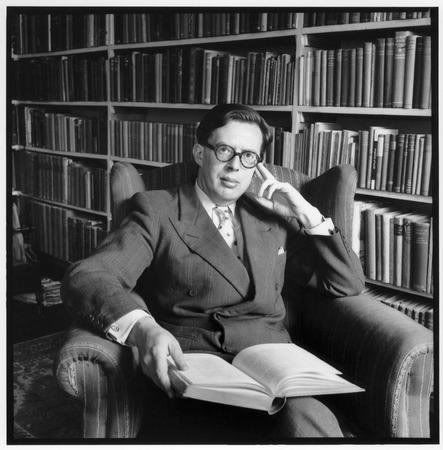
June 27, actually, if you want to be specific, but while little else in the world of culture and so on is currently on my mind, I do know myself well enough to accept that I won't remember to do this almost two months from now. Not counting the two volumes of Aickman's collected stories, the above portfolio depicts the full bibliography of the greatest horror writer of the 20th Century, and one of that century's greatest writers of any kind. This year, which being Aickman's centennial marks the 100th anniversary of his birth, will bring quite a bit in the way of easily affordable reprints; as far as I'm concerned this is a huge deal. So please, everyone, for the sake of his deserved literary immortality but more than anything for your own sake, all you who are parched as if by desert heat for great, strange, eerie, haunting writing, seek out his books. Buy them, or borrow them, and read them. I haven't read close to everything yet, and I even want to read those two waterways books. I bet they're real fuckin' good waterways books.
From the first I understood that [Aickman] was a deeply original artist. This in no way implies that I understood Aickman immediately because I didn't. Sometimes I would look up at the end of a story, feeling that the whole thing had just twisted itself inside out and turned into smoke - I had blinked, and missed it all. It took me a little while to learn to accept this experience as valuable in itself and to begin to see how the real oddness of most of Aickman's work is directly related to its psychological, even psychoanalytic, acuity. Unconscious forces move the stories itself, as well as the characters, and what initially looks like a distressing randomness of detail and event is its opposite - everything is necessary, everything is logical, but not at all in a linear way. To pull off this kind of dream-like associativeness, to pack it with the menace that results from a narrative deconstruction of the notion of "ordinary reality," to demonstrate again and again in excellent prose (no dumb experimentation or affectation here) that our lives are literally shaped by what we do not understand about ourselves, requires a talent that yokes together an uncommon literary sensitivity with a lush, almost tropical inventiveness.
- Peter Straub
Wednesday, October 30, 2013
The Kind of Face You Slash - Day 30: Good Fare, Some Accommodation
What specifically the above book cover is meant to communicate, as the image pertains either to the book's contents or to Robert Aickman in general, is difficult to figure. Granted, when it comes to Aickman's stories I tend to bounce around, never reading a collection straight through but rather picking among the various tables of content for a title that catches my eye, or for a story I've heard something interesting about but haven't yet gotten around to, so maybe somewhere in Cold Hand in Mine there is in fact a story about a beaked and handless armored hedgehog soldier and his dead Indian chief pal having adventures on an alien planet (maybe "Pages From a Young Girl's Journal," I haven't read that one yet), but even if not, and even though I doubt this ever entered anyone's mind along the road to publishing this particular edition of Aickman's classic 1975 collection, the very inexplicability of the image would seem to be, or could be said to be, the whole point. Aickman's reputation as a horror writer, apart from his quite frankly exquisite prose talents, rests on his special gift for creating haunting stories whose eeriness lingers because the reader's ability to to coherently describe what he or she has just read will always be very sorely tested. By which I mean, describe it in terms of "This happened and then this happened, and it all happened because of this." Aickman will not allow this.
If you've never read Aickman -- and if not what's your deal, I've pushed him on you guys often enough, God knows -- you shouldn't take the preceding paragraph to mean that a typical Aickman story features a guy sitting in a museum when suddenly a unicorn walks up to him and they eat peas together THE END. Although absurdity does play a part, even a large part, in his fiction, it is not merely absurd, nor does the absurdity overwhelm the story (though the most surrealistic Aickman story I've read, "Growing Boys," comes close). These elements, which are invariably unnerving in ways that are not always easy to pinpoint, are woven through the lives of his characters, even if only for a brief period of time. It may only be a day out of the decades of life to be lived by a given character, but as Aickman describes these strange -- and that's the word; it is, in fact, Aickman's preferred description -- events they can briefly seem, if not natural, then at least among those things that sometimes people have to deal with. Somehow, Aickman describes the strangest occurrences with a very precise verisimilitude.
Readers familiar with Aickman will probably find that description to be inaccurate as a general description of his body of work, but you must forgive me because at the moment my head is full of one particular story of his, one of his best-known and most-anthologized, called "The Hospice." And I do think the previous paragraph contains a workable description of this, one of his genuine masterpieces. Writing about "The Hospice" presents two problems, one of them being a problem that would spring up when writing about anything by Aickman: one is, how do you describe the indescribable without killing the impact for those who don't know the story; and two, how do you write about a story that you (me) honestly thinks is perfect? Given that opinion, it's entirely clear to me that there is nothing I can say about "The Hospice" that would not be better and more clearly, and I don't use that word ironically, expressed by the reading of "The Hospice" itself. I've read many stories by Robert Aickman over the years, and it's just now, with this story, that I found the one that is plainly the best introduction to his work for newcomers. This isn't to say it's my favorite -- that honor still goes to "The Inner Room," my favorite horror story of all time -- but to understand what Aickman is all about, "The Hospice" is where you should turn.
I will continue my pattern of beginning a new paragraph by referring to the contents of the previous one by assuring you that none of the above is my way of saying "And that's why I'm not going to describe 'The Hospice' to you," though my fear of ruining the experience remains. Nevertheless: Lucas Maybury has finished work at a location that, the reader gathers, is not familiar to him. Wishing he could simply "follow a route 'given' by one of the automobile organizations," he is instead bullied by the manager of the location to take a supposedly shorter route home, one whose benefits have been proven -- again, supposedly -- time and again. But Maybury experiences none of those benefits, and instead is soon lost, and his car is running out of gas. He gets out of his car and walks a bit, and is soon attacked what he, in the darkness, assumes is a cat. It bites his leg, and he kicks back savagely. "The strange sequel was silence," Aickman writes.
Eventually he finds, as you do, a place -- there are no other houses or buildings of any sort in sight -- where he might find food, gas, a phone, something. There is a sign at the entrance that reads: "The Hospice -- Good Fare -- Some Accommodation." Upon entering and asking for food -- and being followed into the restroom by a white-jacketed server while he quickly washes up -- he is shown to the dining room, the walls of which are covered with heavy, massive hangings, the reason for these being "possibly noise reduction":
It is true that knives and forks make a clatter, but there appeared to be no other immediate necessity for costly noise abatement, as the diners were all extremely quiet; which at first seemed the more unexpected in that most of them were seated, fairly closely packed, at a single long table running down the central axis of the room. Maybury soon reflected, however, that if he had been wedged together with a party of total strangers, he might have found little to say to them either.
This was not put to the test. On each side of the room were four smaller tables, set endways against the walls, every table set for a single person, even though big enough to accommodate four, two on either side: and at one of these, Maybury was settled by the handsome lad in the white jacket.
Immediately, soup arrived.
And so the strangeness begins. The food, which is served in enormous quantities, seems to be good enough, but Maybury's inability to finish a course drives the woman serving him to scold him and smash his plate on the floor. He notices, too, upon leaving the dining room that one other diner is attached by a string to a rail that runs around the room. Maybury's pleas to Falkner, the manager of the hospice, to help him find gas, seem to fall on sympathetic ears, yet he comes away from it all without any gas. There is no phone, a bit of information Maybury doesn't believe but he can't do anything about it. The potential for a sexual encounter with a strange, beautiful, "tragic" woman he first saw across the dining room tempts him in a way that belies his worries that his wife Angela will be horribly worried if he's not home soon.
It's all very subtle, and the eeriness is almost more of a nuisance, certainly as Aickman describes Maybury's reaction to it, than anything else. Along the way, and as the strangeness deepens -- and you are not wrong if you believe that Maybury will probably be forced to accept a room for the night -- bits of the kind of man Maybury is are revealed. At one point, through Falkner's attempts to be accommodating, Maybury is paired off with a sad, shrunken man named Bannard, who is delighted by the company as he is, he says, quite lonely. Bannard, a true believer in whatever The Hospice is, is clearly a long-term resident -- is his apparent lack of life experience a result of his being there so long, or is he there because it's the only place he can exist without hassle? Either way, he quizzes Maybury with great interest:
"Tell us about it," said Bannard. "Tell us exactly what it's like to be a married man. Has it changed your whole life? Transformed everything?"
"Not exactly," [said Maybury]. "In any case, I married years ago."
"So now there is someone else. I understand."
"No, actually, there is not."
"Love's old sweet song still sings to you?"
"If you like to put it like that, yes. I love my wife. Besides she's ill. And we have a son. There's him to consider too."
"How old is your son?"
"Nearly sixteen."
"What colour are his hair and eyes?"
"Really, I'm not sure. No particular colour. He's not a baby, you know."
"Are his hands still soft?"
"I shouldn't think so."
"Do you love your son, then?"
"In his own way, yes, of course."
A terrifically strange conversation -- funny, pathetic, unnerving, revealing. It reveals a coldness in Maybury, an absence of affectionate emotion, but what does that "In his own way," as opposed to the clearer and more appropriate "In my own way" reveal? Nothing too good, I'd wager, but it's a very curious bit of phrasing. This is the other thing about Aickman -- if his stories make no logical sense, that is not because he's ignorant of actual humanity.
The ending is one of Aickman's best, and I won't say a word about it. The story comes together, to the degree that it does come together, in a way that was entirely unexpected to me, but unquestionably right on target. It also, in the way Aickman goes about this sort of thing, moves the story from an ambiguous strangeness into legitimate, yet still deeply ambiguous, horror. It is, as I've said, perfect, the kind of ending that all great short stories have, one that is completely of a piece with what has come before, and crystallizes everything into a final paragraph that is inevitable and powerful.
I was talking to a Arion Berger about this story when she was considering covering it herself, and I had to admit I'd never read it. Considering the place "The Hospice" has among Aickman's work, this, I said, was a little bit like a Faulkner fan admitting that they'd never read As I Lay Dying. In retrospect, this was an interesting comparison. And you shouldn't assume that I've just now accidentally revealed too much, but then again, who knows?
Monday, October 24, 2011
The Kind of Face You Slash - Day 24: Tiny Last Straws
I’m running on not a great deal of sleep today, having tried last night to fall asleep while listening to a podcast that dealt extensively with the Jack the Ripper murders, and feeling about that awful bit of history -- possibly for the first time in my life, as unhappy a thing as that is to admit – rather depressed. And then actually sort of frightened, as images of disturbed men entering my bedroom as my wife and I slept drifted unstoppably through my mind. The details of how this fear manifested itself shall be left out of this account, as they would cast me in an undignified light, but rest assured the whole time I was berating myself for thinking and acting like a scared child. (You might also consider excusing any rambling quality that might seep into tonight’s post.)
The upshot of it all is, again, that I didn’t sleep too well, which turns out to dovetail pretty nicely with today’s reading. My impulse for today was to go back and read someone I consider to be one of the giants of horror, Robert Aickman. Aickman’s short fiction is a bit on the long side, typically thirty to fifty pages, and my dumb ass somehow regards reading even a single Aickman story to be something of a commitment, within a single day at least, so as a result my reading of the man I consider to be one of the two best, if not the single best, horror writer of the 20th century, is rather scattershot. I’ve grabbed at his stories off and on over the years, rarely reading more than one over as many days (the one time I did was when I read two for my post on Aickman back in 2008). One of the results of this is that when I do sit down with an Aickman story, I get very excited because I know I will be having a rare reading experience.
So it has again proved with today’s story, “Into the Wood” (which, for anyone who cares to know these things, and I hope there are more than a few of you who do, can be most easily and cheaply found in a used copy of the Aickman collection The Wine-Dark Sea). I chose this one because Peter Straub, in his introduction to the book, says “’Into the Wood’ seems to me the masterpiece of this collection. In it all of Aickman’s themes come together in an act of self-acceptance which is at once dangerous, enigmatic, in narrative terms wholly justified, and filled with the reverence for the imaginative power demonstrated by Aickman’s work in general.” Now, The Wine-Dark Sea also includes “The Inner Room” which I consider to be among the small handful of greatest horror stories ever written (and which Straub, in another book I have, once chose as his own favorite horror story, the fickle bastard), so in my view “Into the Wood” has a lot of work ahead of it in order to supplant that story as the collection’s masterpiece. That I don’t believe “Into the Wood” manages it, though, is of course meaningless. “Into the Wood” is very odd, and very Robert Aickman-esque, which certainly stands to reason, but what I mean is that it is as full of the things Aickman liked to put in his fiction as Straub suggests, to the point that it achieves a certain density, both of tone and of detail and, if such a thing can be dense, of pacing. A lot of Aickman’s stuff is very deliberate in its pacing, and it’s hard to see how it couldn’t be, but “Into the Wood” might achieve some kind of zenith in the area. Which is not a criticism.
It certainly does help that Aickman was a superb writer of prose. His story here is about a middle-aged English couple, Henry and Margaret (aka “Harry” and “Molly”, which confused me for a bit early on) who travel to Sweden because the husband, an engineer, is helping to build a road there (this is something Aickman-esque in itself, a career detail from a man whose non-fiction books bore titles like Know Your Waterways). The husband has his work to deal with, and Margaret has what basically amounts to a vacation to attend to. This separates the two of them at various times, and causes Margaret to reflect on the state of their marriage, which seems quite tenuous, though whatever is at the heart of the rift -- apart from Margaret's clear dissatisfaction -- is not spoken of. Anyway, with one thing or another, Margaret learns of sanitarium, which doubles at a hotel called Kulhus, that intrigues her, and when Henry is called to Stockholm she asks to be put up there to help along her relaxation. Henry agrees, and soon Margaret is checking out her room:
Margaret was given the most beautiful room: large, with a view from the windows extending for miles, charmingly furnished, and with no fewer than three long rows of assorted books in at least four languages. Margaret, who read books, looked at this small library with considerable curiosity. As far as she could tell, the volumes seemed even to have been chosen with care, and to be by no means mere left-behinds or the bedtime reading one might expect -- if one could in an hotel expect anything of that kind at all. But immediately it had occurred to Margaret that these were not books of the sort that most people would read to induce slumber, she observed that the next work on the shelf was a substantial tome named Die Schlaflosigkeit, which she suspected might mean "Insomnia."
And she's probably right, because it turns out Kurhus's function as a sanitarium is to help chronic insomniacs. This Margaret learns from another Englishwoman, a patient there, named Sandy Slater. Among the things Margaret learns from Sandy is that the whole name for the place is Jamblichus Kurhus, "Jamblichus" coming from Edward Gibbon's Decline and Fall of the Roman Empire:
"Jamblichus was the one among the seven sleepers who after they had slept for two centuries, went down into town in order to buy food, tendered the obsolete coins, and found himself arrested...Anyway, places like this used often to be called Jamblichus Groves; even by the unsophisticated."
The Kurhus is also set against a large expanse of wood which Margaret comes to learn is full of well-worn and smooth paths used by the insomniacs to walk through at night, when they should be sleeping. For what purpose? And of course Sandy warns Margaret away from it, but not too strenuously, not in any typical horror story, stay-out-of-the-woods sort of way. Along the way, we will meet some of the other patients, such as Colonel Adamski, a Pole World War II veteran who wants Margaret to feel more free to indulge in the customs of the insomniacs than Sandy is; and a young, thin girl who Sandy claims has never slept a wink in her life. Then, eventually, Margaret goes home.
This is a very hard story to summarize, as are all of Aickman's, because it doesn't follow any typical structure -- it's unique not just to horror, but to fiction in general, in my experience. It is a story that climaxes with a frustrated attempt to find a room to rent. It features the main character leaving the source of unease successfully because she doesn't feel comfortable. So she leaves. What kind of a story is this?
It's a story where the aforementioned unease comes from without, the insomniac hospital, to afflict something within Margaret, her unhappiness and desire for some kind of freedom beyond the thoughtless ideas -- such as "creative outlets" -- generally suggested to housewives in her frame of mind. Colonel Adamski says:
"...For men and women there is to everything a limit, beyond which further striving, further thought, leads only to regression. And this is true even though most men and women never set out at all; possibly are not capable of setting out. For those who do set out, the limit varies from individual to individual, and cannot be foreseen. Few ever reach it. Those who do reach it are, I suspect, those who go off into the further forest."
Margaret's eyes were shining. "I know that you are right," she cried. It is something I have long known, without finding the words."
It doesn't sound very scary, does it? But fairy tales are in there, of an only hinted-at, sinister turn, and myth, and Freud, and all somehow jumbles up in Margaret's head to make her follow an honest and fair train of thought about her unhappiness, and lead her into an abyss. Why? Because she's wrong? No, I don't believe so, nor do I believe Aickman believes so. About his own work, Aickman once wrote:
...I do not regard my work as "fantasy" at all, except, perhaps, for commercial purposes. I try to depict the world as I see it; sometimes artistically exaggerating no doubt...and occasionally exaggerating for purposes of parable... I believe in what the Germans term Ehrfurcht: reverence for things one cannot understand. Faust's error was an aspiration to understand, and therefore master, things which, by God or by nature, are set beyond the human compass. He could only achieve this at the cost of making the achievement pointless.
In a sense, Aickman's stories are magnificently pointless, in that what can be taken away in terms of meaning is usually quite nebulous, or you can't take anything. There's an unease, and a horror, that doesn't come from nowhere, but there is a connection between character and experience that you often can't locate. There's a thread, or a trail, that you can follow, and willingly do, but when you come out the other side, even if you're home, you're still lost.
* * * * *
I apologize for this one. I've been half asleep all day. Robert Aickman deserves better.
The upshot of it all is, again, that I didn’t sleep too well, which turns out to dovetail pretty nicely with today’s reading. My impulse for today was to go back and read someone I consider to be one of the giants of horror, Robert Aickman. Aickman’s short fiction is a bit on the long side, typically thirty to fifty pages, and my dumb ass somehow regards reading even a single Aickman story to be something of a commitment, within a single day at least, so as a result my reading of the man I consider to be one of the two best, if not the single best, horror writer of the 20th century, is rather scattershot. I’ve grabbed at his stories off and on over the years, rarely reading more than one over as many days (the one time I did was when I read two for my post on Aickman back in 2008). One of the results of this is that when I do sit down with an Aickman story, I get very excited because I know I will be having a rare reading experience.
So it has again proved with today’s story, “Into the Wood” (which, for anyone who cares to know these things, and I hope there are more than a few of you who do, can be most easily and cheaply found in a used copy of the Aickman collection The Wine-Dark Sea). I chose this one because Peter Straub, in his introduction to the book, says “’Into the Wood’ seems to me the masterpiece of this collection. In it all of Aickman’s themes come together in an act of self-acceptance which is at once dangerous, enigmatic, in narrative terms wholly justified, and filled with the reverence for the imaginative power demonstrated by Aickman’s work in general.” Now, The Wine-Dark Sea also includes “The Inner Room” which I consider to be among the small handful of greatest horror stories ever written (and which Straub, in another book I have, once chose as his own favorite horror story, the fickle bastard), so in my view “Into the Wood” has a lot of work ahead of it in order to supplant that story as the collection’s masterpiece. That I don’t believe “Into the Wood” manages it, though, is of course meaningless. “Into the Wood” is very odd, and very Robert Aickman-esque, which certainly stands to reason, but what I mean is that it is as full of the things Aickman liked to put in his fiction as Straub suggests, to the point that it achieves a certain density, both of tone and of detail and, if such a thing can be dense, of pacing. A lot of Aickman’s stuff is very deliberate in its pacing, and it’s hard to see how it couldn’t be, but “Into the Wood” might achieve some kind of zenith in the area. Which is not a criticism.
It certainly does help that Aickman was a superb writer of prose. His story here is about a middle-aged English couple, Henry and Margaret (aka “Harry” and “Molly”, which confused me for a bit early on) who travel to Sweden because the husband, an engineer, is helping to build a road there (this is something Aickman-esque in itself, a career detail from a man whose non-fiction books bore titles like Know Your Waterways). The husband has his work to deal with, and Margaret has what basically amounts to a vacation to attend to. This separates the two of them at various times, and causes Margaret to reflect on the state of their marriage, which seems quite tenuous, though whatever is at the heart of the rift -- apart from Margaret's clear dissatisfaction -- is not spoken of. Anyway, with one thing or another, Margaret learns of sanitarium, which doubles at a hotel called Kulhus, that intrigues her, and when Henry is called to Stockholm she asks to be put up there to help along her relaxation. Henry agrees, and soon Margaret is checking out her room:Margaret was given the most beautiful room: large, with a view from the windows extending for miles, charmingly furnished, and with no fewer than three long rows of assorted books in at least four languages. Margaret, who read books, looked at this small library with considerable curiosity. As far as she could tell, the volumes seemed even to have been chosen with care, and to be by no means mere left-behinds or the bedtime reading one might expect -- if one could in an hotel expect anything of that kind at all. But immediately it had occurred to Margaret that these were not books of the sort that most people would read to induce slumber, she observed that the next work on the shelf was a substantial tome named Die Schlaflosigkeit, which she suspected might mean "Insomnia."
And she's probably right, because it turns out Kurhus's function as a sanitarium is to help chronic insomniacs. This Margaret learns from another Englishwoman, a patient there, named Sandy Slater. Among the things Margaret learns from Sandy is that the whole name for the place is Jamblichus Kurhus, "Jamblichus" coming from Edward Gibbon's Decline and Fall of the Roman Empire:
"Jamblichus was the one among the seven sleepers who after they had slept for two centuries, went down into town in order to buy food, tendered the obsolete coins, and found himself arrested...Anyway, places like this used often to be called Jamblichus Groves; even by the unsophisticated."
The Kurhus is also set against a large expanse of wood which Margaret comes to learn is full of well-worn and smooth paths used by the insomniacs to walk through at night, when they should be sleeping. For what purpose? And of course Sandy warns Margaret away from it, but not too strenuously, not in any typical horror story, stay-out-of-the-woods sort of way. Along the way, we will meet some of the other patients, such as Colonel Adamski, a Pole World War II veteran who wants Margaret to feel more free to indulge in the customs of the insomniacs than Sandy is; and a young, thin girl who Sandy claims has never slept a wink in her life. Then, eventually, Margaret goes home.
This is a very hard story to summarize, as are all of Aickman's, because it doesn't follow any typical structure -- it's unique not just to horror, but to fiction in general, in my experience. It is a story that climaxes with a frustrated attempt to find a room to rent. It features the main character leaving the source of unease successfully because she doesn't feel comfortable. So she leaves. What kind of a story is this?
It's a story where the aforementioned unease comes from without, the insomniac hospital, to afflict something within Margaret, her unhappiness and desire for some kind of freedom beyond the thoughtless ideas -- such as "creative outlets" -- generally suggested to housewives in her frame of mind. Colonel Adamski says:
"...For men and women there is to everything a limit, beyond which further striving, further thought, leads only to regression. And this is true even though most men and women never set out at all; possibly are not capable of setting out. For those who do set out, the limit varies from individual to individual, and cannot be foreseen. Few ever reach it. Those who do reach it are, I suspect, those who go off into the further forest."
Margaret's eyes were shining. "I know that you are right," she cried. It is something I have long known, without finding the words."
It doesn't sound very scary, does it? But fairy tales are in there, of an only hinted-at, sinister turn, and myth, and Freud, and all somehow jumbles up in Margaret's head to make her follow an honest and fair train of thought about her unhappiness, and lead her into an abyss. Why? Because she's wrong? No, I don't believe so, nor do I believe Aickman believes so. About his own work, Aickman once wrote:
...I do not regard my work as "fantasy" at all, except, perhaps, for commercial purposes. I try to depict the world as I see it; sometimes artistically exaggerating no doubt...and occasionally exaggerating for purposes of parable... I believe in what the Germans term Ehrfurcht: reverence for things one cannot understand. Faust's error was an aspiration to understand, and therefore master, things which, by God or by nature, are set beyond the human compass. He could only achieve this at the cost of making the achievement pointless.
In a sense, Aickman's stories are magnificently pointless, in that what can be taken away in terms of meaning is usually quite nebulous, or you can't take anything. There's an unease, and a horror, that doesn't come from nowhere, but there is a connection between character and experience that you often can't locate. There's a thread, or a trail, that you can follow, and willingly do, but when you come out the other side, even if you're home, you're still lost.
* * * * *
I apologize for this one. I've been half asleep all day. Robert Aickman deserves better.
Sunday, December 20, 2009
On the Shelf: Assortment
Saturday, October 24, 2009
The Kind of Face You SLASH!!! - Day 24: It Was Not an Unreasonable Dread
In his introduction to The Dark Descent, editor David G. Hartwell describes his "third stream of horror" (streams one and two discussed here and here) this way:.
Stories of the third stream have at their center ambiguity as to the nature of reality, and it is this very ambiguity that generates the horrific effects. Often there is an overtly supernatural (or certainly abnormal) occurrence, but we know of it only by allusion. Often, essential elements are left undescribed so that, for instance, we do not know whether there was really a ghost or not...[T]hird stream stories lack any explanation that makes sense in everyday reality -- we don't know, and that doubt disturbs us, horrifies us.
.
The story I chose to read from Hartwell's selection of "third stream" stories is "The Asian Shore" by Thomas M. Disch (which can be found not only in The Dark Descent, but also in Disch's own collection Getting Into Death). Before I get to the story itself, I wanted to say that I'm getting a little tired of what appears to be the formula of these posts, which is that I spend a few paragraphs running down, with varying degrees of severity, the fiction of the author in question that I'd previously read before continuing to run him down in the context of the story I just read, or, alternately, saying "Hey, but this one's pretty good!" So all I'm going to say here is that I approached "The Asian Shore" as someone who wouldn't describe himself as a fan of Thomas M. Disch. However, I often use these posts as an excuse to read some story I'd long wanted to read, but had never gotten around to -- this is how I landed on Disch's story. Although, I must admit, I recently found out that my long-held curiosity about "The Asian Shore" was based on a mistake, either mine or that of someone I can't remember. The deal is, or was, that science-fiction legend and certified loony Samuel R. Delany once wrote a book called The American Shore, which was, I thought, a critical analysis of a single short story by Thomas M. Disch. I believed, or had been told, that the story was "The Asian Shore". Which makes sense, what with the title similarities and everything, and I thought "Well that story must be pretty incredible, if Delany's going to devote an entire book to it. Even if I don't like it, I gotta read 'The Asian Shore'!" But when I was doing some research today, in preparation for this post, I discovered that Delany's book, while it is a critical study of a single short story by Thomas M. Disch, isn't about "The Asian Shore" at all, but rather "Angouleme", from Disch's book 334. So I've now read "The Asian Shore", but I did so with an exaggerated sense of its extraordinariness. Son of a bitch. Come to think of it, though, what would a limp-ass little blog post look like when compared to an entire scholarly-type book written on the exact same subject? Like a box of crap, that's what. Now I'm thinking I dodged a bullet here. Remind me to never write a blog post about "Angouleme", because that's just asking for trouble.
I'm not entirely convinced that all horror fiction falls into one of Hartwell's three streams, or that, by logical extension, there are only three "streams". But the kind of story he describes above -- which he designates as "fantastic" -- is a legitimate form, and stories that can be categorized in this way are often among my favorites. Of course, Hartwell appears to have merely invented a new term for something that already existed, because Robert Aickman (who died six years before The Dark Descent was published), for instance, wrote what he referred to as his "strange stories" for thirty years. Virtually everything I've read by Aickman would fall into Hartwell's "third stream" (for the record, Aickman's story "The Hospice" is represented in this section of Hartwell's book), and yet in the introduction to his best-of-Aickman anthology, The Wine-Dark Sea, Peter Straub was still describing Aickman's work as "strange stories". I can't help but feel, sometimes, that Hartwell was simply describing things that everyone else already knew about, and was simply hoping his terminology would stick.
.But, either way, his description of the field of "fantastic" or "strange" horror fiction is a good one. Later in his introduction, Hartwell sums it up nicely when he says:
.Third stream stories maintain the pretense of everyday reality only to annihilate it, leaving us with another world entirely, one in which we are disturbingly imprisoned.
.
Hartwell also claims that this kind of horror fiction is the genre's best claim for literary legitimacy, and (loathe as I am to admit it, given how my stomach tends to churn at the idea that genre fiction must be recognized by the correct people before it can be appreciated) I think he has a point, if only because, to me, these stories best embody what horror fiction is. Though much of this fiction is of high quality, it's almost primitive in its approach to fear: nothing makes sense, nothing you know or believe is true, anything can happen, nothing will be explained. The characters in these stories, and the reader, are dragged -- or gently led, as the case may be -- straight into the heart of the unknown, a place where we learn that not only is the unknown everywhere, but it is harmful and inescapable. The sense one takes from reading these stories is that we could leave our home tomorrow morning, get on a bus, and find teeth scattered all over the floor. And as we ride along, no other passenger will comment on it, but we'll watch those teeth shake over the ruts in the street and wonder who they belonged to, and why nobody else seems to care. Nothing about that scenario is necessarily impossible, but it is most definitely strange, not to mention upsetting (by the way: if in the next several months I run across a short horror story called "The Bus With All the Teeth on the Floor", I'm going to sue the ass of whoever wrote it).
.
The story I chose to read from Hartwell's selection of "third stream" stories is "The Asian Shore" by Thomas M. Disch (which can be found not only in The Dark Descent, but also in Disch's own collection Getting Into Death). Before I get to the story itself, I wanted to say that I'm getting a little tired of what appears to be the formula of these posts, which is that I spend a few paragraphs running down, with varying degrees of severity, the fiction of the author in question that I'd previously read before continuing to run him down in the context of the story I just read, or, alternately, saying "Hey, but this one's pretty good!" So all I'm going to say here is that I approached "The Asian Shore" as someone who wouldn't describe himself as a fan of Thomas M. Disch. However, I often use these posts as an excuse to read some story I'd long wanted to read, but had never gotten around to -- this is how I landed on Disch's story. Although, I must admit, I recently found out that my long-held curiosity about "The Asian Shore" was based on a mistake, either mine or that of someone I can't remember. The deal is, or was, that science-fiction legend and certified loony Samuel R. Delany once wrote a book called The American Shore, which was, I thought, a critical analysis of a single short story by Thomas M. Disch. I believed, or had been told, that the story was "The Asian Shore". Which makes sense, what with the title similarities and everything, and I thought "Well that story must be pretty incredible, if Delany's going to devote an entire book to it. Even if I don't like it, I gotta read 'The Asian Shore'!" But when I was doing some research today, in preparation for this post, I discovered that Delany's book, while it is a critical study of a single short story by Thomas M. Disch, isn't about "The Asian Shore" at all, but rather "Angouleme", from Disch's book 334. So I've now read "The Asian Shore", but I did so with an exaggerated sense of its extraordinariness. Son of a bitch. Come to think of it, though, what would a limp-ass little blog post look like when compared to an entire scholarly-type book written on the exact same subject? Like a box of crap, that's what. Now I'm thinking I dodged a bullet here. Remind me to never write a blog post about "Angouleme", because that's just asking for trouble. .
So, "The Asian Shore". The story is about a man named John Benedict Harris. Harris is the author of an abstract philosophical book called Homo Arbitrans, whose subject is, in simple terms, the arbitrary nature of architecture:
.Once the lintels were lying on the posts, once some kind of roof had been spread across the hollow space, then anything else that might be done was gratuitous. Even the lintel and the post, the roof, the space below, these were gratuitous as well. Stated thus it was a mild enough notion; the difficulty was in training the eye to see the whole world of usual forms -- patterns of brick, painted plaster, carved and carpentered wood -- not as "buildings" and "streets" but as an infinite series of free and arbitrary choices...
.It had been his task, these last three or four years, to re-educate his eye and mind to just this condition, of innocence...What he sought...was a sense of the great artifice of things, of structures, of the immense interminable wall that has been built just to exclude nature.
.Ultimately unsatisfied with what he was able to accomplish in his first book, Harris has decided to leave his home city of New York and travel to a part of the world where he will feel totally alien, so that he can better expand his thesis beyond architecture -- though that is still his base point -- to the rest of life and human endeavor. This decision results in the dissolution of his marriage. His wife, it seems, objects entirely to this whole line of thought, which Harris must admit makes a certain amount of sense:
.
If there were no fixed laws that governed the furbelows and arabesques out of which a city is composed, there were equally no laws...to define the relationships woven into the lattice of that city, relationships between man and man, man and woman, John and Janice.
..
If there were no fixed laws that governed the furbelows and arabesques out of which a city is composed, there were equally no laws...to define the relationships woven into the lattice of that city, relationships between man and man, man and woman, John and Janice.
His divorce does not, finally, bother Harris all that much ("Though he saw no necessity for it, he had agreed to Janice's request for a divorce"), and travels, alone, to Turkey, where he hopes to lose himself in his theory, and in that country's ancient temples. Harris does find much that is arbitrary in Turkey, both in the architecture -- he finds Greek and Byzantine symbols etched into the tiles of a Turkish fortress -- but in his day to day existence. For instance, he finds himself continually crossing paths with a woman and a young boy -- sometimes separately, sometimes together -- though he can't explain his connection with them. Is it merely a coincidence? He first saw the woman at the aforementioned fortress, an encounter that ended with him high atop the fortress and she below, signaling and calling inaudibly to him. When he first encountered the boy, the boy was struggling
, cold and wet, through a rainstorm to carry home two buckets filled with water. Wanting to help -- help the boy seemed to be pleading with him to provide -- Harris finally runs away because he sees no way for the two of them to communicate.
.
, cold and wet, through a rainstorm to carry home two buckets filled with water. Wanting to help -- help the boy seemed to be pleading with him to provide -- Harris finally runs away because he sees no way for the two of them to communicate.After a while, the woman comes to his apartment, knocking on the building's front door, and calling up to his window "Yavuz! Yavuz!" When he enquires about this, the building's mail clerk informs him that "Yavuz" is a very common Turkish man's name. Much like "John" is in English, I suppose.
.It's hard to summarize the rest of this story. It's somewhat episodic as a narrative, but thematically it's entirely cohesive. The point where the story ends up is set up brilliantly throughout, such as when Harris goes to see a Turkish film called Kiling Istanbula, which features a kind of Turkish pulp character named Kiling. While watching the film, Harris struggles to determine if Kiling is "fundamentally good, like Batman, or bad, like Fantomas." Disch also includes a passage from a book called The Government of the Ottoman Empire in the Time of Suleiman the Magnificent by A. H. Lyber; this passage, concerning the cross-ethnicity of rulers throughout the Ottoman Empire, and how such cross-ethnicity was achieved, weighs so heavily on Harris's mind that he transcribes in total into his notebook. Even though Harris is in Turkey ostensibly to gather materiel for a new book, you get the impression that this, and a letter he writes in rebuttal to a negative review his earlier book received, is all the writing Harris is getting done.
.Mentally, Harris is coming apart, and it's not hard to pick up on the clues early on. His malfunctioning brain begins with his very thesis, and I got the feeling that Janice was quite right to leave him. He's not a dangerous man, necessarily, but his new philosophy is hollowing him out, and what he experiences in Turkey is not making him any better. In fact, it's proving his thesis correct. Nothing matters, nothing means anything, the arbitrary is the ruling aesthetic and mental construct. Harris has trained his mind and eye to reach the innocence he sought, and the truth that he's now discovered -- the truth he believed in -- is breaking him down.
.This is a terrific story, one of true, dark mystery. That word, "mystery", has come to mean "something that is solvable", but everyone knows that the most disturbing and haunting mysteries are the ones that we are incapable of understanding. Whatever our personal beliefs are, and whatever answer we may some day find, our daily lives are steeped in an unending confusion and perplexity. We wallpaper over all that in order not to go mad, but Harris, in wondering simply about the practicality of architectural design, peels off a strip of that wallpaper, and then keeps peeling. Regarding Harris's split with his wife, Disch writes:
.
The sense of the arbitrary did not stop at architecture; it embraced -- or it would, if he let it -- all phenomena.
..
The sense of the arbitrary did not stop at architecture; it embraced -- or it would, if he let it -- all phenomena.
In the end, Harris lets it.
Friday, October 24, 2008
The Kind of Face You SLASH!!: Day 23 - It is Beyond Even the Forgiveness of God
When I started this project, there were two writers that I knew I had to find time to write about, because neither of them is very well known -- even, I suspect these days, among horror fans -- and both write what I consider to be the finest horror fiction since, oh, I don't know...let's go all the way back to Poe. One of those writers is Thomas Ligotti, who I've already written about. The other is Robert Aickman.
Aickman was an Englishman who published his "strange stories" from the late 50s through the very early 80s (he died in 1981). His bizarre, witty, erudite and completely original fiction has influenced writers such as Ramsey Campbell, but, as Peter Straub says in his introduction to the "best of Aickman" collection, The Wine-Dark Sea, which Straub put together in 1988:
His originality, conscious and instinctive at once, was so entire that although he has provided us with a virtual model of what the "strange story" should be, if anyone tried to write to its specifications, the result would be nothing more than imitative.
You sure got that right, Peter Straub. I've never read any writer of any kind quite like Robert Aickman. I'm going to dive right into a discussion of the first of two Aickman stories (which I picked, by the way, not from The Wine-Dark Sea, but from another collection called Painted Devils)I read for this post, and explain the above along the way.
The first story is called "My Poor Friend", and it's about a kind of grassroots movement to bring localized, water-powered electricity to London. You heard me. Our narrator, we learn in bits and pieces throughout the story, possesses the almost satirically English name of Jocelyn Grover-Stacey. Grover-Stacey, as our story begins, has been bouncing from one job to another, dissatisfied with the progress each employer had been making with bringing water-generated electricity to England. He decides to hitch his wagon to man named Wycliff Bessemer, who seems to have the same genuinie desire for this outcome as he does, and has put together a "Society" to achieve it.
In his position as Bessemer's administrative secretary, Grover-Stacey gives presentations around the city, trying to drum up support. At a party where he's giving one of these speeches, he meets a man named Walter Enright. Enright is a member of Parliament, and Grover-Stacey strikes up a personal and professional relationship with him. Grover-Stacey believes that Enright is the man -- and Enright ensures him that he is correct in this -- to push their cause through Parliament. Enright seems to be a down-to-earth and honest man, with a comfortable air of cynicism about him. And, by the way, he smokes very strange cigarettes:
From his tight waistcoat, he produced a small, cylindrical, gold lighter from wich a tiny green flame erupted upon silent pressure at the base. When he put the cigarette in his mouth, it was as if it had been put between the lips of a wooden figure. Moreover, the cigarette, glowing more yellow than red, apparently gave off no smoke. It was, no doubt, a parliamentary cigarette. Enright's blue eyes seemed to become more limpid as he smoked it.
Enright informs Grover-Stacey that the cigarettes are a special blend, and not everyone likes them. Grover-Stacey doesn't smoke, so he never has to worry about that.
After their initial meeting, Enright invites Grover-Stacey to his home to discuss business. While there, Enright feels it's important to inform him that there are some potential drawbacks to their partnership -- not for Enright, but for Grover-Stacey. These have to do with certain private scandals. For one, Enright's wife has recently left him, though, he claims, not for good. There's also the matter of their two children. Enright says...:
"One was bad enough, but two! It was enough to drive any woman clean our of her mind, let alone being married to me as well. Look at that."
Here, Enright picks up a wooden toy train, covered with teethmarks, and shows it to Grover-Stacey.
"Teeth," said Enright, dropping the toy on the floor. "Just teeth."
It was, as you can see, difficult to think of anything to say.
"You mean there's something unusual about the children?"
"They're not human at all. They ought not to live. But my wife naturally doesn't see it like that."
The two men's partnership remains firm, however, and Grover-Stacey becomes more involved with Parliamentary politics in his drive to push the cause forward.
So. There's your set-up, for lack of a better term. On one hand, you have a story about the British Parliament, its beauracracy and odd personalities, and on the other hand you have this bizarre other story, used almost as shading for most of the length of "My Poor Friend", about a strange man and his strange family problems.
It's very typical to finish an Aickman story and not really have any idea of what has just happened. This is deliberate, and not uncommon among certain kinds of "weird" artists. David Lynch, of course, is known for this. The point in his films -- the ones that work this way at least -- is to disorient the viewer and disturb them with sounds and images that are unnerving in ways you can't quite pinpoint, and to do so at a rate that can almost be assaultive. With Lynch, you're off-balance almost from the beginning.
But in "My Poor Friend", the strangeness is almost buried as you read about Grover-Stacey's adventures through, and views of, Parliamentary politics. And I would argue that this way of presenting the bizarre is far more unsettling to the audience than Lynch's way (and I say that as a fan of Lynch). Because what in the hell is going on here?? What are these children?? Every so often, this element of the story will make its presence known, and then withdraw again. And you never know what in the world any of it means.
Are you supposed to be clueless? In Dark Forces, a massive and indespinsable horror anthology from 198o, editor Kirby McCauley says this in his introduction to Aickman's story "Mark Ingestre: The Customer's Tale":
Aickman rarely explains the the mysterious happening in his stories, but rather haunts his reader by a skillful blending of the supernatural with odd aspects of the modern world or allegory.
And elsewhere I've read Aickman reffered to as a symbolist. I've even seen him refer to himself that way. So in "My Poor Friend", is the supernatural a symbol for something else? An allegory? Does the juxtaposition of the bizarre with British Parliament mean something specific? Aickman comments wryly on Parliament and general politics throughout the story, so I'm not sure what point beyond those cynical observations he would want to make through allegory.
But maybe I'm not a very close reader. Frankly, that's a concern I've had about myself for years. Still, if I knew that there was some direct allegorical connection that Aickman was making between the seemingly disparate strands of "My Poor Friend", would the story stick with me the same way? Would I still turn it over and over in my head, as I do now, if someone "explained" it to me? Or, when opening up Painted Devils to read another story, would my eye fall on the title "My Poor Friend" and make me think, "Oh, that's the story where the supernatural represents the following..."
I'm uncomfortable quoting this book, because I didn't like it, but in James Hynes's novel The Lecturer's Tale, a character describes literature this way:
A literary work is any work of imaginitive writing – prose, poetry, or drama – that is inherently more interesting – rich, complex, mysterious – than anything that could be said about it.
Well, exactly. For me, that is why Aickman works, and that is why "My Poor Friend" will stay with me. If anybody out there wants to explain to me what the story means, please, keep it to yourself.
The other story I read by Aickman is called "The Waiting Room", and, as my dad would say, it feels like he wrote in on his lunch break. For one thing, it's about a third as long as most of his fiction -- the average length of an Aickman story is about thirty pages; "The Waiting Room" is eleven. More importantly, Aickman throws everything I've just been writing about out the window by explaining everything. And the explanation is a rather pedestrian one, at that. The story -- which is about a man named Pendlebury who misses his train home and has to sleep in a railroad office adjoining the station's deserted waiting room -- is fine, but it doesn't have the thrill of the bizarre that most of his fiction has. It would be a fine ghost story to tell around a campfire, nothing more.
Wow, way to fizzle out at the end there! I should have reversed the order of this discussion. Oh well. I would like to point out to anyone who may have been convinced by this post to seek out books by Aickman that most of his work is out of print, and used copies are very expensive. However, the three books that I have -- The Wine-Dark Sea, Painted Devils, and Cold Hand in Mine -- are all relatively easy to come by on-line and in used bookstores, and they're all usually reasonably priced. And you should read him.
Labels:
Horror,
Horror Project,
Peter Straub,
Robert Aickman,
Writers
Subscribe to:
Posts (Atom)