
 A telling feature of the Universal DVD set The Bela Lugosi Collection is that of the five films included, four of them also feature Boris Karloff in roles that are as important as, or more important than, Lugosi’s. This is not something you’re likely to find in sets devoted to Karloff – those may feature films in which Karloff takes a supporting role, as in The Strange Door for example, but you won’t find him repeatedly paired with a single actor who has, over the decades, become more respected and beloved than him. Karloff doesn’t get overshadowed, in other words. Lugosi, on the other hand, seems always on the cusp of becoming a camp figure, at least popularly, due to his waning years spent making movies with Ed Wood. For that matter, Lugosi was never as lucky or as good as Karloff – his signature film, Dracula, is nowhere near as good as Karloff’s equivalent Frankenstein – and as a result Lugosi is fading into the background of his own box sets.
 .
 Still, it would be wrong to try to write off Lugosi, or to ignore the fact he and Karloff made a hell of a double act. One of their strongest pairings is in Universal’s The Raven, directed by Louis Friedlander in which Lugosi plays a total fucker named Dr. Richard Vollin, a retired surgeon who, at the film’s opening, is asked by his former colleagues to perform emergency surgery on Jean Thatcher (Irene Ware), who has just been in a bad car accident. Vollin refuses to help until Judge Thatcher (Samuel S. Hinds), Jean’s father, goes to Vollin’s home and begs him in person, and even that’s not enough until Tatcher tells Vollin that he, Vollin, is clearly better than any other surgeon, his colleagues included. So Vollin performs the surgery, saves Jean, and promptly falls in love with her because, for all his coldness he is, as he tells Jean, “a god with the taint of human emotions”, although if you ever met the guy you might be forgiven for failing to notice that last bit. Vollin is, in truth, a hateful, venomous, violent sociopath, who is also an avid collector and, it turns out, consistent misreader of Edgar Allan Poe.
 .
 Obviously, that title – The Raven, I mean – should tip anyone off to some sort of Poe connection in the film, and it is part of a short cycle of Poe films that Lugosi made. But The Raven is fascinating in that instead of taking Poe’s simple poem of Gothic mourning and inflating it absurdly to somehow encompass mad science and shambling monsters, which is the kind of thing that Poe must be used to by now, it instead uses Poe’s fiction, and the abuse of it, as the basis for Villon’s madness. Admittedly, this abuse takes the form of a torture room in which Vollin has recreated a number of lethal devices described in Poe's fiction, an idea which has been hammered into the ground over the past several decades, but here Vollin goes out of his way to assume an affinity with Poe that betrays a complete misunderstanding of what Poe was about. Vollin gets off on Poe's violence in a way Poe himself never did.
.
Vollin's love for Jean develops quickly, but really gets moving when she invites him to see her perform. She's a dancer, and her current routine is one she calls "The Spirit of Poe", and involves balletic flailing on her part while some guy reads "The Raven" out loud. It is, quite frankly, a pretty doofy bit, but it cements Jean's place in Vollin's black and shriveled heart. Curiously, this routine at times also calls to mind the climactic ballet in Darren Aranofsky's Black Swan, though with the psychosis coming from outside so that Jean becomes the raven in Vollin's mind, as opposed to Nina becoming the black swan in her own.
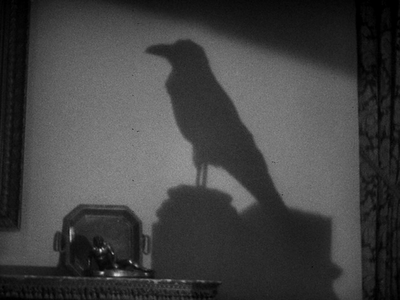
 The fact that The Raven predates every movie I've just compared it to is worth noting, as is the fact that it belongs to that glorious cluster of horror films from the 1930s that not only had the courage of their convictions when it came to dealing with their feverish Gothic trappings, but positively wallowed in them. Director Friedlander packs this thing with wall-filling shadows and mad cackling and drooping candelabra -- it's Gothic simply because its Gothic, not because it sees some snarky camp value in the form. If I may, I'd like to wear my old-fogey hat for a moment and wonder why pure Gothicism has been lost while most other forms of horror and suspense have found their unsullied way back to the big screen. This is the case in America, at least (Spain seems to found a rich vein of the stuff in recent years), with only Neil Jordan's somewhat underrated Interview With a Vampire embracing such imagery more-or-less sincerely.
Obviously, that title – The Raven, I mean – should tip anyone off to some sort of Poe connection in the film, and it is part of a short cycle of Poe films that Lugosi made. But The Raven is fascinating in that instead of taking Poe’s simple poem of Gothic mourning and inflating it absurdly to somehow encompass mad science and shambling monsters, which is the kind of thing that Poe must be used to by now, it instead uses Poe’s fiction, and the abuse of it, as the basis for Villon’s madness. Admittedly, this abuse takes the form of a torture room in which Vollin has recreated a number of lethal devices described in Poe's fiction, an idea which has been hammered into the ground over the past several decades, but here Vollin goes out of his way to assume an affinity with Poe that betrays a complete misunderstanding of what Poe was about. Vollin gets off on Poe's violence in a way Poe himself never did..
Vollin's love for Jean develops quickly, but really gets moving when she invites him to see her perform. She's a dancer, and her current routine is one she calls "The Spirit of Poe", and involves balletic flailing on her part while some guy reads "The Raven" out loud. It is, quite frankly, a pretty doofy bit, but it cements Jean's place in Vollin's black and shriveled heart. Curiously, this routine at times also calls to mind the climactic ballet in Darren Aranofsky's Black Swan, though with the psychosis coming from outside so that Jean becomes the raven in Vollin's mind, as opposed to Nina becoming the black swan in her own.
.
This flip matches to another flip, this time relating to Val Lewton and Robert Wise's The Body Snatcher. In that film, Henry Daniell's ice-blooded doctor sloughs away his guilt over the illegal procuring of bodies for his experiments, and the nefarious ways in which those corpses become corpses, onto Boris Karloff's Mr. Gray, who actually carries out the murders. Gray knows what's up, and knows how the Daniell character rationalizes his transgressions, and further has a lot of fun poking at the doctor's consience. Meanwhile, in The Raven, Karloff again plays a killer, an escaped con named Bateman who seeks out Vollin in hopes that Vollin can "change his face", not only to make him unrecognizable to the authorities, but because Bateman hopes Vollin can erase his ugliness, which he believes to be the source of his wickedness. In The Body Snatcher, Lugosi appears briefly as a drunk who sniffs out the deal between the doctor and Gray, and has to be done away with -- it's a very good scene, with Karloff plying Lugosi with booze (I especially like Lugosi's fuzzy attempt to bat away Karloff's hands as he gets closer). In The Raven, when Vollin's surgery makes Batemen uglier so that he can blackmail him into assisting him with a wild scheme to torture and murder both Jean and Judge Thatcher, Karloff becomes not only Bateman, but Daniell's doctor, in his attempt to hide from his own guilt, and Lugosi's drunk from The Body Snatcher in his inarticulate helplessness. Lugosi's Vollin, then, assumes the form of Gray the puppetmaster, keeping his face hidden and hands clean until the point of no return. He's perhaps somewhat less self-aware than Gray, however, considering that he claims all this torture and murder will ultimately result in his becoming "the sanest man in the world." Which, by the way, must have some claim to being one of the greatest lines of all time.
.
.
The fact that The Raven predates every movie I've just compared it to is worth noting, as is the fact that it belongs to that glorious cluster of horror films from the 1930s that not only had the courage of their convictions when it came to dealing with their feverish Gothic trappings, but positively wallowed in them. Director Friedlander packs this thing with wall-filling shadows and mad cackling and drooping candelabra -- it's Gothic simply because its Gothic, not because it sees some snarky camp value in the form. If I may, I'd like to wear my old-fogey hat for a moment and wonder why pure Gothicism has been lost while most other forms of horror and suspense have found their unsullied way back to the big screen. This is the case in America, at least (Spain seems to found a rich vein of the stuff in recent years), with only Neil Jordan's somewhat underrated Interview With a Vampire embracing such imagery more-or-less sincerely. .
Anyway. The Raven is a treat. Occasionally absurd (Jean's car accident, which sets everything in motion, seems to have been caused by her desperate fear of detour signs) but easy on comic relief, something I can usually do without in such films, it's a jolt of pure, manic, old Hollywood-style horror, wearing its armchair psychology on its sleeve while somehow, at the same time, making it serve the characters and the emotion. And the moral of it might just be: Don't project yourself onto what you read. Sometimes I have no clue why I would ever want to watch any other kind of film.
Anyway. The Raven is a treat. Occasionally absurd (Jean's car accident, which sets everything in motion, seems to have been caused by her desperate fear of detour signs) but easy on comic relief, something I can usually do without in such films, it's a jolt of pure, manic, old Hollywood-style horror, wearing its armchair psychology on its sleeve while somehow, at the same time, making it serve the characters and the emotion. And the moral of it might just be: Don't project yourself onto what you read. Sometimes I have no clue why I would ever want to watch any other kind of film.

_NRFPT_03.jpg)
_NRFPT_02.jpg) Even so, in both films, the best of intentions -- to help mankind live well beyond their natural allotment of years -- results in horror and death. And before Dr. Garth's serum kicks in, both returning Garth to his youth and instilling him with a
Even so, in both films, the best of intentions -- to help mankind live well beyond their natural allotment of years -- results in horror and death. And before Dr. Garth's serum kicks in, both returning Garth to his youth and instilling him with a