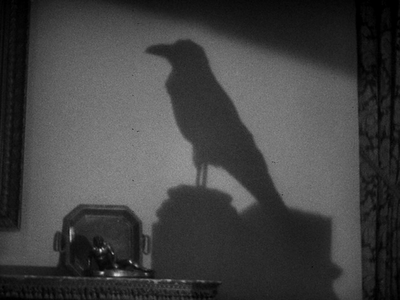
Perhaps you'll recall the many times this month when I've expressed some amount of displeasure over the sanity-crushing grip the eldritch immensity of Howard Phillips Lovecraft's influence has on modern horror fiction. I haven't changed my mind about that, and in fact I'd rather all influences, whatever or whoever they happen to be, would be shoved more aggressively into the attic rather than set with a proud wink on the desks of horror writers everywhere. I can't change the world, alas, but what I can do is point out other stories by writers who have been influenced by someone who, in my opinion, is more deserving, and has a greater claim, on the souls who toil within the genre than Lovecraft (yeah, I'm sick of him! What of it?!). That writer is, well, look:
It hardly needs to be said that without Poe there would be no Lovecraft, or at least not the Lovecraft we know. This is not to say that the two writers are all that similar, and as for Poe himself I'd appreciate it if you'd allow me to link to this post, and let what I wrote there suffice. The gist is, in terms of modern horror, at least in America, Poe's shadow looms larger than a lot of people, including people who write in and about horror, seem willing to admit. To the degree, I should say, that the existence of editor Ellen Datlow's Poe feels like kind of an anomaly. Even Straub's anthology Poe's Children only really took Poe's name as a symbol in the title -- it didn't look for stories that explicitly absorbed Poe as Datlow attempted here. Striking a note that was slightly worrisome, in her introduction Datlow writes that she told her writers that she didn't want pastiches (fine, good) but "I asked each writer to tell me in advance what work of Poe's was to be riffed on..." Oh, hm, well. Why does a specific Poe story have to be riffed on? Why can't something wholly new be written in his spirit? I don't know, you're asking the wrong guy, but based on what I read for today I can't say that Datlow's choice is giving me a great deal of heartburn.
As far as whose stories I chose to read, I had several options, including a number by writers I'd never covered on this blog before. This normally would have been my preference, but in the end I was too strongly pulled in by stories by two guys, Laird Barron and John Langan, I've dealt with before, more than once in the case of Barron. About Laird Barron's "Strappado," I'd only heard it was a good one, and I've been wanting to ramp up my reading of Barron's fiction, so that's that one taken care of, and as for Langan's "Technicolor" I knew that it dealt in some way with Poe's "Masque of the Red Death," and it was told entirely as a lecture delivered by an English professor. Barron I already liked, but what I knew of Langan's work hadn't impressed me, and I suspect it would be lying to myself as much as you if I claimed part of my interest in "Technicolor" wasn't to see if Langan sprawled face-first into a giant table full of pies after the seat of his pants split in front of everybody. Which...more about how that turned out in a little bit.
Barron's "Strappado" is actually fairly close to being in the spirit of Poe than being a straight riff. Reading this removed from the context of Datlow's anthology, I don't believe I would have automatically made the connection to "The Cask of Amontillado" that comes through reasonably strongly once you know the idea. Still, Barron's excellent story stands firmly on its own two legs. It's told from the point of view of Kenshi Suzuki, a man who's ashamed of his lack of connection to Japan, the home of his parents, and overall has a quietly nervous, not withdrawn, but unsure-of-himself demeanor. Kenshi is nevertheless successful, his vague Hollywood production job taking him all over the world on various junkets, during one of which he had a brief but torrid affair with an Englishman named Swayne Harris. As the story opens, the two men find their paths crossing again in an Indian tourism mecca. After sex, they head out for a night on the town, eschewing Kenshi's suggestion of a popular disco in favor of Swayne's of a more hole-in-the-wall location. Kenshi's discomfort with exploring the fringes of foreign countries is overcome by his inability to assert himself, and much of the rest of the story will find him following along. In the nightclub Swayne picked, the two men find themselves in a group of mixed European high-rollers (including one American, who is of course fat and loud and bigoted, Barron choosing to stick with the tiresome "Ha ha ha we're terrible!" self-xenophobia that I find so obnoxious; also, one of the characters is named Luis Guzman, which, I feel, is a strange choice). Swayne adds to the electricity so far generated by money, booze, and vague hints of sex by announcing that he can get them all into the new exhibit by guerrilla artist Van Iblis. This is a big deal -- Van Iblis's work has been banned in England, and his stuff work is often dark and disturbing and is often of an extra-legal, if not quite criminal -- if you get my distinction -- nature. So like Banksy, essentially, but more likely to be focused on death.
But they all go, and are quite excited during the journey to the hidden away warehouse where the exhibit will take place, a journey which is long enough that it's dawn by the time the two cars carrying the wealthy international group arrives. But Barron gets at something very appealingly specific when he writes:
Guzman and Rashid's groups climbed from the vans and congregated, faces slack and bruised by hangovers, jet lag, and burgeoning unease. What had seemed a lark in the cozy confines of the disco became a more ominous prospect as each took stock and realized he or she hadn't a bloody clue as to north or south, or up and down, for that matter. Gnats came at them in quick, sniping swarms, and several people cursed when they lost shoes to the soft, wet earth. Black and white chickens scratched in the weedy ruts.
Embarking on drunken adventures you soon wish you'd been sober enough to decline (as Kenshi actually wanted to) is universal, although the adventures open to these characters is a bit beyond what most people are used to. Which is not beside the point, I suppose, but given Kenshi's head-down, charmingly shy demeanor, their wealth becomes irrelevant pretty easily, if you choose to make it so. In any case, the "adventure" continues when outside the warehouse, associates of Van Iblis instruct the partygoers to strip naked. They're paired off -- due to an odd number of people, Kenshi is alone at the end of this process -- and two by two, they're ushered into the warehouse. And since Barron is vague about what goes on inside, I'll leave it even more vague by telling you nothing. But, you know, it's not good. However, what makes "Strappado" stand out from other horror stories to which it might bear some similarity (I can't think of a specific one, but "Strappado" does not bowl you over with its originality, nor does Barron mean it to) is that in this case, there is actually room for an aftermath -- typically the aftermath in stories like this is someone feasting on corpses or something, but with "Strappado" Barron is at least a little bit interested in the kind of effect horror can have on somebody, the anger and disgust and even upending of basic personality that can follow. In a very subtle way, Barron's story achieves a greater sense of dread than if it had ended with everybody getting their heads split in two, because in Barron's story, for some people the dread doesn't end. An obvious idea, you'd think, but just as obviously an idea few writers have, or at least had and then didn't reject.
As for Langan's "Technicolor," I...okay, I'll just relieve whatever meager suspense I've managed to build up and say that Langan wins this round. I'm not entirely convinced that he brings his very complicated story all the way home, but he at least comes damn close. And anyway, he may have -- a reread someday will decide that for me. But what Langan pulls off here is fairly extraordinary. I'm wary of overselling this, but when you consider that the story, as I've said, takes the form of a college English lecture, and that I, at least, rarely failed to believe the language used, I could picture the professor, any male English professor I ever had, really, saying these very things (well, up to a point), and was moved by the end to pull my Poe biography off the bookshelf to see how much, if any, of what the professor is going on about was based even a little bit on truth (one important element does seem to have come from Poe's delirium in the hospital shortly before his death), and read, and read, and read on fascinated by the strange alternate partial biography of Poe that Langan was laying out, clueless as to where this was all going, I'm fairly confident has achieved something quite admirable with "Technicolor." And he does that, by the way, with a story that finally feels a bit less like something Poe would have written than fuckin' Lovecraft! But I'm not even angry about that!
"Technicolor" is a hard story to summarize, primarily because I'm loathe to spoil the narrative force of it. Langan very seamlessly carries his story from an interesting analysis of the color scheme at play in Poe's "The Masque of the Red Death," told in a thoroughly convincing impersonation of academic speak, into the shadow inspiration for Poe's classic story, who the man was who inspired it, what the man did that inspired it, what the man was trying to do when he did the thing that inspired it, and where this led, and left, a drunken, tumor-addled, and grief-stricken Edgar Allan Poe in his final days. Langan even drops a throwaway bit of classroom atmosphere that pays off quite fairly later on. All structured like a lecture. And it's no small feat -- one I honestly didn't believe Langan would bring off -- that the language necessary for this premise never drives into a ditch. There's interaction between the professor and his students, and the students' words are not given to us, yet at no point does Langan resort to "What's that you say? You want to know what Poe meant by placing the braziers where he did in each of the colored rooms? Well, I'll tell you..." He might skirt that once or twice, but never goes off the road. Plus, the ending, which I think is fairly strong (if I have an issue with it, it's that for as present as Poe is in this story, there's not much of Poe's specific imagination in the ending) somehow feels even more chilling knowing that it's occurring somewhere as innocuous as a college classroom. Not sacred, mind you, because, well, anyway...no, it's that it's so ordinary and everyday, and I can pull up a vision of one of several versions of that place in my head at any time. This is like the idea of horror being more frightening in daylight, but in this case it's more like horror being more frightening in a barbershop. So I guess you may have had the last laugh, John Langan.
Showing posts with label Edgar Allan Poe. Show all posts
Monday, October 29, 2012
Thursday, January 27, 2011
The Collection Project: The Sanest Man in the World
.
A telling feature of the Universal DVD set The Bela Lugosi Collection is that of the five films included, four of them also feature Boris Karloff in roles that are as important as, or more important than, Lugosi’s. This is not something you’re likely to find in sets devoted to Karloff – those may feature films in which Karloff takes a supporting role, as in The Strange Door for example, but you won’t find him repeatedly paired with a single actor who has, over the decades, become more respected and beloved than him. Karloff doesn’t get overshadowed, in other words. Lugosi, on the other hand, seems always on the cusp of becoming a camp figure, at least popularly, due to his waning years spent making movies with Ed Wood. For that matter, Lugosi was never as lucky or as good as Karloff – his signature film, Dracula, is nowhere near as good as Karloff’s equivalent Frankenstein – and as a result Lugosi is fading into the background of his own box sets.
Still, it would be wrong to try to write off Lugosi, or to ignore the fact he and Karloff made a hell of a double act. One of their strongest pairings is in Universal’s The Raven, directed by Louis Friedlander in which Lugosi plays a total fucker named Dr. Richard Vollin, a retired surgeon who, at the film’s opening, is asked by his former colleagues to perform emergency surgery on Jean Thatcher (Irene Ware), who has just been in a bad car accident. Vollin refuses to help until Judge Thatcher (Samuel S. Hinds), Jean’s father, goes to Vollin’s home and begs him in person, and even that’s not enough until Tatcher tells Vollin that he, Vollin, is clearly better than any other surgeon, his colleagues included. So Vollin performs the surgery, saves Jean, and promptly falls in love with her because, for all his coldness he is, as he tells Jean, “a god with the taint of human emotions”, although if you ever met the guy you might be forgiven for failing to notice that last bit. Vollin is, in truth, a hateful, venomous, violent sociopath, who is also an avid collector and, it turns out, consistent misreader of Edgar Allan Poe.
A telling feature of the Universal DVD set The Bela Lugosi Collection is that of the five films included, four of them also feature Boris Karloff in roles that are as important as, or more important than, Lugosi’s. This is not something you’re likely to find in sets devoted to Karloff – those may feature films in which Karloff takes a supporting role, as in The Strange Door for example, but you won’t find him repeatedly paired with a single actor who has, over the decades, become more respected and beloved than him. Karloff doesn’t get overshadowed, in other words. Lugosi, on the other hand, seems always on the cusp of becoming a camp figure, at least popularly, due to his waning years spent making movies with Ed Wood. For that matter, Lugosi was never as lucky or as good as Karloff – his signature film, Dracula, is nowhere near as good as Karloff’s equivalent Frankenstein – and as a result Lugosi is fading into the background of his own box sets. .
Still, it would be wrong to try to write off Lugosi, or to ignore the fact he and Karloff made a hell of a double act. One of their strongest pairings is in Universal’s The Raven, directed by Louis Friedlander in which Lugosi plays a total fucker named Dr. Richard Vollin, a retired surgeon who, at the film’s opening, is asked by his former colleagues to perform emergency surgery on Jean Thatcher (Irene Ware), who has just been in a bad car accident. Vollin refuses to help until Judge Thatcher (Samuel S. Hinds), Jean’s father, goes to Vollin’s home and begs him in person, and even that’s not enough until Tatcher tells Vollin that he, Vollin, is clearly better than any other surgeon, his colleagues included. So Vollin performs the surgery, saves Jean, and promptly falls in love with her because, for all his coldness he is, as he tells Jean, “a god with the taint of human emotions”, although if you ever met the guy you might be forgiven for failing to notice that last bit. Vollin is, in truth, a hateful, venomous, violent sociopath, who is also an avid collector and, it turns out, consistent misreader of Edgar Allan Poe. .
Obviously, that title – The Raven, I mean – should tip anyone off to some sort of Poe connection in the film, and it is part of a short cycle of Poe films that Lugosi made. But The Raven is fascinating in that instead of taking Poe’s simple poem of Gothic mourning and inflating it absurdly to somehow encompass mad science and shambling monsters, which is the kind of thing that Poe must be used to by now, it instead uses Poe’s fiction, and the abuse of it, as the basis for Villon’s madness. Admittedly, this abuse takes the form of a torture room in which Vollin has recreated a number of lethal devices described in Poe's fiction, an idea which has been hammered into the ground over the past several decades, but here Vollin goes out of his way to assume an affinity with Poe that betrays a complete misunderstanding of what Poe was about. Vollin gets off on Poe's violence in a way Poe himself never did.
.
Vollin's love for Jean develops quickly, but really gets moving when she invites him to see her perform. She's a dancer, and her current routine is one she calls "The Spirit of Poe", and involves balletic flailing on her part while some guy reads "The Raven" out loud. It is, quite frankly, a pretty doofy bit, but it cements Jean's place in Vollin's black and shriveled heart. Curiously, this routine at times also calls to mind the climactic ballet in Darren Aranofsky's Black Swan, though with the psychosis coming from outside so that Jean becomes the raven in Vollin's mind, as opposed to Nina becoming the black swan in her own.
The fact that The Raven predates every movie I've just compared it to is worth noting, as is the fact that it belongs to that glorious cluster of horror films from the 1930s that not only had the courage of their convictions when it came to dealing with their feverish Gothic trappings, but positively wallowed in them. Director Friedlander packs this thing with wall-filling shadows and mad cackling and drooping candelabra -- it's Gothic simply because its Gothic, not because it sees some snarky camp value in the form. If I may, I'd like to wear my old-fogey hat for a moment and wonder why pure Gothicism has been lost while most other forms of horror and suspense have found their unsullied way back to the big screen. This is the case in America, at least (Spain seems to found a rich vein of the stuff in recent years), with only Neil Jordan's somewhat underrated Interview With a Vampire embracing such imagery more-or-less sincerely.
Obviously, that title – The Raven, I mean – should tip anyone off to some sort of Poe connection in the film, and it is part of a short cycle of Poe films that Lugosi made. But The Raven is fascinating in that instead of taking Poe’s simple poem of Gothic mourning and inflating it absurdly to somehow encompass mad science and shambling monsters, which is the kind of thing that Poe must be used to by now, it instead uses Poe’s fiction, and the abuse of it, as the basis for Villon’s madness. Admittedly, this abuse takes the form of a torture room in which Vollin has recreated a number of lethal devices described in Poe's fiction, an idea which has been hammered into the ground over the past several decades, but here Vollin goes out of his way to assume an affinity with Poe that betrays a complete misunderstanding of what Poe was about. Vollin gets off on Poe's violence in a way Poe himself never did..
Vollin's love for Jean develops quickly, but really gets moving when she invites him to see her perform. She's a dancer, and her current routine is one she calls "The Spirit of Poe", and involves balletic flailing on her part while some guy reads "The Raven" out loud. It is, quite frankly, a pretty doofy bit, but it cements Jean's place in Vollin's black and shriveled heart. Curiously, this routine at times also calls to mind the climactic ballet in Darren Aranofsky's Black Swan, though with the psychosis coming from outside so that Jean becomes the raven in Vollin's mind, as opposed to Nina becoming the black swan in her own.
.

This flip matches to another flip, this time relating to Val Lewton and Robert Wise's The Body Snatcher. In that film, Henry Daniell's ice-blooded doctor sloughs away his guilt over the illegal procuring of bodies for his experiments, and the nefarious ways in which those corpses become corpses, onto Boris Karloff's Mr. Gray, who actually carries out the murders. Gray knows what's up, and knows how the Daniell character rationalizes his transgressions, and further has a lot of fun poking at the doctor's consience. Meanwhile, in The Raven, Karloff again plays a killer, an escaped con named Bateman who seeks out Vollin in hopes that Vollin can "change his face", not only to make him unrecognizable to the authorities, but because Bateman hopes Vollin can erase his ugliness, which he believes to be the source of his wickedness. In The Body Snatcher, Lugosi appears briefly as a drunk who sniffs out the deal between the doctor and Gray, and has to be done away with -- it's a very good scene, with Karloff plying Lugosi with booze (I especially like Lugosi's fuzzy attempt to bat away Karloff's hands as he gets closer). In The Raven, when Vollin's surgery makes Batemen uglier so that he can blackmail him into assisting him with a wild scheme to torture and murder both Jean and Judge Thatcher, Karloff becomes not only Bateman, but Daniell's doctor, in his attempt to hide from his own guilt, and Lugosi's drunk from The Body Snatcher in his inarticulate helplessness. Lugosi's Vollin, then, assumes the form of Gray the puppetmaster, keeping his face hidden and hands clean until the point of no return. He's perhaps somewhat less self-aware than Gray, however, considering that he claims all this torture and murder will ultimately result in his becoming "the sanest man in the world." Which, by the way, must have some claim to being one of the greatest lines of all time.
.
.
The fact that The Raven predates every movie I've just compared it to is worth noting, as is the fact that it belongs to that glorious cluster of horror films from the 1930s that not only had the courage of their convictions when it came to dealing with their feverish Gothic trappings, but positively wallowed in them. Director Friedlander packs this thing with wall-filling shadows and mad cackling and drooping candelabra -- it's Gothic simply because its Gothic, not because it sees some snarky camp value in the form. If I may, I'd like to wear my old-fogey hat for a moment and wonder why pure Gothicism has been lost while most other forms of horror and suspense have found their unsullied way back to the big screen. This is the case in America, at least (Spain seems to found a rich vein of the stuff in recent years), with only Neil Jordan's somewhat underrated Interview With a Vampire embracing such imagery more-or-less sincerely. .
Anyway. The Raven is a treat. Occasionally absurd (Jean's car accident, which sets everything in motion, seems to have been caused by her desperate fear of detour signs) but easy on comic relief, something I can usually do without in such films, it's a jolt of pure, manic, old Hollywood-style horror, wearing its armchair psychology on its sleeve while somehow, at the same time, making it serve the characters and the emotion. And the moral of it might just be: Don't project yourself onto what you read. Sometimes I have no clue why I would ever want to watch any other kind of film.
Sunday, October 31, 2010
The Kind of Face You SLASH!!! - Day 31: My Fancy Grew Charnel
.
Every horror writer, good or bad, of the 20th century is a spawn of Edgar Allan Poe. Even if an individual writer sees himself as more a descendant of H. P. Lovecraft, say, he is a child of Poe. The entire genre as we understand it now, at least in literature, probably wouldn't exist without him. Peter Straub not only sees the man as a patriarch to the genre -- he edited an anthology in 2008 called Poe's Children -- but as an entire time period, or perhaps more accurately, as a beginning: volume one of his two-part anthology American Fantastic Tales is subtitled From Poe to the Pulps.
.
Frequently, Poe is as much of an agitator among his readers as he is for other writers. Who among horror fans cannot count Poe as one of his earliest literary loves? For myself, my connection to the horror genre began with Stephen King, but my reading of Poe ran almost parallel, to the point where the two authors may have passed under my eye concurrently. Among Poe's classic stories, "The Tell-Tale Heart" has been read by me more times than any other short story (not the kind of distinction on which reputations are built, but at this point Poe doesn't need my help anyway). The reason I returned to that story so often in my youth is because of lines like "I heard many things in hell. How, then, am I mad?" Poe's words can carry a pretty deep chill, even divorced from any context, and "The Tell-Tale Heart", which is unquestionably the story of a homicidal madman praying on a defenseless old man, just happens to also work if the reader takes the narrator at face value. If you're such a reader, you might want to rethink certain things about your life, but the story still works.
.
I said before that I returned to that particular story over and over again "in my youth", implying I haven't been back to it in a while. This is true. Also true is that the same thing could be said of my recent experience of Poe's fiction as a whole, which is to say, there hasn't been any. It's hard to say for sure why this is, but I think I may have convinced myself that I would now find Poe tedious, and didn't want my fond old memories of his writing to be overwhelmed by modern disappointment. Looked at logically, it doesn't seem terribly realistic that my better-read adult self would find a writer like Poe tedious while my attention-span deficient younger self didn't, but there it is. This sad story has a happy ending, though, as I've taken Halloween Day, 2010, as an excuse to reacquaint myself with the man, dead now these past 161 years, as of October 7.
.
I chose a scattering of Poe stories, culled from both his more obscure titles and from his established classics that I simply hadn't read yet. Of that sampling, the two most obscure stories turned out to be comedies (though with an underlying horror premise), and it's interesting to note that this is a form Poe worked in with some frequency, but none of his humor is remembered with anything like the cultural absorption of something like "The Murders in the Rue Morgue". His most famous humorous story would have to be "Never Bet the Devil Your Head", and I sometimes think that more people have seen Federico Fellini's also obscure, very hard to find short film adaptation of that story (called Toby Dammit, and part of an Italian horror anthology film called Spirits of the Dead) than have actually read it. If one were to go solely by one of the comic stories I read for today, "The Devil in the Belfry", the loss of Poe as a comic voice wouldn't be that hard to figure, and wouldn't be that lamentable, either. "The Devil in the Belfry" is a weird, not very funny story that seems to exist solely to express Poe's dislike of either Germans, or the Swiss, or whichever one of those speaks German but is renowned for making great clocks. You might say "Those are both things that Germans do", but the story is set in a town called Vondervotteimittiss, which, I don't know, sounds Scandinavian to me. In any case, the story doesn't really merit much consideration, being, as it is, just a silly manifestation of Poe's xenophobia (which wouldn't matter to me so much if the story were funnier). But another of Poe's forays into comedy, called "Loss of Breath", does.
.
"Loss of Breath" is a story about a man who quite literally loses his breath. He's in the middle of screaming abuse at his wife on the morning after their wedding ("Thou wretch - thou vixen! - thou shrew!") when the breath simply deserts him. He doesn't die, but he does momentarily lose the power of speech. Eventually he's able to work out a different way of speaking, one not dependant on the regular release of breath, and even trains himself as an actor specializing in a particular role for which his tone of voice is well suited. But this man's life -- the life of Mr. Lackobreath, as he comes to call himself -- turns into a series of grotesque disasters, including being hanged from the neck (though not until dead, as the restriction of the rope would not impede his quality of life), the severing of his ears, the severing of his nose, and his premature interment in a burial vault, after he was believed dead by fellow passengers in a train car.
.
That interment is not the end of the story, and despite all the horror listed above, Poe relates the story in a light-hearted tone. And it's actually quite funny. At one point, shortly after losing his breath, Mr. Lackobreath tries to find it again, actually, physically find his lost breath, following William Godwin's view that "invisible things are the only realities". However:
.
My exertions, as I have before said, proved fruitless. Closet after closet -- drawer after drawer -- corner after corner -- were scrutinized to no purpose. At one time, however, I thought myself sure of my prize, having in rummaging a dressing-case, accidentally demolished a bottle of Granjean's Oil of Archangels -- which, as an agreeable perfume, I here take the liberty of recommending.
.
"Loss of Breath" is full of that sort of bizarre aside, or casual understatement, as when our narrator's skull is fractured "in a manner at once interesting and extraordinary." More interesting, perhaps, than evidence of Poe's comedic prowess, is this story's relationship with so much of his other, less whimsical stories, including many of the ones I read for today. The borderline between life and death is one that fascinated Poe, and its one that Mr. Lackobreath walks throughout "Loss of Breath". One of the traditional ways an amateur checks for life in a body in repose is to hold a mirror in front of its mouth. The absence of fogged glass that results when Lackobreath's train companions try this is what lands him in an early grave. This mirror trick is also used to bolster the terrible belief of a group of doctors and mesmerists in one of Poe's most chilling stories, "The Facts in the Case of M. Valdemar".
.
In this story, the title character is dying -- and the facts of his body's corruption are laid out by Poe in no little detail -- and as his future is hopeless he readily agrees to be used in the experiments of his friend and mesmerist, our narrator, known only as P____. Our narrator's idea is to entrance someone, as he puts it, "in articulo mortis", or literally "at the point of death". Valdemar's disease is such that the moment of his death can be pegged with some accuracy, and he remains contact with our narrator, and our narrator with Valdemar's doctors, so that the experiment can begin at the correct time, and so that this moment will not be missed.
.
This moment is not missed, and when it arrives all the interested parties are gathered at Valdemar's death bed, and he is successfully mesmerized. Valdemar is terribly weakened at this point, but his mesmerist is able to control certain of his movements and even communicate. When asked if he's sleeping, Valdemar responds "Yes -- asleep now. Do not wake me! -- let me die so!" The astonishing thing, however, is that the hour judged by his doctors to be Valdemar's last comes and goes, yet Valdemar does not die, and instead remains mesmerized. He continues to answer questions, although his body seems to have shut down, so that his voice appears to come just from his wildly vibrating tongue, and from the depths of his throat, with no assistance from his entirely still lips. And eventually, when asked again if he's sleeping, he responds:
.
Yes! -- no; -- I have been sleeping -- and now -- now -- I am dead.
.
The question then becomes, should Valdemar be woken up? And if so, what will happen?
.
"The Facts in the Case of M. Valdemar" is as despairing and dark as anything Poe ever wrote, with any gray area over the states of life and death representing shrieking horror. That middle ground is not an afterlife, or a living death, as with zombies or vampires, but instead being buried alive, as in "Loss of Breath", or, in "The Facts in the Case of M. Valdemar", a death that still permits communication, not from heaven, or from reanimation -- the story's climax removes all possibility of either of those -- but from delay. The more I read of Poe, the more explicit becomes the source of this terrible intermediate state: the human knowledge of mortality. This is the seed of the entire horror genre, and the disease of Poe's imagination.
.
Never has this been as clear as it is in "The Premature Burial", a story that is not, as I'd always believed, simply the chronicle of a man who has been buried alive. Rather, it is about the idea of being buried alive, and the unthinkable terror that must be felt by anyone who experiences it. At first a series of anecdotes about those who have felt this horror -- some who never lived to tell of it, some who did -- "The Premature Burial" doesn't begin to reveal itself as perhaps the ultimate expression of despair in Poe's life, and even of the genre, in its final pages, when the narrator who has been pondering the idea of early interment reveals that, due to his own medical condition, the symptoms of which can be mistaken for death, he lives in constant fear of waking from one of his spells to find himself encased in wood and covered with closely packed earth.
.
In all that I endured there was no physical suffering, but of moral distress an infinitude. My fancy grew charnel, I talked "of worms, of tombs, and epitaphs." I was lost in reveries of death, and the idea of premature burial held continual possession of my brain. The ghastly Danger to which I was subjected haunted me day and night. In the former, the torture of meditation was excessive -- in the latter, supreme.
.
So supreme, in fact, that at one point he experiences a horrible dream in which a man, or a kind of creature ("I was mortal," it says, "but am fiend.") takes our narrator on a journey of human misery, shown by his hideous guide in "the graves of all mankind":
.
...and from each issued the faint phosphoric radiance of decay; so that I could see into the innermost recesses, and there view the shrouded bodies in their sad and solemn slumbers with the worm. But alas! the real sleepers were fewer, by man millions, than those who slumbered not at all; and there was a feeble struggling; and there was a general sad unrest; and from out the depths of the countless pits there came a melancholy rustling from the garments of the buried. And of those who seemed tranquilly to repose, I saw that a vast number had changed, in a greater or less degree, the rigid and uneasy position in which they had originally been entombed.
.
And so within the story, the horrible but absurd implication is that more people are buried alive than are buried dead. In the world Poe, and the rest of us, lived and live in, however, this passage says that most of us can't sleep. Most of us are in a state of constant despair. Our beds are our graves, or might as well be, or will be soon enough. Few people who have ever walked the earth, Poe is saying, have ever really known peace. Why this should be is, as I've said, because we all know too well where it all leads.
.
It's doubtful Poe would have thought of "The Premature Burial" this literally, and if he did it wouldn't have been in terms of genre, but rather his own brain. Even so, this story is as precise in its metaphor, not only of the story's horror, but of horror as a literary genre, as anything I've ever come across. "The Premature Burial" is horror, the entire history and philosophy of the genre concentrated into about ten pages. And, as horror sometimes does, it even offers, to those of us who love this genre but who may at times take it too close to heart, an alternative. After surviving a close call, our narrator finds his mood changing, his morbidity lifting, his approach to life more welcoming and curious and, simply, peaceful. As he reflects in the story's final paragraph:
.
There are moments when, even to the sober eye of Reason, the world of our sad Humanity may assume the semblance of a Hell -- but the imagination of man is no Carathis, to explore with impunity its every cavern. Alas! the grim legion of sepulchral terrors cannot be regarded as altogether fanciful -- but, like the Demons in whose company Afrasiab made his voyage down the Oxus, they must sleep, or they will devour us -- they must be suffered to slumber, or we perish.
.
Though Poe himself did not do so, these are words to live by, and as appropriate a sentiment on which to close out the month as I'll ever find.

Every horror writer, good or bad, of the 20th century is a spawn of Edgar Allan Poe. Even if an individual writer sees himself as more a descendant of H. P. Lovecraft, say, he is a child of Poe. The entire genre as we understand it now, at least in literature, probably wouldn't exist without him. Peter Straub not only sees the man as a patriarch to the genre -- he edited an anthology in 2008 called Poe's Children -- but as an entire time period, or perhaps more accurately, as a beginning: volume one of his two-part anthology American Fantastic Tales is subtitled From Poe to the Pulps.
.
Frequently, Poe is as much of an agitator among his readers as he is for other writers. Who among horror fans cannot count Poe as one of his earliest literary loves? For myself, my connection to the horror genre began with Stephen King, but my reading of Poe ran almost parallel, to the point where the two authors may have passed under my eye concurrently. Among Poe's classic stories, "The Tell-Tale Heart" has been read by me more times than any other short story (not the kind of distinction on which reputations are built, but at this point Poe doesn't need my help anyway). The reason I returned to that story so often in my youth is because of lines like "I heard many things in hell. How, then, am I mad?" Poe's words can carry a pretty deep chill, even divorced from any context, and "The Tell-Tale Heart", which is unquestionably the story of a homicidal madman praying on a defenseless old man, just happens to also work if the reader takes the narrator at face value. If you're such a reader, you might want to rethink certain things about your life, but the story still works.
.
I said before that I returned to that particular story over and over again "in my youth", implying I haven't been back to it in a while. This is true. Also true is that the same thing could be said of my recent experience of Poe's fiction as a whole, which is to say, there hasn't been any. It's hard to say for sure why this is, but I think I may have convinced myself that I would now find Poe tedious, and didn't want my fond old memories of his writing to be overwhelmed by modern disappointment. Looked at logically, it doesn't seem terribly realistic that my better-read adult self would find a writer like Poe tedious while my attention-span deficient younger self didn't, but there it is. This sad story has a happy ending, though, as I've taken Halloween Day, 2010, as an excuse to reacquaint myself with the man, dead now these past 161 years, as of October 7.
.
I chose a scattering of Poe stories, culled from both his more obscure titles and from his established classics that I simply hadn't read yet. Of that sampling, the two most obscure stories turned out to be comedies (though with an underlying horror premise), and it's interesting to note that this is a form Poe worked in with some frequency, but none of his humor is remembered with anything like the cultural absorption of something like "The Murders in the Rue Morgue". His most famous humorous story would have to be "Never Bet the Devil Your Head", and I sometimes think that more people have seen Federico Fellini's also obscure, very hard to find short film adaptation of that story (called Toby Dammit, and part of an Italian horror anthology film called Spirits of the Dead) than have actually read it. If one were to go solely by one of the comic stories I read for today, "The Devil in the Belfry", the loss of Poe as a comic voice wouldn't be that hard to figure, and wouldn't be that lamentable, either. "The Devil in the Belfry" is a weird, not very funny story that seems to exist solely to express Poe's dislike of either Germans, or the Swiss, or whichever one of those speaks German but is renowned for making great clocks. You might say "Those are both things that Germans do", but the story is set in a town called Vondervotteimittiss, which, I don't know, sounds Scandinavian to me. In any case, the story doesn't really merit much consideration, being, as it is, just a silly manifestation of Poe's xenophobia (which wouldn't matter to me so much if the story were funnier). But another of Poe's forays into comedy, called "Loss of Breath", does.
.
"Loss of Breath" is a story about a man who quite literally loses his breath. He's in the middle of screaming abuse at his wife on the morning after their wedding ("Thou wretch - thou vixen! - thou shrew!") when the breath simply deserts him. He doesn't die, but he does momentarily lose the power of speech. Eventually he's able to work out a different way of speaking, one not dependant on the regular release of breath, and even trains himself as an actor specializing in a particular role for which his tone of voice is well suited. But this man's life -- the life of Mr. Lackobreath, as he comes to call himself -- turns into a series of grotesque disasters, including being hanged from the neck (though not until dead, as the restriction of the rope would not impede his quality of life), the severing of his ears, the severing of his nose, and his premature interment in a burial vault, after he was believed dead by fellow passengers in a train car.
.
That interment is not the end of the story, and despite all the horror listed above, Poe relates the story in a light-hearted tone. And it's actually quite funny. At one point, shortly after losing his breath, Mr. Lackobreath tries to find it again, actually, physically find his lost breath, following William Godwin's view that "invisible things are the only realities". However:
.
My exertions, as I have before said, proved fruitless. Closet after closet -- drawer after drawer -- corner after corner -- were scrutinized to no purpose. At one time, however, I thought myself sure of my prize, having in rummaging a dressing-case, accidentally demolished a bottle of Granjean's Oil of Archangels -- which, as an agreeable perfume, I here take the liberty of recommending.
.
"Loss of Breath" is full of that sort of bizarre aside, or casual understatement, as when our narrator's skull is fractured "in a manner at once interesting and extraordinary." More interesting, perhaps, than evidence of Poe's comedic prowess, is this story's relationship with so much of his other, less whimsical stories, including many of the ones I read for today. The borderline between life and death is one that fascinated Poe, and its one that Mr. Lackobreath walks throughout "Loss of Breath". One of the traditional ways an amateur checks for life in a body in repose is to hold a mirror in front of its mouth. The absence of fogged glass that results when Lackobreath's train companions try this is what lands him in an early grave. This mirror trick is also used to bolster the terrible belief of a group of doctors and mesmerists in one of Poe's most chilling stories, "The Facts in the Case of M. Valdemar".
.
In this story, the title character is dying -- and the facts of his body's corruption are laid out by Poe in no little detail -- and as his future is hopeless he readily agrees to be used in the experiments of his friend and mesmerist, our narrator, known only as P____. Our narrator's idea is to entrance someone, as he puts it, "in articulo mortis", or literally "at the point of death". Valdemar's disease is such that the moment of his death can be pegged with some accuracy, and he remains contact with our narrator, and our narrator with Valdemar's doctors, so that the experiment can begin at the correct time, and so that this moment will not be missed.
.
This moment is not missed, and when it arrives all the interested parties are gathered at Valdemar's death bed, and he is successfully mesmerized. Valdemar is terribly weakened at this point, but his mesmerist is able to control certain of his movements and even communicate. When asked if he's sleeping, Valdemar responds "Yes -- asleep now. Do not wake me! -- let me die so!" The astonishing thing, however, is that the hour judged by his doctors to be Valdemar's last comes and goes, yet Valdemar does not die, and instead remains mesmerized. He continues to answer questions, although his body seems to have shut down, so that his voice appears to come just from his wildly vibrating tongue, and from the depths of his throat, with no assistance from his entirely still lips. And eventually, when asked again if he's sleeping, he responds:
.
Yes! -- no; -- I have been sleeping -- and now -- now -- I am dead.
.
The question then becomes, should Valdemar be woken up? And if so, what will happen?
.
"The Facts in the Case of M. Valdemar" is as despairing and dark as anything Poe ever wrote, with any gray area over the states of life and death representing shrieking horror. That middle ground is not an afterlife, or a living death, as with zombies or vampires, but instead being buried alive, as in "Loss of Breath", or, in "The Facts in the Case of M. Valdemar", a death that still permits communication, not from heaven, or from reanimation -- the story's climax removes all possibility of either of those -- but from delay. The more I read of Poe, the more explicit becomes the source of this terrible intermediate state: the human knowledge of mortality. This is the seed of the entire horror genre, and the disease of Poe's imagination.
.
Never has this been as clear as it is in "The Premature Burial", a story that is not, as I'd always believed, simply the chronicle of a man who has been buried alive. Rather, it is about the idea of being buried alive, and the unthinkable terror that must be felt by anyone who experiences it. At first a series of anecdotes about those who have felt this horror -- some who never lived to tell of it, some who did -- "The Premature Burial" doesn't begin to reveal itself as perhaps the ultimate expression of despair in Poe's life, and even of the genre, in its final pages, when the narrator who has been pondering the idea of early interment reveals that, due to his own medical condition, the symptoms of which can be mistaken for death, he lives in constant fear of waking from one of his spells to find himself encased in wood and covered with closely packed earth.
.
In all that I endured there was no physical suffering, but of moral distress an infinitude. My fancy grew charnel, I talked "of worms, of tombs, and epitaphs." I was lost in reveries of death, and the idea of premature burial held continual possession of my brain. The ghastly Danger to which I was subjected haunted me day and night. In the former, the torture of meditation was excessive -- in the latter, supreme.
.
So supreme, in fact, that at one point he experiences a horrible dream in which a man, or a kind of creature ("I was mortal," it says, "but am fiend.") takes our narrator on a journey of human misery, shown by his hideous guide in "the graves of all mankind":
.
...and from each issued the faint phosphoric radiance of decay; so that I could see into the innermost recesses, and there view the shrouded bodies in their sad and solemn slumbers with the worm. But alas! the real sleepers were fewer, by man millions, than those who slumbered not at all; and there was a feeble struggling; and there was a general sad unrest; and from out the depths of the countless pits there came a melancholy rustling from the garments of the buried. And of those who seemed tranquilly to repose, I saw that a vast number had changed, in a greater or less degree, the rigid and uneasy position in which they had originally been entombed.
.
And so within the story, the horrible but absurd implication is that more people are buried alive than are buried dead. In the world Poe, and the rest of us, lived and live in, however, this passage says that most of us can't sleep. Most of us are in a state of constant despair. Our beds are our graves, or might as well be, or will be soon enough. Few people who have ever walked the earth, Poe is saying, have ever really known peace. Why this should be is, as I've said, because we all know too well where it all leads.
.
It's doubtful Poe would have thought of "The Premature Burial" this literally, and if he did it wouldn't have been in terms of genre, but rather his own brain. Even so, this story is as precise in its metaphor, not only of the story's horror, but of horror as a literary genre, as anything I've ever come across. "The Premature Burial" is horror, the entire history and philosophy of the genre concentrated into about ten pages. And, as horror sometimes does, it even offers, to those of us who love this genre but who may at times take it too close to heart, an alternative. After surviving a close call, our narrator finds his mood changing, his morbidity lifting, his approach to life more welcoming and curious and, simply, peaceful. As he reflects in the story's final paragraph:
.
There are moments when, even to the sober eye of Reason, the world of our sad Humanity may assume the semblance of a Hell -- but the imagination of man is no Carathis, to explore with impunity its every cavern. Alas! the grim legion of sepulchral terrors cannot be regarded as altogether fanciful -- but, like the Demons in whose company Afrasiab made his voyage down the Oxus, they must sleep, or they will devour us -- they must be suffered to slumber, or we perish.
.
Though Poe himself did not do so, these are words to live by, and as appropriate a sentiment on which to close out the month as I'll ever find.
Sunday, July 25, 2010
The Collection Project: Rotten Blood
The half-assed way in which certain classic films pay homage to their literary source material always both amuses and confuses me. In my experience, the zenith for these sorts of references was reached in Rouben Mamoulian's Dr. Jekyll & Mr. Hyde, in which the narrator and protagonist of Robert Louis Stevenson's original story is heard being greeted off-screen, but then never appears, and is never mentioned again. Similarly, in Universal Studio and Robert Florey's 1932 adaptation of The Murders in the Rue Morgue, Edgar Allan Poe's brutal and bizarre chronicle of a series of murders which, it is learned, were perpetrated by an orangutan, Poe's detective, C. Auguste Dupin, is both dismissed and represented in the form of the medical student hero named Pierre Dupin (Leon Ames, credited here as Leon Waycoff). Why Pierre? What was wrong with, at least, Auguste?At least he's there, though, while pretty much the rest of Poe's story is gone. In the film, Poe's idea gets strained through Universal's apparent obsession with mad scientists, in this case appearing in the form of Bela Lugosi as Dr. Mirakle, a carnival showman and secret experimenter in the field of human/ape genetics. He works in the carnival for money, but his passion is finding a human female whose blood is as compatible with Erik -- Dr. Mirakle's ape -- as he can possibly find. This quest leads to the kidnapping of women, the injecting of ape blood into those women, and the eventual disposal of the women's bodies after they've died from having ape blood injected into them. After noticing the positive reaction Erik had to her when she attended their carnival performance, Mirakle soon has his eyes on Camille (Sidney Fox), believing that she will have the kind of blood he so desperately needs. As Camille is Dupin's girlfriend, the source of Mirakle's downfall is not hard to root out.
At 61 minutes, The Murders in the Rue Morgue has no more plot to summarize. The strange thing about the film is that as goofy as it is on paper (and sometimes on film, considering that Erik is presented in shadow and long-shots as a man in a vague, catch-all ape suit, and in close-up as a real chimpanzee, by way of stock footage, and referred to as a baboon), it's hard to say the film ever really steps that far wrong. It looks gorgeous, thanks to the basically infallible Karl Freund, who pulls cinematographer duties here, and it's also full of the kind of strange, and possibly not always intentional, subtexts that frequently marked Golden Age horror movies. For instance, if you check out that image posted at the top, you might see in it some of the dark sexuality that often found its way into these films, where young women in peril frequently also ended up being women bound up and strapped down.
That's Arlene Francis, by the way, and her character, and her introduction, adds a fuzzy class element to the proceedings. Dr. Mirakle finds her on a Paris bridge, watching in horror as two men engage in a knife fight (presumably over her) that ends with both their deaths. Mirakle then swoops in, pegging her as his next guinea pig, only to find later that the contents of her veins aren't what he's after. As she hangs there in his lab, near death, Mirakle rages at her, calling her blood "rotten", and "as black as your sins!" Francis's character is listed in the credits as "Woman of the Streets", and Camille is of a noticeably higher social tier than she -- so what, exactly, are Mirakle's criteria for his blood? To Mirakle, Erik, his ape, is every bit as human as these people he so despises, but perhaps, following a thought process that might be considered counter-intuitive in a person who would think like this in the first place, the people from whom blood should be poached, the people who most closely resemble our nearest animal neighbors, are the people live farthest from the wild.
Then, of course, there's the Scopes Monkey Trial, which would have been a mere seven years old when Florey's film was released. Poe's story (which was first published in 1841) could be seen to be about the dangers of a non-human pretending to be human, having learned only the most superficial behavior from a distance. As this danger leads to violent death (and one of Poe's uncomfortably imaginative murders does make its way into this film), Poe's orangutan could be a stand-in for amoral, sociopathic killers throughout history. But Poe would not have had Darwin available when he wrote his story, and while Darwin is not mention in the film, Dr. Mirakle does tell his carnival audience that humans are descended from apes like his friend Erik. These remarks are met with cries of "Heresy!" and, indeed, Mirakle is not only never able to prove his own lunatic version of Darwin, but he eventually meets his end at Erik's hands. The Scopes trial didn't sit terribly well with everybody, after all, as you might be aware. Then again, Erik still has his eyes on the decidedly human Camille, and hauls her along on his frantic escape, which, you know, sort of brings to mind Cooper and Schoedsack's King Kong, which was, at the time, still a year away.
It's amazing what they used to be able to cram into 61 minutes, isn't it?
Subscribe to:
Posts (Atom)