Showing posts with label Whirlpool. Show all posts

Sunday, July 11, 2010

Bluebeard Devours Everything

.
In a fascinating interview, conducted by Glenn Kenny, on the topic of her film Bluebeard, Catherine Breillat says, partly in reference to the enormous disparity in size between her lead actors:
.
The film is also a tale about the superiority...of the grace...of young women over the power of colossal men.
.
Well, sure it is -- in Breillat's version of Charles Perrault's 17th century fairy tale, Bluebeard (the extraordinary, in pretty much all cinematic senses of the word, Dominique Thomas) is, indeed, massive. I don't know the man's physical dimensions, but next to his most common screen partner here, the whispy Lola Créton as Marie-Catherine, Bluebeard's child bride, Thomas appears to be about 9'4", 582 pounds. And yet Bluebeard, the monster of folklore, who is no less monstrous in this film (yet also strangely, and intriguingly, gentle), is utterly defeated by her, bowing to her every whim, which include putting off sexual intercourse until she's some few years older, as well as giving her the opportunity -- and I'm going to be cagey here -- to tie up some loose ends, at a time when it would really be in Bluebeard's best interest to finally learn to say "No!"
.
However, I think a key word in that Breillat quote above is "also", because her film is as primal, mysterious, simple, and bizarre as the best fairy tales always are. The basic story -- a young woman from a newly poor family is married off to Lord Bluebeard, a huge and powerful man who, it is rumored, habitually marries and then murders women -- can easily be read as a class-tinged showdown between good and evil, which it is. But Breillat contrasts the fairy tale with other scenes, set in the 20th century, of two young girls exploring their home's attic, and eventually settling in to read Perrault's story. The decision to read it is made by Catherine (Marilou Lopes-Benites), against the wishes of her older sister, Marie-Anne (Lola Giovannetti). Marie-Anne says the story scares her, and that she's too sensitive to the violence, but Catherine is hilariously, and eventually a bit uncomfortably, gleeful about the story's luridness, and she seems to practically know it by heart.
.
These scenes of the two young sisters weave into the fairy tale bulk of Breillat's film, not just because it offers a sort of meta-fictional commentary (the young girls are named Marie-Anne and Catherine; Bluebeard's bride is Marie-Catherine, and her own sister is name Anne, played byDaphné Baiwir) on our own distance from a tale as well-known as Perrault's is, but also by simultaneously depicting how the "reader" can get lost in what they know full well is fiction.
.
This last idea is executed towards the end, at a time when the real darkness of Bluebeard has begun to kick in, and when Breillat has amped up her own brand of strangeness. What the sequence achieves (and notice how I'm taking such great pains to not describe it, but if you know anything about Bluebeard's hook, you might guess what this scene involves) is not just a folding together of Breillat's two threads, but foreshadows her alarming climax, and its hints of subconscious, sociopathic violence that can be tucked away inside, well, who knows who. Anybody.
.
But I don't want to go too far with all the above mumbo-jumbo, because Bluebeard is, ultimately, a rich, moody bit of strangeness that shouldn't be explained too cleanly or too readily. At its strongest, it achieves the primal, narrative grip of the Perraults and the Grimms and the Andersens of centuries ago.


The Collection Project Film of the Day:
.
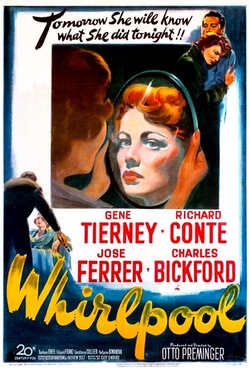
I'm going to cheat again (I said I was going to do this from time to time) and simply link to an old post, one about a film that is also about a powerful man, whose powers, nevertheless, fall shorter than he'd like when applied to a supposedly defenseless woman -- it's Otto Preminger's divisive (check out the comments!) Whirlpool. Here's an excerpt! To entice you!
.
But this film is a bit more than the above. There is a dark sexuality to Whirlpool that, while fairly plain to see, is not actually dealt with as part of the narrative, making the whole thing all the more interesting. When Korvo initially takes Ann out for dinner, he makes a self-deprecating reference to his own less-than-pleasing physical appearance. Later, at the cocktail party, Korvo takes Ann into an empty room and hypnotizes her, with her permission. While hypnotized, Korvo is able to get Ann to perform a couple of innocuous tasks before having her take a seat, holding out his hand to her, and saying, "Take my hand, Ann." But, even hypnotized, she won't do it, and a cloud of shame and anger and disgust passes over Ferrer's face that indicates both the limits of his hypnotic abilities, and what he'd do if those abilities were stronger. An amoral man who believes himself to be ugly will do just about anything to be with a woman as beautiful as Gene Tierney.

Monday, April 13, 2009

Healthy and Adorable

In Otto Preminger's Whirlpool, Jose Ferrer plays a man named David Korvo, and Korvo must be one of the most off-putting characters I've ever encountered in a film. When we first meet him, he's just followed Gene Tierney's Ann Sutton into a department store, escorted by the store detective who has caught her shoplifting. Korvo is a respected customer of this particular store, and also that rarest of things, a famous hypnotist. He gets Sutton out of this particular jam, promptly diagnoses her as a kleptomaniac, and wonders why her husband, noted psychiatrist William Sutton (a miscast, but still good, Richard Conte), has so far been unable to reach the same conclusion.

All of which puts Ann a little bit at Korvo's mercy, as she doesn't want her shameful act of thievery to get out to the public. When he invites her to dinner, she assumes his plan is to blackmail her, and tells him so, although she's also prepared to pay him off. He's offended -- or, rather, he acts as though he's offended -- and reveals that, in fact, all he wants is to take her on as a patient. Yeah, okay, Jose Ferrer. Like I even believe you.

As a slightly off-kilter crime film, Whirlpool is a corker. Tierney is wonderful as a damaged woman who is being used in a few different ways, possibly by more than one man, who finds herself accused of a murder that she's pretty sure she didn't commit. Although she does eventually find herself under Korvo's spell (pun!), she's no dummy, and I love the scene at the high society cocktail party she attends with Korvo, after she's convinced herself that he's no blackmailer (and, in fairness, he's not -- he's much worse). Korvo's natural sliminess and arrogance can't go unnoticed for long, and Tierney's delivery of the line "You're very smug!" is very sharp, and if Korvo was the kind of guy who ever gave a shit, he might have been wounded.

And Ferrer is simply outstanding. It's hard to tell if Korvo intended, from the beginning, to frame Ann for murder. It's clear he intends something other than what he claims, but when he starts gathering the items he'll need to put her in the hotseat, Ferrer plays it as though the ideas are just then occurring to him, and he's just going where the wind takes him. Plus, he's just so amusingly hateful on a minute-by-minute basis, in a way that makes you believe that the characters in the movie can buy into his bullshit, while still allowing the audience to comfort themselves that they wouldn't cross the street to piss on Korvo if he was on fire. If he wasn't on fire, then they'd consider it.

But this film is a bit more than the above. There is a dark sexuality to Whirlpool that, while fairly plain to see, is not actually dealt with as part of the narrative, making the whole thing all the more interesting. When Korvo initially takes Ann out for dinner, he makes a self-deprecating reference to his own less-than-pleasing physical appearance. Later, at the cocktail party, Korvo takes Ann into an empty room and hypnotizes her, with her permission. While hypnotized, Korvo is able to get Ann to perform a couple of innocuous tasks before having her take a seat, holding out his hand to her, and saying, "Take my hand, Ann." But, even hypnotized, she won't do it, and a cloud of shame and anger and disgust passes over Ferrer's face that indicates both the limits of his hypnotic abilities, and what he'd do if those abilities were stronger. An amoral man who believes himself to be ugly will do just about anything to be with a woman as beautiful as Gene Tierney.

Not only that, but there are hints that Ann's relationship with her husband is not all sweet and pure. Early in the film, William Sutton tell shis wife that he just wants her to be "healthy and adorable", and later, when Ann comes home from the cocktail party and drops right to sleep, per Korvo's hypnotic suggestion, her husband starts touching her lightly, and undressing her. Under normal circumstances, this might seem perfectly normal: a woman falls asleep fully clothes, and her husband touches her affectionately before undressing her to make her more comfortable. But coming right after Korvo's "take my hand" moment, and seeing where Preminger cuts off Conte's disrobing of his wife, it's hard not to at least wonder if he plans on benifiting from Ann's fogged out state, where Korvo failed to.

Which sort of begs the question: Why didn't Preminger cast his favorite actor, Dana Andrews, in the role of William Sutton? He would have been more believable as a psychiatrist. For all I know, he wasn't available, but it could also be that Andrews didn't really project warmth, and Conte, on occasion, did, the better to submerge, however shallowly, the possibility that William Sutton had a depraved side to his personality.

Preminger is quickly becoming one of my favorite directors. I've enjoyed a whole passel of his films over the last several months -- Where the Sidewalk Ends, Angel Face, Daisy Kenyon, Fallen Angel -- and each one (barring Daisy Kenyon, a great film, but of a different genre) has taken its place among my top crime movies of the 40s. He had a wonderfully elegant and precise way of moving his camera, and placing it in the best, and therefore only, spot imaginable. See the way the camera reveals a woman sitting on a couch at a crucial moment in Whirlpool, or how much it picks up when Dana Andrews is arguing fiercely with his wife at one point in Daisy Kenyon. He may have been a son of a bitch -- Jean Simmons certainly thinks so, and with good reason -- but he knew how to make a film.

And I'd like to briefly thank Glenn Kenny, whose love of Preminger's films, so fascinatingly expressed both on his old blog (which I won't link to, out of a sense of loyalty) and on his new one (which I will, out of that same sense), clued me in to the fact that Preminger wasn't the flat technician I'd been lead to believe he was. There was more to him than just Laura, which, as good as that film is, is starting to look, in the Preminger filmography, as something of an also-ran.

Followers