Showing posts with label Harlan Ellison. Show all posts

Friday, May 10, 2013

Psychoplasmics: An Introduction


In the February 1987 issue of The Magazine of Fantasy & Science Fiction, in his film column "Harlan Ellison's Watching," Ellison dropped a little announcement of sorts, stating that in his next column he would begin an in-depth study of the film's of David Cronenberg.  Cronenberg, he said, alone among the "wise guy directors currently assaulting us, had "the intellectual virility and talent to become sui generis" and had "become a writer/director with a voice and a view of the world that could be as important, in its own bizarre way, as that of Hitchcock, Ford, Wilder, or Woody Allen."  Ellison's next column was published that April, and it wasn't about Cronenberg.  The problem, Ellison said, was that he was trying to track down Cronenberg's early films -- specifically, Stereo, Crimes of the Future, and Shivers -- not to mention the uncut version of The Brood, all of which, at that time, were rare items.  Ellison next mentioned the project in his July '87 column, but all he said in that case was that he was still working on it.  If you know anything about Harlan Ellison, you'll know that the fact that his following sentence included a status update on The Last Dangerous Visions sort of metaphorically tells the tale of where you might hope to find his completed in-depth study of the films of David Cronenberg.

I bring all this up not to ding Harlan Ellison, really, though he's a writer I've been at war with in my own head for about twenty years now (he is likely unaware of this).  But way back when I was reading Harlan Ellison's Watching, a collection of Ellison's film writing published in 1989, and I came across that original announcement, I thought something along the lines of "Oh good."  So my subsequent trip to that book's index, only to discover that the number of pages in which Cronenberg was referenced tapered off drastically, with no range of pages -- say, 372 - 381, or something -- anywhere to be found under his entry, was quite a disappointment.  But the seed, at least of desire, for such project was planted.  Which is somewhat counterintuitive when you consider that back then I wouldn't have called myself a fan of David Cronenberg.  I would have liked The Dead Zone, and would remember how the ending of The Fly had left me weeping, but other than that I'd found Cronenberg off-putting, weird to no end I could see, plus some other stupid things I can no longer remember.  Yet I thought about him a lot, and was curious enough to be excited to read a long essay about him by a writer I admired.  It would still take a long time for me to get to where I am now.  In case you don't know where that is, my last post should give you some idea.

Undoubtedly, a near-endless number of long essays and career-overviews about David Cronenberg have been written since Ellison bailed on his, but I haven't read them.  There's no use trying to figure out why, mostly because it would just reveal me to be some kind of sourpuss or something, but I can say that it has something to do with not much liking the way most people write about David Cronenberg.  That doesn't mean there's not something terrific out there, but if there is I don't know about it.  And I haven't spent any time at all looking, which sounds smug and dismissive, but in truth it's just, well, the truth.  I might rescue myself from charges of smug dismissiveness by pointing out that I have wanted to write a career overview of David Cronenberg for a very long time, certainly longer than the five months Ellison spent teasing his own, and the specific seed for that, at least the idea to do a career overview of somebody, was planted in 2006, when Dennis Cozzalio began his Robert Altman project.  I really enjoyed that series, and it was exactly the kind of thing I wanted film bloggers, among whose number I could not then count myself, to be writing.  Then later I started this blog, and would sporadically remember that I was free to write this sort of thing myself.  And so, a mere five years later, here we are.

This announcement -- which is what this is, I'm going to write a career-overview series on the films of David Cronenberg, by the way -- functions primarily as insurance that I will follow through.  When I hit "publish" in a few minutes, I'll be locked in.  I have available to me all the films Ellison had to dig for, and while this announcement has been postponed due to certain research materials not arriving when they should have, everything is now squared away.  Which, yes, I'll be using research material.  Sort of.  I'm going to be pulling information and quotes from two reference sources:  Cronenberg on Cronenberg, edited by Chris Rodley and originally published by Faber & Faber in 1992, and then in a revised and updated form in 1997 (I'll be using the 1997 edition); and David Cronenberg:  Interviews with Serge Grünberg, published by Plexus in 2006.  I chose these books, and these books only, because I want only Cronenberg to influence my thinking about his strange films, if anyone's going to.  It's also my plan to read the three novels Cronenberg has adapted into films that I haven't already read, the possibility of squeezing that kind of thing into the course of the series being increased by the fact that I'll be writing and posting these pieces whenever I damn well please.  Not that I expect this to take all that long, but I'm not going to rush it, either.  Each piece will take things as I think they should best be taken, which will mean some films will be written about in pairs -- certain phases of Cronenberg's career allow for this quite smoothly -- while others will stand alone.  There won't be any unifying structure here, unless there is.  I don't know.  Planning is not my strong suit.

But if I don't post this now, I could very well find an excuse not to post it tomorrow, and the day after that, and so on.  So here it goes.  The first post could go up as soon as next week.  I might have another post, which will have nothing to do with David Cronenberg, go up before that, which is the other thing about this -- this series will be on-going, but I won't be neglecting anything else I might want to write about until it's done.  I'll write about Cronenberg when I want to write about Cronenberg, and I'll write about whatever else when I want to write about whatever else.  Not that you care, but I just want to be clear about how this is going to work.

So that's how it's going to work.  Stay tuned.  Ha ha ha to Videodrome or whatever!

Monday, October 3, 2011

The Kind of Face You Slash - Day 3: Not Dead Enough

I wouldn’t write so much about the horror genre if I wasn’t a world-class expert, and it is in that role that I’ve noticed that, along with vampires, zombies are pretty popular these days. Or are still popular, or are popular again. It’s a little difficult to pin down which it is with zombies – with vampires, the modern surge of romantic and occasionally anti-romantic popularity can be traced directly to Anne Rice. With zombies, their very existence can be traced to George Romero, because zombies-as-flesheaters didn’t exist until him, and even he didn’t intend them to be zombies originally, but that’s what people called them, so he went with the flow (the whole “braaaaains” thing doesn’t even come from Romero, but from Return of the Living Dead, which is a damn spoof!). But Romero has always been too much of a cult figure to explain the current mainstream popularity of zombies, and it certainly isn’t the consistent popularity of his subsequent films that has kept the fire burning. So possibly some mixture of Danny Boyle's 28 Days Later, which was heavily influenced by Romero, and Zach Snyder's Dawn of the Dead, which is a remake of...

You know what, it's Romero, even if some people in the audience don't know it. Even the book from which I'm drawing today's stories, The Living Dead edited by John Joseph Adams has the words "When there's no more room in Hell, the dead will walk the Earth", which is obviously Romero's line, written across the back cover. It has no direct reason to be associated with this out of several dozen zombie story anthologies, but there it is, because that line is the true explanation of every zombie outbreak we've read about or seen on film since 1968.

But it's a shame that zombies have come to mean only one thing, undead flesheaters, when they used to have their roots in Voodoo and the occult -- that stuff could still be very interesting and eerie if anybody bothered to do it. Which leads, sort of, to today's first story. It's called "The Song the Zombie Sang" by Harlan Ellison and Robert Silverberg. This one dates back to 1970 -- it first appeared in book form, I believe, in Ellison's collection of collaborative stories called Partners in Wonder, and has been pretty consistently anthologized ever since. For whatever reason, I'm just now getting around to it, despite the long-time love/hate thing I have going with Ellison, and the fact that Silverberg is probably my favorite science fiction novelist. To the point that now, when I think about reading a science fiction novel, I think about Silverberg first, and then go ahead and read Silverberg, to the exclusion of pretty much every other SF novelist you might wish to name. This is my loss, no doubt, but the point is that Silverberg is sort of my ideal when it comes to that genre: thoughtful, imaginative, entertaining, prolific to the point of craziness, but with a variety to his bibliography that most writers with as many books to their name as Silverberg has could not begin to boast. He's even written at least one genuine horror novel, 1973's The Book of Skulls, about a group of college students on a quest to a mysterious desert monastery that supposedly holds the secret of immortality. What seems like a pretty ground-level look at an old SF concept goes pitch black pretty fast, and it's one of the Silverberg novels I've read that lingers most.

Ellison, of course, has written in all sorts of genres, including horror, and if you tried to claim otherwise he would stab your face/sue you (I have to mention here that in The Living Dead, "The Song the Zombie Sang" is credited to Silverberg and "Harlan Ellison®" -- I have never seen that before or since, so Ellison I guess gave up on the idea of trademarking his name, but that's still awesome). None of this changes the fact that "The Song the Zombie Sang" isn't really a horror story. It's a science fiction story that draws from a horror concept to create a world where Nils Bekh, deceased concert musician, can be brought back from the dead to perform. He doesn't shamble out on stage, dripping flesh and bang on paino keys, though. For one thing, his instrument is the "ultracembolo", but also because he's entirely conscious and aware, not just that his name is Nils Bekh and he's expected to perform, but that he's dead, and medical science has reached the, some would say unfortunate, point where death can be eradicated if you should choose, or if the choice should be made for you, and so for two years, any time Bekh has been needed for a concert, a switch is flipped and he's alive again. After, the switch is flipped again, and he's not.

Though I don't know what the actual breakdown of labor was, "The Song the Zombie Sang" feels a lot more like an Ellison story than a Silverberg one, mainly because, for all Ellison's talk about demystifying the act of writing, he's still always been given to praising a good writer as, say, someone who "truly hears the music." This is what the story's about as well, because the central conflict is between, not so much Bekh as the current idea of Bekh, and Rhoda, a young music student who once idolized Bekh but now sees him as a perversion of the art that once meant so much to her:

"...These others, the ones who applaud and grovel and suck up to you, they don't know, they have no idea, but I know. How can you do it? How can you have made such a disgusting spectacle of yourself?...I heard you when I was a child...You changed my whole life. I'll never forget it. But I've heard you lately. Slick formulas, no real insight. Like a machine sitting at the console. A player piano. You know what player pianos were, Bekh. That's what you are."

Whatever salient points Rhoda might be making, it's hard not to think that, as a music student, she's acting a bit big for her britches and the story doesn't disagree. What's interesting to me, though, is that Ellison and Silverberg's idea of a zombie as filtered through science fiction, becomes another kind of robot. Not just robot, but a Frankenstein monster (a concertgoer explains the process that brings Bekh back by to his wife by telling her "about the residual electric charge of the brain cells, the persistence of the motor responses after death" and describing galvanic responses in severed frog legs), which itself was a sort of robot. But in "The Song the Zombie Sang", it's Voodoo, as well, and all this mass of folklore and superstition and horror traditions wound up together to form a zombie story that, in contemporary terms, is much closer to a film like They Came Back, Robin Campillo's film about zombies who are undead, but not much different on the surface. At their core, as human beings, that's something else again, but Campillo's film, and Ellison and Silverberg's story, are both about the sadness of losing that humanity, and being aware of it. And both lead to the same conclusion.

Compare all this with Dan Simmons's "This Year's Class Picture", and you have...well, not that far from the same idea, really, but in the case of Simmons's story, it plays out against a very Romero-ian backdrop. This is no doubt because Simmons originally wrote "This Year's Class Picture" for Still Dead, editors John Skipp and Craig Spector's follow up to their splatterpunk classic Book of the Dead, itself an anthology that was specifically intended to be made up of stories that existed in the zombie apocalypse universe created by Romero in his, then, three Dead films. Which means “This Year’s Class Picture” is a flesheater story – that’s really all that’s meant by keeping it in Romero’s universe – but at the time that was still novel. Even so, flesheater story this may be, there is still virtually no flesheating in it. There is, in fact, only one non-zombie character, and that is Miss Geiss, an elementary school teacher of thirty-eight years who, despite the gruesome collapse of civilization, is determined to carry out her duties for as long as she can, even if her students are all moaning, undead cannibals.

This is the set up for one of those gleefully – which is not to say “any good at all” – tasteless splatterpunk stories from the 1980s, and unfortunately beyond, whose ostensible purpose was to expose the unspoken horrors of everyday life and turn over the rock of society to reveal the detestable insects of our psyche. Or rather, this seems like the set up for one of those stories, but that’s not what it is at all. Simmons does mine his premise for some cheap gags involving school lunches and so forth, and he takes a surprisingly grim shot at children when he has Miss Geiss note that trying to teach zombies wasn’t too much of a step down from what she’d been used to. Otherwise, though, “This Year’s Class Picture” is surprisingly heartfelt.

I must say, I approached this story with some trepidation. In a writer/reader sort of way, Dan Simmons and I go way back. The connecting thread is, well look at that, Harlan Ellison, who somewhere or another sang Simmons’s praises, this being long before Simmons had anywhere near the success he currently enjoys. Ellison discovered Simmons at a writer’s workshop at which Ellison was a featured instructor – Ellison flipped for Simmons’s horror story “The River Styx Runs Upstream”, and yelled at him until Simmons promised to be a writer forever (the story of their meeting is related twice, once by Ellison and once by Simmons, in the introduction and forward to Simmons’s collection Prayers to Broken Stones, and the telling are notable for their differences in tone). Ellison’s words led me to seek out Simmons’s first novel, Song of Kali, which I must count as among the very best horror novels, certainly right near the top of the best modern horror novels, I’ve ever read. Also in the pro column is Summer of Night, a long horror novel about growing up in the 60s that beats Stephen King at his own game; The Hollow Man, about the awfulness of actually being able to read minds (a novel whose tone and general outlook is not too far away from, he look at that, Robert Silverberg’s similarly themed Dying Inside); and Hyperion, the first – and only one I’ve read so far – of Simmons’s hugely ambitious and already classic science fiction series. However, there’s also Carrion Comfort, which, great title or no, Bram Stoker Award or no, is a hellishly turgid slab of a book that would reveal Simmons’s greatest weakness, which is his desire to dump every last scrap of research he’s done for a novel into that novel, so that you, the reader, know that he wasn’t simply dicking around that whole time he was at the library. See also Darwin’s Blade (which ends with a sniper duel, though, so it’s not a total write-off) and Fires of Eden, a book that seems to have followed from discovering that Mark Twain once spent a lot of time in Hawaii, and wondering if you could take that seed and grow it into an especially bad Michael Crichton novel (the answer, improbably, is yes).

His more recent work, such as the acclaimed novels The Terror and Drood, I have no opinion on, though I’m not so far removed from having read Simmons’s great stuff that I no longer have any interest in reading them. And a story like “This Year’s Class Picture” does help remind me what kept me reading in the first place. As I implied before, this isn’t a story about easy shots or caricatures. Feeling ungenerous as I was when starting the story, I assumed Miss Geiss would be portrayed as some ridiculous strict spinster type, who hated joy because she’d never felt any and wanted the world, and I guess her new zombie students, to pay for that. But no, she’s a lovely woman who, while alone now, and possibly not a woman with a rich romantic history, has nevertheless lived – she tries to teach her students geography by showing them old vacation slides of places she loved but would now never be able to revisit – and anyway, virgin or not (the story never says outright, one way or the other, and provides nothing more than hints that this is even something to think about), she is not mocked for that, or sneered at. This choice is not one the splatterpunks would have understood too well, because if we can’t express disdain for those whose existences aren’t rock ’n roll enough, then what are we even doing this for?

But before he was able to write professionally full-time, Simmons was a teacher, and the daily aggravation, frustration, and the love and commitment, of that profession is all over “This Year’s Class Picture.” If it builds on anything from Romero’s early trilogy – and I suppose what I’m about to say might count as a spoiler – it’s Bub, the zombie who learns from Day of the Dead, and in this way Simmons was able to take an absurd and seemingly hopeless situation of his own devising and make me believe that maybe, in the world of the story, in Romero’s universe, what Miss Geiss was doing was actually worth doing. The fact that he’s able to do this while also including a massive zombie attack/massacre proves that Simmons either knows the market, or is good at that whole layering thing. I’m going with the latter (well, both) because elsewhere in “This Year’s Class Picture” is a comparison of the zombie children with the Galvanic principles also referenced in “The Song the Zombie Sang” and, you know, Frankenstein. Simmons, like Ellison and Silverberg, hasn't forgotten where zombies came from. And somehow, his story manages to find a kind of light within the source of its despair.

Thursday, August 12, 2010

Cat People: Both Parts Must Die

.
In theory, I do not mind remakes. My thinking is that remakes are essentially no different from the restaging of plays, except that they cost a lot more, and are frequently in no way necessary. Even so, if a filmmaker can bring something interesting to an already-told story, then why kick up a fuss? Over the years, we've had at least two excellent versions of Invasion of the Body Snatchers, David Cronenberg has improved on Kurt Neumann's already highly entertaining The Fly, and John Carpenter successfully returned to the source material, a novella by John W. Campbell, that was largely ignored in Howard Hawks and Christian Nyby's tremendous The Thing from Another World. So there's reason to be at least not quite so relentlessly negative when another remake is announced. Wait and see, be positive, all that shit. (Furthermore, the arguments against any and all remakes tend to sound like thoughtless and impotent rage. One I hear a lot is that the remake will rake in a truckful of cash, and all these young kids won't even be aware of the original, but I got news for you: superior the original may well be, but those young kids wouldn't have given a damn about it anyway.) Of course, there are any number of films -- like 2001, for instance -- whose hypothetical remakes would probably cause me to vomit in annoyance, but my exception for those films, I have to admit, is essentially arbitrary, and hypocritical.
.
Where things get really hairy, however, is when the filmmaker behind the remake begins talking shit about the original. Even if the original is bad, it's a classless move, and frequently the original has at least something going for it, or nobody would want to remake it in the first place. In his collection of film essays and criticism, Harlan Ellison's Watching, an enraged (of course) Harlan Ellison, speaking on the topic of homage, throws out this:
.
Was any attempt made by concerned parties, to hire a spiritualist who might pierce the veil and get Val Lewton's reaction to writer[sic]-director Paul Schrader's quote in the May-June issue of Cinefantastique, just prior to release of Schrader's remake of the 1942 Lewton-produced Cat People, that "Val Lewton's Cat People isn't that brilliant. It's a very good B-movie with one or two brilliant sequences. I mean, we're not talking about a real classic"?
.
I first read that passage well before I'd seen either version of Cat People, and for whatever reason, at the time, Schrader's words came off far more snide and harsh than they do now. I mean, he does say the original is "very good", and that it has "brilliant sequences". But what particularly sticks in my craw now is the patronizing attitude towards B-movies, which I think a man like Schrader, who has a deep and abiding love for film noir, should have gotten past in the 1960s, at the latest. What, does he think the only film noirs that are truly great are those that were afforded A-movie budgets? In any case, I would be very curious to hear Schrader's thoughts on the subject now, given how history has not only elevated Lewton's Cat People, but relegated his remake to the bargain bin.
.
Of course, history often gets things wrong. I've read enough great novels by forgotten writers to know that. But history was pretty much on target this time around. Personally, I would rank Lewton's Cat People somewhere in the middle of the nine horror films he produced (with massive creative and stylistic input) between 1942 and 1946, but that should be viewed less as a middling take on the film than as a testament to the very high regard in which I hold Lewton's work as a whole. Cat People was the first horror film Lewton produced at RKO, and with it the template was already clear: psychologically based horror, whether it featured supernatural elements or not, with sharp, literate writing, gorgeous, shadow-cloaked cinematography, moral complexity, ambiguity, and powerful sequences of suspense and terror. Lewton didn't cut his teeth on horror, and made these films because he was assigned to; he approached the genre as an outsider, a state of affairs that often yields fascinating results (see also Tom Alfredson, whose first horror film was the exquisite Let the Right One In, the American remake of which is coming soon).
.
Summarizing Cat People at this stage strikes me as a bit pointless, and besides I hate that shit, but suffice it to say it tells the deceptively simple story of the sexless marriage of the mysterious and ethereal Irena Dubrovna (Simone Simon) and lunkheaded good egg Oliver Reed (Trent Smith). The "sexless" part stems from Irena's considered belief that her Serbian ancestors were evil witches, who were able to take the form of cats, primarily (only?) when in the throes of sexual passion. So because she loves Oliver, she refuses to have sex with him. Oliver takes this all pretty well, only taking the step of referring his wife to a psychiatrist (the great Tom Conway, who had all the on-screen class and charm of his more famous brother, George Sanders, but none of the off-screen assholism). Though Oliver's a sweet guy, he eventually drifts, after having a touching conversation with his co-worker Alice (Jane Randolph) about how, until his relationship with Irena, who he loves, he'd never been unhappy.
.
Lewton, Tourneur, and screenwriter DeWitt Bodeen keep the truth of Irena's condition -- is it psychological, or is she really what she says she is? -- ambiguous, almost to the end (all the way to the end, according to some, but it's pretty hard, lack of on-screen cat transformations notwithstanding, to psychologically explain away certain moments, and sounds), and one of the things that's so fascinating about the film, and about the performances of Simon and Smith (some would say he's wooden, but I say he's playing the character) in particular, is that often the film plays, or could have played, straight, as a snapshot of a crumbling marriage, and of Irena's mental breakdown, the kind of breakdown that would warn all concerned parties to hitch the next train out of town, before she starts shredding everything around her, cat or not cat. This is a result, no doubt, of Lewton making a horror film only because he had to, and making it about cat people because RKO already had the title. Later Lewton films would be more straightforward (though no less complex) entries into the genre, but with Cat People he was injecting his real-world concerns, interests, and phobias (he didn't like cats, or being touched) into material that, in less sophisticated hands, would have played out as a half-assed, low-grade pulp knock-off of the kind of werewolf movies that were popular at the time.
.
Which is sort of funny, when you think about it -- as I said, Cat People was handed to Lewton by RKO, who said "Here's your title, now make a movie." A lazier producer would, without question, have told a thinly veiled werewolf story. That's not the story Lewton told, but guess who did tell that story? Paul Schrader. In his film (written by Alan Ormsby), Nastassja Kinski's Irena doesn't know about her true nature, and has to learn, Lawrence Talbot-like, about the family curse that dooms her to a life of cat-transformation any time she meets a guy she'd like to do sex to. Except that, apparently, this has never happened to her before, since not only is she a virgin, but she's never turned into a cat before, which means she's never experienced sexual desire before. From the standpoint of narrative logic, this makes no sense. Whatever Lewton's reasoning was (and I strongly suspect his reasoning had nothing to do with my current point), having his Irena know full well what she was not only made her a much more interesting character, but also obliterated a whole host of storytelling problems. Schrader's film rejiggers quite a few elements of the original story, saving it from being a "pointless" remake, but it perhaps should have either rejiggered fewer, or more. I can't tell which, but Schrader being Schrader, and 1982 being 1982, there was no way anyone involved in the remake was going to dump the sex-makes-her-a-vicious-cat angle. So maybe lose the idea that she's not aware of it, but of course that would have meant losing the character of Paul (Malcolm McDowell), Irena's brother, whose entire purpose, from what I can tell, is to be the one who tells her about their family origins. Well, that, and to introduce a nonsensical incest subplot (the only way they can have sex and not becomes cats is to have sex with family members, you see), which isn't consummated in any case, a fact that mitigates the film's already fairly high sleaze factor by a smidge.
.
But, you know, the thing is, Schrader's Cat People isn't really all that bad. It's not. It is, in fact, a good deal better than I remembered. Kinski is wonderful, McDowell is very good, there's a nice energy and pacing in the first half or so, and, occasionally, strong images, such as those that accompany the astonishingly Last Temptation of Christ-like opening credits, and the shot of blood slowly splashing over Irena's white shoes, on its way to a floor drain. Also, the panthers in this film are very striking, which I mean sincerely. But it's still just a sexed-up, 1980s-style tweak on the werewolf legend, and, in fact, one could easily say that Paul Schrader's Cat People is just Tony Scott's The Hunger, but for werecats. Or rather, one could, if not for the fact that The Hunger came out one year later. So facts have defeated that point, but one thing I think can't be argued is that Schrader's film broke no new ground in horror cinema, and in a number of ways it's in lock-step with the formula of the genre as practiced in the 1980s. For example, Ed Begley, Jr. has the thankless role of the unfunny funny guy, which means you know he's doomed, and indeed he is. There are also a great many tits, which I have no problem with, and even, ahm, blooming from this particular story they come off as gratuitous. It's also a fairly gory film, so with your stock victims, your tits, and your gore, you have all the trappings of a more or less typical 80s horror film. No trails are blazed, whereas that's exactly what Lewton was doing in 1942. Even back then, no one was pulling as far back from genre tropes as Lewton was, and no one was creating so much dread by showing so little. And that restraint, of course, was just the tip of the iceberg.
.
Which, again, I have no problem with -- the tits, gore, and lack of trailblazing, I mean -- and I wouldn't even bring it up (okay, I might, but not like this) if not for that Schrader quote in which he condescends to B-movies. Words hurt, Paul Schrader, and if you're going to express an ignorance of the true meaning of the term "B-movie" -- an ignorance I can't believe you ever actually possessed, even in 1982 -- you're probably going to be called out when you make one, which is what your Cat People is, at least going by your definition of "B-movie", which is very narrow and reductive anyway. So "trashy", I guess, is what both you and I are going for here. And no, I don't believe Paul Schrader will ever actually read this. I just got caught up in things.
.
The other funny thing about all this is that you can sort of sense Schrader straining to bust out of those trashy binds, and that's not a compliment. One thing about B-movies, whether they were trashy or not, is that they often had a sense of pace, something that completely deserts Schrader's Cat People in the last half hour. The film shrugs off the sense of narrative fun and excitement it had been riding, in favor of a last quarter that just drags interminably, all to make a point about being trapped by sexual desire, which was already there anyway, and was already there in the Lewton film, too.
.
Again, though: Schrader's film isn't that bad. And I wonder, if it hadn't been a remake, if history wouldn't have been kinder to it (I'm sure it has its rabid defenders, but it's unlikely they'll turn the tide). But of course, it is a remake, and that's the curse of of such films -- without the film being remade, the remake would never exist, would never even be conceived of, and unless what's being offered is of especially high quality (a not inconceivable notion, as I've shown), the remake will come and go in a blink. Profitable, maybe, but not much else can be hoped for. It's a tough road to hoe, when you think about it, especially on the screenwriting end, which must be a just about entirely thankless task. But give it a shot anyway, if you happen to feel like it. I won't bitch. Just, you know...show some respect.
.

Thursday, January 7, 2010

Kreativ Blawgging

.
Just yesterday, Neil Fulwood, of The Agitation of the Mind nominated me for a Kreativ Blogger Award, which, I must say, is awfully decent of him. This came totally out of the blue, and in addition to being flattering, it also gives me an excuse to put off my 100 Favorite Film list for another day or so (I'm not done, so that's good). There are, you see, stipulations for accepting this reward. Please to see below:

1. Thank the person who nominated you for this award.

(Thank you, Neil!)

2. Copy the logo and place it on your blog.

3. Link to the person who nominated you for this award.

(Done!)

4. Name 7 things about yourself that people might find interesting.

5. Nominate 7 Kreative Bloggers.

6. Post links to the 7 blogs you nominate.

7. Leave a comment on each of the blogs letting them know they have been nominated.

Okay, seven things about myself that people might find interesting. Eek. Well, okay.

1. I have written two novels. Neither has been published, and neither has even been subitted to a publisher. One of them, a horror novel I wrote in high school, does not deserve such treatment, but the other one is not a total failure. It's a Western called Wake the Chinaman (the title is adapted from a line in Rio Bravo), and the basic plot -- bandits rob a bank, shed blood, are pursued by a posse -- could not be more basic, but as I went along I found myself branching out into subplots and character histories that I'd never intended when I began, and some of that stuff does, I believe, give the book some life. I even experimented a little, not with language, but with digressive chapters, such as one that advances character (and maybe even plot, though I can't remember) by following a green-glass bottle that is passed from one character to another. No, the chapter is not told from the bottle's point of view, but it serves as the connective tissue. Also, I'm very proud of the climactic shoot-out. However, the good stuff, or the stuff I think is good, doesn't really get going until the second half of a manuscript that is over 900 pages long. Yeah, I know, but shut up. The point is, re-writing the thing in order to try and get it up to snuff is a task so daunting that I don't even like thinking about it.

2. Once, I woke up from an Ambien-induced sleep, and experienced genuine madness. This is true. I was in the hospital for something that required painkillers, and those painkillers were, quite simply, wonderful. But after a while, I realized I was requesting painkillers that I didn't actually need, so I thought it wise to stop that. The night I did stop, I couldn't sleep, so the next night they gave me an Ambien, and in the middle of the night I woke up, because the TV was on, a nurse had just entered, and left, the room, and so on. So what I did was, I got out of bed, and, in my mind, I was doing...something. Something that I believed would benefit the Carter Family, which in my mind was a singing group. And which is, indeed, a singing group, but I remember differentiating, in my psychotic state, between that one, and the one I was trying to help. And the thing I was doing to help them was remove the IV from my arm. It was actually right in my wrist, in that big vein under your palm, and I took that sucker right out, all the while wearing a big, fogged-out grin (or so I remember). Shortly afterwards, I snapped out of it, and noticed blood on the floor and on my hands, and I stood there dumbstruck, thinking, "I'm crazy. I'm a crazy person." Thankfully, and through dumb luck, I did a pretty clean job of removing the IV, and all the nurses had to do was put me back to bed and tell me to chill the fuck out. But I still remember walking out of my room, to the nurses' station, holding my hands out in front of me, and saying something to the effect of "I don't know what just happened." I don't think I knew what caused this until the next morning.

3. I once witnessed a near-fatal drowning. My wife and I were at the beach with some friends, and one of those friends and myself were standing near the edge of the surf, looking out on the ocean. It was a bit of a windy, turbulent day, and there weren't many swimmers out, but there was a cluster of them about fifty to a hundred yards in front of us. Both my friend and I heard some shouting over the sound of the waves, and it pricked in my mind early that they might be calling for help, but I couldn't tell. At about the same time, my friend, some other on-lookers who were near us, and myself all clued in that that was what they were calling for, and the other on-lookers already had their phones out. The short version is that this young girl started to drown, a group of guys went out to save her, and then they got caught in the same riptide. The emergency folks who got there were facing the same riptide, but fortunately a couple of surfers happened by, and the cops told them to get out there with their boards, which both surfers instantly did, and they, along with some EMTs, helped haul everybody back in. The young girl was still unconscious when I, and my group, finally left, but we did see on the news that, eventually, she was okay.

4. I once witnessed a near-fatal car accident. My wife and I were travelling home from visiting relatives, and I had to use the little girls' room, so she was pulling off the freeway, onto an exit, so I could hit the loo. On the off-ramp, my wife spotted a car coming up fast in her rearview mirror, and just as I was about to say, "Oh, he's probably...", this car came flashing past us at, literally, about 100 mph. Up ahead, we saw him go through the guard rail, at the turn, like it was cooked spaghetti. Then we saw him hit a tree on the other side, and the car hopped up in the air, flipped over, and came down on its roof. We saw stuff flying from the car that I was convinced were corpses, until we stopped and saw that it was just clothes -- there were packed suitcases in the trunk. The driver, meanwhile, eyes as big as saucepans, was dragging himself from the wreckage. His shirt was torn, there was a cut on his chest, and he was clearly out of it mentally -- either from shock, booze, drugs, or some combination of the three -- but otherwise he appeared to be fine (the car was dead as shit, though). As with the drowning, other people had pulled out their phones and were dealing with the situation before we got there, so my wife and I just went on our way. Those packed bags and wild eyes have always made me wonder where that guy was going, if he was running from someone. It wasn't the cops, because they would have been right behind him. So who?

5. I have a phobia about driving, and therefore I do not drive.

6. My wife and I were married in Vegas, on the observation deck of the Stratosphere. Not that interesting, maybe, but we liked it.

7. I once met Harlan Ellison at a book-signing. He was a hero of mine at the time, and he was as gruff and funny as you might expect, although in retrospect I wonder if some of that gruffness wasn't for show. His audience expected it of him, so he had to do it. Some of it seemed forced. But he was very nice to me overall. One of the books I brought for him to sign was an original Ace Double science fiction book, with Ellison's novel The Man with Nine Lives on one side, and his collection of stories, A Touch of Infinity on the other. At the beginning of the day, Ellison said he would not personalize any of his signings, but when he opened that book he saw that the inside cover had been stamped with the name "Neil Olinoff". That was the previous owner, and Ellison asked if it was me. I said no, my name was Bill, so he crossed out "Neil" and wrote "Bill". The "Olinoff" stayed, however.

Now, to nominate. The following seven bloggers completely and honorably represent, and define, the word "kreativ". Each of these bloggers (and more, but I could only choose seven!) writes with great skill, wit, intelligence, and originality about films, and it's a pleasure to read each of them.
.
1. Greg at Cinema Styles
.
2. Dennis at SLIFR
.
3. Glenn at Some Came Running
.
4. Marilyn and Rod at Ferdy on Films
.
.
.
7. Arbogast at Arbogast on Film
.
So that's it. When I get a chance, I will leave comments at each of those blogs informing them of their newfound prestige. Meanwhile, thanks again, Neil!
.
UPDATE: I'm cheating, and adding an 8th kreativ blawg. This one is called The Thriller in a Manila, and it is the only bad writing blog I'm aware of. Hosted by Cliff Knoetz (known to some as the mysterious "Noumenon"), it's a very unusual site.

Thursday, October 29, 2009

The Kind of Face You SLASH!!! - Day 29: That New Being, the New Master

If I wanted to, and didn't mind reading and writing exclusively about vampires (I would), I think I could very easily get a whole month's worth of posts out of the book pictured above. As you can see, it advertises itself as "The Most Complete Volume of Vampire Tales Ever Published". I have no idea if that claim is true, but if it isn't I'd very much like to meet the book that makes it a liar. This thing is over 1,000 pages long (including a 100-some page bibliography of vampire fiction), and it includes stories by virtually everybody: Bram Stoker, Clark Ashton Smith, Clive Barker, Richard Matheson, Lafcadio Hearn, Charles Beaumont, Steve Rasnic Tem, F. Paul Wilson, Harlan Ellison, Guy de Maupassant, Arthur Conan Doyle, Anne Rice, Manly Wade Wellman, Vernon Lee, J. Sheridan Le Fanu, and on and on. It's a brand new book, and instantly essential. The only drawback that I can see is that the print on each page is divided into two columns, like magazine print, or the old pulps and serials. On one hand, this keeps the book from being something like twice the size it is already, but on the other hand stories that appear to be only fourteen pages turn out to be quite a bit longer. As a result, what with time is always of the essence with me this month and everything, I wasn't able to cram in all the glorious reading I'd fantasized about while poring over The Vampire Archives' table of contents. Besides which, reading fiction in two columns just jacks with my brain.
.
I did manage two stories, which really is close to my limit, but the first one, Harlan Ellison's "Lonely Women are the Vessels of Time", is a bit of a throwaway. Short and one-dimensional, pretty much by design, it shows Ellison on auto-pilot scolding mode. It's about a guy named Mitch who, following the funeral of a girlfriend he didn't much like, goes to his local bar to pick up chicks. The girlfriend committed suicide, and while he tells himself he shouldn't care, because she was just supposed to be a one-night stand who managed to hang around for a while longer, Mitch does feel a bit sick to his stomach about the whole nasty situation. Still, he does end up going home with a woman, and the book is called The Vampire Archives, so there you go.

"Lonely Women are the Vessels of Time" is one of Ellison's "loneliness" stories; he's written a number on that theme, and this one isn't a patch on, for instance, "Lonelyache". The sub-theme of "Lonely Women..." is how some people do things out of loneliness that, in fact, make other lonely people even lonelier -- in this case, men who troll for one-night stands with women who are vulnerable, but want more, and then don't get it. Fine, but I wonder if the story is so short and shrug-worthy because Ellison doesn't drink alcohol, and never has. Most of the story is set in a bar, and while I'm sure Ellison has been in bars, I think you need to at least have been a drinker at some point in your life to get bars. Or maybe not -- they're actually fairly uncomplicated, when you think about it. But whatever the reason, Ellison just wasn't feeling it here, I don't think, and perhaps was just desperate to graft some kind of story onto that title (which, not to pile on or anything, feels forced) before he forgot it. He didn't like the idea that three months down the line he'd be thinking, "What the hell was that title? It was so good. Something like, 'Lonely Women are...the Vases of Hope'. No, that's shit. 'Lonely Women are Like Kettles of Sadness'. Oh, Jesus, I hope that wasn't it. I was telling everyone what a great title I'd thought up." You get the idea.

The other story I read was Guy de Maupassant's "The Horla". Like "Lonely Women are the Vessels of Time", "The Horla" is only kind of a vampire story. Neither one features the traditional be-fanged, bloodsucking fiend of the night that we're all used to, but both feature creatures that come in the night and drain their victims, or control them, or both. In Ellison's story, sex is at the root, but in "The Horla" something much more complex is going on. The story is told in the form of a diary kept by an unnamed man who, when we first meet him, is actually quite upbeat, marveling at the glory of the new day and the beauty of his home. This is significant, because in the next entry he's suddenly become ill. Not only is he sick, but his spirits have plummeted:
.
Whence come those mysterious influences which change our happiness into discouragement, and our self-confidence into diffidence? One might almost say that the air, the invisible air, is full of unknowable Powers whose mysterious presence we have to endure.
.
He's genuinely perplexed by his current state, particularly after his doctor informs him that (of course) he can find nothing physically wrong with him. His physical condition remains unchanged for almost a month, and his mood, if anything, worsens. At one point, he even takes what he hopes will be a refreshing walk through the woods around his home, only to find himself plagued by the belief that something terrible, but unseen, is hunting him. After this low point, he resolves to take a trip to Mont Saint-Michel, from which he does indeed return feeling much better. While there, he meets a monk who, when questioned about a particular hill on which stands a strange and ancient monument, relates to our narrator a series of legends that involve the hill, and the area. After being struck by one legend that involves a mysterious shepherd who is followed by two goats with human faces, he asks the monk if he believes the story:

"I scarcely know," he replied, and I continued: "If there are other beings beside ourselves on this earth, how comes it that we have not known it long since, or why have you not seen them? How is that I have not seen them?" He replied: "Do we see the hundred-thousandth part of what exists? Look here; there is the wind, which is the strongest force in nature, which knocks down men, and blows down buildings, destroys cliffs and casts great ships on the rocks...have you ever seen it, and can you see it? It exists for all that, however."

Though our narrator returns from his trip feeling better, this doesn't last. Shortly, he finds himself tortured in his sleep by uncertainty, and the dread that there is someone, or some thing, harassing him at night. His previously full water bottles are drained dry the next morning. Is he drinking the water, but not knowing he's doing it? Eventually, he sets up a string of experiments, and the results all seem to point to some invisible stranger. And whatever it is is not merely taunting him, or toying with him:

.Last night I felt somebody leaning on me and sucking my life from between my lips. Yes he was sucking it out of my throat, like a leech. Then he got up, satiated, and I woke up, so exhausted, crushed, and weak that I could not move...

And later...

Picture to yourself a sleeping man who is being murdered and who wakes up with a knife in his lung, and whose breath rattles, who is covered with blood, and who can no longer breathe and is about to die, and does not understand -- there you have it.

Our narrator will fluctuate between believing that some supernatural creature is overtaking his life, and believing that he has gone, or is quickly going, completely mad. Eventually, he will be convinced of the former, when he feels his body being entirely controlled by this invisible thing, this "horla". Though he can still think for himself, and write in his diary, his every other action is dictated by someone else. If he wants to stand up, he will stay seated. And feeling no particular personal urge, he will nevertheless find his body compelled into the garden to eat strawberries.

Finally, he will deduce that what has possession of his body -- if not his mind -- is a new, or rather previously unknown, form of life:

We are only a few, so few in this world, from the oyster up to a man. Why should there not be one more, once that period is passed which separates the successive apparitions from all the different species?

...Why not other elements beside fire, air, earth, and water? There are four, only four, those nursing fathers of various beings! What a pity! Why are there not forty, four hundred, four thousand? How poor everything is, how mean and wretched!

What's so interesting about this aspect of "The Horla" is the fact that it plays into the question of what the evolutionary life-form will be that eventually pushes out human beings. This is a subject more often dealt with in science fiction -- Theodore Sturgeon's More Than Human, for example, or Arthur C. Clarke's Childhood's End -- but here it joins up with the vampire myth, and drives our poor narrator absolutely bonkers. One of the things de Maupassant was pulling from to combine these ideas was the supposedly "scientific" (and then new) work being done in the fields of hypnosis and "mesmerism". The narrator sees such an experiment successfully executed, or so it appears, at least, and it's this experience that begins to lead him away from a belief in his own madness. The most important thing the monk in Mont Saint-Michel says to him is that no one has seen even one hundred-thousandth of what exists. Why can't this "horla" -- as he claims it calls itself -- be part of that?

Ordinarily, when dealing with horror fiction that aims for psychological ambiguity -- is the supernatural in the story real, or is it all in the narrator's disintegrating mind? -- I fall on the side of the monster, if for no other reason than that, in such stories, monsters are more interesting to me. But "The Horla" tips the scales more towards the narrator's madness than most such stories. Obviously, for starters, all the information we get about the narrator and his situation is from his diary. We have no other witnesses, we are privy to no other opinions of the narrator, or anything. All we see, we see through his eyes. Not only that, but de Maupassant uses the idea of mirrors and vampires in a way that perhaps tells us more about the man looking into the mirror than about what he's seeing. And that ending...the narrator's final plan (not to mention his plan B) for dealing with the horla, when viewed objectively, is the work of a total madman. The tone of de Maupassant's prose, of the narrator's voice, at this point even becomes a little manic. Which of course it would be, as would anyone's whose body was being controlled by one of those horla things, but...

Yet, I can't shake the importance of the story's beginning, that first diary entry: they're the words of a man in love with life, his life in particular. And then suddenly it all begins to crumble. Why? If his fate is the result of a psychological break, what in the world brought it on? There's no clue. So as far as motivation is concerned, the horla has it all, even if it doesn't exist. Based on what we know, the supernatural reading of "The Horla" actually makes some degree of sense. Total madness makes no sense at all. But really, when does it ever?

Tuesday, October 20, 2009

The Kind of Face You SLASH!!! - Day 20: Her Flesh was Like Putty and Tasted of Soap

If memory serves, the first time I ever came across the name Tom Reamy was in the "Further Reading" appendix to the wonderful, essential book Horror: 100 Best Books, put together by Stephen Jones and Kim Newman. The Reamy book in question that made that list (and the "Further Reading" list to Jones and Newman's follow-up -- and equally essential and wonderful -- Horror: Another 100 Best Books) is called San Diego Lightfoot Sue and Other Stories. As I've mentioned before, I'm attracted to books of horror fiction, or horror stories, that don't sound like horror, so that one stuck in my mind, though it would be many years before I actually got my hands on a copy.

The idea behind the Jones and Newman books is that one hundred writers are asked to pick, and write a brief essay on, their favorite horror book -- anthologies, single-author story collections, novels, etc. Although I don't doubt that Reamy's book isn't alone in having this distinction, I find it slightly curious that it makes both appendices, but wasn't picked for any of the now two hundred essays that make up both volumes. To me, this indicated that, even with all the obscure authors and books being brought back to the forefront in the essays, Reamy's book was still hanging out on the very fringe. Not forgotten, entirely, but getting there. This idea intrigued me further.

One of the reasons for this continued obscurity, if not the reason, is that, sadly, Tom Reamy died far too young, with only two books to his name. One is San Diego Lightfoot Sue, and the other is a novel, published after his death, called Blind Voices. According to his surprisingly lengthy Wikipedia entry, Reamy died, at age 42, of a heart attack, and was found slumped over his typewriter, seven pages into a new story. That last bit sounds apocryphal, like the story of Blind Lemon Jefferson being found frozen to death, clutching his guitar, but I hope it's true. "Hope" sounds like the wrong word, but you know what I mean.

In any case, I finally got myself a copy of San Diego Lightfoot Sue. It includes what then (1979) would have been a ubiquitous introduction by Harlan Ellison, which is both distressingly focused on Ellison, and astoundingly laudatory of Reamy and his work -- both typical features of Ellison's introductions to other people's books. Ellison focuses, and saves his highest praise, for every story in the book -- "Twilla", "San Diego Lightfoot Sue" and "Under the Hollywood Sign" especially -- other than "Beyond the Cleft", which is the one I chose to read. Ellison mentions it, pointing out that he, Ellison, kinda sorta gave Reamy the idea, and he says it's "terrifying", but that's more or less it. So I'm on my own.

"Beyond the Cleft" is an "evil child" story. There are all sorts of these, ranging from the child-as-cold-murderer of The Bad Seed to child-as-Satan of The Omen, to children-as-packs-of-ravening-cannibals. "Beyond the Cleft" belongs to this last category, and it begins, after the briefest of prologues, like this:

At 2:17 PM on Thursday afternoon, Danny Sizemore killed and ate the Reverend Mr. Jarvis in the basement of the Church of the Nazarene in the township of Morgan's Cleft, North Carolina.

Along with being, I think, a pretty effective "grabber", as they used to call them in the business, that sentence gives you a pretty good sense of Reamy's tone and style, at least in this story. Outside of the dialogue, of which there's not a hell of a lot, the story reads almost as non-fiction. It's entirely dispassionate, nearly clinical, and all the better for it. Deaths are sudden, and not lingered over. A major character's fate is thrown away, so that the fictional death effects us, in one very small way, as a real death -- in other words, as an actual stoppage of something. We are not following this person anymore, because this person no longer exists.

Everything happens at 2:17 PM on Thursday afternoon, or rather, everything begins at 2:17 PM on Thursday afternoon. Apart from the murder of Reverend Jarvis, at the nearby schoolhouse a mass of children attack and slaughter many of their teachers, and even their fellow students -- those that haven't also been infected anyway. Like pretty much all stories that involve people suddenly going wild and attempting to consume their brethren, there is some sort of transmittable disease involved, although the specifics of it -- even much that might be called "general" about it -- is left to our imagination. At nearly thirty pages, I'm tempted to think the absence of any sort of pay-off is a fault of "Beyond the Cleft", but any time I say such things to myself, I have to quickly ask, "Well, what kind of pay-off would satisfy beyond the often phony sense of closure that mars so much modern horror literature?" Since I almost never have an answer to that, I'm forced to slink off in embarrassment.

Like "Bindlestiff", yesterday's Depression-era werewolf story, "Beyond the Cleft" is a period piece, set sometime in the 1920s or 30s, in a part of North Carolina that Reamy goes out of his way to tell is deeply secluded:

After a brief consultation with the other families, Cleatus Morgan [founder of Morgan's Cleft] decided this rich and fertile valley, though practically insulated from the outside world, was a definite windfall. So they settled in and prospered by their own standards. Indian Creek, which ran pure and bright and teemed with fish, provided power for a gristmill; the valley and surrounding heights were thick with Virginia deer, wild turkeys, dove, and quail. Little was needed from the outside.

From a plot standpoint, this choice of place and time serves to make the lack of outside help, or contact of any kind, easier to swallow. With the small populations of places like Morgan's Cleft, it's also easier, and quicker, to get across the sudden decimation of an entire community. While we never see Morgan's Cleft at its peak, Reamy does still manage to drive home the idea that an entire town, once comfortable, is being rapidly and inexplicably destroyed.

There's something else, though, something more at work when you consider that Reamy set his story some forty years before he actually wrote it, and set it in a secluded environment. The last lines of the story -- which I hesitate, mostly out of habit, to reproduce here, but you'll be able to infer the content -- make it clear that whatever has caused this living horror to take place isn't done yet, and is, in fact stronger. So what does that mean, forty years, or seventy years, later? If no one outside of Morgan's Cleft knew this was happening at the time, and Morgan's Cleft no longer exists, and this...thing can be passed along from person to person, rather easily, than what damage has it done to the human race? What effects are we now experiencing, completely ignorant that there is anything unusual going on with our species? And wouldn't this, in fact, explain quite a lot?

Thursday, October 15, 2009

The Kind of Face You SLASH!!! - Day 15: An Orchid Thus Come By

Glancing over the contents page of my copy of John Collier's Fancies and Goodnights is kind of depressing. It's dotted with hashmarks, indicating which stories I've read so far. Not counting what I've read over the last couple of days, there are a total of eighteen hash marks, which is over half the stories. And what do I remember from all that reading? I remember a reasonable amount of "Evening Primrose", and the ending of "Witchs Money", and what kind of story "Back for Christmas" is...and that's about it. Nothing whatsoever remains in my brain of "Squirrels Have Bright Eyes" or "Thus I Refute Beelzy" or "A Touch of Nutmeg Makes It" or "Wet Saturday" or "Another American Tragedy" or "Without Benefit of Galsworthy". I do have a vague sense of two other stories that I'm pretty sure were by Collier, but I don't remember what they were called. I think one might have been "Bottle Party" and the other "Little Memento", but I don't know for sure.
.
I read all those stories many years ago, so I suppose it's not so strange that my memory can't hold onto all of them. But it's depressing -- and it's only so depressing, because I can, you know, just read the stories again if I want to, which I do -- because Collier is one of those writers that I'd heard about for years, first from Harlan Ellison, and then as I researched the name and tried to find Collier's books, from a host of other writers who praised the man almost as highly as Ellison himself, if not more. And as big a pain in the ass as Ellison can be, anyone who's read him knows that when he recommends other writers, he recommends the shit out of them, to the point where you almost can't sleep until you've at least gotten a taste (see also: Gerald Kersh). Then, when you finally track down some of the writer's work, it's like you've just won something. You're not only about to read something really good, but considering how hard you've worked to get to this point, you're going to be in on something, as well. Pretty soon, the number of people who've read John Collier and who are still alive will swell by one. It'll be Harlan Ellison, maybe three other guys, and you.
.
So, having ascended to that magical sphere as it pertains to John Collier, it's kind of a pisser that I can't remember very much of what I've read. I do know he's good, though. I know this despite the almost inevitable twinge of disappointment that follows the completion of the sort of quest described above, a twinge I do remember feeling when I first started reading Collier. Because of course I expected him to be the most unusual and brilliant writer I'd ever read -- if you don't have unreasonably high expectations for this sort of thing, you'd give up in a week. One of the reasons I think I remember "Evening Primrose" better than many of the other Collier stories I've read is because that was the first one that I finished without any of that twinge remaining ("Witchs Money", too), though it would return in a little while.
.
The main reason that I know John Collier is good is because of a book called His Monkey Wife, or Married to a Chimp. This is one of Collier's novels -- his first one, in fact -- and I think that title speaks for itself. That title is what the book is about, as a matter of fact, and it's a stunning piece of work. His Monkey Wife is basically a send-up of English, upper-class, early 20th Century romance novels, where one member of the loving couple is from some class below said upper-class. In the case of Collier's novel, that class is the ape class. Except the novel isn't quite the goof that description implies. It's also weirdly dark, beautifully written, discomfiting, and you almost can't quite believe the damn thing ever got published. My edition of Fancies and Goodnights, by the way, is part of an old Time/Life series, and in the preface, some chowderhead who identifies himself as "The Editors" calls His Monkey Wife "not very remarkable", outside of its basic premise. He can't have actually read the book, or he'd never say that. Then again, Collier himself wrote a review of the book -- privately, for himself only -- in which he said of the author of His Monkey Wife:
.
From the classical standpoint, his consciousness is too crammed for harmony, too neurasthenic for proportion, and his humour is too hysterical, too greedy and too crude.
.
Oh, what does he know*.

As a writer of short horror fiction, the best, and laziest, way I can think to describe Collier is as a cross between P. G. Wodehouse and Roald Dahl. Dahl's fiction for adults was often incredibly nasty and dark (and, while I'm at it, pretty terrific, too), while Wodehouse's stories were all light and froth, and, most importantly, lifted up by a mastery of the language, an ability to show that the English language was the greatest comedic tool ever devised. Collier possessed Wodehouse's skill with words, and Dahl's sardonic mean streak. At its best, it's an awfully nice marriage..
The first story I read is called "Bird of Prey", and it tells the story of Jack and Edna Spalding, and of their parrot Tom. One day, Tom is attacked by something; he's not killed, but Jack and Edna find him sprawled on their front porch, a clump of feathers ripped away. Edna believes a cat did it, but Jack saw something else:
.
He went to the rail and looked out and around, but there was no sign of a cat. Of course, it was not likely there would be. Jack was more interested in the fact that the swaying vines were spread over a length of several feet, which seemed a very great deal of disturbance for a fleeing cat to make. Finally he looked up, and he thought he saw a bird -- a big bird, an enormous bird -- flying away. He just caught a glimpse of it as it crossed the brightness of the moon.
.
And that giant bird didn't exactly attack Tom, either. What it did do, and what comes of it, parallels, at least thematically, a particular rift in the Spalding's marriage, a rift that is ultimately exploited in an ending that is both horrible, cruel, detached and bizarre. This story is only ten pages long, and to quote more -- to quote the best of it -- would be to spoil it, but there is a particular description of action, thrown away in the middle of a sentence, in the last paragraph that I've read over several times, because its very vagueness is so awful. I sit there imagining what Collier could mean, while Collier sits back chuckling at what people are willing to do to each other, and themselves.
.
As good as "Bird of Prey" is, the other story I read, "Green Thoughts", is something of a small masterpiece, and is closer in style and effect to His Monkey Wife than any other Collier story I've read (at least that I can remember). Our hero is Mr. Mannering, an amateur but enthusiastic botanist, who, at the story's beginning, receives a very special flower in the mail:
.
The orchid had been sent among the effects of his friend, who had come by a lonely and mysterious death on the expedition. Or he had brought it among a miscellaneous lot, "unclassified," at the close of the auction. I forget which it was, but it was certainly one or the other of these. Moreover, even in its dry, brown, dormant root state, this orchid had a certain sinister quality. It looked, with its bunched and ragged projections, like a rigid yet a gripping hand, hideously gnarled, or a grotesquely whiskered, threatening face. Would you not have known what sort of an orchid it was?
.
Mr. Mannering did not know. He read nothing catalogues and books on fertilizers. He unpacked the new acquisition with a solicitude absurd enough in any case toward any orchid, or primrose either, in the twentieth century, but idiotic, foolhardy, doom-eager, when extended to an orchid thus come by, in appearance thus.
.
.
I've quoted the beginning of "Green Thoughts" so extensively because how often, when reading horror fiction, do you get to revel in the language itself, to be so grabbed by the words, as Collier allows you to be here? I wasn't even sure I was going to read "Green Thoughts" -- technically, I'd read enough other Collier stories to get by tonight -- but when I read about Mannering's particular doom-eagerness when faced with an orchid thus come by, I was set. I thought, "This is my story."
.
The orchid first takes out a cat belonging to Mr. Mannering's Cousin Jane, with whom he lives, and then Cousin Jane herself. And then -- I'll just tell you -- Mr. Mannering himself. Each are consumed, though not killed, and while much of their bodies are subsumed into the giant plant, their heads bloom again, fully formed, as flowers. And that's actually the story -- it's not about a monster plant rampaging through Torquay (yep, Torquay), but rather what would it be like to find yourself turned, literally, into a vegetable? Mr. Mannering handles it pretty well, initially, with some exceptions:
.
The impossibility of locomotion, for example, did not trouble him in the least, or even the absence of body and limbs, any more than the cessation of that stream of rashers and tea, biscuits and glasses of milk, luncheon cutlets, and so forth, that had flowed in at his mouth for over fifty years, but which had now been reversed to a gentle, continuous, scarcely noticeable feeding from below. But the physical is not all. Although no longer a man, he was still Mr. Mannering. And from this anomaly, as soon as his scientific interest had subsided, issued a host of woes, mainly subjective in origin.
.
Eventually, a more objective woe will appear, in the form of Mannering's miserable no-good nephew, who takes legal possession of Mannering's home and all his possessions, including his greenhouse, in which he makes a fairly shocking discovery. And this strange and amusing story about death, rebirth and plants turns very cold-blooded and distanced. As in "Bird of Prey", what the reader becomes witness to is made all the more unhappy and unpleasant because Collier holds us back, with him, watching it from a hill. Even the words don't seem to care that much. They're interested, of course, but that's hardly the same thing.
.
Thinking about it now, I'm reminded of another masterpiece of this kind of writing: Richard Hughes's A High Wind Jamaica. That brilliant novel could be reasonably termed a horror story, as well (if we're going to expand the definition to include Lord of the Flies, then throw Hughes's novel in there, too: it's twice as frightening, and ten times better). Both Hughes and Collier are on that hill with us, watching the nightmare unfold, and they show us where to look, and tell us what it all looks like, so that we may see it more clearly. They're smiling, but we're not. Except when we are.
.
--------------------------
.
*Information on Collier's self-review is taken from Paul Theroux's introduction to His Monkey Wife, published by Robin Clark Books.

Tuesday, May 26, 2009

Very Quickly Now

(Vague but major spoilers for Let the Right One In are contained within the first two paragraphs of this post)

Over the weekend, I finally got around to watching Let the Right One In, the Swedish vampire film, directed by Tomas Alfredson, that last year was hailed as one of the best movies of the year, one of the best horror films ever made, and possibly the best vampire film, period, full stop, the end. It's all a little too fresh for me to make any similar proclamations, but it is a damn good film, easily the best horror film I've seen in at least a few years. Last year, I wrote about the novel by John Ajvide Lindqvist on which the film is based (don't click on that link if you don't happen to feel like it, because the post is nothing to get too worked up about), and the short version is that I wasn't too keen on it. Apart from problems with either the prose itself, or the translation, it's clear to me now that the novel's greatest problem was massive bloat: it's about 500 pages long, and truly didn't need to be more than 300. A film that clocks in at just under two hours is going to have needed to hack away at a lot of that, to carve away anything that wasn't essential. Sometimes, what's inessential to a novel is part of what makes it great, but in the case of Lindqvist's novel that which was intended to add color simply drained all the life out of the story. .

Not so the film, which is wonderfully moody and sad, and which preserves everything strong about the novel. Part of the genius of Lindqvist's story (and he wrote the screenplay) is that in rooting for Oskar -- the young boy who is relentlessly bullied at school, and who leads a largely friendless existence until he meets a young girl name Eli, a girl who treats him well, who likes him, and for whom he feels immediately protective -- the audience is basically rooting against themselves. Everyone -- everyone who's not a bully, at least -- wants the weak and bullied to finally lash out against their tormenters, and when we see it happen in movies, when the asshole at the summer camp finally gets knocked into the lake, our impulse is to cheer. But in reality, when the tormented strike back, it's not always the bullies who get lashed. Let the Right One In, it seems to me, without ever mentioning it, is based on this idea. At the end, Oskar and Eli are on their own, traveling who knows where, to live their lives together. But we know what it takes for Eli to stay alive, and so does Oskar. Eli will take what she needs from whoever she can find, and if Oskar becomes like Hakan, Eli's previous keeper, he will provide for her at the expense of the first person he can lure.

Root for Oskar and Eli if you want to -- I did -- but you do so at your own peril.

* * * *

I just finished watching Erik Nelson's documentary about science fiction, horror, and etc. writer Harlan Ellison, Dreams with Sharp Teeth. It was more or less what I expected it to be, except maybe a little bit better. Clearly, Larson came to the project as an acolyte, and Ellison is his altar. The only words spoken against Ellison -- this man who has amassed such an array of enemies that at one point they formed a club -- in the entire film are those uttered gently and with love by his friends and admirers. Ellison himself has claimed that Larson should have interviewed some of the many people who hate him, but Larson's excuse is that Ellison is his own worst enemy. True enough, and up to a point, but believing that does not make the film more interesting.

But I grew up reading Ellison, and though I now find him to be an obnoxious, insufferable egomaniac, he can still be a darned entertaining one (his rant about writers getting paid is a highlight of the film). If you've read enough of Ellison over the years, especially his autobiographical essays (all of his essays are finally about him, no matter what his ostensible subject is), then you've heard all this before, so it probably helps if you have some distance from that part of your reading history, as I do, before checking this out. It's a hagiography, but I can't find it within myself to get too worked up about that. Ellison's an old guy now, and he's written some terrific fiction, and he got kicked around a lot when he was a kid. Let him have his movie.

* * * *

Speaking of documentaries with which Harlan Ellison has some involvement, when is this thing coming out?
.
I can't pretend to be any kind of expert on the bizarre work and life (presumably also bizarre) of Brother Theodore, but what small taste I've had over the years -- on Letterman, in films, now in internet clips -- really makes me want to be an expert. Singular, hilarious and disturbing, Brother Theodore has been a background fascination of mine for years. How could I get my hands on his albums? Is it possible I could ever see him perform live? The answer to the second question is now, of course, "No", and the first one is "Probably not", due to the steep prices at which used copies are currently selling. And knowing just enough about some obscure artist to make me want to know more, only to have a full understanding and appreciation of the art thwarted by that very obscurity, until finally I have to settle for scraps and biographies or documentaries, is not a fate with which I'm unfamiliar. So I'm used to it. Once again, you've defeated me, The Universe. Now at least let me see this goddamn documentary.

"Originality" has become a meaningless word. The loss -- not physically, which is inevitable, but in terms of cultural memory -- of people like Brother Theodore is the reason -- the entire reason -- for that. Far too often, true originality gets buried with the body. If no one tells you, or shows you, what the word means, how will you ever know? That's why I want to see the film: to remind myself what genuine, mad innovation really is.

Monday, October 13, 2008

The Kind of Face You SLASH!!: Day 12 - Your Eyes Are Mad!

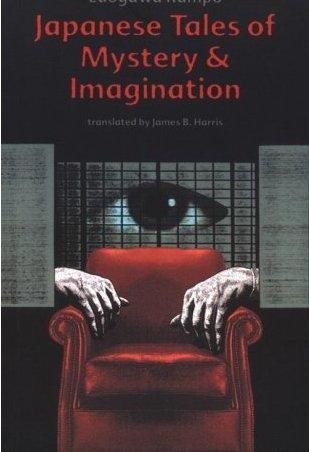
My first encounter with Edogawa Rampo was in a story anthology called My Favorite Horror Story. Edited by Mike Baker and ubiquitous anthology organizer Martin H. Greenberg, the book is just what you'd think it would be: a collection of stories, each hand-picked by a different horror author. Looking at the book now, at least half of the choices are surprisingly obvious ("The Tell-Tale Heart"? "The Rats in the Walls"?). But along with a couple of other less common choices (Richard Matheson's slightly dated, but still excellent, "The Distributor"; and Robert Aickman's -- there's not other word for it -- masterpiece, "The Inner Room") there's a story at the end called "The Human Chair", by Edogawa Rampo. At the time I bought the book, I'd never heard of Rampo before. "The Human Chair" was chosen by Harlan Ellison as his favorite. I'm pretty sure that if Baker and Greenberg had caught Ellison a dozen different days, he'd have had a dozen different choices, but on that particular Wednesday, or whatever, it was Rampo's "The Human Chair".

Over the years, Ellison has, through his writing, turned me on to dozens of great, forgotten authors, so I was excited about this one. In his introduction to the story, Ellison asks us to do the following:

Let us play a little game, just the two of us, you and I. I will say something, and you repeat it. Here we go:

Edogawa Rampo

Not bad. Let's try that again. Like this: Ed-O-Gah-Wah Ram-Po. Edogawa Rampo. Say it again. Edogawa Rampo. Now say it faster. Edogawa Rampo. Faster, go faster, say it faster, and slur it a little.

Edogawa Rampo, Edagarapo, Edgarawanpo, Edgarawanpoe.

Edgar Allan Poe.

Rampo's real name was Hirai Taro, and in his day he was considered Japan's foremost writer of mysteries (he might still be, for all I know), and he chose his pseudonym based on his deep appreciation of Poe. While "mystery" and "horror" are usually two distinctly different genres, Japanese genre fiction tends to have, to Western eyes, a distinctly bizarre tint, so when it's imported to the US, or England, the genre distinctions can become blurred. Besides, while Poe wrote mysteries as well, he's known now primarily as a father of American horror fiction. And Rampo's best known book, in the West, is a collection of stories called Japanese Tales of Mystery & Imagination, which first came out in the US in 1956. I'm pretty sure in that title, "imagination" is code for "horror".

So. "The Human Chair" really pissed me off.

Yes, it was bizarre. And yes, it was unique. But as it turns out, all that intriguing strangeness was just Rampo's way of jerking me around. I finished that story, and closed the book, and wondered what the hell Ellison thought he was doing, recommending that story to me. But Ellison also tipped me off to John Collier, so I figured we'd call it a wash.

This was more or less my frame of mind when I returned to Rampo for this project. As has been my habit this month, I chose two stories, in this case "The Caterpillar" and "The Red Chamber". I was concerned that I might find myself reading a straight-forward mystery, and not a horror story. This, of course, would have been catastrophic. It would likely have ended my horror project as we know it, and it could have even burned down the entire internet. Fortunately, I chose wisely. Or, wisely-ish.

"The Caterpillar" gave me hope that Rampo and I might find some common ground after all. It's the story of a woman named Tokiko, whose beloved husband, Sunaga, has returned from the war bearing devestating, horrific injuries. His face has essentially been obliterated, only his eyes remaining unmarked. He is deaf and mute. Both his arms and his legs have been amputated at their bases. Sunaga is the title character.

Initially, Tokiko is both grief-stricken by her husband's deformities, and loving in her care for him. But as time goes by, aspects of her personality begin to resurface after, we gather, years of lying dormant:

As for Tokiko, although hers was a timid heart, she had always entertained a strange liking for bullying the weak. Moreover, watching the agony of this poor cripple aroused many of her hidden impulses.

These impulses manifest themselves sexually. Sunaga can still technically perform, and Tokiko knows that helping him in this way would both please him and serve to make him feel more like a human being. But Rampo hints that Tokiko's chosen form of torture involves arousing him, teasing him, and leaving him to writhe in frustration.

Meanwhile, Tokiko also managed to find a secondary source of pleasure in tormenting this helpless creature whenever she felt like it. Cruel? Yes! But it was fun -- great fun!...

Not cool, Tokiko. We know just enough about Tokiko to be a bit stunned that she would behave so inhumanly, but not enough to find it unbelievable. So we're left horrified that Sunaga should face a lifetime of this kind of torture, with no means of resistance. And Tokiko's cruelty, matched by her own frustration at having to live with a "caterpillar", is about to reach a fever pitch.

This is pretty rough stuff. It's one of those "humans-are-the-real-monsters" stories, and is quite effectively unblinking. And more importantly for me, it showed that, regardless of what I thought of "The Human Chair", Rampo was capable of more than just empty gamesmanship.

The other story I read, "The Red Chamber", really pissed me off. Well, up to a point, it did. Here's how it begins:

The seven grave men, including myself, had gathered as usual to exchange blood-curdling horror stories. We sank into the deep armchairs, covered with scarlet velvet, in the room which had been dubbed the "Red Chamber" and waited eagerly for the narrator of the evening to begin his tale.

As far as my tastes go, this is a very promising beginning. This evening's narrator, Tanaka, is new to this group of grave men, and his story is a corker. Tanaka is a man who has become very bored with his life. Extraordinarily bored. Dangerously bored, really, because the solution he devises for his problem is to become a murderer. He will murder for the sake of amusement, and will do so in such a way that will ensure that he's never caught. For instance, one day (he tells his audience), he notices an old country woman, unused to the chaos of urban traffic, crossing a busy street. He notices that she is about to pass across the tracks of a speeding streetcar. If left alone, this woman has time to cross without injury. But by shouting "Look out, old woman!", he insures that she will freeze in panic, allowing the streetcar to plow into her. So Tanaka has successfully murdered the woman, while in the view of any witnesses appearing to have tried to save her. And this is more or less how he goes about taking lives. Ninety-nine of them, we learn. He'd like to make it an even hundred.

Not bad, right? Pretty chilling, if you let yourself get wrapped up in it. But then -- and I'll have to tread carefully here, to avoid spoilers -- Rampo yanks the rug out from under us with his big twist at the end. I won't reveal it here, but suffice it to say, I was about ready to throw the book across the room. To make it worse, I actually read "The Red Chamber" before I read "The Caterpillar", so at the time my two experiences with Rampo had ended with him metaphorically spitting in my face. Seriously, I was cheesed off.

But there is something to the final paragraph of "The Red Chamber". Again, I can't get into it, but there is a mildly haunting quality about what follows the big twist. There's no second twist involved, no "Or did he???" or "The End...???"-style shenanigans. It's just a hint that Rampo's motive in telling this story was not to simply yank my chain. The problem is, had he ended the story in a way that was more in line with his set-up, that haunting final paragraph would have been much, much stronger. And, quite honestly, it would have made more sense.

So, oh well, I guess. I'm three short stories into the bibliography of very prolific writer, who is still in print over forty years after his death, and is considered one of the giants in his particular genre in all of Japan. So I'll keep reading him. But Edogawa Rampo, you're on warning.

Followers