This Tuesday sees the release to
Criterion Blu-ray of Michael Mann's classic 1981 crime film
Thief, and this strikes me as conspicuously well-timed. Not as conspicuously well-timed as a Christmas Day release would have been, but still not bad. I say this because now that
Thief is about to be in the cinephile air again, the door opens to look at critically acclaimed movies that take a somewhat sympathetic look at criminals and ask "Why is
this okay, but
that isn't?" "
That" being, in case you're not already ahead of me, Martin Scorsese's surprisingly controversial
The Wolf of Wall Street. Not that one wouldn't expect a film like that to be controversial on some, or many, levels, but the particular way in which
The Wolf of Wall Street has been controversial is, I'd say, most curious. And by the way, it's necessary to get this off the table before I even begin, and you'll believe me or you won't, but my issue isn't that some people don't like Scorsese's film, but that some who don't like it blame the film for being, itself, immoral, and a glorification of the animal behavior Scorsese depicts (or if they don't think the film goes that far, they at least believe unsophisticated viewers will take it that way, and wish to emulate the characters therein). Which I'll get to, but I think I was talking about
Thief.
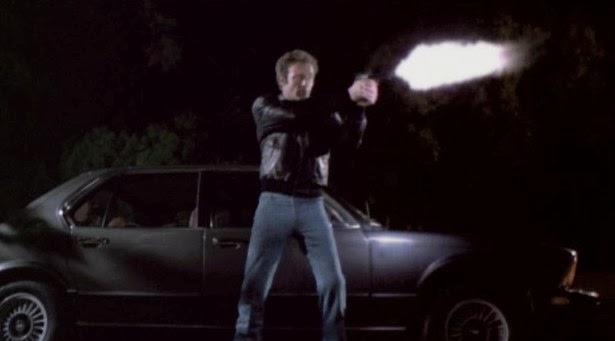
Thief was Michael Mann's feature debut, and though it's a touch over two hours long and also not my personal favorite of his films, it's perhaps his most tightly constructed -- simple and clear in its storytelling while allowing just enough room for Mann's aesthetic, rooted always, it seems, in the 1980s, to blossom, something he'd probably, after thirteen years spent in the then stylistically barren world of television, been aching to see happen. The film also features a possibly career-best performance by James Caan as Frank, an ex-con and professional thief who, like any working man, has his eyes on retirement. He knows what he needs to be happy, and he knows how much money he needs to make that happen. After one of Frank's confederates is killed, and one or two things lead to other things, Frank gets roped into a professional relationship with a crime boss named Leo (Robert Prosky, who at 51 was here appearing in only his second film). Frank is wary, because part of his plan for his life depends on his professional independence, but the way Leo describes it he might get to his destination faster. It turns out that Leo is a liar and a sadistic piece of shit, but you knew that.
The thing is this, though. Frank is a criminal. He doesn't break into homes and whack people with clubs and take their life savings, but he still takes other people's money, and I'm pretty sure we can all agree that this is something that is wrong to do and should not be legalized. He's not Robin Hood, either, instead wallowing in the money, saying at one point to his girlfriend Jessie (Tuesday Weld) "I wear $150 slacks, I wear silk shirts, I wear $800 suits, I wear a gold watch, I wear a perfect, D-flawless three carat ring. I change cars like other guys change their fucking shoes. I'm a thief." The idea of
Thief, however, is that he should get to keep his money. "Better him than Leo," the thinking seems to go, but somehow never "Better the people he's stealing from than him." A curious aspect of the romantic outlaw ("in American culture," I feel compelled, but don't want, to add, so we'll call this parenthetical a compromise) is that unless they're literally Robin Hood, or have been transformed into Robin Hood by time, and by those who for their own reasons would prefer to see some criminals in that light ("Armed Thugs Shoot, Kill Our Beloved Dillinger" reads on headline in the Onion's
Our Dumb Century), is that they're never remorseful. At best, they just want to stop, or they want to retire, like everybody else on the planet. Taking what doesn't belong to them is just a gig they happen to be good at, and about which they should feel no worse than if they happened to be good plumbers. Of course they'd never be plumbers because in order to live they need that
juice!, but anyway, remorseless, is my point. If that thief seems like a nice guy otherwise, as James Caan's Frank certainly does, then hey bud, live your life. His name is Frank and the woman he wants to marry is named Jessie. There are no coincidences.
It comes down to execution. Not by the filmmaker, or in terms of craft, because the same thing can be done well or badly, but the execution of crime. In
Thief, Frank and his partners are really good at what they do, and audiences and critics appreciate this. I'm not immune to it myself, and in fact my dad was an FBI agent who worked bank robbery cases for a long time, and he told me that the ingenuity of some of these guys was just plain admirable. This doesn't make it right, of course, but in movies like
Thief the morality of it is not an issue. There are no victims of Frank's crimes, just money being hauled in a big sack with a dollar sign on it. The trick to fool your audience, and critics which is really my point here, is to have a worse criminal than your hero, and this Leo guy is really something else, but why should anybody fall for that old gag? Why should the only people questioning the morality at work in
Bonnie & Clyde be the uptight dissenters (of which I am one, and here I'll move away from Arthur Penn's deeply off-putting milestone because I've gone on about this at length many times, but should curiosity grip you here is my more
relevant post about it)? And why, so often, are we rooting against the cops, rooting that they fail to stop our hero criminal from doing something to someone else what we would never want them to do to us? (Because it's just a movie? Well, in part, indeed.) Because of half-formed ideas about The System, presumably, that allow for empathy for the criminals but not the police, and which allows for the bloodless gunning down of cops in
Bonnie & Clyde (sorry!) because all the red stuff is being kept in store for the deaths that really matter. This isn't exactly
Thief's bag, or anyway not Mann's, because while this specific film does feature some corrupt cops he typically portrays them as heroes, or with a fair amount of sympathy at least. But taking the cops back out of it and sticking only with the hero criminals, I hold none of this against
Thief. It's an excellent film, for one thing, and that's pretty far from negligible, and because I understand that
Thief isn't Mann's attempt to endorse robbery as a way of life.
One of the most interesting, and one of the strangest, films in the long history of criminal hero movies is Don Siegel's
Charley Varrick, from 1973. In this film, the title character, a bank robber, is played by Walter Matthau, and as the film opens he and his crew are preparing to rob a bank. As they go through with this, some nearby cops, doing their jobs and appearing quite friendly and likable sort, follow up a hunch. In the below still, a deputy played by Rudy Diaz is about to be shot in the head by one of Varrick's partners. This partner is Nadine (Jacqueline Scott). Nadine is Charley Varrick's wife.
She's about to be mortally wounded herself (good, I say), but here's what's so fascinating about
Charley Varrick. Varrick is going to escape with one of his men (played by Andy Robinson), and Nadine who will die on the way to their hideout. Varrick will be shown mourning the death of this woman who we just saw shoot an innocent and, from what we've seen, good man through the head, and this man is mourning her. Well, she's his wife. This makes sense. Even the worst among us are human, and so on. But Varrick is not meant to be, for example,
White Heat's Cody Jarrett, a character we can be fascinated by while still reviling him. Once Nadine's body has gone up in the car fire Varrick set to make her corpse more difficult to connect to him, Varrick is a bereaved hero who discovers that the money he has stolen belongs to the mob, the bank having been shady in that way, who has sent out a vicious hitman named Molly (Joe Don Baker) to get it back, by any means. Molly is the embodiment of the evil shadow of organized crime, also represented by a character played by John Vernon who tells another low level colleague, who actually did the mob work in the bank, that these unseen men would come at him "with a pair of pliers and blowtorch" (a line Quentin Tarantino lifted for
Pulp Fiction). Varrick has nothing to do with
those guys, who, on top of everything else, and perhaps this is the key to the box here, are
organized. It's about power, you see: Varrick might be bad, but we want him to win because at least he's not powerful
But the strangeness of
Charley Varrick doesn't stop there, because director Don Siegel, not, as I understand it, anybody's idea of a bleeding heart hater of cops, isn't making
Bonnie & Clyde (sorry!). It's perfectly true that most of the film is about Varrick, and it's just as true that Varrick is the hero. But Siegel doesn't forget about that dead cop. In a scene shortly following Varrick's escape from the scene, the sheriff arrives on the scene. He's played by William Schallert, an actor who often turned up as humorous scolds in comedies but is very good here as the good small-town cop with a horrible mess on his hands. When he gets out of his car, he walks along until we see his stride halt somewhat, and we see that he's come upon the dead officer. A brief shake of his head not only shows the suppression of emotion he needs to get on with his job, but later, after tending to another wounded cop, he goes back to the body, picks up the dead man's hat and places it over his face. Then Siegel stays there for a minute while Schallert picks some bits of grass off the crown of the hat, to clean it up, to give the man as much dignity as leaving his dead body in the grass, as Schallert is professionally obligated to do for now, can permit. Not a lot of filmmakers, making a movie like
Charley Varrick, would keep the camera there for this controlled piece of mourning. I won't say who, but I can think of one off the top of my head who not only probably wouldn't, but definitely didn't.
Anyhow, the morality of
Charley Varrick, an otherwise lean piece of work, is about as crazy a jumble as you'll find in such a picture. The leader of the criminal group that murdered that man is now, somehow, supposed to be the guy we want to get away? Why shouldn't we be fine with Molly taking his head off with a shotgun? Movies allow for the expression of the kind of bloodlust we, the audience, might otherwise, though not necessarily, choose to either keep hidden or be practical and real-life about, so why do we let Varrick off the hook? More to the point is why is
Charley Varrick not questioned? "How can Don Siegel endorse a man like Charley Varrick?" is a question that I've never heard critics ask about this movie, and obscure though it may be to general audiences, among movie freaks it, like
Thief, is very well-liked. And I like it too, incidentally, but if Siegel didn't show Schallert picking those bits of grass from the dead cop's hat, I bet I wouldn't. If not for touches like that, we'd be left with a film that offered nothing within it to refute the idea that Varrick's crimes, and the crimes of his wife, which so far exceed in vileness what
Thief's Frank ever does, do not therefore render him unworthy of our sympathy. But
Charley Varrick does have those touches, and so I won't argue against or condemn a film that Siegel didn't make.
So what does any of this have to do with Scorsese's
The Wolf of Wall Street, a film that pretty clearly has nothing to do with any of the movies I've just been...
...sorry, so like I'm saying, what does any of this have to do with
The Wolf of Wall Street? Well, that film, which I think is pretty fantastic, does not, it has been argued, contain whatever touches would be it's equivalent of William Schallert picking grass off a dead man's hat, and which would therefore reveal that the unbridled greed and hedonism and thievery on display in Scorsese's film was not, in fact, being celebrated by the filmmakers. And okay look: these sorts of movies, as I've tried to illustrate, tend to break down in one of two ways. Either, like
Thief, they regard the criminal with empathy, and so you like him or her, and so when shown the alternative (Robert Prosky in this case), well, good luck, Frank! Or like
Charley Varrick and
Bonnie & Clyde (sorry!) they can show the criminal doing terrible things, things beyond just theft, or being remorselessly connected to terrible things, and either expect (
Bonnie & Clyde) or allow room for
(Charley Varrick) the viewer to hitch their wagon to them anyway. The issue, when it comes to
The Wolf of Wall Street, is why is this one suddenly so different? People fuckin'
love that
Bonnie & Clyde shit (I'm not going to apologize for bringing it up anymore), and that thing is a moral catastrophe, and is designed to be understood the way I understand it (though admittedly not with the horrified reaction I bring to it).
The things at issue here are various, and most prominent, though not remarked upon to my knowledge, is the fact that the kind thievery at play in
The Wolf of Wall Street, which is Wall Street malfeasance, is currently politicized, has been for several years, and frustrates many because, and maybe the Hays Code had a point here, many of the real-world perpetrators have not been sufficiently punished, or punished at all. So they skate by in real life and now we gotta see these fucks skate by in the movies? On
Christmas?? So there's that, and there's also the fact the film is funny, and everybody in it has a lot of fun and the thing only really turns dark when the Feds show up and try to pull the blinds on everything. Anyway, this is what has been said about the film, or this is roughly, in capsule form, what has been said about it. "Your film is a reckless attempt at continuing to pretend that these sorts of schemes are entertaining," said
this person.
This person says of
The Wolf of Wall Street's characters "[Y]ou're supposed to envy them anyway, because the alternative is working at McDonald's and riding the subway alongside wage slaves." Even if those who criticize the film on these ground allow that Scorsese and his actors know that the behavior they are depicting is disgusting, they insist that they believe it is a disgusting
hoot. What they somehow don't acknowledge is that no, it's just disgusting.
The Wolf of Wall Street strikes a very grotesque note quite early on, when Oakmont & Stratton, the Wall Street firm run by Leonardo DiCaprio's Jordan Belfort, makes a big trade (or whatever), and the celebration becomes a bacchanal. At the center of this, yet also somehow forgotten, is a woman who Belfort says agreed, for a price, to have her head shaved. Scorsese shows this happen, and the woman laughs and cries as her long hair is shorn away, beginning to look half-crazed, her head filling up with greed and regret and maybe even some unacknowledged fear. But it's all in fun. Scorsese just thinks this is fun. Don't do it, but come on it's fun. This is clearly a logical takeaway from this scene.
"Where are the victims?" some have pointedly asked of
The Wolf of Wall Street. "Where are the victims?" no one has ever pointedly asked of
Thief. Yet in the case of Mann's film they'd have much more justification. Because Frank (of Frank and Jessie, please remember) is the
hero of
Thief. Belfort is
not the hero of
The Wolf of Wall Street. He's the protagonist, but this is not necessarily the same thing, and certainly isn't here. If Belfort is the hero. If you think we're meant to admire him, even if we think that admiration is intended to be begrudging, does that mean you think the honest, hard-working FBI agent, played by Kyle Chandler, who is working to bring Belfort down, is the
villain? And if he's not the villain, then who is he?
It's all about money, of course, and the political aspect of money, particularly now, and how Frank struggles for it while Belfort swims in it. Frank is just like us! Belfort disdains money as much as he loves it, and he really loves it a lot. Is that hard to see? For many, many years, critics have complained about films that hold the audience's hand, leading them to the one conclusion the filmmakers want everyone to arrive at, but now at least a portion of critics are complaining that their hands aren't being held firmly enough. And because, in a flagrant disregard of the Hays Code, nothing truly bad happens to Belfort at the end. Except what happened to Henry Hill in Scorsese's
Goodfellas. Belfort has to stop drinking and using drugs and he punches his wife in the stomach and loses his kids. He's a schnook eating egg noodles and ketchup, but with a lot more money in his pocket. No one missed the "point" (God forgive me) of
Goodfellas. And if you, like David Edelstein, think Kyle Chandler on the subway in
The Wolf of Wall Street is saying "Who wouldn't want to live like Belfort rather than this dope?" then please think once again of the schnooks and the egg noodles and the ketchup, and think about who the schnooks are meant to be in
Goodfellas, and all the implications of that, and why did no one ever get mad at that movie? I'll show you who's a schnook.
The triumph of
Thief in this capacity may be that even though it offers the viewer an easy out when it comes to its criminal hero (that big diner monologue is mainly what I'm thinking of here), Mann still knows what's what when it comes to people like Frank. Yes, he's the best of a bad lot, yes, rather him than Leo, certainly. But look where he is at the end. Look what he's forced to do. What Mann never bothers telling us is that while Leo is the monster, Frank would never have even been in the same room as that prick if he'd chosen an honest line of work. He can romanticize it all he wants, and he does, but his life as a thief has actually fucked everything up for him, and for those he cares for. Mann keeps pretty quiet about that throughout the film, but that doesn't mean it's not there, right in plain view. If you're paying attention, it sticks out like a shaved head.