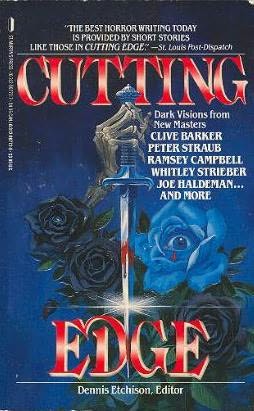
Over the years, I’ve read a good handful of stories by Dennis Etchison, a writer of primarily short horror stories, and someone praised to the rafters by the likes of Stephen King, Peter Straub, Karl Edward Wagner, and so on. That good handful of stories I’ve read has never blossomed into a full Etchison habit, however, because Etchison strikes me as the American version of Ramsey Campbell, at least as far as they affect me personally, in that both men garner immense respect from their peers, but leave me a bit cold, and slightly confused as I try to work out what, precisely, is the big deal.
.
As with Campbell, I don’t actively dislike Etchison, and in fact have fond memories of the first Etchison story I read, called “Talking in the Dark”, from his collection Red Dreams. That one is a horror story about horror fiction, which is something that always intrigues me, and it’s also, as I remember, fairly pulpy and demonic, which are two words I’ve since learned not to associate with Etchison’s fiction. More typical would be a story like the oft-anthologized “The Dog Park”, another of my early Etchison reads; that one (again, as I remember), is almost all mood, all strangeness. Which is great! It’s just that I’ve never felt like Etchison’s writing chops were at the level everyone else claimed they were. He often writes at the level of pulp, but with an eye towards Robert Aickman-level strangeness. This can be an odd mix.
.
For today, I read two stories from Etchison’s collection The Death Artist (which also contains “The Dog Park”, for those interested, though as I implied it’s hard to buy an anthology of modern horror fiction that doesn’t have that story). The first story, “No One You Know”, is told mainly through dialogue, and as it’s only about fourteen pages anyway, this is a bit of a speed-read. It’s also not a supernatural horror story, or even the kind of terrestrial horror that so many modern writers have chosen to explore, by which I mean it’s not about a serial killer. No, this one is more about human cruelty, specifically male cruelty, and its overall impact has the feel of something Neil Labute might have written, before he shifted gears and became a journeyman Hollywood director.
.
There’s not much to say about “No One You Know” that it can’t say better for itself. It’s almost all told through phone conversations, between Michael and Jeannie, the girlfriend he’s just cheated on, or Jeannie and her friend Mara, or Michael and Mara, whose connection you can perhaps guess. What pushes this beyond, or at least away, from and ordinary love triangle is the fact that Michael keeps threatening to shoot himself if one or another of the two woman doesn’t take him back, or take him in, depending on who he’s talking to. As a quick shot of a story, “No One You Know” works well enough, with one of those slow-dawning climaxes that has you thinking about, and then remembering, the story longer than you initially believed you would. No, it’s the other story I read, the one with the apparently hideous title “Deadtime Story”, that is really the one to talk about, as it’s the more typically Etchison-esque of the two, the one that really illustrates my pulp/Aickman comparison from earlier.
.
.
As with Campbell, I don’t actively dislike Etchison, and in fact have fond memories of the first Etchison story I read, called “Talking in the Dark”, from his collection Red Dreams. That one is a horror story about horror fiction, which is something that always intrigues me, and it’s also, as I remember, fairly pulpy and demonic, which are two words I’ve since learned not to associate with Etchison’s fiction. More typical would be a story like the oft-anthologized “The Dog Park”, another of my early Etchison reads; that one (again, as I remember), is almost all mood, all strangeness. Which is great! It’s just that I’ve never felt like Etchison’s writing chops were at the level everyone else claimed they were. He often writes at the level of pulp, but with an eye towards Robert Aickman-level strangeness. This can be an odd mix.
.
For today, I read two stories from Etchison’s collection The Death Artist (which also contains “The Dog Park”, for those interested, though as I implied it’s hard to buy an anthology of modern horror fiction that doesn’t have that story). The first story, “No One You Know”, is told mainly through dialogue, and as it’s only about fourteen pages anyway, this is a bit of a speed-read. It’s also not a supernatural horror story, or even the kind of terrestrial horror that so many modern writers have chosen to explore, by which I mean it’s not about a serial killer. No, this one is more about human cruelty, specifically male cruelty, and its overall impact has the feel of something Neil Labute might have written, before he shifted gears and became a journeyman Hollywood director.
.
There’s not much to say about “No One You Know” that it can’t say better for itself. It’s almost all told through phone conversations, between Michael and Jeannie, the girlfriend he’s just cheated on, or Jeannie and her friend Mara, or Michael and Mara, whose connection you can perhaps guess. What pushes this beyond, or at least away, from and ordinary love triangle is the fact that Michael keeps threatening to shoot himself if one or another of the two woman doesn’t take him back, or take him in, depending on who he’s talking to. As a quick shot of a story, “No One You Know” works well enough, with one of those slow-dawning climaxes that has you thinking about, and then remembering, the story longer than you initially believed you would. No, it’s the other story I read, the one with the apparently hideous title “Deadtime Story”, that is really the one to talk about, as it’s the more typically Etchison-esque of the two, the one that really illustrates my pulp/Aickman comparison from earlier.
.
 “Deadtime Story” is very odd. It’s the story of a young college student named Shaun who works at a convenience store, doesn’t really have any friends, doesn’t have much of anything. As the story begins, Shaun is just showing up for work, and his boss warns him about personal calls on the store phone. Apparently, someone has been calling for him. Shaun tells his boss not to worry, he’ll take care of it, while idly wondering who might have been calling. He finds out soon enough when, after he's alone in the store, the phone rings again, and the man at the other end not only says that he knows Shaun, but that Shaun knows him, and that it's time Shaun paid up.
 .
It turns out that Shaun does know what this is about, though the reader is left in the dark. It has something to do with:
.
That bored night at the Club, looking for something, anything to give the edge back to his life; the ones he had met there, the beers outside, then the game, and the promises -- the pact. In the morning it had seemed like a bad dream. He had hoped it would go away. But now he knew that it would not.
.
That plain, cliche'-heavy prose is typical of Etchison, but the effect he's going for ultimately is something else again. The rest of "Deadtime Story" involves Shaun wondering around town, trying to figure a way out of the debt he owes. He goes back to the Club (which in daylight is much more drab and sagging then it had apparently been on the night Shaun made his mistake) and is told that without ID he can't be helped, or speak with anyone. On the bus, he finds himself surrounded by homeless people, one of whom tries to sell him a self-help book. Early in the story, before the mysterious phone call, a few pages are given over to Shaun asking his boss for more hours. Later, several pages are given over to his plan to ditch out on cab fair. Then there's the strange eleven-year-old who's having a party with her friends and wants Shaun to come over.
.
The only other story/work of art I can quickly think to compare to "Deadtime Story" is Scorsese's film After Hours. While it's not a great comparison, both are strangely ominous, feature much that is inexplicable, encounters with odd strangers, and take place over a compact period of time. Still, while I have little doubt that someone, somewhere has argued that After Hours is a horror film, it's obviously not, and "Deadtime Story" obviously is. But it has the same sense of pinball randomness as the Scorsese film, less urban than suburban, maybe, though this difference strikes me as not entirely relevant.
.
If After Hours can be simplified as a dark night of the soul, but funny, then "Deadtime Story" can possibly be simplified as a dark night of the soul, but not funny at all. An argument over how much, or how little, hope is offered at the end of Scorsese's film, as Griffin Dunne's character finds himself back at work, but no such argument would ever get off the ground in relation to "Deadtime Story" -- Shaun has a greater relation to his fate than Paul does in that film, so perhaps God is more merciful with Paul. Either way, most of the events in both After Hours and the Etchison story can be explained away as a bunch of random shit that just happens. So be careful. And for God's sake, try not to be bored.