Showing posts with label Cormac McCarthy. Show all posts
Saturday, November 2, 2013
When the Axe Comes Through the Door
Andrew O'Hehir's review of The Counselor appears, as depressing as this is to say, to be the big one. But when you, or someone else on the staff tasked with this job but who is pulling directly from your review, slaps on a title like "Meet the Worst Movie Ever Made," you're going to enjoy a fair amount of traffic. Is it possible that O'Hehir could have possibly anticipated such a thing beforehand? Could that, now wait I'm just thinking this out here, have possibly motivated him to write such absurdities as those that litter his review, a review that, given the content of it, might have more accurately been titled "I'm Going To Use The Phrase 'The Devil's Candy' Something Like Six Times'?" Since O'Hehir happily -- gleefully, even -- imagines all sorts of cynical self-satisfaction blackening the hearts of The Counselor's principal creative forces -- director Ridley Scott and screenwriter Cormac McCarthy, for example -- I'm going to go ahead and say "He absolutely fucking did." It's a terrible, infuriating review, badly written and devoid of an argument about what the film is, and constantly falling back on boilerplate critic-speak so that he might better fail to describe what his objections are. Here's a key passage, or as "key" as it's ever going to get, from the review:
[T]he narrative of the film is almost entirely discursive, and largely consists of the Counselor sitting around with his obviously crooked associates —Pitt in a dingy white suit, stringy hair and a black eye; Bardem in hilariously ugly designer duds, accessorized with girly cocktails — having stilted, stylized conversations about women and money and snuff films and the meaning of life that don’t go anywhere. It’s like a mumblecore movie about a bunch of Sarah Lawrence philosophy majors, made by coked-up rich people for 100 bajillion dollars.
Well, hold the phone, if I'd known the dialogue was going to be stylized I daresay I would never have bothered! O'Hehir also calls the dialogue "stilted," which is at least a pejorative, but as with anybody who has ever used that word in a review, he believes that since "stilted" has a definition his work is now done, and providing examples and arguing his case would therefore be redundant: I said it was bad, which is my evidence that it is bad. As it happens, I rather liked McCarthy's dialogue, and tend to favor his writing in general, and furthermore thought The Counselor in general was pretty fantastic, about which more later. But right at the moment my head is full of this nonsense that I have to use as my launching point.
Except, no, I should reel this in. I would hate to be discursive, which The Counselor isn't, and which anyway, once again, isn't a pejorative unless you then go ahead and describe in what way the film under discussion falters as a result of this discursiveness, which O'Hehir doesn't do. And so, the plot! Michael Fassbender plays the titular character (we're never told his name) a very successful defense attorney who is deeply in love with Laura (Penelope Cruz), a sweet and beautiful woman with whom the counselor is about to forge what would appear to be a perfect life. However, we learn that the counselor is rather lackadaisically attempting to enter into the world of drug trafficking. He's being helped along in this endeavor by one of his clients, a flamboyant nightclub owner named Rainer (Javier Bardem) who is not entirely unfamiliar with the world of the Mexican drug cartels. Because of this familiarity, Rainer never stops warning the counselor about what kind of men are being dealt with, the kind of men being dealt with kind of being the core of the entire film. Why, precisely, the counselor thinks it's a wise move, or an okay thing to do, to go into business with a drug cartel, even at some remove, is never explained (this kind of withholding also bothers O'Hehir); all we know is that at one point he says that his back is against the wall, and we also know that he's arrogant enough to think he can handle it. "You can't," is what Rainer tells him, and "You absolutely can't" is what Westray (Brad Pitt), another link in the chain of clients and shady associates the counselor uses for his drug deal, says. But he does, and because he's naive, and because he's arrogant, he doesn't realize that someone, Rainer's girlfriend Malkina (Cameron Diaz, who is not very good, I'll go ahead and agree with O'Hehir about that) is working against him -- or not him, specifically, but certainly against his best interests -- and leaving him vulnerable to an angry cartel.
And an angry cartel is unlike anything else. This, you see, is the "point," if I must be forced to use that word. Westray's short speech about snuff films is not in the least "discursive", and it certainly goes somewhere -- where it goes could not be plainer. It functions, first, to illustrate what the cartels are capable of, how their violence is so very different from most people would imagine it to be. Horrible violence to most people is shooting someone in the head. Violence to the cartels is a snuff film, or a bag full of severed heads, or death by bolito, a weapon described in the film that I will leave to you to learn about. I'm paraphrasing here, but Westray follows up his bit about snuff films by saying something like "If you ever thought there is something these people are not capable of, there isn't." So that's where it goes, first, and then? Well, it provides information that pays off very clearly later on. If O'Hehir can't be bothered to pay attention to the film unspooling in front him, then why should I pay attention to him when he writes things like "This is...like having Alice Waters and Mario Batali labor in the kitchen for a while and then serve you a gray-green burger on Wonder Bread, with what looks like somebody’s pubic hair stuck to it" and believe it to be anything other than a child's idea of wit? He's not just wrong, he can't even be funny about it. This is unforgivable.
But I'm being discursive again. Elsewhere, I've seen Cormac McCarthy, the Pulitzer Prize-winning novelist who wrote the script for The Counselor, pilloried for having gone off the deep end with this one. "Cormac McCarthy," goes the cry, "You are so great! Why have you written something so verbose and crazy and violent!? Your very first novel ever, The Road, wasn't like that! WHAT HAS HAPPENED TO YOU!?" I might be paraphrasing again, but the idea many are expressing that The Counselor is somehow unlike the McCarthy works we all, as a people, have enjoyed in the past, appears to have dug its claws in to the point that the response by others has been "Yeah, what's the deal with that, Cormac McCarthy?" And I'm reminded of one thing, as I always am when the subject turns to questions of Cormac McCarthy's writing style, and what I'm reminded of is this:
It howled execration up the dim camarine world of its nativity wail on wail while he lay there gibbering with palsied jawhasps, his hands putting back the night like some witless paraclete beleagured with all limbo’s clamor.
That's Cormac McCarthy describing the cry of a baby in his novel Outer Dark, which, now that you mention it, why didn't The Counselor have any palsied jawhasps or witless paracletes?? The gist being, The Counselor is pure McCarthy, or, rather, no -- in terms of the films preoccupations and use of violence, and the types of violence used, its Biblical morality, and almost pathological unwillingness to offer the viewer a shred of hope, in all these ways, yes, it's pure Cormac McCarthy. However, the language used -- the English language, not cinematic language -- is more like the comparatively straightforward No Country for Old Men, a novel and film with which The Counselor shares more than a few similarities. But the speeches in this new film should not be sticking in so many craws. They're quite excellent, in my view, and if they aim for profundity, whether or not they reach it doesn't mean they don't achieve poetry. Pitt has some terrific ones as Westray, but his are mostly fairly plainspoken. Ruben Blades, on the other hand, has something of a showstopper of a speech late in the film, his character being perhaps the last person to gently but in no uncertain terms explain to the counselor what a fool he's been. In the speech, he says, among much else, that the counselor wants to return to where he was, but "life won't accept you back." I fear this is not exact, and I would very much like it to be, but it's at least close. And, as a way to express the damage done not only spiritually but in practical and hellishly moral ways, when a certain moral line is crossed, it's clear and precise in its language; you cannot be the Prodigal Son, it says, because you've gone too far. What will happen has, for all intents and purposes, already happened.
Hey, but quit being so discursive! And don't cost any money at all to make, either. O'Hehir -- who spends at least a third of his review describing how he thinks The Counselor will one day be regarded (hint: it will be regarded as something that rhymes with "pevil's bandy," and it rhymes with "pevil's bandy" five time) -- gets pretty hung up on the fact that The Counselor was made by a Hollywood studio and therefore had some money behind it. In the bit from his review quoted above, O'Hehir says "100 bajillion dollars" but you guys don't think he could have literally meant that, do you?? Wait, I just checked -- the film cost $25 million, so pretty modest as these things go nowadays. But for fuck's sake, O'Hehir might as well have screamed, if you're going to make a film whose budget ends in "-illion," at least have the decency to not have so much talking in it. And yes, I wish O'Hehir had come clean and just fucking said that, since it's plain as day that's what he was thinking. If you're bored and confused -- that he was confused has been proved -- then just say so. Don't mask it with some vague economics-based self righteousness.
I think The Counselor is a terrific film, which I hope I've made clear. Fassbender is wonderful, even if his accent is sketchy -- watch him coming apart in a late face-to-face conversation with Pitt. His posture, his eyes, his voice, express the feeling that the counselor's life has now changed into something unimaginable. Cruz is heartbreaking, effortlessly sweet -- her face when she sees her engagement ring is about as on the money as I've ever seen that oft-dramatized scenario played -- and Bardem plays the flamboyance of a somewhat unlikable person as something that could easily exist and function on this earth. In fact, Bardem saves one of the film's missteps, which is the already-infamous "car-fucking" scene. The mistake there, in my view, was to go to the flashback at all, unless Ridley Scott was going to shoot it so that it, if such a thing is even possible, looked like it belonged with the rest of the film. He didn't, and it doesn't, but that scene exists prior to the film's main action, and the story is being told by Bardem's Rainer to the counselor, and as Bardem plays it (and as McCarthy writes it), Rainer is still utterly thunderstruck by what he witnessed, even disturbed in a way he can't really define. What comes through most is Rainer's confusion. But even this, for all its absurdity, much of it ill-advised, isn't "discursive" or "beside the point"; it may not work, but it leads to a realization. It's not the product of McCarthy or Scott saying "Hey everybody, let's put this stupid goofball shit in our 100 bajillion dollar movie!" Then everybody else goes "Hooray!"
I must be blunt about this: if you're going to trash a film in the way O'Hehir did, you must understand what you're trashing and you must then make your case. It's simply not enough to say that Cormac McCarthy's script is "labored," as O'Hehir does, because what in the world does that mean? It can mean something specific if you put it in your review, but if you don't then I guess you'd better say the film you're trashing might be the worst film ever made, because at least in that case you might go viral.
Labels:
Andrew O'Hehir,
Cormac McCarthy,
Ridley Scott,
The Counselor
Thursday, November 26, 2009
I See Your Lips Moving, But...
Here's something I'd like to see people stop doing: claiming that a novel is unfilmable because of the prose. This is an old conversational ploy that is intended to make the speaker appear superior and more knowledgeable about not only film, but literature, and the process of adaptation, than the person to whom he or she is speaking, particularly if the listener has expressed some enthusiasm for the film under discussion. The statement also betrays an astonishing ignorance.
I bring this up now because I'm stumbling across this particular bit of foolishness again and again in connection with John Hillcoat's film version of Cormac McCarthy's novel The Road (for the record, I am not personally aware of any film critics who've gone this route in relation to Hillcoat's film, but I've seen it in comments section of blogs and other websites all across this great internet). The specific adaptability of The Road is irrelevent, because the very idea -- that a book cannot be adapted to film because of the author's prose style -- is bullshit almost across the board. Guess what? Nobody's prose gets "adapted" to the screen. What gets adapted, faithfully or not, is character, story, theme, mood, atmosphere, dialogue. It is impossible to adapt prose to film -- a filmmaker can depict what is being described, but he can't depict the description itself.
Adding to the silliness of the idea is that The Road is written in a style far more straightforward than anything else McCarthy has written, outside of No Country for Old Men. Here's an example of The Road's style:
The following day they crossed the river by a narrow iron bridge and entered an old mill town. They went through the wooden houses but they found nothing. A man sat on a porch in his coveralls dead for years. He looked a straw man set out to announce some holiday. They went down the long dark wall of the mill, the windows bricked up. The fine black soot raced along the street before them.
What can't be filmed from that is the deliberately antiquated phrasing of "He looked a straw man...", but you can sure as hell shoot the image described. Talent, or the lack thereof, dictates the rest.
So Cormac McCarthy's prose won't be adapted by John Hillcoat, or anybody else. You know another writer whose prose will never make it to the big screen? Dan Brown. And Stephen King. And James Joyce. And Charles Dickens. And Vladimir Nabokov. And Leo Tolstoy. And Alain Robbe-Grillet. Although Joyce is maybe a bad example, because, for instance, Ulysses (never mind Finnegans Wake) might actually be unfilmable, at least as a whole, since, in that case, many large sections of that novel contains prose that is so baroque that it obscures action to the point of obliteration. Since this is part of the experience of Ulysses, putting the entirety of it on-screen might be impossible. Well, no. Improbable. I'm sticking with the less concrete word, because I could very well be proven wrong some day.
Oh, also, happy Thanksgiving, everybody!
I bring this up now because I'm stumbling across this particular bit of foolishness again and again in connection with John Hillcoat's film version of Cormac McCarthy's novel The Road (for the record, I am not personally aware of any film critics who've gone this route in relation to Hillcoat's film, but I've seen it in comments section of blogs and other websites all across this great internet). The specific adaptability of The Road is irrelevent, because the very idea -- that a book cannot be adapted to film because of the author's prose style -- is bullshit almost across the board. Guess what? Nobody's prose gets "adapted" to the screen. What gets adapted, faithfully or not, is character, story, theme, mood, atmosphere, dialogue. It is impossible to adapt prose to film -- a filmmaker can depict what is being described, but he can't depict the description itself.
Adding to the silliness of the idea is that The Road is written in a style far more straightforward than anything else McCarthy has written, outside of No Country for Old Men. Here's an example of The Road's style:
The following day they crossed the river by a narrow iron bridge and entered an old mill town. They went through the wooden houses but they found nothing. A man sat on a porch in his coveralls dead for years. He looked a straw man set out to announce some holiday. They went down the long dark wall of the mill, the windows bricked up. The fine black soot raced along the street before them.
What can't be filmed from that is the deliberately antiquated phrasing of "He looked a straw man...", but you can sure as hell shoot the image described. Talent, or the lack thereof, dictates the rest.
So Cormac McCarthy's prose won't be adapted by John Hillcoat, or anybody else. You know another writer whose prose will never make it to the big screen? Dan Brown. And Stephen King. And James Joyce. And Charles Dickens. And Vladimir Nabokov. And Leo Tolstoy. And Alain Robbe-Grillet. Although Joyce is maybe a bad example, because, for instance, Ulysses (never mind Finnegans Wake) might actually be unfilmable, at least as a whole, since, in that case, many large sections of that novel contains prose that is so baroque that it obscures action to the point of obliteration. Since this is part of the experience of Ulysses, putting the entirety of it on-screen might be impossible. Well, no. Improbable. I'm sticking with the less concrete word, because I could very well be proven wrong some day.
Oh, also, happy Thanksgiving, everybody!
Labels:
Adaptation,
Cormac McCarthy,
James Joyce,
John Hillcoat,
The Road,
Ulysses
Thursday, December 18, 2008
Top Books of the Year
I haven't seen enough new films to work up a best-of list, and I stopped keeping a list of all the films, from whatever year, I saw in 2008 awhile back. However, I do keep a running list of all the books I've read, so picking my favorite ten from that was relatively easy. Below, wouldn't you know it, I've posted the results. By the way, only two of these novels came out this year, but oh well. Live with it, suckers.
10. Brief Interviews with Hideous Men by David Foster Wallace
Foster's devestating suicide earlier this year spurred me to finally take a serious stab at his fiction. Following my usual pattern, I chose a collection of his short fiction. None of you know this, but I tried to hack out a whole post about this book, but the complexities, brilliance and occasionally infuriating gimmicks defeated me. This book is unlike anything else I've ever read. In all honesty, it's also not the sort of thing that would usually be a natural draw for me. But it's also clearly the work of a man who was feircely talented, incredibly smart, and, more likely than not, bound up too tightly inside his own head.
9. The Lambs of London by Peter Ackroyd
This novel tells the highly fictionalized story, based on fact, of Charles and Mary Lamb, two devotees of Shakespeare in 19th century London who, in Ackroyd's version of events, became involved with William Henry Ireland (another historical figure) best known for writing, among other things, entire plays which he was able, for a while, to pass off as lost works by Shakespeare. This book is quietly and darkly observant, and, by the end, more than a little chilling.
8. The Streets of Laredo by Larry McMurtry
I put off reading this sequel to McMurtry's masterful Lonesome Dove for, well, a really long time. I mean, it couldn't be as good as that first book, could it? McMurtry's just trying to soak up more of that sweet Lonesome Dove cash, isn't he? The answer to the first question is, "No, it's not." The answer to the second question is, "How the hell should I know?" But The Streets of Laredo is pretty great, whether you think it measures up to its predecessor or not. McMurtry's prose can be lean to a fault at times, but at other times, for long stretches, you have to wonder how he's able to do so much with so few words.
7. The Hunter by Richard Stark (Donald E. Westlake)
Finally -- finally! -- I was able to read the first book in the series upon which Donald Westlake's ultimate legacy will be based. The Hunter is his first novel (writing as Richard Stark) about Parker, a cold-blooded, amoral thief. Parker is a true anti-hero, in that nothing that he does can be considered morally good. If he lets someone live, it's only because killing them would cause him too much hassle. If he kills someone, he does so because letting them live would cause him more hassle. He's a stone cold bastard, but he's also smarter than everyone else. Westlake is a great writer, and The Hunter is a great place to start, if you want evidence of that fact. (Note: This year, I also read the second novel in this series, The Man with the Getaway Face. It wasn't as good as The Hunter, but it's still excellent.)
6. The Man in the Ceiling by Steve Rasnic Tem and Melanie Tem
The best book I read for my The Kind of Face You SLASH!! series.
5. The Cry of the Owl by Patricia Highsmith
I read this novel, my first Highsmith, around the beginning of the year, so it's hard now for me to summarize what I loved so much about it, both as a story and a piece of prose. But I did indeed love it very much. Like McMurtry, Highsmith tells her chilling story about everything going to hell for a small group of people in very spare language, completely free of pretense, which forces you to focus on what matters most: the people, and what's happening to them.
4. In the Garden of the North American Martyrs by Tobias Wolff
Another writer I read for the first time this year is Tobias Wolff. I'd been hearing about how great he supposedly is for a long time, and the sheer volume of it eventually wore me down to the point where I said, "Fine, goddammit, I'll read one of his stupid-ass books". The one I chose, one of his several collections of short stories, knocked me out. There are few writers, of the short story or any other kind of fiction, as precise as Wolff. There are even fewer for whom the word "perfect" would seem like anything other than sheer hyperbole. But Wolff acheives perfection m0re than once, in this collection alone. Here, read the brilliant Hunters in the Snow for yourself. Tell me I'm wrong.
3. Lush Life by Richard Price
Richard Price is one of America's greatest living writers. His mastery of dialogue is the equal of David Mamet's, and his observation of human behavior is as keen as any I've ever encountered. His last four novels can be roughly categorized as crime novels, but, while I bristle at the idea of calling them "more" than that, I would have to say that they are crime novels while also being several other things. Lush Life tells the story of a random, senseless murder and its investigation and consequences. If that sounds like old-hat to you, than you're going to miss out. Price is a genius, simple as that.
2. Old School by Tobias Wolff
Wolff is primarily a writer of short fiction, but a few years ago he did publish Old School, his "first" novel ("first" in the sense that it's actually his second, but it's the only one he's willing to acknowledge), about the narrator's experiences in a private school in the 1950s and 60s. Each year at this school, a distinguished writer is invited to speak to the students. Each year also brings with it a writing contest, the winner of which will be able to have a one-on-one meeting with the visiting author. Roughly speaking, the novel follows the narrator as he tries to win each contest, and an opportunity to meet, respectively, Robert Frost, Ayn Rand and Ernest Hemingway. Wolff proves with this that he should write more novels. It's really exquisite -- beautiful and funny, and it has one of the most moving final paragraphs I've read in a long time.
1. Outer Dark by Cormac McCarthy
See below. How's that for an anti-climax?
10. Brief Interviews with Hideous Men by David Foster Wallace
Foster's devestating suicide earlier this year spurred me to finally take a serious stab at his fiction. Following my usual pattern, I chose a collection of his short fiction. None of you know this, but I tried to hack out a whole post about this book, but the complexities, brilliance and occasionally infuriating gimmicks defeated me. This book is unlike anything else I've ever read. In all honesty, it's also not the sort of thing that would usually be a natural draw for me. But it's also clearly the work of a man who was feircely talented, incredibly smart, and, more likely than not, bound up too tightly inside his own head.
9. The Lambs of London by Peter Ackroyd
This novel tells the highly fictionalized story, based on fact, of Charles and Mary Lamb, two devotees of Shakespeare in 19th century London who, in Ackroyd's version of events, became involved with William Henry Ireland (another historical figure) best known for writing, among other things, entire plays which he was able, for a while, to pass off as lost works by Shakespeare. This book is quietly and darkly observant, and, by the end, more than a little chilling.
8. The Streets of Laredo by Larry McMurtry
I put off reading this sequel to McMurtry's masterful Lonesome Dove for, well, a really long time. I mean, it couldn't be as good as that first book, could it? McMurtry's just trying to soak up more of that sweet Lonesome Dove cash, isn't he? The answer to the first question is, "No, it's not." The answer to the second question is, "How the hell should I know?" But The Streets of Laredo is pretty great, whether you think it measures up to its predecessor or not. McMurtry's prose can be lean to a fault at times, but at other times, for long stretches, you have to wonder how he's able to do so much with so few words.
7. The Hunter by Richard Stark (Donald E. Westlake)
Finally -- finally! -- I was able to read the first book in the series upon which Donald Westlake's ultimate legacy will be based. The Hunter is his first novel (writing as Richard Stark) about Parker, a cold-blooded, amoral thief. Parker is a true anti-hero, in that nothing that he does can be considered morally good. If he lets someone live, it's only because killing them would cause him too much hassle. If he kills someone, he does so because letting them live would cause him more hassle. He's a stone cold bastard, but he's also smarter than everyone else. Westlake is a great writer, and The Hunter is a great place to start, if you want evidence of that fact. (Note: This year, I also read the second novel in this series, The Man with the Getaway Face. It wasn't as good as The Hunter, but it's still excellent.)
6. The Man in the Ceiling by Steve Rasnic Tem and Melanie Tem
The best book I read for my The Kind of Face You SLASH!! series.
5. The Cry of the Owl by Patricia Highsmith
I read this novel, my first Highsmith, around the beginning of the year, so it's hard now for me to summarize what I loved so much about it, both as a story and a piece of prose. But I did indeed love it very much. Like McMurtry, Highsmith tells her chilling story about everything going to hell for a small group of people in very spare language, completely free of pretense, which forces you to focus on what matters most: the people, and what's happening to them.
4. In the Garden of the North American Martyrs by Tobias Wolff
Another writer I read for the first time this year is Tobias Wolff. I'd been hearing about how great he supposedly is for a long time, and the sheer volume of it eventually wore me down to the point where I said, "Fine, goddammit, I'll read one of his stupid-ass books". The one I chose, one of his several collections of short stories, knocked me out. There are few writers, of the short story or any other kind of fiction, as precise as Wolff. There are even fewer for whom the word "perfect" would seem like anything other than sheer hyperbole. But Wolff acheives perfection m0re than once, in this collection alone. Here, read the brilliant Hunters in the Snow for yourself. Tell me I'm wrong.
3. Lush Life by Richard Price
Richard Price is one of America's greatest living writers. His mastery of dialogue is the equal of David Mamet's, and his observation of human behavior is as keen as any I've ever encountered. His last four novels can be roughly categorized as crime novels, but, while I bristle at the idea of calling them "more" than that, I would have to say that they are crime novels while also being several other things. Lush Life tells the story of a random, senseless murder and its investigation and consequences. If that sounds like old-hat to you, than you're going to miss out. Price is a genius, simple as that.
2. Old School by Tobias Wolff
Wolff is primarily a writer of short fiction, but a few years ago he did publish Old School, his "first" novel ("first" in the sense that it's actually his second, but it's the only one he's willing to acknowledge), about the narrator's experiences in a private school in the 1950s and 60s. Each year at this school, a distinguished writer is invited to speak to the students. Each year also brings with it a writing contest, the winner of which will be able to have a one-on-one meeting with the visiting author. Roughly speaking, the novel follows the narrator as he tries to win each contest, and an opportunity to meet, respectively, Robert Frost, Ayn Rand and Ernest Hemingway. Wolff proves with this that he should write more novels. It's really exquisite -- beautiful and funny, and it has one of the most moving final paragraphs I've read in a long time.
1. Outer Dark by Cormac McCarthy
See below. How's that for an anti-climax?
Tuesday, December 16, 2008
All Limbo's Clamor
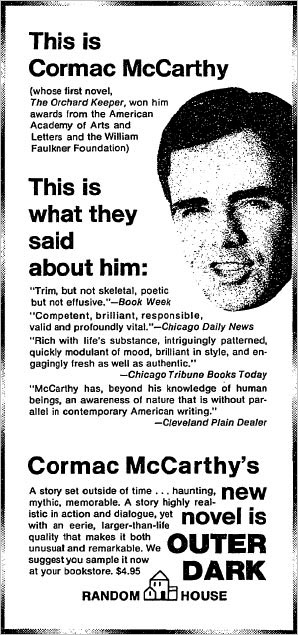
Well, of course some of them will. Had I started with Outer Dark, I feel pretty confident I would have continued to read McCarthy. After all, it's a work of bizarre, unique genius. But it's also one of the most gut-turning, unblinking and disturbing horror novels I've ever read.
More about that word "horror" later. First, I'll give you a brief idea of the story. Somewhere in the American South, probably around the end of the 19th century, a woman named Rinthy Holme is about to give birth. Her brother, Culla, is the father. Upon giving birth, Culla takes the baby (a boy, or "chap", as he's referred to throughout the novel) into the woods and leaves it there. He tells his sister that the baby died of natural causes. In fact, the baby didn't die at all, but rather was taken from its lonely patch of forest by a tinker (referred to only as "the tinker"). Rinthy discovers
her brother's lie, and, believing that Culla traded the child to the tinker, sets out to find her "chap". Shortly after that, Culla sets out to find Rinthy.
The novel tells its story in alternating chapters: one chapter following Culla, the next following Rinthy. Every third chapter, or so, is broken up by short accounts of three mysterious, unnamed, deeply dangerous men. These men begin to leave behind them a trail of corpses (one of the killers, "the bearded man", uses a large knife to "unhinge" a man), though the reasons behind these murders are mysterious, as is the connection between the killers and Rinthy and Culla.
As always, McCarthy's prose is striking: a bizarre mix of Hemingway, Faulkner, Joyce and the Bible, but still completely McCarthy's own words. As one might imagine, this mixture produces disorienting results. A clean, precise sentence such as...
It was later afternoon when they set forth again, out from the town, the wheels rasping in the sand, back down the yellow road.
...is followed up immediately by sentences like this:
Night fell upon them dark and starblown and the wagon grew swollen near mute with dew. On their chairs in such black immobility these travelers could have been stone figures quarried from the architecture of an older time.
That "starblown" is particularly Joycean. There are a lot of brand new compounds like that (see also "redgummed" and "spraddlelegged", along with many more). As with Joyce, this has the effect of very concisely and poetically describing an image by using words that, in effect, hadn't existed before. But also like Joyce, he can produce nearly impenetrable (or actually impenetrable, in the case of Joyce) passages that make you want to put the book down and not speak to it for a few hours:
It howled execration up the dim camarine world of its nativity wail on wail while he lay there gibbering with palsied jawhasps, his hands putting back the night like some witless paraclete beleagured with all limbo's clamor.
That was from the second of two paragraphs, back to back, early in the novel that made me begin to fear I'd pulled the wrong book from my shelf, when I read this about four months ago. I do find this kind of writing infuriating, and I don't really understand why the critical community doesn't also look at it a little askance. But it's so taken for granted with McCarthy that even the back cover copy of my edition can't help but get into the act, with its proud and giddy use of the word "fabular".
However, that kind of writing is very rare, and more often we get this kind:
Holme left the road and clambered up the rocky slope to give them leeway. The first of the drovers was beating his way obliquely across the herd toward him, the hogs flaring and squealing and closing behind him again like syrup. When he gained the open ground he came along easily, smiling up to where Holme sat on a rock with his feet dangling and looking down with no little wonder at this spectacle.
This scene, which describes Culla Holme watching a sea of hogs being herded through a field, will turn sour for Culla. Many of his experiences during the course of this novel do. Each of his chapters described him searching, often vainly, for work to support himself during his search for Rinthy. He's occasionally accused of crimes he didn't commit (while only the tinker, who we do meet again, is aware of the crime he actually did commit). Rinthy's chapters, on the other hand, describe her finding kindness and charity almost wherever she goes, though her search for the tinker and her son seems hopeless. Meanwhile, those three men have started killing people, and we gradually realize that we've met their victims earlier in the book, when Culla encountered them in his travels.
So where is all of this heading? It's heading, as is usually the case with McCarthy, to a kind of Apocalypse. (Spoiler) For McCarthy, in book after book, the sick, mad, shrieking end of humanity is represented by the violent death of infants. Babies are murdered by the handful in Blood Meridian; a baby is roasted on a spit in The Road (and though I don't wish to drag politics into this, I'd be remiss if I brought up this motif and didn't mention that, in No Country for Old Men, Sheriff Bell speaks very unfavorably about abortion). These infants are always faceless and nameless, but by being slaughtered so casually and motivelessly in Blood Meridian, or used for sustenance by depraved adults in The Road, their humanity is somehow heightened. This, McCarthy is saying, is as bad as it can get. Once this happens, nothing is salvageable. In Outer Dark we get this act presented, by its perpetrator, as a kind of infernal lesson, or as a rebuke. It's a way of saying to the one who witnesses it: See what you did?(End spoiler)
I've thought a lot today about the violence in McCarthy's fiction, and I think that, for myself, one of the reasons it's so jarring is because it's so uncommon in literary fiction. Other writers of McCarthy's stature and ambition have dealt with savage violence from time to time, but with those writers it tends to be a sort of experiment, or an itch that needed scratching before returning to their other work. But in McCarthy, grotesque, brutal violence is always there, and it's depicted at a level so graphic that the only equivelant in fiction I've seen is in the horror genre. But what I realized today is that, in horror fiction (of which I read a lot), if the book is especially violent it tends to also be especially bad. The truly great horror writers are generally more subdued about violence, often only suggesting the worst; if they deal with it straight on, they only very rarely dwell on it. But McCarthy takes the violence of "splatter" horror and weds it with the stark poetry of great American fiction. It's a jarring combination, almost appalling. And in Outer Dark, it's also otherworldly. The three killers float through the novel like ghosts, and they shouldn't know, or care, about the events of this story; they shouldn't know about Culla or Rinthy or their baby. But by the end, the bearded man seems to know more than he's saying. In fact, he knows more than we do.
Labels:
Blood Meridian,
Books,
Cormac McCarthy,
Horror,
No Country for Old Men,
Outer Dark,
The Road,
Writers
Subscribe to:
Posts (Atom)