Ramsey Campbell has a way of finding his way into these posts, if not every year than near enough. I've written in the past about my reservations about his work, but I think, I hope, I've made it clear that those reservations are of a substantially different sort than my reservations about, say, John Shirley. Campbell is a serious, talented writer, whose reputation, I'd say, is deserved, but whose body of work warrants a maybe more agnostic appraisal. So anyway, in a nutshell, that's where I stand. But since Campbell is such a serious (and I mean that in a good way, even though a lot of people these days consider "serious" to be a pejorative) and knowledgable writer, any time he feels compelled to offer up recommendations, I'm going to listen, not least because Campbell views the current ("current" meaning "about the last thirty years") state of horror fiction in much the same way I do -- in other words, he thinks a lot of it is bad, except for the stuff that's good, the problem there being the good stuff often does not announce itself, and needs the Ramsey Campbells of the world to do the announcing for it. Which isn't to say I always agree with his tastes, but I do more often than not. This all leads me to today's anthology, edited by Campbell and bearing the typically 1980s childishly "spooky" title Fine Frights. The concept behind Fine Frights is very simple: it is made up of horror stories that Campbell loves and would like you to read. There are few anthology concepts better than this one, really, and in approaching it for today's reading was a simple matter; any one of them, or two of them, could pay off. As it happens, my decision was made simpler yet by the fact that in a June post in which I essentially begged you people to help me, a reader going by the handle "frobbert" listed quite a selection that included a story called "Child's Play" by Villy Sorensen. This recommendation was seconded by noted horror fiction blogger Will Errickson, and so when I did an "internet-web search" for Sorensen's name, Fine Frights popped right up. Because "Child's Play" is in it, you see. But "Child's Play" can wait for a minute. It has been my habit over the years to, for some reason, confine myself to a rigid and strictly chronological structure in these posts, in that when I'm covering two or three stories in one post, I cover them in the order I read them, even if that means I close out with a shrug. "Child's Play" is not a shrug, and I'd like to end on that one. Not to say my other selection, "The War is Over" by David Case, is much of a shrug, either. In his brief story introduction to "The War is Over," Campbell tells a charming story of first meeting Case in the bar of a hotel that was hosting a horror writers' convention, the charming part being that Case and his wife were there just to drink, completely unaware that the hotel was full of other horror writers who revered him. And with good reason, so far as I know, though "The War is Over" is thus far my first experience of Case's work. And it's an interesting one. As the title implies, the story takes place post-war...some war, any war, I guess, though my mind took me to World War II, possibly only because that's where my mind usually goes when faced with the word "war." Case, though, refuses to specify nations or nationalities, the character names -- Maria Schell, Rudolf, Paul -- sounding vaguely European, or American (but probably European, for some unspoken logistical reasons, and anyway, "Maria Schell," but never mind). Maria is in love with Rudolf now, though in the recent past their countries opposed each other in the war in question, an apparently horrific one, as these things tend to be. But somehow this no longer matters, their former grievances lost in the murk of the actual countries, mattering on that plane, but not on theirs, and anyway if they can get past that, they can get past anything. As the story opens Rudolf is away, having a day out with Maria's daughter, Maria's husband having died in the war. Maria is feeling happy again, confident that her life with Rudolf is as assured as can be reasonably expected. As she returns to her apartment, she meets Paul, a wartime friend of Rudolf's who says he came by to speak with Rudolf. In his absence, Paul and Maria begin to talk, about the shared differences of their war experiences, and of Rudolf's own, and what he faced, and what he did. It's a simple story, and a good one, and one whose outcome I more or less figured out maybe halfway through. This is not a criticism, because while this is getting off the subject of whether "The War is Over" is any good or not (it is), what's interesting to me here is what led me to guess the ending, which is simply that I knew I was reading a horror story. Had I not known this, I might well have followed it blindly and unaware into that horror, but that knowledge, paired with the setting and the structure pretty clearly left only one possibility. And I wonder if genre writers think about this, specifically if Case did in this particular instance, if genre writers ever say to themselves "I write these kinds of stories and people know I write these kinds of stories, so pretending I don't as I write this one is an empty exercise but I have to do pretend because otherwise this isn't a story." This is not a knock on Case, or the genre, or any genre, or fans, or anthologies specific to a given genre, or anything at all, really. But it's a reality of genre writing, even if that genre is Stories About Divorce. At some point, you're gonna have to put a divorce in there. This, by the way, isn't even, or not quite, a matter of formula, which is a subject I do feel almost right on the brink of going off, perhaps even losing my shit, about. But no matter how much a writer refutes the very notion of "the requirements of the genre," you can't write a horror story that's about a happy child who takes a nap and dreams about daisies and wakes up happy and then that's it. "The War is Over" is a horror story, so the horror's coming. But, so, "Child's Play." Now this one, this is really interesting, and extraordinarily disturbing, for a number of reasons. It's also a hard story to write much about because it's rather short, and rather simple, and also rather predictable but here not because it's in a horror anthology and therefore etc., but rather because the ending is a tragically foregone conclusion. Villy Sorensen's small masterpiece is about two young brothers who have an uncle who hurt his toe, developed blood poisoning, and had to have his leg taken off. This is a subject of great fascination for the brothers. One day the two boys come upon another, even younger boy, who himself has injured his toe. Sorensen writes: A little boy was running barefoot alongside a horse and cart. He was trying to find out how a horse has four legs and yet still manages to run. But he quite forgot how he himself should run and suddenly he got such a pain in his big toe that it seemed as if there was no other feeling in his whole body. He hopped about on one leg and said, "Ooh!" and screwed up his little face that would never get any bigger. Well. That's on page two, by the way. Sorensen wrote "Child's Play" in 1953, it's rather gruesome in the way that only restraint can produce, and is all the more disturbing for the fact that the perpetrators of the horror have no clue what they are doing, there is not an ounce of malevolence fueling their actions. There have been horror films where there is actually, it turns out, no real villain -- The Sixth Sense leaps to mind -- but in those cases it turns out that the frightening moments can eventually be accepted as benign, if still eerie. "Child's Play" is more like Richard Hughes's classic A High Wind in Jamaica where the awfulness is unambiguously awful -- it never reveals itself to be merely sad, or even, actually, helpful -- but the blame lays only on the fact that children don't know any better, and can't know any better, and the mistakes that stem inevitably from this can be as nightmarish as the most premeditated cruelty. Sorensen of course meanwhile writes it all in simple, childlike prose, an eerily removed children's book author who can't stop what's coming, but he can tell you a story about it. And the last line is killer. |
Showing posts with label Ramsey Campbell. Show all posts
Tuesday, October 2, 2012
The Kind of Face You Slash - Day 2: He Doesn't Know What Dying Means
Wednesday, October 20, 2010
The Kind of Face You SLASH!!! - Day 20: Please God Don't Let It
.
I think what I'm going to do now, at least to close out the week, is slip back in time for a little while by revisiting horror writers I've already covered during past The Kind of Face You SLASH!!!es. The reason for this is twofold: first, last night I found myself in a bit of a panic because I hadn't picked out anything to read for today, and had no good ideas. There are always stories to choose from, but any sort of specific reason for choosing a given story was absent, and it's helpful to have one of those. The other reason is that, in some case, I feel like I've given major horror writers pretty short shrift -- I aboslutely gave both Peter Straub and Clive Barker short shrift last year, but in this instance I'm thinking of guys who aren't quite so close to being household names. So I have a couple of these posts on deck, and this weekend I'll be able to finish a couple of longer stories I'm reading, and hopefully be full of fresh ideas for the final week.
.
To begin this miniseries of posts, however, I've chosen writers who aren't covered by either reason for doing this I've given above. The first writer, Ramsey Campbell, I devoted two posts to in 2008, or a post and a half: one he shared with M. R. James, and the other was all about his novel The Face That Must Die. Meanwhile, today's second author, Michael Chabon, has only written two horror stories his entire career, and after today I'll have covered both of them. My
excuse is that I simply really wanted to read the two stories in question here, saw no reason to deny myself, and so there, that's it, that's all.
excuse is that I simply really wanted to read the two stories in question here, saw no reason to deny myself, and so there, that's it, that's all..
But back to Ramsey Campbell. My problems with his writing -- and I mean that very specifically, because much of what stops me short with him is his actual prose -- are, I would think, pretty well chronicled in the two posts linked to above. I think I've flat-out stated that I don't really know how to describe the problem, but in thinking about this post, and the Campbell story I read for today, I hit on a sort-of explanation, which is this: often with Campbell, I'm convinced that what I'm seeing in my head as I read is not what he's intending me to see, because what I'm seeing is far more clunky and not so evocative as what he must have been shooting for. This, I'll grant you, is a supremely unhelpful bit of criticism, and entirely unfair to Campbell, probably, but it happens to some degree every time I read him. For instance, in today's story, "The Companion", Campbell writes about a "green glow" (only once, I believe, and it's not a vital piece of the story, but more on that later). Now, green glows in horror fiction are among my most hated things. Nothing that glows green is ever going to read to me as anything other than a cheap special effect, and wherever that glow is coming from is immediately divorced from any reality that I can at least buy into for the time it takes me to read the story or novel. This is the closest I can come right now to illustrating why Campbell often makes me grind my teeth, although it's more than that -- he can be talking about something mundane, but describe it in such a way that it fills my head all lopsided and full of needless corners. I don't know if anyone else has ever had this experience reading anybody, but that's where I am with Campbell.
.
However, in "The Companion", there's also writing like this, decribing Stone, our protagonist, entering a "funfair", or amusement park:
.
But there wasn't much to see. The machines looked faded and dusty. Cars like huge armchairs were lurching and spinning helplessly along a switchback, a canvas canopy was closing over an endless parade of seats, a great disc tasselled with seats was lifting toward the roof, dangling a lone couple over its gears. With so few people in sight it seemed almost that the machines, frustrated by inaction, were operating themselves. For a moment Stone had the impression of being shut in a dusty room where the toys, as in childhood tales, had come to life.
.
But there wasn't much to see. The machines looked faded and dusty. Cars like huge armchairs were lurching and spinning helplessly along a switchback, a canvas canopy was closing over an endless parade of seats, a great disc tasselled with seats was lifting toward the roof, dangling a lone couple over its gears. With so few people in sight it seemed almost that the machines, frustrated by inaction, were operating themselves. For a moment Stone had the impression of being shut in a dusty room where the toys, as in childhood tales, had come to life.
.
Pretty good, I think. I chose "The Companion" because in the comments section of an earlier post, someone (I believe it was Bryce Wilson, but forgive me if I'm wrong) brought it up, saying that it was an exceptional story that might free me a little bit from my Campbell aversion, and also pointing me towards a passage in Danse Macabre, Stephen King's analysis of horror's history, in which King says:
.
Several collections of [Campbell's] stories are available, the best of them probably being The Height of the Scream. A story you will not find in that book, unfortunately, is "The Companion"*, in which a lonely man who tours "funfairs" on his holidays encounters a horror beyond my ability to describe while riding a Ghost Train into its tunnel. "The Companion" may be the best horror tale to be written in English in the last thirty years; it is surely one of half a dozen or so which will still be in print and commonly read a hundred years from now.
.
As a plot synopsis, that's actually pretty much it, or as close to it as you should be willing to get regarding a story that's only about twelve pages long. I also share his reticence to describe the story's final horror, though less because I don't think I could -- hell, I could just quote it! -- but rather because, well, that's the big moment. It's the story's whole reason for being. It's the reason it's called "The Companion". And reading that moment last night, I thought "Okay. I get it. This time, at least, I get it. It wasn't entirely smooth, getting here, but if I read more stuff by Campbell that was as eerie as this, or this close to just plain terrifying, it would be much easier for me to understand his reputation." I probably didn't think all that in just those words, but so what. "The Companion" is a very fine story that needs to be read to have any sense of why it's so good. King's praise for it is perhaps a bit excessive in my view, but matters of degree such as these are not worth arguing about.
.
So on to Michael Chabon, the Pulitzer Prize-winning author who I feel is quite overrated, but who has written a grand total of two short horror stories that I like very much. The background to Chabon's interest and dabblings in horror are discussed in the above-linked post, but basically this is something Chabon has been working through at least since Wonder Boys, before he'd revealed how heavily into genre fiction this capital "L" literary writer really was. He even announced a collection of horror fiction was in the offing soon after Wonder Boys was published, but it never happened. Still, Wonder Boys was 1995, and when his collection of stories Werewolves in Our Youth appeared in 1999, it contained a horror story called "In the Black Mill" (it was also attributed to August Van Zorn, for reasons also covered in that earlier post). That's the story I read in 2008, and I was pretty fond of it, despite making a sort of
gimmick, or gag, out the Lovecraft influences, such as naming the region in Pennsylvania where the story takes place "Yuggoghenny", which is a very Lovecraftian way to spell something. But Chabon powered through those nervous tics to produce a story of real originality and strength, with a killer ending. "More!" is what I demanded.
gimmick, or gag, out the Lovecraft influences, such as naming the region in Pennsylvania where the story takes place "Yuggoghenny", which is a very Lovecraftian way to spell something. But Chabon powered through those nervous tics to produce a story of real originality and strength, with a killer ending. "More!" is what I demanded..
Well, it's 2010, and here we have a whole brand new short story called "The God of Dark Laughter" (don't know where it first appeared, but I read it in the second volume of Peter Straub's American Fantastic Tales). Here's how it begins:
.
Thirteen days after the Entwhistle-Ealing Bros. Circus left Ashtown, beating a long retreat toward its winter headquarters in Peru, Indiana, two boys out hunting squirrels in the woods along Portwine Road stumbled on a body that was dressed in a mad suit of purple and orange velour.
.
I don't know about you, but that's a story I'm going to want to finish. Which I did, obviously, and what we have is Chabon attempting -- with some success, I believe -- to advance, or flesh out, his own version of Lovecraft's Cthulhu stories, complete with his own race of maniacal gods who live in space, and whose return to Earth will signal doom for us all. The way Chabon sees it, there is (at least) Ai, "the God Who Mourns", and what Ai mourns is the fact that the universe is a meaningless whirlpool of suffering; and then there is Ye-Heh, "the God of Dark and Mocking Laughter", and what he's mocking is the same thing that Ai is mourning. All of this comes from the acts of Yrrh (again, these letter combinations are all very familiar to readers of Lovecraft), the "father-god", who:
.
...an eternity ago, tossed the cosmos over his shoulder like a sheet of fish wrap and wandered away leaving not a clue as to his intentions...
.
Ai and his followers think that's terrible. Ye-Heh and his followers think it's hysterical. The murder of the clown, and its investigation by Ashtown's district attorney (our narrator) form the point at which those followers clash. And it all takes place in the Yuggoghenny region of Pennsylvania.
.
I still think Chabon should shed a bit of his, I believe, nervous and self-conscious attitude towards writing this stuff. It does seem to make him insecure, and if his ambition in this arena is to create a cycle of stories similar to Lovecraft's, then he should probably produce them at a rate faster than one every eleven years. But these are excellent stories, both of them, and I'm much more keen to see what this Michael Chabon does next than the one who rakes in the prizes and scales the bestseller lists and all that. This is the really interesting Chabon. More, please.
.
.
*The story can, however, be found in his later collection Dark Companions.
Friday, October 15, 2010
The Kind of Face You SLASH!!! - Day 15: The Dull, Dumb, Faceless Thing
.

There are two subgenres of horror that, these days, work almost like poetry, at least in a commercial sense. Those are the weird tale and its near-sibling, the ghost story. Together, these subgenres practically make up the entire core of horror, and most everything else grows outward from them. So far outward that only the whispiest of connections can be traced now, but that doesn't mean they're no long there. The relation to poetry is that nowadays weird fiction and ghost stories, even the best of them, are most often published by very small presses, whose market is the hardcore fans, mixed with the collectors -- this is reflected in the prices charged by most of these small presses. Not that all poetry is published by small presses, but poets are doomed to not make a living from their poetry, as ghost and weird fiction writers are, I'd say, similarly doomed, although I know nothing, and care to know nothing, about the various financial situations of these writers. But this stuff is no longer easily marketed, because it's no longer what people think of when they think of horror (as poetry is usually not what people think of when they think of literature). You sort of have to know what it is before you even know it's out there. In other words, I only know who Mark Samuels is, for instance, because I know what weird fiction is.
Similarly, I only know who Terry Lamsley is because I know that there are still people out there writing classical (which is not to say derivative) ghost stories. Lamsley's work is published by small presses, and as is often the case with writers so published, there is one book that gets sold at a price that wouldn't make a regular working stiff horror fan such as myself blanch at the idea of paying for it. With Lamsley, that book is Conference with the Dead, published by Night Shade books. In his introduction to Conference with the Dead, Ramsey Campbell -- who has an incredibly sharp eye for this kind of writing -- relates an interesting, charming and even inspiring anecdote about his introduction to Lamsley's work. In brief, he says that he was at a science fiction convention, and encountered Lamsley hawking his self-published collection Under the Crust (check out how much that one is currently going for online). Because Lamsley was standing right there, Campbell found it difficult to simply put the book down, having just picked it up for a browse-through, and also Lamsley hailed from, and set much of his fiction in, Buxton, where Campbell had met his wife. So he bought the book, and later that night, after reading some of it, called Stephen Jones and Karl Edward Wagner to announce the arrival of a major new talent.
Later in the introduction, Campbell says:
In this book Lamsley consolidates his reputation as an inheritor of all the qualities of classic English supernatural horror fiction: wit, detachment, an economy of effect bordering on the poetic, a seemingly effortless originality.
Yes, yes, yes, and yes, from what I've been able to tell after reading seven of the ten stories in Conference with the Dead. Reading Lamsley, I'm reminded of M. R. James, without thinking that Lamsley is simply treading old ground. You might come away from your first Lamsley story tempted to say "They don't write 'em like that anymore", if it weren't for the fact that Lamsley is alive and well and writing at this very moment (well, probably). The fact, or the theory, that his classicism is why Leisure Books, the most productive publisher of affordable, mass market horror fiction (new and reprints), hasn't come near Lamsley yet is both depressing and inevitable (and, for the record, Leisure Books puts out some good stuff on occasion, and they're far from a total write-off. I just wish Lamsley and his kin could get a look into that sort of deal).
For today, I read two Lamsley stories, the first of which, "Blade and the Bone", is the most M. R. James-y of Lamsley's many M. R. James-y stories. It tells the story of Ogden Minter, a man of late middle age, but still very active, who is on vacation with his wife, Poppy. Poppy hurt her ankle in a bike accident, however, and "Blade and the Bone" find Ogden on his own, tracking Poppy's antiquarian interests through the English countryside. Specifically, on this day, he's looking for an old church called St. Margaret, with the intent of taking photographs of the church and its surrounding, and of collecting any lore about the area he might pick up from the locals, all of which he plans on presenting to Poppy later in the day. We're told that Ogden not only doesn't share Poppy's antiquarian streak, but that he's lost a fair amount of interest in Poppy herself. Still, this is something to do.
.

At one point, Ogden is caught in a massive rainstorm, and seeks refuge in one of a group of abandoned cottages and huts. Inside, he finds a vast collection of abandoned tools, some of them apparently fairly old, even ancient, and some quite unusual:
He came up short then, because he suddenly found hismelf contemplating some very strange toolds indeed. If they were tools, in the normal sense! Occupying a spcae of their own, and isolated in a frame fixed to the wall, were a number of knifelike objects with curving blades and ornately carved handles. They were quite free of rust. They were obviously part of an incomplete collection, as they had been set out in the form of a tapering cross, and there were three gaps where the missing weapons should have been.
Weapons?
Suffice it to say, the history of these tools, or weapons, is eventually laid out, as is the history of the region, and of St. Margaret herself. "Blade and the Bone" isn't very long, but, like the fiction of M. R. James, it's rather dense, condensing centuries worth of information into one long monologue delivered in a tearoom by an old man. There's some very nice imagery towards the end of this story, as the early chill builds to a full blast of cold air, though quoting those passages would defeat the purpose of reading it for yourself. I will question the very ending, as I'm not sure what happens there necessarily significantly heightens the story's natural dread, though having thought about it for a little while now, I'm not sure where else Lamsley might have profitably taken the story. Even so, the final half page has a whiff of the obligatory about it.
The longer of the two stories I read for today is called "Screens", and I preferred this one, even heavily preferred it, to "Blade and the Bone", which I already liked a good deal. If I have any nit to pick, it's not with the story itself, but rather with Ramsey Campbell's brief thoughts on it in his introduction. And it's not even that I think Campbell is wrong -- in fact, I think he's probably right in his view of what's happening in this story. But if he is right, then that means "Screens" has an explanation, of a sort at least, and I feel it would be more effective without it. That's not to say that in Campbell's reading of it, the bizarre events of the story are suddenly reduced to Scooby Doo-ian hijinks, because no matter how you slice it, "Screens" is still a pretty bizarre story. It's just that with Campbell's take on things, by the end of the story you do have a "who", whereas, the way I initially read it, you didn't even have a "what".
All of which will hopefully makes far more sense to anyone who's actually read "Screens". If you haven't, the story is about a hapless, utterly luckless man named Andrew, who has just returned to his little home village of Longton after some weeks away on a business trip in Scandanavia. Andrew is divorced, and also slightly disfigured, due to a hang-gliding accident (Lamsley's fiction is full of this kind of strange, off-hand detail). He's not a native to Longton, and therefore feels like a perpetual outsider. This feeling is alleviated a bit by his friendship with his neighbor, a widow named Kate. Slightly older than Andrew (by seven years), the wags of Longton nevertheless find much about their relationship worthy of gossip. Though their relationship has not proceeded with anything like the pace the townspeople believe, it's reasonably clear to the reader, if not to Andrew, that he wouldn't mind so much if it had.
Eager to see Kate again, Andrew finds himself waylaid into chatting with an elderly shopkeeper who tells him that Kate hasn't left her home in a some time, and the people who have seen her at home have noted her disheveled appearance. Concerned, Andrew makes his way to her home as quickly as he can, nearly running over a young girl walking her dog, who suddenly walks in front of his car. He finally makes it to Kate's home, but he does indeed find her a different person, as described by the shopkeeper. She is disheveled, and she's nervous, distracted, occasionally overly enthusiastic...but strangest of all is the haste with which she shuts off her television when Andrew enters her home:
He pointedly looked away from her toward the television. The screen was mostly dark, but formless, off-white, slithering shapes that he could not identify drifted langorously across it from time to time. He couldn't make out what was going on. He leaned forward and squinted. The volume was low; he was unable to understand a word of the whispered commentary.
When she saw what he was doing, Kate pointed the remote at the set and touched a button. The picture shrank and shrank. There was a whirr and a click, and Andrew realised that he had been watching a video.
.
From the there, things will become stranger, and worse for Andrew, as the plot expands to encompass a missing child (possibly the girl who dashed in front of Andrew's car) and a bizarre gray figure Andrew sees first in Kate's backyard. The appearance of this figure allows Lamsley to get at the heart of this kind of horror writing, as he describes Andrew regarding it more in awe than fear, as his ability to provide context to the thing before him shuts down.
.
Summarizing the plot of short stories often strikes me as foolish, though I do it every day in October -- still, I'm cutting off my summary of "Screens" right here. Best that you just read it yourself. And once you do, if you agree with Campbell's take on it, fine, but I think he's possibly being a bit too...maybe not literal, but perhaps too analytical. Probably not that, either, but the fact is that his interpretation of "Screens" can be supported by what's on the page, but it cannot be fully confirmed. I think "Screens", like most, if not all, weird fiction and ghost stories, roots its horror far in the past, even in another world, or dimension -- specifically when and where, I don't know, but I think what's going on in "Screens" is greater in its portent than simply the hideous results of somebody's dabbling in the occult (which would have to be the implication of Campbell's reading, I think).
.
In any case, Lamsley is a very fine writer, who deserves to struggle far less in order to get his work out there. Such is the lot of pretty much all the best horror writers these days, and in some cases I suppose it's appropriate, in a certain sense. In life, as in the fiction, this kind of creeping dread has to be dug for.
Wednesday, October 29, 2008
The Kind of Face You SLASH!!: Day 28 - The Nightgown Wraiths
The story -- another long one -- is "Mr. Dark's Carnival", by Glen Hirshberg. Hirshberg is what is known as a "rising talent" in the genre: he's in his early forties and has a mere three books to his name, but he's raked in a healthy portion of award for his short fiction, and has earned praise from the likes of Peter Straub, Ramsey Campbell, and others. Campbell, in his introduction to Hirshberg's collection The Two Sams (from which "Mr. Dark's Carnival" is taken), compares him to M. R. James and Thomas Ligotti. Well then.
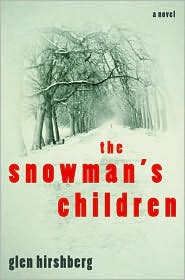
As it happens, earlier this year I read Hirshberg's novel, The Snowman's Children. That novel is more of a coming-of-age thriller -- a genre designation I may have just now coined, but which has a long history anyway -- than a horror novel, but I found it to be pretty skillful and intriguing, if a little too earnest. Hirshberg has really made his name with his short fiction, however, which I've always gathered is firmly and unquestionably horror, so I figured now was a swell time to dive in.
I was hestitant to pick "Mr. Dark's Carnival", as the title seems to hint that it's some sort of reflection on Ray Bradbury's Something Wicked This Way Comes, and, since I've never read that book (I should really stop admitting that sort of thing), I didn't want to read a 40-plus-page story that I wouldn't be able to fully appreciate. But Ramsey Campbell, in his introduction, said that the story deeply explored why readers and writers are drawn to fear, why we seek it out (or something like that), and considering that we're at the tail end of this horror project, I thought the story might be especially appropriate.
So here's what the story's about. In a small town in Montana, a college history professor named David Roemer is winding up his annual Halloween lecture, which deals with a bit of local legend. Back in the day's of America's Western expansion, and before Montana was officially a state, a man named A
From this grew a legend of a place called "Mr. Dark's Carnival", which was actually one of those haunted house attractions that go up around the world every Halloween. This legend is not gone into specifically, beyond the fact that there were apparently unusual invitations to the haunted house issued. But Professor Roemer claims that such a place never existed, that it is in fact only a legend.
Towards the end of his lecture, he gets word that a troubled former graduate student of his has committed suicide. This man's girlfriend, Kate, was also one of Roemer's former students, as well as one of his former lovers. He goes to comfort her, and, long story short, comes across an invitation to Mr. Dark's Carnival. Which he and Kate excitedly attend.
Frankly, I don't quite know what Campbell was on about in his introduction. All this story really explores is why people go to haunted house attractions, which is, if not self-evident, at least uninteresting. As you can probably guess, Roemer and Kate make it to the carnival, and find it far more elaborate and bizarre and intriguing than they'd hoped it would be. And as you can probably also guess, there are really only two ways this thing can end, and, again, neither one is
For instance, the subplot about the troubled ex-student who committed suicide seems poised to supply some unusual pay-off, either thematically or narratively, but all it does is provide the explanation for a rather tired twist at the end. What's ironic about the by-the-numbers quality of this story (which, in all fairness, is not a weakness from which Hirshberg's The Snowman's Children suffers) is that throughout Roemer's journey through the fake-or-is-it haunted house, any time he's not suitably impressed with what he takes to be effects or clever bits of misdirection, he expresses his disappointment about some standard bit of haunted house business that he's seen too many times in his life to count. Was Hirshberg not aware that he was practically begging his readers to make similar complaints about his story? Was that part of his point? I really don't think it was, and I'm left just feeling befuddled.
And remember when I said that one of the drawbacks of The Snowman's Children was that it was too earnest? Well, this next complaint is connected to that, although I'm not sure "earnest" is the right word here. But at one point, Roemer actually says the following:
Walking through a haunted house properly is a lot like making love.
Okay, well, that just about shreds it. If he'd said "Walking through a haunted house properly is a lot like fucking", I might have respected him more.
All right, well, that was a major disappointment, which is an odd thing to say about a story that isn't actually bad. When considered with other horror stories that revolve around Halloween night and haunted houses, it works perfectly well. I was just expecting more. I'm nowhere near done with Hirshberg -- not even close, really -- but I'll adjust my expectations accordingly next time.
Okay, well, that just about shreds it. If he'd said "Walking through a haunted house properly is a lot like fucking", I might have respected him more.
All right, well, that was a major disappointment, which is an odd thing to say about a story that isn't actually bad. When considered with other horror stories that revolve around Halloween night and haunted houses, it works perfectly well. I was just expecting more. I'm nowhere near done with Hirshberg -- not even close, really -- but I'll adjust my expectations accordingly next time.
Sunday, October 5, 2008
The Kind of Face You SLASH!: Day 4 - Trying to Do Something Positive
This should give you some idea of the realities of being a prolific, venerable, prize-winning and (perhaps most importantly) in print author of horror fiction: in 2000, or 2001, thereabouts, Ramsey Campbell, in order to supplement his income, took a job as a bookseller at his local Borders bookstore. I found this out when I read the acknowledgements page of the Campbell novel that grew out of that experience, The Overnight. I was stunned, and even alarmed, when I read that. As a reader of, and about, horror fiction, I've always been aware of Campbell's name. If you don't read horror fiction at all, you still know who Stephen King is, and maybe Dean Koontz. If you're a little more aware of the genre, you also know Peter Straub and Clive Barker. But I would think that if all you can manage is a casual interest in horror, you're going to know who Ramsey Campbell is. He's been called a "horror writer's horror writer", he's won many prizes for individual novels and stories, as well as any number of lifetime achievement and Grand Master honors. And he still had to take a seasonal position at Borders.
Campbell's first novel was the strikingly titled The Doll Who Ate His Mother, in 1976 -- I have no idea what kind of a splash that novel made at the time, but I know that now it's held up as something of a classic (and it's a novel I really need to re-read). After several film novelizations
written under a pseudonym, Campbell returned in 1979 with his second true novel, the also-strikingly-titled The Face That Must Die. From what I can tell, this novel is still regarded by many as Campbell's masterpiece. Of course, that title instantly conjures up visions of cheap science fiction and horror films from the 1950s and 60s -- perhaps Campbell's novel is about a scientist whose face was blown off in some sort of science-based mishap, and while his body died, his face lived on to destroy all who allowed the accident to occur. The Face That Must Die is sort of a strange title for this novel, because not only is it not like those old films, it's so unlike them that the fact that the title will ring that bell for many of its readers seems not to have occurred to Campbell.
What the novel is about is a man named Horridge, a paranoid loner with a bum leg who lives off his disability checks. He believes the world around him is going to rot, and Horridge blames foreigners, drugs, general permissiveness and, especially, homosexuals for this turn of events. He sees threat and mockery at almost every turn, and cant imagine why no one will do anything about it. Near the beginning of the novel, Horridge comes to believe that he might be able to contribute to the cause. In the papers, he's been reading about a string of murders. All of the victims appear to be homosexuals. Going about his daily business, he has cause to pass by a particular boarding house, and in the window of one of the rooms he sees a man's face. That face matches, as far as he's concerned, the police sketch of the face of the murderer. This is enough for Horridge, and he sets about trying to bring this man to justice, first by anonymously contacting the authorities, and later, when that doesn't work, through more extreme measures.
The face Horridge saw in the window belongs to Roy Craig. Craig is innocent of the murders, and he's also (and I just realized that this is a complete coincidence, used in part, excusably, by Campbell to get his plot moving) a homosexual. When Horridge begins making harrassing phone calls to Craig, the fact that the caller apparently knows about Craig's sexual proclivities weighs on Craig's psyche. But Roy Craig is not the protagonist of this novel, though I suspect he should have been. No, that role belongs to Cathy Gardner, a young woman who works at the local library, and is unhappily married to a drug-abusing pseudo-anarchist named Peter. They live in the same boarding house as Craig, and Campbell follows the unhappiness of their home life to almost the same degree that he charts Horridge's spin from paranoid delusion to murder. Of course, the lives of the Gardners eventually intersect with Horridge's, but Peter is obnoxious, and Cathy is a bit of a limp rag. I liked her far more than Peter, but hers is not an especially interesting head in which to spend time.
In any case, as I said, things eventually turn violent, which brings up two points. One, if this novel is going to be categorized by any genre, the "suspense" label seems far more appropriate to me. There are chases, situations where the reader knows something about a character that other characters sharing the scene don't know, long car rides at night where the driver is being forced by a razor-wielding madman to do his bidding...I guess it all depends on how far you're comfortable stretching the definition of the word "horror". In Peter Bogdanavich's wonderful film Targets, Boris Karloff, playing an aging horror film icon, points to a newspaper headline about a series of sniper killings, and says that his brand of high-toned Gothic horror is can't compare to this new kind of real-world horror. And maybe that was on Campbell's mind when he wrote it, but I have a sneaking suspicion that the The Face That Must Die was labeled horror because of the title, and because that's what Campbell writes, almost exclusively. It's also quite possible that my definition of "horror" is narrower than others.
The other point that the violent content of the novel brings up has to do with, well, violence. Up to this point in my reading for this project, violence as it's portrayed in horror has not been something I could really get into, because the stories haven't lent themselves to discussing the topic, but it's obviously a big subject, especially these days, when, for many people, violence is the point of the genre. The Face That Must Die allows me to kick things off, because, for all my
problems with the novel (a little more on those in a bit), I have to say that Campbell excels here. One of the murders involves Horridge bashing in a character's head with a blunt object. Here is just about the extent of Campbell's description of that:
Then he struck until his arm was tired. He could tell he'd done enough, by a change in the quality of the blows.
This does two things: it succesfully forces the reader to imagine the awfulness of what has just been done, and it gives you an idea of Horridge's mind and how it effects his morality, how easily it allows him to kill.
The other murder is, in a way, considerably more violent, but still just as restrained. So many modern horror writers absolutely wallow in the minutiae of the killings they described, and it's gotten to the point where many of these writers have fooled themselves into believing that such writing is an essential part of the genre, even though when they are so diligently cataloguing the viscera, they're almost always aiming for the cheap seats. Now, sometimes that sort of writing is, in fact justified. Not only that, I freely admit here and now that I have been, and will be again, an occupant of those cheap seats. A deliberate occupant. But I don't fool myself about why I'm reading that novel, or watching that film, and I know that what I'm experiencing at those times is far more often than not a bastardization of the genre. If you want to get into why I like that stuff despite what would appear to be some very strong objections to it, well, that will probably be a topic for another post.
So Campbell's on his game in those sections of the book. Where the book falls apart for me is when he introduces the completely superfluous gimmick of giving us the same scene from different points of view. The first time Campbell does this -- which also happens to be the novel's first murder -- it actually plays quite well. But then again, we don't really get the whole scene twice. When the first character's point of view ends (and you can imagine at what point it ends), we switch to the other character. There is no repeat of information. Every other time Campbell does this, however, there's no pay-off. The second murder is written the same way, with the result that Campbell ends up telling the reader things we already knew. Later, Campbell treats us to a lugubrious chase (for lack of a better word) that ends with no confrontation of any sort. Okay, fine, but why does Campbell feel the need to essentially give us the entire anti-climactic chase again? And all told, this takes up between 20 to 30 pages. Absolutely baffling.
Then the book ends with a long, by-the-numbers, but, nevertheless, occasionally hard to follow climactic showdown, and I found myself putting the book down with considerable disappointment. There was a reasonably well-done epilogue that added a bit of a sting to what had just preceded it, but in the end I was left with the same impression of Campbell that I've always had, which is that he's a very talented writer who doesn't recognize his own weaknesses, and who complicates his novels with occasional gimmicks and turgid prose. He would benefit from a much clearer eye.
Campbell's first novel was the strikingly titled The Doll Who Ate His Mother, in 1976 -- I have no idea what kind of a splash that novel made at the time, but I know that now it's held up as something of a classic (and it's a novel I really need to re-read). After several film novelizations
What the novel is about is a man named Horridge, a paranoid loner with a bum leg who lives off his disability checks. He believes the world around him is going to rot, and Horridge blames foreigners, drugs, general permissiveness and, especially, homosexuals for this turn of events. He sees threat and mockery at almost every turn, and cant imagine why no one will do anything about it. Near the beginning of the novel, Horridge comes to believe that he might be able to contribute to the cause. In the papers, he's been reading about a string of murders. All of the victims appear to be homosexuals. Going about his daily business, he has cause to pass by a particular boarding house, and in the window of one of the rooms he sees a man's face. That face matches, as far as he's concerned, the police sketch of the face of the murderer. This is enough for Horridge, and he sets about trying to bring this man to justice, first by anonymously contacting the authorities, and later, when that doesn't work, through more extreme measures.
The face Horridge saw in the window belongs to Roy Craig. Craig is innocent of the murders, and he's also (and I just realized that this is a complete coincidence, used in part, excusably, by Campbell to get his plot moving) a homosexual. When Horridge begins making harrassing phone calls to Craig, the fact that the caller apparently knows about Craig's sexual proclivities weighs on Craig's psyche. But Roy Craig is not the protagonist of this novel, though I suspect he should have been. No, that role belongs to Cathy Gardner, a young woman who works at the local library, and is unhappily married to a drug-abusing pseudo-anarchist named Peter. They live in the same boarding house as Craig, and Campbell follows the unhappiness of their home life to almost the same degree that he charts Horridge's spin from paranoid delusion to murder. Of course, the lives of the Gardners eventually intersect with Horridge's, but Peter is obnoxious, and Cathy is a bit of a limp rag. I liked her far more than Peter, but hers is not an especially interesting head in which to spend time.
In any case, as I said, things eventually turn violent, which brings up two points. One, if this novel is going to be categorized by any genre, the "suspense" label seems far more appropriate to me. There are chases, situations where the reader knows something about a character that other characters sharing the scene don't know, long car rides at night where the driver is being forced by a razor-wielding madman to do his bidding...I guess it all depends on how far you're comfortable stretching the definition of the word "horror". In Peter Bogdanavich's wonderful film Targets, Boris Karloff, playing an aging horror film icon, points to a newspaper headline about a series of sniper killings, and says that his brand of high-toned Gothic horror is can't compare to this new kind of real-world horror. And maybe that was on Campbell's mind when he wrote it, but I have a sneaking suspicion that the The Face That Must Die was labeled horror because of the title, and because that's what Campbell writes, almost exclusively. It's also quite possible that my definition of "horror" is narrower than others.
The other point that the violent content of the novel brings up has to do with, well, violence. Up to this point in my reading for this project, violence as it's portrayed in horror has not been something I could really get into, because the stories haven't lent themselves to discussing the topic, but it's obviously a big subject, especially these days, when, for many people, violence is the point of the genre. The Face That Must Die allows me to kick things off, because, for all my
Then he struck until his arm was tired. He could tell he'd done enough, by a change in the quality of the blows.
This does two things: it succesfully forces the reader to imagine the awfulness of what has just been done, and it gives you an idea of Horridge's mind and how it effects his morality, how easily it allows him to kill.
The other murder is, in a way, considerably more violent, but still just as restrained. So many modern horror writers absolutely wallow in the minutiae of the killings they described, and it's gotten to the point where many of these writers have fooled themselves into believing that such writing is an essential part of the genre, even though when they are so diligently cataloguing the viscera, they're almost always aiming for the cheap seats. Now, sometimes that sort of writing is, in fact justified. Not only that, I freely admit here and now that I have been, and will be again, an occupant of those cheap seats. A deliberate occupant. But I don't fool myself about why I'm reading that novel, or watching that film, and I know that what I'm experiencing at those times is far more often than not a bastardization of the genre. If you want to get into why I like that stuff despite what would appear to be some very strong objections to it, well, that will probably be a topic for another post.
So Campbell's on his game in those sections of the book. Where the book falls apart for me is when he introduces the completely superfluous gimmick of giving us the same scene from different points of view. The first time Campbell does this -- which also happens to be the novel's first murder -- it actually plays quite well. But then again, we don't really get the whole scene twice. When the first character's point of view ends (and you can imagine at what point it ends), we switch to the other character. There is no repeat of information. Every other time Campbell does this, however, there's no pay-off. The second murder is written the same way, with the result that Campbell ends up telling the reader things we already knew. Later, Campbell treats us to a lugubrious chase (for lack of a better word) that ends with no confrontation of any sort. Okay, fine, but why does Campbell feel the need to essentially give us the entire anti-climactic chase again? And all told, this takes up between 20 to 30 pages. Absolutely baffling.
Then the book ends with a long, by-the-numbers, but, nevertheless, occasionally hard to follow climactic showdown, and I found myself putting the book down with considerable disappointment. There was a reasonably well-done epilogue that added a bit of a sting to what had just preceded it, but in the end I was left with the same impression of Campbell that I've always had, which is that he's a very talented writer who doesn't recognize his own weaknesses, and who complicates his novels with occasional gimmicks and turgid prose. He would benefit from a much clearer eye.
Friday, October 3, 2008
The Kind of Face You SLASH!: Day 3 - We Mean What You Read
Reading that (and taking special note of the title of his autobiography), you might get the sense that the ghost stories whose fame keeps his name alive, were maybe not the most important thing in James's life. And you'd be right. My understanding of how James got into the ghost story business is that he was an enthusiastic participant in the English tradition of telling ghost stories to family and friends during the Christmas season. Having a fine imagination, and being a skilled writer, James turned out to be especially good at this, and so he took to writing down these stories, and eventually publishing them.
And he did indeed write many very good stories. I commend to your attention, among others, "Casting the Runes", "The Ash-Tree" and "The Mezzotint". But I would also suggest that you don't read too many of these stories at once, because I think you will find, as I did last year, that James's frivolous dealings with the horror genre might become apparent to you. If you're not especially invested in the genre, this probably won't bother you too much, but since I clearly am, I find the sameness of some of these stories, as well as a tendency to tie things up (not always too neatly, thankfully) through expository dialogue to be pretty frustrating. If only he'd cared more! He was so good at this, up to a point, that just a little more emotional investment in these stories could have...what, made them immortal? They already are, and many, many horror enthusiasts consider them among the best stories the genre has ever produced. And I suppose they are. I just wish they'd been written by someone who genuinely considered himself a horror writer.
For today's selections, I have picked James's "The Haunted Dolls' House", as well as another story by a different writer who I will get to shortly. The James story is about exactly what it claims: a man named Chittenden has in his possession a dolls' house of extraordinary quality, which he sells at a very low price -- so low that the buyer would have been suspicious had he not believed he was outsmarting the seller -- to a man named Mr. Dillet. After selling the dolls' house, Mr. Chittenden speaks to his wife:
"It's gone," he said."
"Thank God for that!" said Mrs. Chittenden, putting down the teapot. "Mr. Dillet, was it?"
"Yes, it was."
"Well, I'd sooner it was him than another."
"Oh, I don't know; he ain't a bad feller, my dear."
"Maybe not, but in my opinion he'd be none the worse for a bit of a shake up."
And a shake up is what Mr. Dillet has in store for him, because that night, after he's set up the dolls' house and gone to sleep, he's awoken by strange going's-on within the miniature house. As Mr. Dillet watches, he notices the dolls, who now look simply like tiny people, move about and enact some rather dark schemes. Not all of what goes on there is clear to Mr. Dillet, but it seems pretty clear that a murder, and possibly more than one, has taken place. The next morning, Mr. Dillet commiserates with Mr. Chittenden, does a little investigating, finds out some things, some spoilers happen, and that's it.
If I seem to be arrogantly dismissing a writer who is considered one of the giants of the horror genre, I really don't mean to be. James had great gifts as a writer: he was economical, funny, imaginative, and gave his stories a great sense of strangeness. The problem is simply that by the end of many of his stories, I got the feeling that he would rather be doing other things. He had a full life outside of this genre. This was a hobby to him. He was an expert hobbyist, but a hobbyist nonetheless.
One of his many devotee's is a writer considered to be one of the very best in modern horror, a Liverpudlian named Ramsey Campbell. In the story notes to his collection Waking Nightmares, Campbell talks about being asked to write a traditional ghost story for an anthology:
Now, I was becoming convinced (and still am) that many of today's horror writers are unaware of the traditions of their field. Indeed, one course on writing horror advises its students to avoid learning from the old masters, as if there aren't already too many writers who appear to have read no fiction older than themselves. I therefore welcomed the chance to demonstrate that the techniques employed by M. R. James are as valid as ever.
I'd like to know the name of the person running the course he talks about, so I can punch that person in the stomach. Because, despite my reservations about M. R. James, he was gifted, and much better, in many ways, than the vast majority of horror writers who have succeeded him, especially those working today. Campbell uses the word "techniques", and I'm not sure I can
describe this as that, but James at his best (which "The Haunted Dolls' House" isn't) is able to draw the reader along with little mysterious touches to his stories that build both in size and strangeness until the reveal out-bizarres everything that went before, and, hopefully, leaves the reader more chilled by the solution than he was the build-up. Nowadays, the "solution" to horror stories and novels renders all that build-up irrelevent, because the point to which it was all leading is boring, and rote, and a waste of time.
The story Campbell ended up with is called "The Guide", and it's about an old man named Kew who is vacationing in the Suffolk and Norfolk area of England with his daughter and her family. Kew, as it happens, is a great fan of M. R. James, and he spends a fair chunk of his vacation trying to locate a collection of his ghost stories. Oddly enough, he does find a book by James, but it turns out to be a guidebook James wrote to the very area in which Kew is vacationing (James really did write such a book). Seeing this as better than nothing, Kew buys the book, only to find mysterious scribbles in the book's margines:
churchyard on the cliff -- my old parish.
and
There was a man so versed in the black arts that he was able to bide his time until the elements should open his grave...
The guidebook is a very old edition, and Kew begins to wonder if the scribbles, which he gradually finds it easier to decipher, might not have been made by James himself, perhaps as notes to a story he never completed. Using the guidebook, and the clues in the notes, Kew gets his family to drop him off in the area where he believes the aforementioned "churchyard on the cliff" to be located. He meets an innkeeper, finds the church, someone who might be a priest, and something else entirely.
The ending to this story is very unnerving, and I think this is one of the most successful stories I've read by Campbell. I've read a handful of his stories, as well as three novels, and I've always had a hard time with him, because to further my frustrations with this genre, Campbell -- who is incredibly smart about horror -- is twice as sincere about this kind of fiction than James, while at the same time being half the writer. For example, am I the only person who finds this passage more than a little sloppy?
It seemed he had no choice, for his body was audibly withering, a process which dragged his head down to show him what had become of him. Barely in time, his cry awakened him.
Him him him. His his. That whole thing needs to be recast, I think. Or this:
...he let the book fall on the grass, where it fell open at the scribbled page.
Why not, at least, "dropped" instead of "fell"? And I don't think I'm picking nits, here.
I'll get into Campbell more in a day or two. I'll be finished with his novel The Face That Must Die sometime this weekend, and with that novel, whatever I may finally think of it (to be fair, it's very intriguing so far) I will have made the leap into the modern age of horror fiction. And we'll see how that goes.
Labels:
Horror,
Horror Project,
M. R. James,
Ramsey Campbell,
Writers
Subscribe to:
Posts (Atom)