Showing posts with label James Cameron. Show all posts

Tuesday, March 27, 2012

Say Goodbye

I've heard it said that if you don't care for James Cameron's Titanic, or rather if you say you don't like James Cameron's Titanic, because as we shall see the former is an impossibility, then the only reasonable conclusion to be drawn is that you are a liar. Because Titanic is "impeccably crafted." I think there's generally more to the argument, sometimes something to do with special effects and spectacle, but mostly focused on how impeccably crafted the whole thing is. But I don't like it. I don't. I find it a turgid sprawl of basic ideas poorly executed, at least up until the ship actually sinks, at which point the film does attain a level of tragic splendor. This occurs, interestingly enough, only when Cameron shifts focus away from his star-crossed lovers and spends some time with the nameless masses of passengers and crew as they slip and tumble into the Atlantic. Cameron's "Nearer My God to Thee" montage is very affecting, the single best part of the film. I just find it curious that out of a three hour film, the most concentrated bits of emotional payoff come from people the script had no reason to give names to. Whatever the creative foundation for these moments is, I've always felt it was a shame that Cameron couldn't have built his entire film on it.

Thankfully, someone already did. Roy Ward Baker and screenwriter Eric Ambler's A Night To Remember, which James Cameron has doubtlessly seen a billion times, and which Criterion is re-releasing today on Blu-Ray, is such a film, an almost clinical, though hardly cold, step-by-step dramatization of what led to this tragedy on April 14, 1912. It focuses on the pure history of the event, centering its story on Second Officer Charles Lightoller (Kenneth More) and Thomas Andrews (Michael Goodliffe), the designer and builder of the Titanic. Lightoller stands in for the businesslike heroism that is expected of the crew of a sinking ship, and many of my favorite shots in A Night to Remember are of crew life on the ship after it has started going down. Some of these have the air of a store closing down for good, rather than one of impending doom, which somehow makes it all the more chilling. Baker portrays the sinking of the Titanic as almost ridiculously slow -- slow enough that the passengers who don't fully understand their predicament find it easy to remain in denial until the water is at their shoes.

One of the best sequences in the film mirrors these shots, as Baker portrays the eerie quiet of the Titanic before it hits the iceberg. This being a film based on one of the defining events of the 20th century, you know what's coming, and our tension is heightened by seeing waiters cleaning up a dimmed dining room -- this is a store closing for the night, as opposed to for good -- and, for instance, the strange, slow zoom on a rocking horse, a shot I love perhaps beyond reason, or at least beyond easy definition. It has something to do with an object so easily set in motion shown in a moment of utter stillness.

If Lightoller represents businesslike heroism, Andrews represents businesslike despair. "She's going to sink," he tells Cpt. Rostron (a terrific Anthony Bushell), after laying out his case that the disaster is a "mathematical certainty." With nothing to be done to reverse things, Andrews settles into the task of saving as many lives as possible, resigned to, if not exactly comfortable with, the knowledge that his own life won't be among them. "Are you not even going to try?" a crewman asks Andrews, who is standing alone and blank in one of the ship's upper-class lounges, as the Titanic's begins sinking faster by the minute, and is met with an almost cold glance. Andrews's fate is, in his mind, as much of a mathematical certainty as that of his ship.

A Night to Remember (a title, obviously, taken from the Walter Lord book from which the film is adapted, and about as good a title for this story as I can imagine) has a grimness about its details that Cameron never matched. At his best, Cameron was occasionally able to depict the sadness, but he never managed the horror. Baker and Ambler manage it, and without fuss. As people struggle to survive in the freezing ocean, a man (George Rose's drunken baker) clings to the side of lifeboat until someone's death makes room for him to scramble aboard. Another man pulled from the waters implores Lightoller to save the child he is carrying, unaware that the child is already past saving. The simple shot of Lightoller glancing at the other men on the boat to indicate that the child is gone, but to say nothing to the man, ends with Lightoller placing the corpse back into the water, and a quick fade-out, as if Baker can't bear to linger on it.

A Night to Remember is a superb historical drama whose simplicity of style, when applied to such a big event, does honor to that event in a way that spectacle never can. It's perhaps bad form to use one film to beat up on another, but the truth is that Cameron's Titanic has always rankled me, especially when a corrective to his film was already made, forty years previously.

Sunday, May 16, 2010

Neytiri Calls Me Skxawng

Yeah, so, I watched Avatar. Or as I like to call it: The John Walker Lindh Story. Ah, see, because at its heart James Cameron's insanely successful science-fiction epic is an allegory about the Iraq War, with US Marine Jake Scully (Sam Worthington) finding his sympathies shifting from US/Earth interests to those of the Na'vi, the humanoid inhabitants of Pandora. And Pandora is the planet the US/Earth Marine/mercenaries are set to plunder for natural resources, and they're willing to bomb the shit out of everything to get it, and the phrase "shock and awe" is used in relation to the military tactics used by the Earth forces. Also, this time around the US blows up the World Trade Center. It's all very confusing.
.
This latter detail highlights why I won't be getting into the politics of Avatar -- or indeed any aspect of Avatar -- very deeply. The basic reason is this: while the politics are there in Cameron's film, and while I detest them, they are also completely moronic, barely thought out, and utterly toothless. They're also kind of an afterthought. Cameron has been kicking around the idea for this film for a very long time, or so I understand, and I doubt the Iraq War and Sept. 11 material was always on his mind. When he got around to actually making the film, he just threw everything in, getting so mixed up in the process that he credited his Sept. 11th allegory to those who were, in reality, the victims of it (the crumbling WTC, incidentally, is evoked in a scene where US forces launch a missile strike against the Na'vi's very best tree), but he never really cared about it that much. I mean, he meant it, but he didn't care about it, because James Cameron is essentially a gearhead, or a tech-geek; what matters to him is creating big worlds with big effects, the likes of which haven't been seen before (well, on movie screens, at least -- book, magazine, and album covers are another thing, because those can't move). Ultimately, and broadly, I'm ready and willing to give the political aspect of the film a pass, or ignore it, because it's clear so little effort was put into it. The only thing I really object to is being forced to notice the analogy, and then asked to not follow that analogy through to its logical conclusion, which should be self-explanatory to anyone who watches Avatar and makes note of the rooting interest Cameron wants us to take up.
.
But anyway! So with the politics dispensed with (in a more involved fashion than I'd planned, but oh well), what's left? Top of the line special effects, occasionally stunning imagery, all to the service of a nearly three hour film, most of which time is taken up with learning how all our brains are connected to trees' brains. Avatar is a thuddingly dull film for great stretches, with no new ideas, but some pretty great technology at its disposal. The whole film is a rehash, sometimes of classic science fiction, sometimes of Cameron's own films. Giovanni Ribisi's Parker, for instance -- the casually evil corporate goon who's behind all this -- is just a less-well imagined, boiled down version of Paul Reiser's Burke from Aliens (by the way, I've heard some people criticize Ribisi's performance, but I think he does a pretty good job of playing the character as written; it's the character as written that's the problem), and Michelle Rodriquez's tough-girl pilot, and the whole space marine thing, are from Aliens, too (and, erm, from Heinlein's Starship Troopers).
.
But let's not get bogged down with where Cameron's ideas came from. If he'd done anything with them, nobody would care, but there's a shocking absence of drama in all this. When things really start to heat up, a major character is killed off in one of the lamest death scenes I've ever witnessed in a film like this. It's as though Cameron took it as a given that we'd be moved, so he needn't bother. The fact that the character dies, and is then taken by our heroes to the Na'vi who are asked to save this person using their native magic, the final prognosis being, in essence, "Nope, sorry, she's too dead", signalled to me that things were edging away from the dull into the unintentionally hilarious.
.
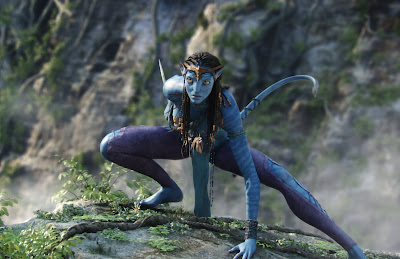
In the credit where credit is due department, I should say that Zoe Saldana's performance as Neytiri, our window into the Na'vi's world and Scully's love interest, is quite good. I don't know if this is because she threw herself into the job of motion-capture performance with an unusual amount of gusto, or if the computer whizzes who worked on her character were particularly on their game -- I don't know how this stuff works, but it's probably a bit of both. In any case, Saldana provides the story with far more life than any other element in the film. Not a hard distinction to achieve, however, since more than any other Cameron film -- and I'm generally not a fan -- Avatar feels like a jumble of technology that needed some sort of basic and self-consciously earnest story as an excuse be used.
.
- - - - - - - - - - -
.
The Collection Project Film of the Day:
.
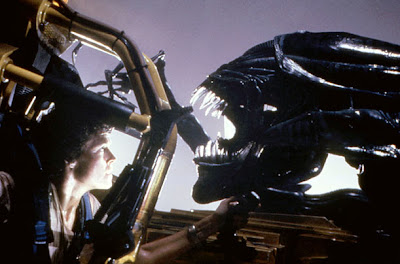
Contrast all this with Cameron's Aliens. This is by no means a perfect film -- for one thing, God is that fucker long, and, related to that, it doesn't know when to quit -- but there's a tension to it that never lags. A good hour of the film goes by before we encounter any alien mayhem (said mayhem, by the way, when the Marines get ambushed after they've been made to give up their ammunition, is actually much thinner than I remembered it; the shit hits the fan, there's an explosion, then a bunch of fuzzy monitors and yelling), but Cameron never lets the audience's attention wander. When the film first came out, part of this effect was, no doubt, attributable to the anticipation created by Ridley Scott's original film (and the idea that Cameron's sequel is somehow better than Scott's is an objectively provable untruth that needs to die), but the fact that I still felt that tension yesterday says something. The fact that, after two hours, I was also saying "Shit, Bishop still hasn't been ripped in half?? How much longer does this thing go on!?" says something, too.
.
There's also the, or some, performances in Aliens. Avatar has Saldana and, sort of, Ribisi (I'm not sold on the opinion that Stephen Lang's villainous Quaritch was anything special), and that's it. Aliens has a rock solid central performance from Sigourney Weaver, typically easy and strong work from Michael Biehn, and Paul Reiser, who, against all logic, is really good as the odious Carter Burke. The facts of his awfulness are pretty over-the-top, but Reiser really sells it well, especially when he's been found out, and is being interrogated by Weaver, Biehn and Bill Paxton. Reiser plays Burke as a skilled liar who is unsure if this talent can save him, but it's all he's got left.
.
And what about those special effects? Obviously, the film was made before the CGI era, and there's a moment in Aliens when, after the shit has hit the fan, our surviving heroes are hustling to meet their command ship, which they hope will whisk them to safety. That ship has been infiltrated by aliens, and the ship crashes right in front of our heroes. I don't believe that a spaceship has ever actually crashed only a few hundred feet away from Sigourney Weaver, but you'd never know it to watch that footage. It's seamless. Meanwhile, in Avatar, even at its absolute, considerable best, you think "Man! That is only barely a cartoon!"
.
I'm not anti-CGI, and defend it often. But when a film completely lives on those effects (as well as the 3D Imax presentation, which I didn't experience, so I don't now spend my nights wishing I could live in the movie), as Avatar absolutely does, it's hard not to wonder what the big deal is, and why so many people care so much. What would have been great is if, with Avatar, Cameron had created those same effects, and had attached them to a story that was engaging right off the bat, before a second of film had been shot.

Saturday, July 18, 2009

Talk About Your Missed Opportunities


Watching Terence Malick's Days of Heaven again, for the first time in a while, I was reminded of this exerpt from an interview with film composer James Horner, regarding Horner's work on Malick's The New World:

I would sum up Terry as a brilliant photographer - and that's where it stops. The images in The New World are stunning, in Thin Red Line are stunning. In Thin Red Line he was surrounded by a couple of three or four people, a wonderful editor, a wonderful sound effects person who guided him through the dubbing and a couple of other people. And on The New World they were not employed. And Terry shot The New World and the whole idea of The New World was going to be a love story between John Smith and Pocahontas. And there is no reason in the world why it could not have been as great love story as Titanic was.*

I know! If only, right? Why can't Terence Malick, a filmmaker whose head is full of poetry and images and who is willing to follow his story where it leads him, instead of dragging it, spitting and kicking, after him be more like James Cameron, whose head is full of technology, and who would probably fire half his crew if anything ever happened on one of his sets by accident. With Days of Heaven, Malick takes his story, which is at root a potboiler, and makes it Biblical. With Titanic, Cameron took tragic history and turned it into television.

Okay, I thoroughly dislike Titanic. I understand that many people like it, and I'd rather not fall into the trap set up by Horner, intentionally or not, of comparing and judging one filmmaker against another, especially as the two have almost nothing to do with each other. But isn't it interesting that Horner seems to think that The New World would have been better had it been more like a film that had already been made (a film for which Horner's score won an Oscar, not incidentally)? What a blinkered view of film he must have, and how interesting that the opinion comes not from a studio suit, but from someone on the creative side of filmmaking. This also reminds me of something Owen Gleiberman said in his review of Wes Anderson's The Darjeeling Limited, which was, roughly, that he expected Anderson to be able to make a really wonderful film some day, if he could just stop being Wes Anderson. In other words, if only he'd subsume himself into the machine. Let your instincts and point of view fall away. Don't make the films you want to make -- make the films I want to see. And that's a film critic talking, folks, but it's the same thing with Horner and Malick. Gleiberman wants Anderson to lose his individuality, and Horner wants to write the score for a movie that's just like that other movie he wrote that other score for. You know the one. It's where Leonardo DiCaprio teaches Kate Winslet how to spit, and then he falls off a boat.

Perhaps I'm making far too much of these couple of quotes, but Days of Heaven is such an original, beautiful and haunting movie that Horner's belief that Malick would be a better filmmaker if he'd just model himself on the guy who wrote a scene in one of his movies where a big robot asks a teenager what crying is, really and truly fries my ass. He said it three years ago, and I'm still chapped about it. That's what seeing Days of Heaven again for the first time in about ten years will do to you. It instantly makes you the enemy of anyone who has ever said a word against Terence Malick.

So watch it, you!


*This is from an audio interview, all the links to which seem to be dead now, though if you do a search for "James Horner interview Malick", you'll find plenty of references to it. In any case, I came across the transcipt portion quoted above some time ago here.

Followers