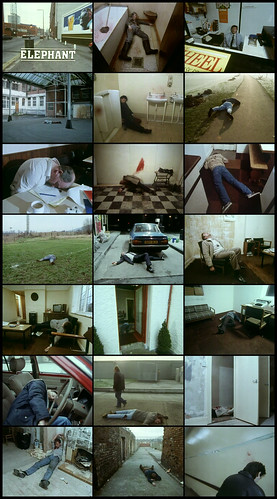
The reputation of Alan Clarke, the British film and TV director who passed away in 1990, rests primarily on four films: the TV films The Firm about soccer hooligans starring Gary Oldman and Made in Britain starring Tim Roth as a skinhead, his unusual, bleak, near-silent short film Elephant, which consists entirely of a series of brief scenes depicting seemingly random murders, though the context of the times in which it was released made it clear that Clarke was commenting directly on the Troubles in Northern Ireland, and Scum, a movie Clarke made twice, first for TV in 1977, and then again, because the original version was censored, in 1979 as a theatrical feature. Scum has just been released on DVD and Blu-ray by Kino Lorber, and I watched it last night.
Though fascinated by Elephant, I recall being dubious about The Firm (I haven't seen Made in Britain), so I believe my expectations were reasonable going in. But I do have a certain wall up when it comes to what appears to have been Clarke's philosophy, or part of his philosophy, for making films. If you're not familiar with his work, you should at least be able to tell from the not-even-thumbnail sketch of what three of his most famous films are about that Clarke was a socially-minded artist, one who wished to open the audience's eyes to what he viewed as certain social injustices or issues of the day. Okay, but there are problems inherent in this approach that I think Clarke illustrates quite handily in Scum. Scum stars a very young Ray Winstone as Carlin, who, when we meet him, is being dumped into another in a series of borstals -- what we in America might call "juvie" -- and he comes with a reputation as a tough kid, maybe a thug, bad news in any case. It is the plan of the adult administrators and guards at this new borstal to break Carlin, and to do so they place him in the same dormitory as Banks (John Blundell), the young inmate who currently runs the borstal's population through brutality. Carlin seems to not be too bad a guy, really, and along with the meek Davis (Julian Firth) and the smirking, rebellious Archer (Mick Ford), the three of them form a kind of moral coalition within the dangerous and unforgiving prison.
But here's my problem. When you read about movies, and you read the opinions people have about movies, often you'll find the complaint that a given movie has "two-dimensional characters," and, should the occasion call for this distinction, "two-dimensional villains." Myself, this kind of talk about film characters is exasperating, more often than not, for reasons not particularly relevant at the moment, but there are, I've noticed, a few exceptions to the rule that villains should not be "two-dimensional" (or "cardboard thin," if you like). First there's certain kind of action movies, which exist for reasons that render this whole point moot, but after that you're also given the all-clear to depict your villains thoughtless, uncomplicated sadists just for the sake of it all in satire, and in social issue dramas. Satire I could go on about, and I shouldn't, but okay basically what satire is now, as it's practiced today, is, is it's a license to boil the complexity out of current events because that's funny and because people will say "Hey you're pretty smart!' and then you go "I know I am!" and then when you don't make any money you can say "Man I wish people would embrace satire as a form" and the first guy will see "I agree." That's what satire is used for now. But moving on, you get to do this in social realism dramas, which is what Scum is. And please understand, it's not that I think Scum is wrong. The film takes a stance on borstals that is somewhat less that laudatory, but I will readily admit that the state of juvenile prisons in England over thirty years ago is not really my area of expertise. So in terms of what Scum is aiming for -- it's "point" -- it, and Clarke, could be dead on the money. But I'm less likely to accept that a filmmaker is in a position to make such a point if he or she sets up the adversaries of that point in his or her film as the kind ridiculously vile caricatures Clarke offers here. In order to intelligently debate a point of view, you're supposed to be able to counter the most intelligent argument the opposition can mount. Most artists who are drawn to making issue films of this sort have no interest in going that deep, so that you actually have a scene where Archer, the smart inmate, has a conversation with one of the few sadism-free prison administrators, and of course Archer, who's been in the system for a little over a year, talks circles around the man who has worked in it for thirty. Young people is where it's at! Maybe. Anyway, it's transparent nonsense -- not Archer's argument, necessarily, but the absence of any other argument, even coming from the one character who might actually have one. This, meanwhile, is the best of this sort of thing that Scum can manage. Otherwise, the prison admins do thing like look through a window at a young helpless boy being gang-raped by three other inmates, and smile. That's the argument that Clarke has it in him to tear down.

None of this is why I watch movies, though, so how is Scum with that removed? Pretty good! Ray Winstone is extraordinary -- he was something like 22 or 23 at the time, but he seems at that time to have already grown into his considerable talent. I know Winstone is kind of ubiquitous now, and everyone's pretty sure they know how good he is, but the reason for that he's ubiquitous is Scum, which kicked off his career in England, and his performance in fellow Alan Clarke alum Gary Oldman's Nil By Mouth, a performance that made everybody who saw it say something along the lines of "Holy shit." In Scum, Carlin is a guy who clearly has an anger problem, but isn't some kind of monster (he's not a warden for Christ's sake!), and for much of the film Winstone has to play Carlin's anger and desire for payback as something that he has entirely under control. Think about that -- it's not really bubbling just under the surface, which is a way to play both things at once. Winstone has to play one thing in a way that makes you aware that Carlin has the other thing taken care of. I don't think that's a common type of performance. Of course, eventually Carlin snaps, as he must, and that's actually a bit of a disappointment, but oh well, Scum is a prison film at heart. And as such, Clarke makes it very hard to not think about Robert M. Young's Short Eyes from 1977, the same year as the TV version of Scum but two years before this version, though the similarities here may be entirely superficial -- it's been a while since I've seen Short Eyes. But I thought about it a lot. Regardless, more clearly a source of inspiration is Milos Forman's One Flew Over the Cuckoo's Nest, to a degree that I might regard as unfortunate if Clarke didn't pull off his version of certain moments his own blunt aplomb. Plus, in fairness, Scum passed its DNA off to, among other films, Rick Rosenthal's Bad Boys from 1983. I'm thinking of a particular scene here, involving snooker balls in Scum and cans of soda in Bad Boys, that is, in its own nasty and vicious way, hugely satisfying. Which is the thing about Scum, and about Clarke -- whatever issues I take with the way Clarke chooses to depict what I believe he believed was the most important facet of this movie, the social element, he was a gifted enough artist to overcome that and create a film that is powerful as a work of art. Despite many, many claims to the contrary, these are different things, and different goals. Clarke's art succeeds, and his lecture fails, but who wanted the lecture anyway?