Okay. Really, really quick one today. The last few days I’ve thought these would be quick, and then they aren’t, really, so I’ve engineered this one specifically to zip by. Time, she is crowding me.
What I do every October when I want to write something short is I plum the contents of a couple of anthologies that I have which are dedicated to the short, short horror story. Some of these are eight or nine pages, which is bullshit, because none of these should be longer than five or six pages at the most. So that’s how I scour for these, going by page count first, then author and title. And frankly, I don’t think this is working anymore. Yesterday I read two stories using this method, both taken from a book called 100 Creepy Little Creature Stories (the cuteness of this title is something I kind of resent): “The Fisherman’s Special” by H. L. Thompson and “Smudge Makes a New Best Friend” by Peter Cannon – neither author was familiar to me, but something about the title of each made me curious. That’ll show me, I guess because neither one is worth the effort to talk about at any length.
In fairness to “The Fisherman’s Special”, it was written somewhere between 60 and 80 years ago – the copyrights page of the anthology in question is really vague on the matter – so at the time it was originally published the story’s kicker might have had more impact. But even then, the idea behind the story had to be ancient. Our narrator is on a train sitting next to a stranger. For one reason or another, the two of them get to talking about old legends and folktales, and the stranger insists that back where he’s from, Sweden, werewolves are actually a thing. Then a he proceeds to tell a story about two brothers and a volatile love triangle and lycanthropy, as well as a tell-tale wound suffered by said lycanthrope, and so you’ll never guess who winds up bearing a similar wound. I’m not sure what there is of worth to say about something like this, except that our narrator has only heard this story told, he didn’t witness any of it, so the fact that his seatmate has a wound like the one the werewolf has in the story, proves absolutely nothing. If I told you that I’d heard a story about a guy who turned into a creature from the Black Lagoon, and while he was the creature someone put out a cigarette on the back of his hand, and then I showed you my hand and there was a burn scar on the back of it, would that prove to you that I was actually a creature from the Black Lagoon? If you’re the narrator of “The Fisherman’s Special”, then yes it would.
Meanwhile, the even less said about Peter Cannon’s “Smudge Makes a New Best Friend” the better. This thing is from 1993, and maybe I just don’t get it. I mean, I GET it, but I don’t get it. A guy meets a girl, they get together, they end up at her place, and he meets her cat, Smudge. He likes the cat, but it has a habit of kneading an old stocking the girl leaves out for her, and drooling on it, because, Smudge’s owner says, as a kitten he weaned too soon. The guy thinks it’s gross, but whatever. Until he starts living in the girl’s apartment, and much as he likes the cat, he really can’t take this habit, and asks the woman to take Smudge to see a…a cat therapist. But instead of doing that she puts something in the guy’s drink one day and turns him into a cat, who also kneads and drools over articles of her clothing. THE END.
So what is this? Is this some sex thing? The implication is that Smudge is also a former human and suitor, so is this kneading and drooling some vestige of their human desire for the woman? If so, then shouldn’t the intensity of their physical relationship have been highlighted in some way? Or even mentioned in any way at all? As it is, they seem to fall into comfortable domesticity almost immediately.
Something similar, but admittedly less egregious, is going on in Gary McMahon’s “Strange Scenes from an Unfinished Film”. See, being fed up as I was, I decided to turn to another anthology, this time the 2010 edition of Paula Guran’s The Year’s Best Dark Fantasy and Horror, which I knew to contain some stories much shorter than you tend to find in those kinds of collections. The core of McMahon’s story is, by now, no less a cliché than what Thomson was up to in “The Fisherman’s Special”, but I fall for it every time: mysterious film director, specialized in horror, lost film has been found, horror ensues. The problem here, or one of the problems, is that in keeping his story down to about six pages, a decision I’m at a loss to understand, McMahon has no room to build up any sense of the looming, deceased film director, named Reef. The narrator is interested in him because his dad was once an extra in one of Reef’s films. And his horror output is described as “controversial.” That’s pretty much all we get, yet this lost ten-minute film at the center of “Strange Scenes from an Unfinished Film” is sought after mightily, and would be a huge windfall for anyone who found it. But why the obsession? No clue at all.
What transpires from the finding of the film is effective enough, though. There’s some nice imagery, and the horror is left almost entirely on the level of insinuation and this works quite well – McMahon achieves a genuine creepiness at times. But the movie love/obsession that is supposed to inform the story is entirely unearned. A reference is made to a creature building a nest out of coils of film, but meanwhile no one in the story can bring themselves to mention the films of the director the reader is somehow supposed to find fascinating, in terms other than complete indifference. Other than the movie that the story’s about, of course.
Also unearned is the title of Peter Straub’s "Variations on a Theme from Seinfeld". Seeing that title in a table of contents, I wanted to know what the hell kind of horror story could come from it. Well, it is a horror story, a rather strange and eerie one about a doppelganger and the unhappy world he inhabits, but any connection to Seinfeld is just Straub being cute. The theme in question would have come from that episode where Jerry, George, and etc. stumble upon the Bizarro versions of themselves, and of course that was a variation on a theme from the Superman comics. So maybe Straub is saying the theme from Seinfeld is a Bizarro version of a theme from Superman, or a doppelganger of it, but why? And plus no, he’s not saying that, or shouldn’t be saying that, because part of the joke in Seinfeld is that everybody picks up on the Superman stuff and talk about it at length. Bizarro, the character, doesn’t have that kind of self awareness. And why such a jokey title for a story that is actually not all that jokey? Why is Peter Straub making me think almost exclusively about his odd choice of title rather than the story to which it is attached? Because the title seems to promise a horror story unlike anything I’ve ever read before, and instead delivers a story, a good story, the likes of which I actually have read once or twice before. Maybe I should sue him.

Showing posts with label Peter Straub. Show all posts
Showing posts with label Peter Straub. Show all posts
Wednesday, October 12, 2011

Monday, October 11, 2010
The Kind of Face You SLASH!!! - Day 11: Queen of the Laugh Parlors
.
 Though the zombie-ness of "Sea Oak" is not in question, if I were a betting man I would say that no one was more surprised to see a Saunders story included in not one, but two horror anthologies in one year than Saunders himself. Because I appear to have been correct: Saunders is an arch satirist, and a gut-bustingly funny one, at that. "Sea Oak" is a satire, one about modern poverty and living a life in which you're eternally doing without, as Aunt Bernie does in this story. Aunt Bernie lives with her nieces, Jade and Min, and her nephew, our narrator, in a tenement or rundown apartment building called Sea Oak. The nephew works at a male strip club called Joysticks, whose bizarre theme is World War II era fighter planes and pilots. Min and Jade, both of them single mothers, are first seen struggling to study for their GEDs while watching a TV show called How My Child Died Violently:
.
The audience is shrieking threats at the parents of the killer while the parents of the victim urge restraint and forgiveness to such an extent that finally the audience starts shrieking threats at them too. Then it's a commercial. Min and Jade put down the babies and light cigarettes and pace the room while studying aloud for their GEDs. It doesn't look good. Jade says "regicide" is a virus. Min locates Biafra one planet from Saturn.
.
 Next up is Millhauser, and I'm very pleased to have an opportunity to talk about one of my favorite writers. Millhauser is an odd duck, writing, in a clear but mannered prose, stories about things like early 20th century American animators, or architects who construct entire cities within one building in downtown Manhattan, or magicians, or writers who create their masterpiece before the age of 10. That last one is the basic story of his first novel, Edwin Mullhouse. That novel may be a gloss on Nabokov's Pale Fire (a fact I wasn't aware of when I read the Millhauser, as I'd not yet read the Nabokov) but it's still very much it's own work of art, a brilliant, funny, wondrous, frightening and masterful piece of fiction that stands pretty high on my own list of favorite novels. Millhauser won the Pulitzer in 1997 for his novel Martin Dressler: The Tale of an American Dreamer (that's the architect one, though my summary doesn't really quite get there), and wrote the short story (his preferred form, I've gathered) "Eisenheim the Illusionist", on which the Neil Burger film The Illusionist was based. And quite how Burger was willing and able to take that supremely odd little story and transform it into a contender for that year's big twist movie, I'll never know or understand. Suffice it to say, I was fairly annoyed by The Illusionist..
 Another year, another massive, expansive anthology of horror fiction edited by Peter Straub. Two this year, actually, but they're kind of a package deal, in that they are volume one and volume two of American Fantastic Tales, the first taking the reader from "Poe to the Pulps", and the second charting "the 1940s to Now". At what point Straub gets involved in these high profile anthologies, I don't know -- does he pitch the general idea to the publisher, in this case New American Library, or does someone at NAL have an idea and think "Straub's always good for this kind of thing." And he is, and in truth there's no real conrete idea to the American Fantastic Tales anthology that would need to be pitched. The idea is "We should do another giant collection sampling 200 years worth of horror fiction, because people like those", and you're off to the races. The point is, Straub seems to get a lot of cherry anthology-editing gigs -- he also did NAL's H. P. Lovecraft: Tales from a while back.
Anyway, obviously today I'm going to begin my two part look at this two volume anthology (whether or not I'll be doing part two tomorrow or later is something I haven't decided), and, counterintuitively, I've chose to do these back to front, covering the "1940s to Now" volume first. There's no reason for this, outside of the fact that I very much wanted to read the two stories from this volume that are on deck for today, and saw no reason to deny myself the pleasure. In general, volume two of American Fantastic Tales is fairly packed with stories I want to read, moreso than its brother: most inticingly is "The God of Dark Laughter", Michael Chabon's, by my count, second horror story ever, despite the fact that he promised a full book of them about a decade ago (his earlier story, "In the Black Mill", is, i thought, aces); something by Jeff VanderMeer called "The General Who is Dead"; "The Myseries of Joy Rio" by Tennessee Williams, and so on. You're guaranteed a good mix from Straub, although I wish he'd be a little more creative when picking work from established horror writers. Not all of Thomas Ligotti's fiction is easy to come by, so do we need to see yet another reprint of "The Last Feast of Harlequin"? And great as it is, Harlan Ellison's catalogue is vast enough that "I Have No Mouth and I Must Scream" probably could have used a rest.
.
But who cares, really, because Straub also included stories by George Saunders and Steven Millhauser. It didn't shock me to see a Millhauser story included here, because while he's never been labeled a horror writer, and has too much literary cache' for that anyway (plus Straub is an avowed Millhauser fan), I'm pretty familiar with his work (I'm also an avowed Millhauser fan) and therefore know the dark games he can get up to. Saunders, though, threw me for a bit of a loop. I admit I'd never read his work before last night, but I was always under the impression that he was something of an arch satirist whose work, while possibly skirting the edges of science fiction (the premise, as I understand it, behind his story "CivilWarLand in Bad Decline" struck me as something of an SF gray area), would rigorously resist any kind of genre categorization. But lookit here, because "Sea Oak" is a zombie story! It's so much a zombie story that the sucker also pops up in that John Skipp anthology I talked about yesterday.
.
Though the zombie-ness of "Sea Oak" is not in question, if I were a betting man I would say that no one was more surprised to see a Saunders story included in not one, but two horror anthologies in one year than Saunders himself. Because I appear to have been correct: Saunders is an arch satirist, and a gut-bustingly funny one, at that. "Sea Oak" is a satire, one about modern poverty and living a life in which you're eternally doing without, as Aunt Bernie does in this story. Aunt Bernie lives with her nieces, Jade and Min, and her nephew, our narrator, in a tenement or rundown apartment building called Sea Oak. The nephew works at a male strip club called Joysticks, whose bizarre theme is World War II era fighter planes and pilots. Min and Jade, both of them single mothers, are first seen struggling to study for their GEDs while watching a TV show called How My Child Died Violently:.
The audience is shrieking threats at the parents of the killer while the parents of the victim urge restraint and forgiveness to such an extent that finally the audience starts shrieking threats at them too. Then it's a commercial. Min and Jade put down the babies and light cigarettes and pace the room while studying aloud for their GEDs. It doesn't look good. Jade says "regicide" is a virus. Min locates Biafra one planet from Saturn.
.
Saunders could possibly be viewed as being downright nasty and condescending in his lampooning of poor people, even though "Sea Oak" turns the neat trick of becoming genuinely moving by the end. All the emotion in "Sea Oak" comes from Aunt Bernie, an old woman who never even had a boyfriend, and, when she dies from fright when faced with an intruder while she's home alone, her nephew reflects:
.Did she ever go on a cruise? All her life it was buses. Buses buses buses. Once she went with Ma on a bus to Quigley, Kansas, to gamble and shop at an outlet mall. Someone broke into her room and stole her clothes and took a dump in her suitcase while they were at the Roy Clark show. That was it. That was the extent of her tourism.
.Aunt Bernie comes back from the grave, however, and her former sweetness and overpowering, even obnoxious, optimism has been replaced with an angry, cursing, decaying terror who insists to her nephew and nieces that this time around she's going to get laid, because she never had anything in her first life, and she's sick of having nothing. She wants her family to start earning money, and tells her nephew that the way to get that particular show on the road is for him to show his cock (her words). As a stripper, he's limited to wearing what I guess are called "T-backs", as well as a penis simulator. It's against policy to show the real thing, but Aunt Bernie informs him that this is how to make real money. She even uses her otherworldly powers to imprint the women who are up for that sort of thing, so he won't anger anyone. The first time he attempts this, he notices that at the table with the imprinted women he's focusing on is an ex-girlfriend, from years ago. He lived at home at the time, with, among other people, his Uncle Ed, who, while the nephew and his girl were making out on the couch, came home drunk and urinated in the dishwasher. She broke up with the nephew after that, sending him this note:
.
.
You will always be my first love...But now my path converges to a higher ground. Be well always. Walk in joy. Please don't think me cruel, it's just that I want so much in terms of accomplishment, plus I couldn't believe that guy peed right on your dishes.
.I tried to read that bit out loud to my wife, and I couldn't make it through. Really, the entire Saunders portion of this post could be given over to just rampant quoting, because "Sea Oak" is quite hilarious. As a horror story -- as a story intended to invoke feelings of horror or fear or dread or a particular kind of unease -- I'm not sure how to rate it, but I'm positive that doesn't matter. The Aunt Bernie character carries a lot on her back, including a great deal of humor, but most importantly she allows Saunders to stand free and clear (or free, anyway) of the harshest charges of condescension that might otherwise come his way by providing the story with an honest emotional punch at the end. But hell, if we were only allowed to make fun of the rich and the middle classes, what kind of a world would this be?
.Next up is Millhauser, and I'm very pleased to have an opportunity to talk about one of my favorite writers. Millhauser is an odd duck, writing, in a clear but mannered prose, stories about things like early 20th century American animators, or architects who construct entire cities within one building in downtown Manhattan, or magicians, or writers who create their masterpiece before the age of 10. That last one is the basic story of his first novel, Edwin Mullhouse. That novel may be a gloss on Nabokov's Pale Fire (a fact I wasn't aware of when I read the Millhauser, as I'd not yet read the Nabokov) but it's still very much it's own work of art, a brilliant, funny, wondrous, frightening and masterful piece of fiction that stands pretty high on my own list of favorite novels. Millhauser won the Pulitzer in 1997 for his novel Martin Dressler: The Tale of an American Dreamer (that's the architect one, though my summary doesn't really quite get there), and wrote the short story (his preferred form, I've gathered) "Eisenheim the Illusionist", on which the Neil Burger film The Illusionist was based. And quite how Burger was willing and able to take that supremely odd little story and transform it into a contender for that year's big twist movie, I'll never know or understand. Suffice it to say, I was fairly annoyed by The Illusionist.. .
“Dangerous Laughter”, the second story I read for today, is typical Millhauser, though it could not possibly be typical for anyone else. In its story of suburban teenagers – mostly female, I gathered, and located some decades back from the present day, or at any rate located out of a specific time – developing, from a strange but simple game to a kind of sensual mania, an obsession with laughter calls to mind his novella Enchanted Night, for example, as well as the story “Sisterhood of the Night” from his collection The Knife Thrower and Other Stories. In all three, but particular in “Dangerous Laughter” and “Sisterhood of the Night”, Millhauser seems to be exploring, through teenage girls, new kinds of witchcraft. In “Dangerous Laughter”, all the most powerful characters, those who are best at inducing wild, spasmodic, mad laughter in others, are female -- from Bernice Alderson, whose methods are methodical, her bearing almost regal as her house becomes one of the central locations for “laughter parties”, to Clara Schuler, the shy, disheveled girl who displays a surprising gift for prolonged, transformative laughter, or “performance”, as it’s sometimes referred to.
.
Though she’s not the narrator (that role goes to someone who is, as always, unnamed), Clara becomes the focus, as she represents the possible, even likely, fate of anyone who seeks out this type of personal abandonment to ruthlessly, or is, perhaps, simply too good at it. But her fate is plain to see, even before we see Clara at one of the “laugh parties”, looking “suddenly old”. There’s a mixture of addiction and sexuality in “Dangerous Laughter”, though the latter is in some sense dismissed when we’re told that everyone saw the link between this intense laughter and sex, the true connoisseurs, which is who this story is about, reject making that link the point of it all. The point is…what? Abandonment, as I said, and power, and a strange kind of sorcery.
.
But it’s the witchcraft of teenage girls, at least in his fiction, that makes Millhauser an occasionally interesting participant in the horror genre. Nobody is casting over spells, or reading mystical texts, or anything like that. But walking through the neighborhood on a summer night when all the houses are dark, and meeting your friends in a field to play a new game, that turns into an obsession…this is the kind of witchcraft that Millhauser is most often thinking about. And notice I didn’t say “magic” – nothing so charming as that. I said witchcraft.
.
Though she’s not the narrator (that role goes to someone who is, as always, unnamed), Clara becomes the focus, as she represents the possible, even likely, fate of anyone who seeks out this type of personal abandonment to ruthlessly, or is, perhaps, simply too good at it. But her fate is plain to see, even before we see Clara at one of the “laugh parties”, looking “suddenly old”. There’s a mixture of addiction and sexuality in “Dangerous Laughter”, though the latter is in some sense dismissed when we’re told that everyone saw the link between this intense laughter and sex, the true connoisseurs, which is who this story is about, reject making that link the point of it all. The point is…what? Abandonment, as I said, and power, and a strange kind of sorcery.
.
But it’s the witchcraft of teenage girls, at least in his fiction, that makes Millhauser an occasionally interesting participant in the horror genre. Nobody is casting over spells, or reading mystical texts, or anything like that. But walking through the neighborhood on a summer night when all the houses are dark, and meeting your friends in a field to play a new game, that turns into an obsession…this is the kind of witchcraft that Millhauser is most often thinking about. And notice I didn’t say “magic” – nothing so charming as that. I said witchcraft.
Thursday, October 22, 2009
The Kind of Face You SLASH!!! - Day 22: We Are Ambivelant About Violence
After writing about Stephen King the other day, I figured it was only fair and reasonable to take a look at two other horror writers who came along in his wake, achieved a great deal of success, but are both still oddly considered more cult figures that best-selling authors. The thing is, they both are best-selling authors, but because, rightly or wrongly, each is considered better King: these guys are sometimes talked about as the real artists of the genre, as compared to the more populist King..
.
.
I'm talking, of course, about Peter Straub and Clive Barker. The three writers were commonly lumped together in the old days, often by critics, and often for the purposes of denigrating King. Of course, King is inextricably linked to both men, because he's co-written two novels with Straub (The Talisman, which did neither author any favors in my view, and its sequel Black House, which I haven't read, but I've always thought it sounded kind of interesting), and when Barker's series of story collections, The Books of Blood, first hit American stores, they were emblazoned with the now rather infamous King quote: "I have seen the future of horror, and its name is Clive Barker."
.I've read a certain amount of both Straub and Barker's work, though in my younger days I was never anywhere near as devoted to them as I was to King (I didn't even think I liked Barker very much, until I got older). Straub, I always thought -- and still do, sometimes -- was a tiny bit ponderous, though I suspect that, at his best anyway, he's really just demanding patience from the reader, which, at my worst, is something I'm sorely lacking. The point is, his books don't start off guns a-blazin', and since, like King (and Barker, while I'm at it) his books have a problem with bloat, it's sometimes hard for me to work up a head of steam while reading him. And, for the reco rd, I've never read his most famous novel, Ghost Story. I saw the film, which no doubt has delayed my reading of the book, but it's still kind of inexcusable. But, so you know, I've made my way through Shadowlands, If You Could See Me Now and The Hellfire Club, and I've run hot and cold on each of them. Shadowlands had a wonderful sense of place and character, but the ending was too big and neat, a complaint, in fact, that could apply to the other novels I've read, as well -- If You Could See Me Now ends with fireworks, betraying the quiet dread that preceded it, as well as an intriguingly flawed hero, and The Hellfire Club squandered a great villain and great premise on a standard thriller ending. However, I've also read a novella by Straub called Mr. Clubb and Mr. Cuff, from his collection Magic Terror, and although I didn't then, and don't now, quite know what to make of it, it is by a huge margin the best and most interesting piece by Straub I've read. And Straub himself has admitted to a particular fondness for that story. The evidence is strong that long horror novels are a dead end, and perhaps many of the people who write them know that, as well.
. rd, I've never read his most famous novel, Ghost Story. I saw the film, which no doubt has delayed my reading of the book, but it's still kind of inexcusable. But, so you know, I've made my way through Shadowlands, If You Could See Me Now and The Hellfire Club, and I've run hot and cold on each of them. Shadowlands had a wonderful sense of place and character, but the ending was too big and neat, a complaint, in fact, that could apply to the other novels I've read, as well -- If You Could See Me Now ends with fireworks, betraying the quiet dread that preceded it, as well as an intriguingly flawed hero, and The Hellfire Club squandered a great villain and great premise on a standard thriller ending. However, I've also read a novella by Straub called Mr. Clubb and Mr. Cuff, from his collection Magic Terror, and although I didn't then, and don't now, quite know what to make of it, it is by a huge margin the best and most interesting piece by Straub I've read. And Straub himself has admitted to a particular fondness for that story. The evidence is strong that long horror novels are a dead end, and perhaps many of the people who write them know that, as well.
Clive Barker's another story. His stuff was strange and unpredictable right from the beginning, and even though it was full of the kind of sex and violence that has become too much of a staple in the genre, in a carrot-that-wags-the-dog kind of way, you also never knew how far he would go. More importantly, when you read a story like "In the Hills, the Cities", with its feud between two villages acted out in the most berserk fashion imaginable, or "The Body Politic", with its sea of disembodied hands, you know full well that he's not clinging to the coattails of a past master. Even though I've always had issues with Barker -- those early stories weren't all winners, for instance, and his take on Poe's "Murders in the Rue Morgue" is, frankly, plain stupid -- he was always thrilling to read. The very act of reading his work, as a young kid, felt positively transgressive, in fact, "In the Hills, the Cities" and "The Skins of the Fathers" in particular. But guess what happened when I started reading his novels? Great ideas with a lot of padding. Barker himself has said of The Damnation Game, his first novel, that he thought at the time that he was writing a real page-turner, until he went back to it years later and found it kind of a slog. Well, me too! Due to the Hollywood backdrop, his later novel Coldheart Canyon, flies along much more smoothly, but is also not as successful. The right people live, and the right people die, and Barker's transgressions begin to seem more calculated.
.All of which sounds a great deal more negative than it probably should. The fact is, I truly like both these writers, and admire the hell out of them, too. Neither of them write to a market (though it could be argued that Barker has all but created his own market), and both stand apart from the crowded world of horror fiction as being eminent talents who, frankly, probably are better than Stephen King. But a frustration with their work remains.
.The Barker story I chose for today is a relatively recent one called "Haeckel's Tale" (it can be found, among other places, in volume 17 of Stephen Jones's Best New Horror series), and what I found sort of odd about it is that it's probably the most traditional horror story I've seen from Barker, at least as far as its structure is concerned, while retaining the outre' sex and violence he's known for. The story is told as a double flashback: it's narrated, ostensibly, by an aging scientist and philosopher who we know only as Theodore, who tells the story of a night in 1822 when his circle of philosopher pals got together, as they often did, to get drunk and talk politics, science, and so on. On that night, spurred by a discussion of a man named Montesquino (I must admit that at first I very nearly read that name as "Mansquito") who'd recently Hamburg -- where the story is set -- claiming to be a necromancer, or a "scientist" who supposedly could commune with, and raise, the dead. Completely dismissed by the majority of the group,  including Theodore, one among them wonders if maybe they're not being too hasty. His name is Ernst Haeckel, and, after some pressure, he agrees to tell them why he thinks necromancy might be legitimate.
. including Theodore, one among them wonders if maybe they're not being too hasty. His name is Ernst Haeckel, and, after some pressure, he agrees to tell them why he thinks necromancy might be legitimate.
"Then listen," Haeckel said. "What I'm about to tell you is absolutely true, though by the time I get to the end of it you may not welcome me into this room, because you may think I am a little crazy. More than a little, perhaps."
.And his story is quite something. Briefly, ten years ago, Haeckel was obliged to walk back to his hometown of Luneburg to visit his ailing father. This journey would take days, and at one point he was caught in a terrible rainstorm. Attempting to bed down among trees by the side of the road, he was warned away from doing so by an old man named Walter Wolfram, who tells him, "It would not be wise for you to sleep here tonight." The reason it wouldn't be wise is because the spot Haeckel has chosen is actually part of an old graveyard. Made uneasy by this fact, against his scientific nature, Haeckel agrees to accompany Wolfram to his own, where he will have a hot meal and a bed. He will also meet Wolfram's beautiful young wife, Elise; hear, in the night, Elise's baby crying (a baby he was not told about during the trio's conversations before bed); and secretly witness a curious exchange of money between Wolfram and a mysterious and off-putting Englishman named Doctor Skal. Later that night, Elise leaves the house. Where to, Haeckel doesn't know.
.Confronting Wolfram about the scenes he has witnessed -- which also include seeing a desperate and wild-looking Elise staring out the window while rubbing her crotch -- he learns that Elise's first husband died, and that Doctor Skal is a necromancer. Believing this "science" to be pure fraud, intended, by the perpetrator, to not only separate women from their money, but often from their clothes and, let's say, dignity, Haeckel races after Elise, imagining himself rescuing her for the depraved Doctor Skal. What he eventually finds belongs to the category "things that can't be unseen".
.It occurs to me that anyone reading this summary might come to a pretty accurate assumption about what Haeckel sees, but that's okay. As I said, this is, in its own way, a very traditional horror story, pulling its structure from the classic works of writers like M. R. James. I've never been entirely clear what the originators of this kind of second-hand narrative felt was the benefit of this structure, but, for whatever reason, it's absolute catnip to me. I think one thing it achieves is a plain telling of the story, and the horrors that lie within, while maintaining a distance by regarding everything at the level of a rumor. And the distance doesn't relate to intimacy with the characters -- Haeckel's emotions are palpable, as are Wolfram and Elise's -- but rather to reality. Again, what happens in these stories, at least the modern versions, is often made more or less explicit, but not only is it being told to you after the fact -- it's being told to you by someone who wasn't even there in the first place. He just heard it from a guy. It's like an urban legend, in that sense, and, as such, allows the mystery to remain, despite the fact that we've "seen" everything. Of course, the way such stories manage this is to basically cheat, but if it works, it works, and Barker's story works.
.
Is "Haeckel's Tale" all that original? No, which is the other odd thing about it. Barker's been dining out almost exclusively on his truly formidable imagination for decades. After something like "In the Hills, the Cities" -- which I view as his signature story, despite the fact that the films Hellraiser and Candyman a re based on his fiction, -- he was almost obligated to. But "Haeckel's Tale", however graphic, in a very modern way, its final pages, is very intentionally part of a form, and a tradition. His creative mind doesn't get much of a peak in, and yet he's able to find in tradition the fundamental effectiveness of the genre, and the story, ultimately, just sails.
 re based on his fiction, -- he was almost obligated to. But "Haeckel's Tale", however graphic, in a very modern way, its final pages, is very intentionally part of a form, and a tradition. His creative mind doesn't get much of a peak in, and yet he's able to find in tradition the fundamental effectiveness of the genre, and the story, ultimately, just sails.
.
Meanwhile, the story I read by Peter Straub is...what is it again? It's called "A Short Guide to the City" (it can be found in his collection Houses Without Doors) and I'll be straight with you -- there's not a whole lot I can say about it. There is no story, as such, and while there are people in it, there are no characters. "A Short Guide to the City" is what the title says it is: a guide through an American city, albeit an unnamed one, that seems to be written with the intent to lure tourists, while achieving the opposite effect. This description makes it sound a little like a gimmick, but it's far from that.
.
We are introduced to this city by being told about the "viaduct killer", a serial murderer who is plaguing the town:
.
The viaduct killer, named for the location where his victims' bodies have been discovered, is still at large. There have been six victims to date, found by children, people exercising their dogs, lovers, or -- in one instance -- by policemen. The bodies lay sprawled, their throats slashed, partially sheltered by one or another of the massive concrete supports at the top of the slope beneath the great bridge. We assume that the viaduct killer is a resident of the city, a voter, a renter or property owner, a product of the city's excellent public school system, perhaps even a parent of children who even now attend one of its seven elementary schools, three public high schools, two parochial schools, or single nondenominational private school.
.
From there, we are, indeed, guided through the city, where we learn about the different districts and enclaves, subcultures and historic buildings, as well as all their strange rites and legends. Broadly realistic in much of his description of the city, occasionally -- and increasingly, as the story goes along -- Straub will add a bit of information that is pure dark fantasy, though not, technically impossible. Such as the stories about the rich citizens owning private zoos, or the bohemian "memorists" who live in the ghetto, who memorize the work of all the artists in the area, regardless of the medium, in order to preserve the work. This is in lieu of painting on canvas, or writing on paper.
.
There is much that is darker about this city, about how violence permeates it, and how its citizens deal with that violence ("The ghetto's relationship to violence is unknown"). Some handle it badly, and throughout our guide, whoever he or she may be, will pause in their tour to tell us whether or not the viaduct killer is believed to hail from a particular part of town. And then there is the bridge, the great unfinished bridge, which serves as the city's symbol of violence, due to its relation to the idea of this "interrupted or left undone". The citizens regards the "Broken Span", as some call the bridge, with a great deal of trepidation; meanwhile, the bridge seems to have exacted a psychological toll on those gaze upon it:
.
In the days before access to the un-bridge was walled off by an electrified fence, two or three citizens each year elected to commit their suicides by leaping from the end of the span; and one must resort to a certain legical violence when referring to it.
 "Broken Span", as some call the bridge, with a great deal of trepidation; meanwhile, the bridge seems to have exacted a psychological toll on those gaze upon it:
.
In the days before access to the un-bridge was walled off by an electrified fence, two or three citizens each year elected to commit their suicides by leaping from the end of the span; and one must resort to a certain legical violence when referring to it.
.
"Elected to commit their suicides"...what a wonderful, horrible, strange little turn of phrase that is. Overall, "A Short Guide to the City" is very reminiscent of the fiction of one of my favorite writers, Steven Millhauser, whose Pulitzer Prize-winning novel Martin Dressler is about a man who builds elaborate hotels, and large chunks of the the book are given over to intricate, awed, but clinical descriptions of these amazing buildings. Many of Millhauser's stories, in fact, simply describe entirely imagined towns and societies, often with a tinge of unease. Straub, who has expressed a great admiration for Millhauser in the past, has written his own version of such a story: a narrative without people and whose true story is hidden. And while violence permeates "A Short Guide to the City", it is kept "off-screen", as it were, and is only one source of the horror. The other source, we learn, can be found in the act of waiting. You can read the story to find out what I mean by that, but I think we can all agree that this should be regarded as unusual.
Monday, October 5, 2009
The Kind of Face You SLASH!!! - Day 5: Here is Your Son in Nine Years
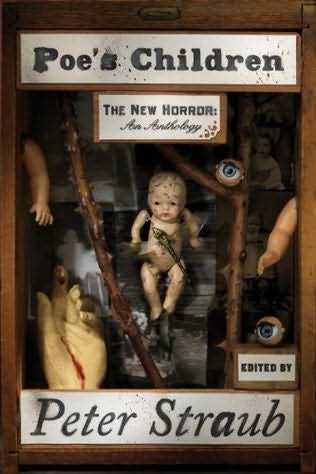
Peter Straub is less than happy with the state of modern horror literature -- with good reason -- and he wants to do something about it. Before we get to what he did, and whether or not I think he's pulled it off, let's take a look at why he's upset. In the introduction to Poe's Children, the anthology of horror fiction he edited in 2008, he says this about how the genre is perceived, and condescended to, by critics:
Claiming that a work transcends its genre is almost exactly like saying, as people once were wont to do, that an accomplished African-American gentleman, someone say like John Conyers or Denzel Washington, is a credit to his race -- the unstated assumption of course being that the race in question needs all the help it can get...
 Well, nobody ever said life was fair. Anyway, Straub comes off in this introduction as smart, reasonable, and correct about everything, but he also provides hints at how frustrating he's found his life as a good writer who happens to write (mostly) horror fiction, and to see how that genre, which means so much to him, not only denegrated by critics, but to see the standards of the genre lowered, by horror writers themselves, to such a degree that the critics begin to have a point. He says that, in his Guest of Honor speech at the World Horror Convention one year, he "responded to the decaying world I saw around me by saying that horror was a house that horror had already moved out of."
Claiming that a work transcends its genre is almost exactly like saying, as people once were wont to do, that an accomplished African-American gentleman, someone say like John Conyers or Denzel Washington, is a credit to his race -- the unstated assumption of course being that the race in question needs all the help it can get...
By my own ground rules, then, I have been called a credit to my race maybe half a dozen times, directly or indirectly, and about half of those times I was dumb enough to feel flattered.
He goes on to say that, despite the fact that Poe has "somehow crept into the canon", and the critical adulation granted to the ghost stories of Henry James and others, horror fiction is, or was, generally understood to be "inherently trashy, unliterary to the core, actually rather shameful..."
During the late seventies, when you thought of horror, you did not think of the Master of Lamb House, Rye. What came to mind instead were paperbacks with graphics of broken dolls, severed heads, or minimalist mouths letting slip single drops of blood.
Please to note the central image of the cover for Poe's Children:
.
.
Ouch. But also, yay. That quip got him some nasty looks, he says, but the nasty looks came from writers who haven't survived as horror writers since that day. History being the judge of all this, he claims, throwing out the names of forgotten writers who made their nut during the horror boom of the 70s and 80s, like Frank deFelita and Robert Marasco -- but it's here that I think he's being slightly unfair. For one thing, history isn't always right. Lots of artists end up forgotten, but does anyone truly believe that "forgotten" necessarily equals "unworthy"? More importantly, he asks "Who now reads...Robert Marasco or Frank deFelita", and the answer, at least regarding Marasco, is that I do. I read his one big novel, Burnt Offerings, last year, and I thought it was terrific. The guy simply wasn't that prolific -- two novels and two plays, before he died in 1998 -- and that lack of output has more to do with his being forgotten, I believe, than the fact that Marasco was riding the horror train to easy riches, free from the burden of genuine talent.
But anyway. Overall, Straub's point is well made, and one thing that I find interesting about Poe's Children is not so much who is represented in the contents page, but who's missing. Jack Ketchum, for instance, and Edward Lee, and Richard Laymon. Bryan Smith and Brian Keene. Outside of Smith (which forces me acknowledge he might be quite good, for all I know), I've sampled all of these guys, partly because they are so ubiquitous in modern horror anthologies (Laymon died in 2001, but unless the anthology is entirely made up of original stories, he still pops up regularly), and I think they're all...kind of...well, junk. Ketchum talks a big game regarding the seriousness of his work, and to be perfectly honest, he might mean every word, but his stuff reads, more often than not, like plain old nasty splatter. And kind of badly written, to boot. Edward Lee, meanwhile, wrote City Infernal, one of the worst books, of any genre, that I've ever read.
None of those guys get a look in to Poe's Children, however. Instead, you have people like John Crowley, Thomas Ligotti, Dan Choan, M. John Harrison, Steve Rasnic and Melanie Tem, and David J. Schow. Not everyone who gets a place in the anthology is a writer for whom I have a great deal of affection, but I respect the integrity, seriousness and genuine writing chops of each of them (well, the jury's still out on David Schow, but the one story I've read by him I'm told is a bad representation of what he's capable of, so I look forward to giving him another try).
Which brings me to the stories themselves, or the two I read for this post. First up is Kelly Link, and her story " Louise's Ghost", and....oh, for Pete's sake. It's a real pain in the ass to get all revved up over several paragraphs of introduction to talk about the great things that can be achieved in the horror genre, only to find myself up against the fact that I now have to write about "Louise's Ghost". And tearing into it is not something I entirely relish, either, because I'm finding it less and less amusing these days to look at the work of accomplished writers, point and laugh, and then piss all over it. Criticism is one thing, but gleeful evisceration is another, and while I can work myself into that kind of frenzy on occasion, and even justify it to myself (if only I was writing about Edward Lee today...), I can't find it in myself to do it to Kelly Link, or at least not to "Louise's Ghost", despite the fact that I honestly hated it.
"Louise's Ghost" is this kind of story: there are two main characters. Both are named Louise. One Louise is a single mom whose daughter will only eat green food (before this phase, she pretended to be a dog all the time). This Louise also only dates cellists. The other Louise is having an affair with a married man, and she has a ghost in her apartment. The ghost is a naked man, who can, on a given day, be the size of a normal man, or be very small. Or covered in hair, or not. Sometimes, he sleeps in a drawer in her bedroom. He never speaks, and is never threatening. She wonders what to do, and the other Louise tells her that there's an old folk remedy for this kind of thing, and it involves spitting on her floor. The Louise with the ghost doesn't want to spit on the floor, because she just cleaned it. So the other Louise says maybe there's a book she could buy, like "Exorcism for Dummies". Ha ha. Ha. The only reason I can tell, by the way, for both characters to be named "Louise", is so that the conversations can be charmingly confusing, what with the constant use of "Louise said" throughout.
The thing is positively choking on quirk. "Louise's Ghost" is exactly like what people who hate Wes Anderson's films claim he's doing, but which he's actually not doing. Quirk and whimsy are goals in and of themselves in "Louise's Ghost", and it all adds up to a monumentally frustrating 18 pages.
The second story I read is called "The Sadness of Detail", and it was written by Jonathan Carroll. Now here's where things get perverse. I have a reasonably long history with Carroll. I haven't read the guy's complete works, but, stretching back about fifteen years, or more, I've read five novels, one novella, and a generous helping of his short fiction. Somewhere along the line, I came across a quote about Carroll that stated, in effect, that everybody's favorite Jonathan Carroll  novel is the first one they read, and this has absolutely proven to be the case with me. The first Carroll novel I read was the first one he wrote, called The Land of Laughs, and the most recent novel I read, Outside the Dog Museum, is by far my least favorite. The Land of Laughs was an original, creepy, and eventually nasty bit of horror fantasy, a vague genre distinction in which most of his stuff can be categorized (though not Outside the Dog Museum, which is closer to that weasley critical phrase "magic realism"). The problem, I found, with Carroll is that his books are always populated with too-sophisticated bohemians who like to write in cafes, and who are just bursting with love for the wounded women they meet, and the terribly sweet and precocious children they're raising alone, the kind of children who exist only in fiction, in that they might walk up to their mother's new boyfriend and say "Can I give you a hug?" Which actually happens in, I believe, his novel After Silence. In short, it's all just so smug and teeth-achingly saccharine, until somebody dies, and the book goes black. Maybe this says more about me than it does Carroll, but it's at those moments that his fiction tends to finally pick up a bit, but it's also often too little too late (but, uh, seriously: check out The Land of Laughs. It's really good).
So why pick "The Sadness of Detail" to read for this post? Because it was short, because I have a history with Carroll from which I could get some mileage, and because I want to like Carroll again. Everybody else seems to love the guy (Link, who has published two collections of stories, is also pretty beloved), so why did I lose the thread? Or, if my criticisms of Carroll or just, how likely is it that he's only written one book that I truly enjoyed? He's quite prolific. The odds are in my favor, aren't they?Well, yes. Maybe. I think so, anyway, because "The Sadness of Detail" is a good story. Briefly, it's the story of a woman -- who is only referred to as "Mrs. Becker", and that only once, very late in the proceedings -- who lives, presumably, in Germany. She favors a quiet, very nice-sounding cafe (cafes again!) called Cafe Bremen. She's known there, and has casual friendships with the owner, Herr Ritter, and the staff. One day, after running errands, she stops by there for a glass of wine, and is approached by a man who shows her a series of photographs of her family. These pictures don't show her son or husband as they are now, or were, but rather as they will be. "Here is your son in nine years", he says, showing her a picture of an 18 year-old man, who lost an eye in a car accident, ruining his dreams of becoming a pilot, which is, in fact, the dream of her nine year-old boy, Adam. The man, who calls himself Thursday because that's the day he met Mrs. Becker (I could detect no parallels between this story and G. K. Chesterton's The Man Who Was Thursday, oustide of an interesting religious angle that develops towards the end, but it wouldn't shock me to learn that other connections escaped me), also shows her photographs of her husband, Willy, "after the divorce". For various reasons, Mrs. Becker believe that these pictures are on the level, and, further, believes Thursday when he tells her that this future doesn't need to come to pass. If, the next day, she can bring him a sketch of a child sitting under a tree (a sketch she made days ago, and which took her no time to complete), her son will not lose his eye, and will live a satisfied life.
The story is ten pages long, and to say more wouldn't be fair. But what's interesting about this story is that the horror is almost subliminal. Thursday eventually appears to be a rather benign figure who wants Mrs. Becker to help him with something that can only be described as incredibly important, and he taps into her desire to free herself from an unhappy marriage (Willy does sound like kind of a turd). But his solutions, while not quite demonic, are sort of quietly...wrong. And it is the lack of resistence that Mrs. Becker shows towards these ideas, along with a creeping sense that the world is not what she believed it to be, that makes this story discomforting, beyond its surface narrative.
So these are two of Poe's children, as Straub sees it. Whatever my reservations, this is frankly preferable to what we so often get, which is Sean S. Cunningham's children.
Wednesday, October 29, 2008
The Kind of Face You SLASH!!: Day 28 - The Nightgown Wraiths
 Guess what I went and did? I left the book containing today's horror selection at work. Fortunately, I had finished the story, so I can write about it, but unfortunately I don't have it here in front of me for reference. Or to quote from. So this one will probably be pretty short.
The story -- another long one -- is "Mr. Dark's Carnival", by Glen Hirshberg. Hirshberg is what is known as a "rising talent" in the genre: he's in his early forties and has a mere three books to his name, but he's raked in a healthy portion of award for his short fiction, and has earned praise from the likes of Peter Straub, Ramsey Campbell, and others. Campbell, in his introduction to Hirshberg's collection The Two Sams (from which "Mr. Dark's Carnival" is taken), compares him to M. R. James and Thomas Ligotti. Well then.
As it happens, earlier this year I read Hirshberg's novel, The Snowman's Children. That novel is more of a coming-of-age thriller -- a genre designation I may have just now coined, but which has a long history anyway -- than a horror novel, but I found it to be pretty skillful and intriguing, if a little too earnest. Hirshberg has really made his name with his short fiction, however, which I've always gathered is firmly and unquestionably horror, so I figured now was a swell time to dive in.
I was hestitant to pick "Mr. Dark's Carnival", as the title seems to hint that it's some sort of reflection on Ray Bradbury's Something Wicked This Way Comes, and, since I've never read that book (I should really stop admitting that sort of thing), I didn't want to read a 40-plus-page story that I wouldn't be able to fully appreciate. But Ramsey Campbell, in his introduction, said that the story deeply explored why readers and writers are drawn to fear, why we seek it out (or something like that), and considering that we're at the tail end of this horror project, I thought the story might be especially appropriate.
So here's what the story's about. In a small town in Montana, a college history professor named David Roemer is winding up his annual Halloween lecture, which deals with a bit of local legend. Back in the day's of America's Western expansion, and before Montana was officially a state, a man named A
 l...bert? See, this is the problem with not having the book in front of me. Well, whatever. We'll go with Albert. Anyway, a man named Albert Dark took residence in this little town, and became judge. Apparently, for the most part, he was a pretty lenient judge. But on four different occasions, during his many years as judge in that town, posses hauled men who they claimed had committed some sort of crime to Dark's home, demanding swift justice. On each of these four occasions, the judge complied, with the stipulation that before the man was to hang, he would spend his final night in the judge's home, and, when the time came, Judge Dark himself would do the hanging.
From this grew a legend of a place called "Mr. Dark's Carnival", which was actually one of those haunted house attractions that go up around the world every Halloween. This legend is not gone into specifically, beyond the fact that there were apparently unusual invitations to the haunted house issued. But Professor Roemer claims that such a place never existed, that it is in fact only a legend.
Towards the end of his lecture, he gets word that a troubled former graduate student of his has committed suicide. This man's girlfriend, Kate, was also one of Roemer's former students, as well as one of his former lovers. He goes to comfort her, and, long story short, comes across an invitation to Mr. Dark's Carnival. Which he and Kate excitedly attend.
Frankly, I don't quite know what Campbell was on about in his introduction. All this story really explores is why people go to haunted house attractions, which is, if not self-evident, at least uninteresting. As you can probably guess, Roemer and Kate make it to the carnival, and find it far more elaborate and bizarre and intriguing than they'd hoped it would be. And as you can probably also guess, there are really only two ways this thing can end, and, again, neither one is
 all that exciting. I was really struck by how ordinary this story was. Not bad, just ordinary. This, from Glen Hirshberg, who, of the genre's new breed of talent, is one of horror's most respected torch-bearers. I mean, really, Glen Hirshberg? A haunted house attraction on Halloween that might actually really be haunted?? I just don't know what to say. I enjoyed it. It would be a nice campfire story, if you took out all the stuff that doesn't lead anywhere, which would be about half of it. But "Mr. Dark's Carnival" is the definition of "nothing special".
For instance, the subplot about the troubled ex-student who committed suicide seems poised to supply some unusual pay-off, either thematically or narratively, but all it does is provide the explanation for a rather tired twist at the end. What's ironic about the by-the-numbers quality of this story (which, in all fairness, is not a weakness from which Hirshberg's The Snowman's Children suffers) is that throughout Roemer's journey through the fake-or-is-it haunted house, any time he's not suitably impressed with what he takes to be effects or clever bits of misdirection, he expresses his disappointment about some standard bit of haunted house business that he's seen too many times in his life to count. Was Hirshberg not aware that he was practically begging his readers to make similar complaints about his story? Was that part of his point? I really don't think it was, and I'm left just feeling befuddled.
And remember when I said that one of the drawbacks of The Snowman's Children was that it was too earnest? Well, this next complaint is connected to that, although I'm not sure "earnest" is the right word here. But at one point, Roemer actually says the following:
Walking through a haunted house properly is a lot like making love.
Okay, well, that just about shreds it. If he'd said "Walking through a haunted house properly is a lot like fucking", I might have respected him more.
All right, well, that was a major disappointment, which is an odd thing to say about a story that isn't actually bad. When considered with other horror stories that revolve around Halloween night and haunted houses, it works perfectly well. I was just expecting more. I'm nowhere near done with Hirshberg -- not even close, really -- but I'll adjust my expectations accordingly next time.
Okay, well, that just about shreds it. If he'd said "Walking through a haunted house properly is a lot like fucking", I might have respected him more.
All right, well, that was a major disappointment, which is an odd thing to say about a story that isn't actually bad. When considered with other horror stories that revolve around Halloween night and haunted houses, it works perfectly well. I was just expecting more. I'm nowhere near done with Hirshberg -- not even close, really -- but I'll adjust my expectations accordingly next time.
Friday, October 24, 2008
The Kind of Face You SLASH!!: Day 23 - It is Beyond Even the Forgiveness of God
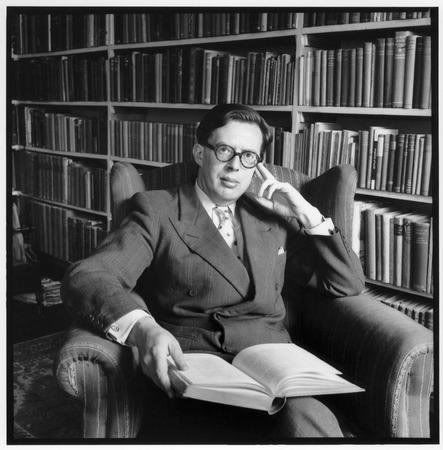
When I started this project, there were two writers that I knew I had to find time to write about, because neither of them is very well known -- even, I suspect these days, among horror fans -- and both write what I consider to be the finest horror fiction since, oh, I don't know...let's go all the way back to Poe. One of those writers is Thomas Ligotti, who I've already written about. The other is Robert Aickman.
Aickman was an Englishman who published his "strange stories" from the late 50s through the very early 80s (he died in 1981). His bizarre, witty, erudite and completely original fiction has influenced writers such as Ramsey Campbell, but, as Peter Straub says in his introduction to the "best of Aickman" collection, The Wine-Dark Sea, which Straub put together in 1988:
His originality, conscious and instinctive at once, was so entire that although he has provided us with a virtual model of what the "strange story" should be, if anyone tried to write to its specifications, the result would be nothing more than imitative.
You sure got that right, Peter Straub. I've never read any writer of any kind quite like Robert Aickman. I'm going to dive right into a discussion of the first of two Aickman stories (which I picked, by the way, not from The Wine-Dark Sea, but from another collection called Painted Devils)I read for this post, and explain the above along the way.
The first story is called "My Poor Friend", and it's about a kind of grassroots movement to bring localized, water-powered electricity to London. You heard me. Our narrator, we learn in bits and pieces throughout the story, possesses the almost satirically English name of Jocelyn Grover-Stacey. Grover-Stacey, as our story begins, has been bouncing from one job to another, dissatisfied with the progress each employer had been making with bringing water-generated electricity to England. He decides to hitch his wagon to man named Wycliff Bessemer, who seems to have the same genuinie desire for this outcome as he does, and has put together a "Society" to achieve it.
In his position as Bessemer's administrative secretary, Grover-Stacey gives presentations around the city, trying to drum up support. At a party where he's giving one of these speeches, he meets a man named Walter Enright. Enright is a member of Parliament, and Grover-Stacey strikes up a personal and professional relationship with him. Grover-Stacey believes that Enright is the man -- and Enright ensures him that he is correct in this -- to push their cause through Parliament. Enright seems to be a down-to-earth and honest man, with a comfortable air of cynicism about him. And, by the way, he smokes very strange cigarettes:
From his tight waistcoat, he produced a small, cylindrical, gold lighter from wich a tiny green flame erupted upon silent pressure at the base. When he put the cigarette in his mouth, it was as if it had been put between the lips of a wooden figure. Moreover, the cigarette, glowing more yellow than red, apparently gave off no smoke. It was, no doubt, a parliamentary cigarette. Enright's blue eyes seemed to become more limpid as he smoked it.
Enright informs Grover-Stacey that the cigarettes are a special blend, and not everyone likes them. Grover-Stacey doesn't smoke, so he never has to worry about that.
After their initial meeting, Enright invites Grover-Stacey to his home to discuss business. While there, Enright feels it's important to inform him that there are some potential drawbacks to their partnership -- not for Enright, but for Grover-Stacey. These have to do with certain private scandals. For one, Enright's wife has recently left him, though, he claims, not for good. There's also the matter of their two children. Enright says...:
"One was bad enough, but two! It was enough to drive any woman clean our of her mind, let alone being married to me as well. Look at that."
Here, Enright picks up a wooden toy train, covered with teethmarks, and shows it to Grover-Stacey.

"Teeth," said Enright, dropping the toy on the floor. "Just teeth."
It was, as you can see, difficult to think of anything to say.
"You mean there's something unusual about the children?"
"They're not human at all. They ought not to live. But my wife naturally doesn't see it like that."
The two men's partnership remains firm, however, and Grover-Stacey becomes more involved with Parliamentary politics in his drive to push the cause forward.
So. There's your set-up, for lack of a better term. On one hand, you have a story about the British Parliament, its beauracracy and odd personalities, and on the other hand you have this bizarre other story, used almost as shading for most of the length of "My Poor Friend", about a strange man and his strange family problems.
It's very typical to finish an Aickman story and not really have any idea of what has just happened. This is deliberate, and not uncommon among certain kinds of "weird" artists. David Lynch, of course, is known for this. The point in his films -- the ones that work this way at least -- is to disorient the viewer and disturb them with sounds and images that are unnerving in ways you can't quite pinpoint, and to do so at a rate that can almost be assaultive. With Lynch, you're off-balance almost from the beginning.
But in "My Poor Friend", the strangeness is almost buried as you read about Grover-Stacey's adventures through, and views of, Parliamentary politics. And I would argue that this way of presenting the bizarre is far more unsettling to the audience than Lynch's way (and I say that as a fan of Lynch). Because what in the hell is going on here?? What are these children?? Every so often, this element of the story will make its presence known, and then withdraw again. And you never know what in the world any of it means.
Are you supposed to be clueless? In Dark Forces, a massive and indespinsable horror anthology from 198o, editor Kirby McCauley says this in his introduction to Aickman's story "Mark Ingestre: The Customer's Tale":
Aickman rarely explains the the mysterious happening in his stories, but rather haunts his reader by a skillful blending of the supernatural with odd aspects of the modern world or allegory.
And elsewhere I've read Aickman reffered to as a symbolist. I've even seen him refer to himself that way. So in "My Poor Friend", is the supernatural a symbol for something else? An allegory? Does the juxtaposition of the bizarre with British Parliament mean something specific? Aickman comments wryly on Parliament and general politics throughout the story, so I'm not sure what point beyond those cynical observations he would want to make through allegory.
But maybe I'm not a very close reader. Frankly, that's a concern I've had about myself for years. Still, if I knew that there was some direct allegorical connection that Aickman was making between the seemingly disparate strands of "My Poor Friend", would the story stick with me the same way? Would I still turn it over and over in my head, as I do now, if someone "explained" it to me? Or, when opening up Painted Devils to read another story, would my eye fall on the title "My Poor Friend" and make me think, "Oh, that's the story where the supernatural represents the following..."
I'm uncomfortable quoting this book, because I didn't like it, but in James Hynes's novel The Lecturer's Tale, a character describes literature this way:
A literary work is any work of imaginitive writing – prose, poetry, or drama – that is inherently more interesting – rich, complex, mysterious – than anything that could be said about it.
Well, exactly. For me, that is why Aickman works, and that is why "My Poor Friend" will stay with me. If anybody out there wants to explain to me what the story means, please, keep it to yourself.
The other story I read by Aickman is called "The Waiting Room", and, as my dad would say, it feels like he wrote in on his lunch break. For one thing, it's about a third as long as most of his fiction -- the average length of an Aickman story is about thirty pages; "The Waiting Room" is eleven. More importantly, Aickman throws everything I've just been writing about out the window by explaining everything. And the explanation is a rather pedestrian one, at that. The story -- which is about a man named Pendlebury who misses his train home and has to sleep in a railroad office adjoining the station's deserted waiting room -- is fine, but it doesn't have the thrill of the bizarre that most of his fiction has. It would be a fine ghost story to tell around a campfire, nothing more.
Wow, way to fizzle out at the end there! I should have reversed the order of this discussion. Oh well. I would like to point out to anyone who may have been convinced by this post to seek out books by Aickman that most of his work is out of print, and used copies are very expensive. However, the three books that I have -- The Wine-Dark Sea, Painted Devils, and Cold Hand in Mine -- are all relatively easy to come by on-line and in used bookstores, and they're all usually reasonably priced. And you should read him.
Subscribe to:
Posts (Atom)