by Roderick Heath

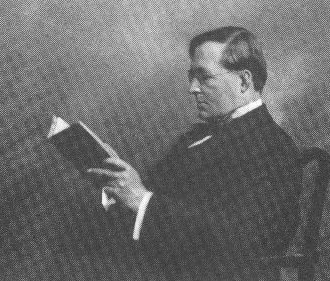
Montague Rhodes James, like C. S. Lewis and J. R. R. Tolkien after him, exemplified a bygone variety of creative and scholarly fecundity that many people would easily conjure to mind: the image of the British university don, scribbling away at private, eccentric visions as a pastime in between lectures and research. Perhaps James helped create the image himself, with his characters often coming from the ranks of tenured savants, variously absent-minded, churlish, gruff, and/or asocial. The impact James, Lewis, and Tolkien had on the fantastic genres of the twentieth century was powerful, and yet they stood far outside the usual flow of pressures familiar to most commercial genre writers, in their own time and ours (quite distinct from today when literary writers basically have to become teachers to make a living). Rather the contrary, their appeal and achievement lay precisely in the way they offered to readers respite from the raucous. Like Tolkien, James made his own delight in the arcane and the trappings of the scholarship he enjoyed part of the texture of his work, and likewise, the sense of untold lodes of lore and knowledge informs so many fleeing concepts and words found in their work. But James, a medieval scholar, archaeologist, translator, archivist, and finally teacher, was ultimately a very different kind of artist to the two later fantasy writers, and not just because they were Oxfordians. James’ world is our world, petty, mundane, often chokingly dull and predictable, and yet every now a veil is ripped and emanations of another zone invade stable reality and shock his characters into comprehending the fragility everything that surrounds them. The past stalks them like a bloodhound. Their transgressions, their need to learn, to uncover, to profit, to know, becomes their undoing as they run into the limits of the liminal. If they are to be saved, if they can be saved at all, they must abide the primal rules of the taboo and the ritual. Return the treasure to its hiding place. File the ancient document in the deepest archive. Pass the runes back. Run away as fast as you can.
An anecdote from James’ childhood holds that he broke out in tears when faced with a birthday party, and only calmed when he was allowed to retreat into a library, and around the same time he developed a fascination for an antique bible that he poured over for hours in delight. Not surprisingly, he died unmarried. Yes, James was what we’d now call a nerd, and much of his later writing contains an element of self-criticism, and self-provocation, in having the bubble of scholarly calm, and the domesticity and regulated, conciliatory civility of English life around it, disturbed by reminders of the uneasy nature of all stability. James’ prose is off-hand, rarely descriptive, except when sensatory experience starts to be distorted by strange presences and epiphanies. Oftentimes he writes as he’s speaking to another academic scholar, mumbling about manuscripts and pedantic details of dating, often commencing stories with dry anecdotes how he obtained such and such a paper and recounting the peculiar story behind it. The feeling of confidentiality, even intimacy, that James could create, turns his readers into confidants, fellow academes, someone to be told over a nice glass of sherry and a warm fireplace just why Professor so-and-so had to retire last year, or why Mr somebody-or-other seemed to just vanish. There’s often the carefully contrived feeling that he’s writing down a conversation or experience of his, or a friend’s. James got a kick out of reading his stories to fellows and friends around the university. It’s also certainly an aspect of the dryly realistic approach he takes, and indeed often gives his work a unique quality, at once fustily old-fashioned and peculiarly modern, even post-modern, as texts and accounts pile up, as if loosely arranged in a pile on his desk, trying to add them up into a narrative, scanning the evidence for the pivotal phrase, the revelatory moment.
There’s anticipation in James of Jose Luis Borges’ games with fake manuscripts and troves of imagined lore in this method. ‘Count Magnus,’ one of his most famous and anticipatory tales, is amassed in such a fashion, and indeed James states it upfront: these “papers out of which I have made a connected story…assumed the character of a record of one single experience, and this record was continued up to the very eve, almost, of its termination.” The recent craze for “found footage” movies –
The Blair Witch Project, Rec, Cloverfield, Diary of the Dead, Chronicle, ad nauseum – which has proven particularly popular in horror cinema, is based around exactly the same method, and popular for exactly the same reason. As a storytelling method, it raises an ambiguity, however spurious, over the presumed nature of the narrative the audience is experiencing, bringing some elements into crucially sharp relief whilst helping obscure others. Wilkie Collins’
The Woman in White and Bram Stoker’s
Dracula exemplified the epistolary novel as a method for making the supernatural seem credible, but James’ approach is consciously much less neat. Whereas
Dracula makes very clear what threat the living protagonists are dealing with, and gives them all the power of a rational society to meet it, ‘Count Magnus’ is genuinely disturbing for its elision, even abstraction, generated by James’ careful diffusion of the narrative in making the reader conscious of how it’s been recorded, or not recorded. He’s far more engaged with the almost tactile nature of the document as a repository of selective truth.
James was the great suggester of horror fiction, what Val Lewton would be for the cinema, the firm proponent that true interest lay in just what can’t be entirely identified, quantified, or treated with a rational mind. James’ namesake Henry had laid the building blocks for the psychological horror story with ‘The Turn of the Screw,’ but both men digressed from taking such a tack too literally, knowing the effect of such stories would degrade if reduced too obviously to symbolic tales of repression and frustration, and probably such an approach would have bored them anyway. And yet these qualities haunt M.R. James’ stories, stalking his heroes with their dried sap and fusty introversion. James’ stories often seem to ramble at first, partly because of his methods, as if the product of some intelligent but disorganised mind and disinterest in the reader’s immediate desires. ‘The Treasure of Abbot Thomas’ commences with a full, long paragraph of Latin, an antiquarian’s nastiest joke on his average reader. Structure and language often seem quaint, distracted, and yet his best stories always seem to suddenly crystallise in some memorable piece of phrasing that doesn’t violate the authorial voice and yet signals the presence of the unnatural, an obtuse invocation of something intensely disquieting, with an effect that can raise goosebumps at the right hour of the morning. Examples stick in my mind years after first reading them:
“…He could have sworn, he said, though it sounded foolish, squirrel or not, it had more than four legs.” – The Ash-Tree
“There was something about its motion which made Parkins very unwilling to see it at close quarters.” – Oh, Whistle, and I’ll Come to You, My Lad
“One remark is universally made by those to whom I have shown the picture: ‘It was drawn from life.’” – Canon Alberic’s Scrapbook
“…But now his face was not there, because the flesh of it was sucked away off the bones.” – Count Magnus
These lines are generally benign out of context, only effective after the mood James creates has done its work. Only the last quote resembles a kind of gore money shot found in movies, where the other quotes are more oblique, yet all contain a queasy communication of unnatural physicality, made flesh out of the perversities of nightmare figurations. As Nigel Kneale, one of many genre writers who counted James among his influences, noted, James was always at his most concise and effective when describing physical mutilation and abnormality. The line from ‘Canon Alberic’s Scrapbook’ comes at the end of a passage describing an illustration in a medieval book, of a Satanic monstrosity so perversely shaped a sane and lively contemporary expert in morphology couldn’t sleep for nights after seeing it. The idea that it’s so real, so troubling, that it can only have been drawn with the model standing before it, provides a gleefully alarming punchline. H.P. Lovecraft often tried to achieve a similar effect, to impart to the reader a sense of something so utterly inhuman that it beggars both countenancing and description. Lovecraft is often mocked for sometimes failing to achieve what he was going for, which indicates perhaps how skilled James was. He never made the mistake of describing too much. The use of the most seemingly bland, inexact word imaginable, “something,” in the quote from ‘Oh, Whistle,’ is James’ coup there, conjuring a disturbing image for the reader without anything concrete: everyone can fill in their own disturbing movement. The thing with more than four legs that mysteriously stalks the estate in ‘The Ash-Tree’, which proves, in the climax, to be a spider: nothing so unnatural in that, except that the spiders, when uncovered, prove to be poisonous brutes the size of a king crab. In ‘The Treasure of Abbot Thomas,’ the treasure-hunting hero uncovers a horde of treasure, only for an unseen monster to gasp him with a clammy sensation of cold flesh, unknowable numbers of limbs, and wretched stench. James’ ability to concisely communicate a sense of tactile unease permeates so many of his tales that some commentators have believed he was trying to work through a phobic dislike of all physical contact.
‘Count Magnus’ begins, as usual, in a conversational manner, as the narrator, James “himself,” imparts how he assembled the tale from many documents, whilst mentioning that the reason he now possesses them thanks to a stroke of fortune which, however, he can’t reveal until the story’s end. The protagonist of his tale, Wraxhall, is only vaguely rescued from the obscurity of the written word and the fragmentary nature of the evidence; even his first name isn’t given, and the sorts of accidents that render a historian’s work frustratingly hard, in this case a fire that consumed a repository, have conspired to keep Wraxhall’s background all the more obscure. A professional writer with scholarly interests, Wraxhall embarked upon writing a guide book for English tourists who wanted to venture to Sweden, having already written one on his time in Brittany. James takes a poke at the fad for such books in the 1840s and ‘50s, a time when the idea of recreational travel was becoming more possible for burgeoning middle class folk in Britain, and explains the formula for writing such books: “reported conversations with intelligent foreigners, racy innkeepers and garrulous peasants.” James’ sideswipe at a sort of dated version of Lonely Planet and the well-manicured paths of popular travel gives both an aptly mundane background to his story, a hint of satire, and also a digression of mood that’s a familiar part of his method. Wraxhall, James goes on to explain, travelled widely in Sweden before visiting a hamlet in Vestergothland, where he wanted to investigate a large archive kept by a prominent local family, at their manor house, known as Råbäck. As if out of deference to the family’s respectability, he only goes so far as to refer to them by the name of one of their antecedent clans, De La Gardie.
Loneliness is a keynote of ‘Count Magnus’ – loneliness, rootlessness, exposure, and finally desperation. Wraxhall is a forgotten being, albeit one who, in his time, was successful, but untethered to any hearth or heart, past middle-age and “very much alone in the world.” James notes that “he had, it seems no settled abode in England, but was a denizen of hotels and boarding-houses.” He declines an offer to stay with the De La Gardies and instead takes up in a hotel a mile away from the manor, a consequential choice. Wraxhall’s intention to write a usefully middling book is twisted back on itself, as he all but disappears within his travel notes with their seemingly inane lists of fellow passengers. James folds the narrative inwards like origami until he only comes through as the distant but haunting memory of strangers of a frantic man who died mysteriously and gruesomely. Whilst sifting through the De La Gardie archive, he learnt unusual things about the founder of the family’s fortunes, Count Magnus, whose body rests securely in a large sarcophagus in the church that sits halfway between manor and hotel. The church sits in the midst of a private forest Magnus used as a game reserve. So zealous was Magnus about the inviolability of his property and protecting it from usurpers that he burnt down the houses of neighbours, with whole families inside, and earned infamy for vicious reprisals to a peasant rebellion. Yes, Magnus was a right charmer, but for Wraxhall, as for most any inquisitive contemporary person safe in their vantage centuries hence, horror and tyranny have become sideshow. Discovering that Magnus apparently dabbled in alchemy and magic on top of such ruthless aristocratic behaviour “only made him a more picturesque figure.”
Count Magnus should be, like Wraxhall, a mere vestige, for, like the writer, he is held firmly in the grip of the past, extant to posterity only through his works, writings, and legend. But here emerges qualitative difference: Magnus is force of nature and force outside of nature, as desolating and consuming as nuclear fallout, and the totems of his existence have terrible power. Far more so than Wraxhall, who can barely dominate a page of his own narrative. Wraxhall is hapless Everyman. Magnus is extraordinary aristocrat, a product of an age with a different, less constrained idea of power, made immortal by different concepts of existence. Magnus’s portrait, Wraxhall records, depicts an extraordinarily ugly man. His book of cabalistic and alchemic research, which the unlucky writer finds in the De La Gardie archive, contains references to the unholiest lore. His body still lies in a sealed sarcophagus in the church, held in check by three massive padlocks. His house and grounds are still inviolate. Upon the sarcophagus are engraved unusual designs, including one that depicts a mysterious, diminutive form chasing a hapless man in a forest, at the direction of an onlooking master. Of the pursuer, we’re told, “the only part of the form which projected from that shelter was not shaped like any hand or arm. Mr Wraxhall compares it to the tentacle of a devil-fish.” Holy hentai, Batman. But most of all the power of Magnus is sensed the effervescent fear apparent in the locals when questions about Magnus’ activities are raised. The terror engendered by Magnus in his tenants and neighbours when alive was bad enough, but his malign reputation still reverberates. Wraxhall’s enquiries are, in what is now a familiar pattern for genre fans, deflected and delayed by garrulous men and helpful priests who suddenly clam up and avoid further questions when some particularly grim or evil subject is broached, especially that matter of the Black Pilgrimage.
Like Arthur Conan Doyle, who wrote fine some fantastic stories situated on similar fault lines of the modern consciousness to his, James was essentially a late Victorian writer, but one who also kept producing stories until his death in the 1930s, who helped mediate his era’s struggle to accept the coexistence of emergent modernity’s sanitising urges and nagging cultural spectres. The capacity of the Victorians to be both archly rational and airily religious stemmed from a zeitgeist very different to the one James, with his knowledge of the arcane world of medieval and classical literature, knew underpinned much of the European intellectual tradition. In studied contrast to the sun-dappled, pacific moods of the tea-sipping Anglican sensibility, James dredges up pages torn from ancient alchemy textbooks, points of lore from near-forgotten grimoires, relics from before Hastings, and obscure evils from the darkest corners of Mosaic and early Christian mythologies, like the monster from ‘Canon Alberic’s Scrapbook’, a Solomonian grotesque that quite literally seems to eat its way off the page to stalk the milquetoast sons of men inhabiting the future. James delights in suggesting such scarcely plumbed depths from ages when distinctions were far more permeable and the zone of religion, science, magic, philosophy, and politics grew in tangled, troublingly intimate awareness of each-other. Lovecraft synthesised a body of imagined lore to prop up his morbid universe. James merely refers with sinister vagueness to such a body of possibly imagined yet authentic-sounding volumes from the dark vaults of Medieval Europe’s covert intelligentsia violating boundaries of presumed reality. Wraxhall records Magnus as possessing “the book of the Phoenix, book of the Thirty Words, book of the Toad, book of Miriam, Turba philosophorum, and so forth.” At the heart of the story’s mystery is a genuine piece of Biblical lore, the village of Chorazin in the Holy Lands, where the Antichrist will supposedly be born. Magnus went on his “Black Pilgrimage” there to kneel in obeisance before a Satanic emissary, and “brought something or someone back with him.”

Could it be that Magnus returned to his home with his own personal devil, that disturbing imp, the one portrayed on the side of his sarcophagus? Well, duh. Small wonder that Magnus in all his cruelty and malignancy emerges far more vividly than Wraxhall from his artefacts, to the point where Wraxhall falls under his spell, quite literally it seems. “Ah, Count Magnus, there you are,” he utters fatefully (and fatally) in a seeming jest whilst gazing at the Count’s mausoleum: “I should dearly like to see you.” Later, “James” informs us, Wraxhall recounted an odd interlude of distraction bordering on compulsion, recovering to find himself “singing or chanting some such words as, “Are you awake, Count Magnus?” or, “Are you there, Count Magnus?”’ There’s an echo here of the repeated name that manifests Clive Barker’s Candyman, with a similar note of reference to both religious liturgy and childish invocation. “He had not no eyes for his surroundings, no perception of the evening scents of the woods or the evening light on the lake,” James notes as Wraxhall is drawn towards the church for one of his dissociative reveries, drawing the reader’s attention to imagine precisely those things whilst describing Wraxhall’s state, a fine example of James’ minimalist skill.
‘Count Magnus’ is interesting not least because of its resonance with that more famous undead literary count; indeed, the anthologist Peter Haining once included the story in a collection entitled
The Rivals of Dracula, where I first read it. As in Stoker’s book, a Briton travels into an unfamiliar locale in one of Europe’s extreme places, and encounters a supernatural remnant of an aristocracy that once lorded over a Europe so different to the new society, and yet whose powerful grip on the mind and reality of the structure of that society can still prove staggeringly powerful. Like Dracula, based on Vlad ‘the Impaler,’ Count Magnus De La Gardie is associated with the past’s harshness. Except that where Vlad was a religious warrior in a time of invasion, Magnus is characterised as a vicious oppressor, who seems to have actively sought as much power in the spiritual world as he had in the human, his hubris both transcendingly mighty and amazingly petty and greedy (a common trait of those who set evil in motion in James’ tales). Unlike Dracula, Magnus remains a threatening cypher, a black figure at the far end of the path in the twilight. James’ manipulation of viewpoint and storytelling texture is most pronounced when Wraxhall finally extracts the source of his innkeeper Nielsen’s anxiety in discussing Magnus. Nielsen cautiously offers up his own anecdote from “my Grandfather’s time – that is, ninety-nine years ago.” Another layer of storytelling, another layer of time, and yet here the presence of threat becomes tangibly immediate. “I can tell you this one little tale, not any more. You must not ask anything when I have done.” Nielsen presents details like James himself, hard and impersonal, descriptive but unelaborate, telling everything by only telling what was sure. Nielsen’s recounting of grandfather’s story of two men who decided to mock Magnus and violate his domain, that private forest, culminates in pure horror movie shtick, recollections of dreadful screams (“just as if the most inside piece of his soul was twisted out of him”) and mocking, inhuman laughter. The fearful morning after finds one man driven mad, pushing away what he still imagines is threatening him, and the other man, the good-looking one, the one who no longer had a face: “The eyes of Anders Bjornsen were looking up, because there was nothing to close over them.”
Yikes. By James’ standards this is gory, showy stuff, but splendidly achieved, wrought with an exacting skill, like the use, in the sentence I quoted earlier, of the word “sucked” in noting the mutilation of Bjornsen’s face. Not a cliché like eaten, gnawed, or ripped, but
sucked. What the hell kind off unholy creation could suck a man’s face off, we’re left to wonder. Perhaps even more effective is the description of the reaction of the men present – so appalled were they that they buried Bjornsen on the spot – and those who have been told this tale and have its intimations engraved upon their natures. This note recurs again in the story’s finale. The precision of James’ words, the suggestive quality, both avoids description and yet somehow describes the business here with true menace and clarity. Nielsen’s anecdote is a work of artisanal concision, delineated with pronouncements that describe the edge of taboo and atrocity, recalling an event so terrible it still chills the blood of people 99 years later, and ending with the bluntness of a smash cut in a movie, for the story continues the next day, without note of what sort of night’s sleep Wraxhall had after hearing that. Not too bad, it seems, as Wraxhall remains ignorant of threat until it’s too late. Too late being when, about to depart for England, he stops for a farewell visit to Magnus’ sarcophagus from which the padlocks keep seeing to fall off (a touch pilfered by Terence Fisher and Peter Bryan for
The Brides of Dracula, 1960) in defiance of basic physics. The last one clangs to the floor at his feet, and “there was the sound of metal hinges creaking, and (he) distinctly saw the lid shifting upwards.” Bad enough, but Wraxhall further describes that “there was something more than I have written that alarmed me, but whether it was sound or sight I am not able to remember. What is this thing I have done?”
Wraxhall’s subsequent flight from Sweden and journey home dissolves then, James reports, is described only in a peculiar series of lists he makes of fellow passengers, and James’ inference from his handwriting that a mere few days of sailing reduced him to “a broken man.” It becomes clear what he was looking for, a tall man under and old-fashioned hat and a short companion in a hooded cloak. Magnus and his familiar, pursuing the scholar, for whatever reason, whether for a petty slight or in maliciously black-humoured fulfilment of his wish, the undead master and malignant imp dog Wraxhall’s footsteps until he meets his fate in a village, Belchamp Saint Paul. The sparseness of the narrative style here, with James’ bare-boned, inference-laden telling from scant details, somehow manages to wring the worst kind of existential despair from the situation. Wraxhall finds himself spiralling unavoidably towards the most terrible of ends. The bitterest of ironies, this man who has no home and knows only boarding houses and hotels can find lodgings in the village but no aid, for even the parson’s away for some reason, and we’re left to imagine a Wraxhall in his final hours quivering in terror at what will inevitably be his horrific end. “What can he do but lock his door and cry to God?” James questions bleakly.
Nor does James provide any final escape: “And the jury that viewed the body, seven of ‘em did, none of them wouldn’t speak of what they see,” he recounts. Note the shift to the regional dialect, James’ last twist of technique, as he now quotes an eyewitness (and not even distinguished by quote marks), another layer of storytelling and this one the most immediate and faux-authentic, spoken to James’ own ear, or so he would have us believe. And how did he piece together the bulk of Wraxhall’s narrative? Why, he happened to inherit the house where Wraxhall found his last lodging, so benighted by the event that no-one would live in it, so he had it demolished, uncovering Wraxhall’s papers. Nice one, Monty. James wasn’t always a downbeat or unsentimental writer, and some of his great endings, as tales like ‘Casting the Runes’ and ‘Lost Hearts’ provide memorable defeats for evil, as does the closest thing I think he ever wrote to a romantic narrative, in ‘The Tractate Middoth’. But never in James’ work is the feeling that the forces of the supernatural are more than briefly containable. No silver bullets, no stakes through the heart, no handy exorcisms. Often his tales end with the protagonists wisely repairing whatever violation they’ve committed and retreating gratefully into obscurity. This quality makes him still feel modern and vital in the horror genre, and one reason why his influence seems to me to be everywhere in it today, even in product from another culture, like those signal J–Horror works, The
Ring movies. Whereas Bram Stoker finally demonstrated that the new world of the mercantile bourgeoisie could forge alliance with the deferential local aristocracy and the new prophets of science to defeat an emissary of an evil variously identified as foreign, bygone, and tyrannical, James offers no such solace, nor even a grip on the phenomenon. Magnus and his familiar are finally as alien as Stanislaw Lem’s planet in
Solaris, as cryptic and unforgiving as Kafka’s unseen forces, seemingly as unstoppable as Lovecraft’s Elder Gods. Magnus is the pure spirit of the past’s evil, but also the future’s, blank, abstract, and implacable, sure as death. Wraxhall does at least achieve one small victory. No-one who reads his tale would ever make the mistake of wanting to meet Count Magnus.
-----------------
Roderick Heath is an author, poet, and hopeless film geek, a resident of the Blue Mountains, outside Sydney, Australia. He is a proud dropout of the prestigious Australian Film, Television, and Radio School. He writes for the blogs Ferdy on Films and This Island Rod, and is a member of the Online Film Critics Society.