Showing posts with label H. P. Lovecraft. Show all posts

Tuesday, October 22, 2013

The Kind of Face You Slash - Day 22: As For Red Hook -- It is Always the Same

by Glenn Kenny


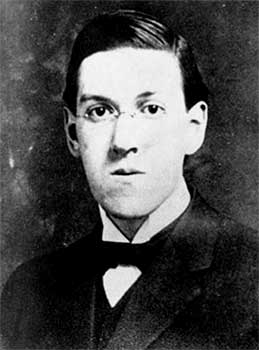
The complaint of H.P. Lovecraft, Michel Houllebecq implicitly argues in his exceptional critical study H.P Lovecraft: Against The World, Against Life (published in English translation by, some will be amused to note, Believer Books), is essentially a social one. While the Rhode-Island born Lovecraft was the son of a man who made a living as a traveling salesman, his deeper roots were in what Houllebecq calls “the puritanical Protestant old bourgeoisie of New England.” Hence, Lovecraft was “reactionary in every regard” and “particularly old-fashioned.” (Emphases Houllbecq’s.) “It seemed evident to him that Anglo-Saxon Protestants were by nature entitled to the highest positions within the social order.” To read this sentence and then look at any of the extant photographic portraits of Lovecraft, including the one on the dust jacket of the Library of America edition of his Tales, a 21st-century American almost has to laugh: this was clearly one VERY clenched-up fellow.

The apartment building on 169 Clinton Street in Brooklyn is an unextraordinary and entirely unthreatening structure on the rim of Brooklyn Heights, now one of the borough’s most, um, elite and inarguably expensive neighborhoods. For Lovecraft, who occupied that building in 1925, it was either a portal to hell on earth, or hell on earth itself. The writer’s brief sojourn there gave him a wholly human hook on which to hang his visions of “cosmic” horror. It revealed said horror for what it was, what the title of Houllebecq’s study points out: that what Lovecraft was truly repelled by, truly feared, was indeed life itself.

When the 35-year-old Lovecraft perched there, the subdivisions of neighborhoods stretching from Brooklyn’s Borough Hall down past the Gowanus Canal and into the Erie Basin and so on were not so widely acknowledged as they are today, if we read Lovecraft’s 1925 story “The Horror At Red Hook” correctly:

Red Hook is a maze of hybrid squalor near the ancient waterfront opposite Governor’s Island, with dirty highways climbing the hills from wharves to that higher ground where the decayed lengths of Clinton and Court Streets lead off toward the Borough Hall.

Well, while we are here, we might as well let Lovecraft go on (in quoting him I’m retaining the British spellings featured, I presume, in his originals and reproduced in the LOA edition):

Its houses are mostly of brick, dating from the first quarter to the middle of the nineteenth century, and some of the obscurer alleys and byways have that alluring antique flavour which conventional reading leads us to call "Dickensian". The population is a hopeless tangle and enigma: Syrian, Spanish, Italian, and negro elements impinging upon one another, and fragments of Scandinavian and American belts lying not far distant. It is a babel of sound and filth, and sends out strange cries to answer the lapping of oily waves at its grimy piers and the monstrous organ litanies of the harbour whistles. Here long ago a brighter picture dwelt, with clear-eyed mariners on the lower streets and homes of taste and substance where the larger houses line the hill.

That last sentence is particularly crucial as it embodies a reactionary paradox that directly informs what ends up being the nihilism at the heart of Lovecraft’s work and its horror. That is, its romanticization of the past, with its “clear-eyed mariners” and “homes of taste and substance.” Ah, those were the days, indeed. And yet the past is also the temporal space in which the ancient evils summoned by Robert Suydam, the proto-hipster (you raise an eyebrow, but the case is supportable, I insist, and will provide evidence to that purpose a bit further down) villain of “The Horror At Red Hook.” If the old days were better…the older days were worse…and the forces that were tamped down in the older days cannot be tamped down, even were one able to suppress figures such as Suydam.

Continuing to wax (feigned) nostalgia for the salad days of a vicinity he most likely cannot wait to be shot of, Lovecraft writes:

One can trace the relics of this former happiness in the trim shapes of the buildings, the occasional graceful churches, and the evidences of original art and background in bits of detail here and there—a worn flight of steps, a battered doorway, a wormy pair of decorative columns or pilasters, or a fragment of once green space with bent and rusted iron railing. The houses are generally in solid blocks, and now and then a many-windowed cupola arises to tell of days when the households of captains and ship-owners watched the sea.


After the elegiac, wistful touch, Lovecraft cuts to the more or less present:

From this tangle of material and spiritual putrescence the blasphemies of an hundred dialects assail the sky. Hordes of prowlers reel shouting and singing along the lanes and thoroughfares, occasional furtive hands suddenly extinguish lights and pull down curtains, and swarthy, sin-pitted faces disappear from windows when visitors pick their way through. Policemen despair of order or reform, and seek rather to erect barriers protecting the outside world from the contagion. The clang of the patrol is answered by a kind of spectral silence, and such prisoners as are taken are never communicative. Visible offences are as varied as the local dialects, and run the gamut from the smuggling of rum and prohibited aliens through diverse stages of lawlessness and obscures vice to murder and mutilation in their most abhorrent guises. That these visible affairs are not more frequent is not to the neighbourhood’s credit, unless the power of concealment be an art demanding credit. More people enter Red Hook than leave it—or at least, than leave it by the landward side—and those who are not loquacious are the likeliest to leave.

Into this morass wanders the story’s hero, a police detective named Malone, who, at the story’s outset, is revealed to have retired to Rhode Island, where he lives in a state of occasional horrific nervous agitation—post-traumatic stress, we might call it today. By Lovecraft’s account, Malone did not much venture from his Flatbush precinct to check in on Red Hook, but when he was obliged to walk among its red-brick houses, “he seemed to see in them some monstrous thread of secret continuity, some fiendish, cryptical, and ancient pattern utterly beyond and below the sordid mass of facts and habits and haunts listed with such conscientious technical care by the police. They must be, he felt inwardly, the heirs of some shocking and primordial tradition: the sharers of broken scraps from cults and ceremonies older than mankind.”

His reasons for investigating the area have to do with the aforementioned Suydam, whose background is replete in Lovecraft-approved bonafides, as it were; he is “a lettered recluse of an ancient Dutch family,” and said family settled in Flatbush “when the village was little more than a pleasant group of colonial cottages.” But Suydam’s family sues to have Robert institutionalized, because he grows “shabbier and shabbier” as a result of his “unaccountable hauntings of disreputable Brooklyn neighbourhoods.” Suydam’s self-defense is that “[h]e was […] engaged in the investigation of certain details of European tradition which required the closest contact with foreign groups and their songs and folk dances.”

I referred above to Suydam as a proto-hipster, but his nominal rationale is that of the anthropological hipster, the one in search of authenticity. In recent years the sort of “hipster” that has blighted, say, Carroll Gardens, a subset of what Lovecraft calls Red Hook, imports his or her simulated remnant of cultural authenticity and cloaks it over what living space he and or she may be able to afford. “Authentic” Carroll Gardens culture as it was known twenty or thirty years ago was in and of itself at least partially reactionary, with deep roots in Italian-American idiosyncrasies; the new would-be inhabitants come in to this relatively quiet and peaceful neighborhood and sneer at the “tackiness” of the shrines to Pio of Pietrelcina that decorate some front lawns, not particularly caring that these benighted Catholics are also responsible for the features of the neighborhood that make it so pleasant. It is a scene that would confound Lovecraft, who in a letter to his friend Frank Belknap Long deplored the “Italo-Semitico-Mongoloid” hordes of New York’s Lower East Side, and perhaps have a hard time accepting that the interlopers in the above scenario sometimes sport mustache wax.

Make no mistake: for Lovecraft, what New York’s most ineffectual mayor (that would be David Dinkins) referred to as a “gorgeous mosaic” was an “awful cesspool.” In “The Horror At Red Hook,” Lovecraft cites as explanatory (though not mitigating) circumstances Malone’s observation (“as one who united imagination with scientific knowledge”) that “modern people under lawless conditions tend uncannily to repeat the darkest instinctive patterns of primitive half-ape savagery in their daily life and ritual observances.” One can intuit in the following clause the affinity between Lovecraft and his hero in this tale: “he had often viewed with an anthropologist’s shudder the chanting, cursing processions of blear-eyed and pockmarked young men which wound their way along in the dark small hours of morning.”


In the climax of “The Horror At Red Hook” the reader discovers that Suydam was not, in the 1920s, really up to anything that Alan Lomax would soon be doing in the deep south, but rather enacting rituals which would first bring back his lost youth, then transform him into one of the looming, slobbering, moistly bulging black terrors which Lovecraft’s fiction fairly teems with. What distinguishes Lovecraft from other writers who held racist perceptions is his ability to give his hate a literary form that is at least partially detachable from the specific sources of that hate. “What is indisputable,” Houellebecq insists, “ is that Lovecraft […] was full of rage.” Before making this observation, Houellebecq cites the French critic Francis Lacassin: “The myths of Cthulhu draw their cold power from the sadistic delectation with which Lovecraft subjects humans punished for their resemblance to the New York rabble that humiliated him, to the persecution of beings come from the stars.” Lovecraft felt humiliated by said rabble’s very existence; they didn’t even need to do anything to him. While Lovecraft would never admit it even were he able to recognize the quality in himself or his work, the combination of his fear and resentment make him, in a sense, an exemplary literary nihilist, one of the few genuine ones the art has produced.

And as for Cthulhu, it is worth noting that Lovecraft only invented him after living in Brooklyn. (Who’s to say that the mythical being is not, somehow, a character in Hubert Selby, Jr.’s harrowing first novel? ) So there’s just one more thing that literature owes Kings County for, you could say.
-----------------------
Glenn Kenny, a writer, has lived in the Carroll Gardens section of Brooklyn since the late 1980s. His critical study, Robert De Niro: Anatomy of an Actor, will be published by Cahiers du Cinema next spring.

Wednesday, October 19, 2011

The Kind of Face You Slash - Day 19: Even Death May Die

One topic that I feel must be at least touched upon at some point, meaning now, in this series is the existence, as a thing that people do, of the continuing "Cthulhu* Mythos" stories, inspired by and in some ways just short of copied from the works of H. P. Lovecraft. The other day, in my post about two short stories inspired directly by classic horror films, a commenter named John said that one of the stories sounded like fan fiction. For whatever reason, I hadn't made this connection myself, possibly because, while I didn't care for the story in question, it was well-written and professionally published. Even so, John had a point, and I wonder why the Cthulhu stories, the modern stories written decades after Lovecraft himself was consumed by the Great Old Ones, are not similarly regarded.

It can't help my thinking on this subject that I have, to date, read only one story, maybe two, that qualify. Although I guess that depends on what you consider the appropriate qualifications for a story to be part of the post-Lovecraft Cthulhu Mythos ("mythos" is one of my least favorite words, by the way). Thomas Ligotti is blatantly inspired by Lovecraft, but to date I have not read a single story by him that actually referenced Cthulhu or Yog-Sothoth or the Necronomicon or Abdul Al-Azred -- in short, nothing created by Lovecraft. What about Michael Chabon's two horror stories, which go so far as to include names that sound like they could have been created by Lovecraft? I don't know, but I feel like what counts is writing a story with Cthulhu in it (or what/whoever). By that standard, I haven't read much, and none of what I have read was written by August Derleth. If you're going to approach this subject, you should probably approach it through the door Derleth is holding open for you, and from the doorway of which he is signaling you wildly. But I just have never read the man. It's my impression that no one reads Derleth for pleasure anymore, and that the man, despite having a name that sounds like it should belong to an evil wizard, lives on as an enthusiastic promoter of Lovecraft and the kindly and endlessly helpful publisher and encourager of any number of young horror writers. Not because of his fiction, though. Yet it's Derleth, as much as, if not more than Lovecraft himself, who is the reason stuff like, say, Night Shade Press's The Book of Cthulhu, edited by Ross E. Lockhart, even exists.

And why Brian Lumley exists, at least in the incarnation he currently enjoys. Lumley has written a lot of stuff, and is best known for his Necroscope series of novels about an occult investigator named Harry Keogh. He has also written a great deal of Cthulhu fiction, and is the author of the one unabashedly fannish story of that kind I've read (the other one, the one I'm not sure about, is Lawrence Santoro's "God Screamed and Screamed, Then I Ate Him", and I'm not sure simply because I can't remember if Cthulhu or any of the other Old Ones are specifically named, though I do remember the references could not have been clearer). That story is called "The Fairground Horror", and it is a disappointment. I've given much thought about why it is such a disappointment, and there are an unfortunate host of reasons. To begin with, as a fan of circus/carnival/fair-based horror stories, I was personally disappointed that the setting of Lumley's story was basically an afterthought. It gave him an excuse for his two main characters, brothers who ran a freakshow (about which we learn nothing) that eventually gets transformed into an attraction called "Tomb of the Great Old Ones", having been transformed by Hamilton Tharpe's global plundering of sites of great and ancient evil. Somewhat to his brother Anderson's chagrin, Hamilton supplants the old exhibits with these bizarre new artifacts, and also goes about attracting experts in the field of, I suppose, ancient evil, to come see them. Anderson can't help but notice that these experts -- who are basically their only customers by now -- follow Hamilton into the tent, but never leave.

One day, he witnesses the explanation:

[Anderson] could still listen...and now Hamilton's voice came strange and vibrant, though still controlled in volume -- in a chant or invocation of terrible cadence and rhythmic disorder. These were not words the younger Tharpe uttered bunt unintelligible sounds, a morbidly insane agglutination of verbal improbabilities which ought never to have issued from a human throat at all! And as the invocation ceased, to an incredulous gasping from the doomed explorer, Anderson had to draw back from his hole lest he become visible in the glow of a green radiance springing up abruptly in the centre of Hamilton's encircling relics.

So Hamilton lures these men back to be consumed in the green light of Cthulhu, because he, Hamilton, is a priest of the cult. Up to this point, Anderson thought his younger brother was involved merely in a murder-for-cash scheme.

As a story, "The Fairground Horror" has a couple of big problems. The first is that it's told mainly from the point of view of Anderson, and in flashback as he watches a new scholar enter the carnival tent. We learn very early that Anderson had to kill Hamilton, and it's very clear that the person doing the luring in the very beginning is Anderson. So we know that he has usurped his dead brother, and for most of the rest of the pretty long story, Lumley just tells us that yup, that's the deal, all right. Anderson's inability to believe that the madness his brother has revealed to him, and the terrifying dreams of Cthulhu he, Anderson, now experiences, are actually real, do nothing for us as readers. We know already. Lumley wastes a lot of time acting as though H. P. Lovecraft fans need to be convinced of any of this stuff.

It's not that well written, either, and this becomes key in ways beyond the obvious. Lumley, I've gathered, is a very happy guy, and very thrilled to be doing something he loves for a living. He writes Lovecraft stories because he loves Lovecraft. He just seems like a nice person. However, this is a weird trait to have as one of H. P. Lovecraft's torchbearers. Lovecraft himself was a miserable human being, an unhappy bigot who funnelled his disturbed imagination into these classic stories. And he, too, had several faults as a writer. But read this, a passage, ostensibly from the Necronomicon, written by Lovecraft for his classic "The Dunwich Horror":

As a foulness shall ye know Them. Their hand is at your throats, yet ye see Them not; and Their habitation is even one with your guarded threshold. Yog-Sothoth is the key to the gate, whereby the spheres meet. Man rules now where They ruled once; They shall soon rule where man rules now. After summer is winter, and after winter summer. They wait patient and potent, for here shall They reign again.

And now this, from "The Fairground Horror":

"You have been warned, AND YET YOU MEDDLE! While the Great Rising draws ever closer and Cthulhu's shadow looms, still you choose to search out His secrets for your own use! This night there will be a sign; ignore it at your peril, lest Cthulhu bestir Himself up to visit you personally in dreams, as He has aforetime visited others!"

Now which of those two passages better evokes a feeling of ancient terror and evil? It's not the one with all the exclamation marks, I'll tell you that. The best writing in "The Fairground Horror" are quotes from Lovecraft, including this post's title, which comes from the Necronomicon as "quoted" in Lovecraft's "The Nameless City": "That is not dead which can eternal lie/And with strange aeons even death may die." I don't really want to suggest that having a disturbed mind, as Lovecraft did (and as Poe did, and as Ligotti does), is essential to writing great horror fiction. Many great writers seem pretty well-adjusted, as far as I can tell -- M. R. James, Reggie Oliver, Mark Samuels, and so on. But Cthulhu and the rest of the Great Old Ones came specifically from the troubled mind of Lovecraft. To wander in, all happy-go-lucky and in possession of a perfectly healthy brain, and start trying to recreate what an unhealthy, but sincere, brain already made, must result in something that is pale and thin in comparison -- you weren't born with the problems that led to its creation in the first place. Ligotti has said that he believes the next great horror writer will come from the diseased fringes, the place where Lovecraft and Poe came from. I think that's hogwash. But I do believe the next great horror writer (after Ligotti and Samuels and Oliver, I mean) will create his own work. I don't say that to imply Lumley is stealing. He's not. He's created plenty of his own, and he bows to Lovecraft and Derleth. But this, stories like "The Fairground Horror"...it's only enthusiasm.


*By the way, according to L. Sprague de Camp, "Cthulhu" should be pronounced something like "T'luh-luh." This I learned from his Lovecraft biography. It reminds me of when I learned that Robert Louis Stevenson intended "Jekyll" to be pronounced "JEEK-il". My response to that was, yeah, good luck sellin' that one, gramps!

Tuesday, February 23, 2010

Cap-Syool Reviews!! Enjoy Them Now!

.
Here are some for you to read! Will you!?

Dragonwyck (d. Joseph L. Mankiewicz) - This is one of Vincent Price's very early Gothic thriller/melodrama roles (it's also the first film by Mankiewicz). The story is basically that a young woman (Gene Tierney) is overwhelmed by the wealth and smoothness of distant relative and wealthy landowner, Nicholas Van Ryn (Price). Then when she marries him, she finds out he's a crazy asshole. Price is wonderful, as always, and his final breakdown is terrific -- nobody did sweaty, arrogant psychic disintegration quite like Price -- but Mankiewicz seemed a bit too concerned with making his film important -- laying on the plight-of-the-worker stuff a bit too heavy -- and therefore, in his mind (I'm wildly speculating) better than your standard genre film, and the result is that the film sags. There's a terrific efficiency to the best genre films, especially from this era (the film was made in 1946), so that when a film like Dragonwyck makes a transparent attempt to rise above them, it's hard not to see why those other films are so very good.
.

Summer Hours (d. Olivier Assayas) - This beautiful and beautifully acted French film, about a wealthy French family, whose matriarch passes away in an early scene, struggling to deal with her estate (consisting mainly of a gorgeous country home, and a sprawling collection of artwork), is not actually about family strife so much as it is about losing your past, and how much more meaningful art can be to the individual than it ever will be as art. Charles Berling, as the eldest son Frederic, gets the top marks, but as I said, everyone is superb. And for a movie with such a small, intimate story, there's an incredible pace to it, of the kind that would utterly confuse your run-of-the-mill contemporary thriller filmmaker. Carried along, no doubt, by those performances. Top shelf.

Johnny Guitar (d. Nicholas Ray) - A quite strange Western from the 1950s, featuring Joan Crawford and Mercedes McCambridge as the White Hat and the Black Hat, respectively. A lot has been made of this gender twist on the traditional Western, but the film itself doesn't hammer on any particular point: this is just the story, and these are just the characters. Mind you, its tone is less that of a Western than it is a melodrama, or "women's picture", of the kind that Douglas Sirk made at his most bombastic (which shouldn't be taken as a criticism of Sirk). But if it works, it works, so why complain about bombast, if that's the goal, and the goal is struck dead center? Besides which, any film that features Sterling Hayden and Ernest Borgnine can't be that bad. The fact that Hayden plays the title character who is also the Mysterious Stranger shouldn't confuse one into thinking that Joan Crawford isn't, in fact, the star (she's great, too, as is McCambridge). So what it is, in fact, is a genre mash-up; while that idea tends to yield horror-comedies, or horror-Westerns, or horror-SF, here we have Western-melodrama, which is actually a hybrid with a long history. All of which I suppose to say that I'm a bit curious why so many people think Johnny Guitar is so bizarre.

.

Extract (d. Mike Judge) - Each of Mike Judge's live-action films (I'm excluding Beavis and Butthed Do America, because I remember that being a bit of a sensation at the time) has taken its own sweet time finding an audience. Office Space and Idiocracy were both dumped by their studios, and each has gained cult audiences of varying degrees of healthiness. His newest film, Extract, actually got a legitimate theatrical release, and still nobody went. Nobody who did go seemed overly taken with it, and my expectations were therefore low. But I really enjoyed it, as it turns out. It's not as near-perfect as Office Space, or as occasionally riotous as Idiocracy, but unlike that latter film it also doesn't run out of steam in the last third. It's consistently genial and entertaining, bolstered by a terrific cast of outstanding deadpan comic performers -- Jason Bateman, J. K. Simmons, Kristen Wiig, Ben Affleck, and the inhumanly attractive Mila Kunis, to name a few. Mike Judge knows ordinary people, and he knows what's so funny about them.

The Children (d. Tommy Shankland) - This horror film was primarily striking to me because it plunks a family down as the only possible victims, and then begins killing them. It's quite a bit more complicated, as well as better, than that sounds, but it's still the aspect of the film that stands out most strongly for me. The gist is, over Christmas an extended family gets together to celebrate, but one of the children has contracted some sort of virus, which only seems to be spread through the other children nearby, and which turns them into blank-eyed killers. This is brutal stuff, especially when the adults start fighting back, which you do sort of hope they'll do, but for God's sake look what they're doing! It's that sort of film, with, it would seem, some deeper implications having to do with abortion, but which I haven't quite parsed, and which may not be totally parse-able.
.
Dead Snow (d. Tommy Wirkola) - This movie was fun enough, I suppose, but if you're going to make a movie that spoofs other zombie movies, don't get around to the spoofing eventually. Don't play it reasonably straight for half the movie, possibly longer, and then go all zany and madcap all of a sudden. I'd prefer a movie about zombie Nazis in the snow to be played as straight as possible, myself, but if I can't have that I'd at least like a filmmaker who can commit to a tone.
.
You know, I think I want to withdraw that "fun enough" comment. It is, in a way, but it's also sort of incompetent, and cheap, and thinly imagined. I'd forgive it a bit more if it had ended with the stirring scene of zombie butchery cut to a Finnish folk spiritual song, but they didn't stop there, and all my goodwill drained off.
.
Gamer (d. Neveldine/Taylor) - Well, it's happened. We now live in a world where you can watch a new film and not see the influence of Hitchcock, or Ford, or Welles, or Chaplin, but rather of Tony Scott. And not the Tony Scott of Crimson Tide, but the guy who made Domino and slapped those motherfucking English subtitles of lines already spoken in English by American actors all over Man on Fire. And all in service of what? A remake of The Running Man. And it's worse than the original.
.
Take me, Lord. I'm ready. I cannot breathe air with the same people who allowed Gamer to be made. With the two unconscionable bastards who made it, and who joined their last names with a meaningless backslash, Face/Off style, creating in my mind the Hellish image of a bi-headed, quadri-limbed Nether-God, who would thunder its heavy legs across the planet, leaving blasted cities and fallow land in its wake as it tossed back its slavering heads and shrieked its murderous laughter into the cosmos. Such a world is more than my feeble mind can accredit.
.
Day 37
.
I awake in the middle of the night. A ghastly storm is assaulting my home, throwing back my shuttered windows, the latches all tinfoil and twine to these blustery and soaking hands! The window....the window is open, and inviting.
.
Day 38
.
The television flickers on, unbidden by my hand or mind. Gamer is on. Michael C. Hall is dancing to "I've Got You Under My Skin" while his henchmen, in time to the music, prepare to attack Gerard Butler.
.
The open, flapping window is streaked with the chilled rains. As flaps the window, so flaps the pages of Al-Hazred's Necronomicon. A book I had destroyed. I know I did. I set it alight and flung its blazing, ashy pages into the sea's gaping throat!! How can it be here now!? And now that kid who plays Butler's controller is on the screen again...as through the window I hear the bleating of the dread Neveldine/Taylor rolling over the distant hills...
.
The window! The window!!

Wednesday, October 28, 2009

The Kind of Face You SLASH!!! - Day 28: Tell Me Tales of Inconceivable Fear and Unimaginable Love

Clark Ashton Smith began his literary career as a poet, and despite devoting much of his writing life to horror and fantasy fiction, it would have to be said that he remained so by inclination. His mentor was a man named George Sterling, who, when Smith first turned his attention to fantastic stories, applauded his efforts, but said:
.
I don't advise you to devote much time to such things...the mind of man begins to smile at anything that is inherently absurd and outdated. Your faculties are far too fine to be wasted on such vacua...
.
...You have squeezed every drop from the weird (and what drop!) and should touch on it only infrequently, as I on the stars. The swine don't want pearls: they want corn; and it is foolish to hope to change their tastes.
.
Horror fans! We never get an ounce of credit! But, okay, I can't blame him.
.
For the above chunk of background, I borrowed liberally from the story notes written by Scott Connors and Ron Hilger, editors of the new five-volume edition of Clark Ashton Smith's collected stories. These are truly lovely volumes put out by Night Shade Books, and have provided me with my first taste of the fiction of Smith, about whom Gene Wolfe has said:
.
Let us pause briefly to notice that although Lovecraft has had many imitators (he is in fact quite easy to imitate) and [Robert E.] Howard more than a few, no one imitates Smith. There could be only one writer of Clark Ashton Smith stories, and we have had him.
.
So it would seem. Having now read some of Smith's work, even if only the tiniest fraction, it seems very easy to not only trace certain influences, but also more or less coincidental similarities to contemporaries like Lovecraft, Smith's fiction is very much on its own, and the primary reason would be his style. I'll admit right off the bat that I already feel like I'm talking out of my ass, given how little I've read -- the truth is I would have read more, but time was unusually restricted today (I particularly regret not being able to fit in the stories "The Abominations of Yondo" and -- especially, because the title is so striking -- "A Murder in the Fourth Dimension"). Even so, I was immediately struck by Smith's writing, and instantly grateful to Connors, Hilger and Night Shade for refusing to let Smith sink, forgotten, into history, as so many other genre writers, good and bad, already have.
.
All the fiction I read today comes from The End of the Story, volume one of this collection, and the main story I read is, indeed, called "The End of the Story" -- a rather curious and interesting title, it now occurs to me -- which, as a piece of plot-work, is very conventional. The reader is told right away that...
.
The following narrative was found among the papers of Christophe Morand, a young law-student of Tours, after his unaccountable disappearance during a visit at his father's home near Moulins, in November, 1789...
.
Morand's tale concerns his attempted journey home to visit his father. He is waylaid by a storm, and forced to seek shelter at a nearby monastery in the (fictional) region of Averoigne. There he meets a highly gregarious monk named Hilaire, who instantly befriends Morand, offers him food, a bed, and access to the monastery's vast library, which includes "the finest works of heathendom and Christendom, even...certain unique writings that survived the holocaust of Alexandria."
.
Not only that, but Hilaire offers Morand -- a young scholar and lawyer -- the opportunity to read "an unknown dialogue of Plato", "two lost tales of Miletus", and so on. There is also a strange little six-page manuscript that immediately sparks Morand's interest, but about which Hilaire says:
.
"There is a curse on the pages that you hold in you hand...Christophe, there are things beyond your understanding, things that it were not for you to know. The might of Satan is manifestable in devious modes, in diverse manners; there are other temptations than those of the world and the flesh, there are evils no less subtle than irresistible, there are hidden heresies, and necromancies other than those which sorcerers practice."
.
He further implores Morand not to read the manuscript -- comes just short of forbidding him, in fact -- which, of course, makes it far more likely that Morand will read it, which he does.
.
What he reads is a short account of the mysterious fate of Gerard, Comte de Venteillon, who, on the eve of his marriage, disappeared -- a point that puts me in mind of Shirley Jackson's "The Daemon Lover". The gist is, in the forest near his home, Gerard meets a "half-human creature with hoofs and horns". Appalled by the image, as a Christian, Gerard demands that the creature speak for itself...
.
Laughing wildly in the twilight, the bizarre being capered before him, and cried:
.
"I am a satyr, and your Christ is less to me than the weeds that grow in your kitchen-middens...

.
"Stay, Gerard de Venteillon, and I will tell you a secret, knowing which, you will forget the worship of Christ, and forget your beautiful bride of tomorrow, and turn your back on the world and on the very sun itself with no reluctance and no regret."
.
The satyr does tell him the secret, and Gerard does turn his back on everything, making his way not towards his bride but to the mysterious ruins of the Chateau des Faussesflammes (literally "House of False Flames"). These ruins, Morand believes (correctly), might well be the same ruins he's noticed on a hill near the monastery. And, of course, he's drawn to them himself.
.
The evil in this story is as ancient as that found in Arthur Machen's "The Great God Pan", and, of course, it is quite intriguing how Machen's story hangs over so much horror fiction that came after, particularly the fiction I've read this month. Not only are there mysterious satyrs in Smith's forest, but Pan is mentioned in Laird Barron's "The Imago Sequence" ("The panpipes went wild") -- sorry I forgot to mention that one -- Machen himself was referred to in Mark Samuels's "The White Hands", and there is yet more to come. But Smith's belief and reliance on the ancient past for his source of evil seems somehow more genuine -- and don't forget, I really liked all those other stories. Perhaps this is due to Smith's vocabulary. Here, Morand reflects on his desire to visit the ruins near the monastery, despite the warnings that Hilaire has just given him:
.
Before he had finished speaking, a resolve had sprung to life full-born in my mind: I felt that I must go to the Chateau des Faussesflammes and learn for myself, if possible, all that could be learned. The impulse was immediate, overwhelming, ineluctable; and even if I had so desired, I could no more have fought against it than if I had so desired, I could no more have fought against it than if I had been the victim of some sorcerer's invultuation.
.
This language sounds like it was itself drawn from some ancient spellbook. I mean, "invultuation"? But it works. The language drew me back centuries, or more, to the time of the evil which Morand will soon face (though he won't quite see it as evil).
.
In another story I read, "The Epiphany of Death" (another title more intriguing after you've read the story than before), Theolus, the narrator discusses his strange relationship with a man named Tomeron. Tomeron thinks very highly of Theolus, but, while fascinated by him, Theolus's opinion of him is somewhat different:
.
Though he fascinated him at all times, there were occasions when my interest was not unalloyed with an actual sense of repulsion. At whiles, his pallor was too cadaverous, too suggestive of fungi that have grown in the dark, or of leprous bones by moonlight; and the stoop of his shoulders conveyed to my brain the idea that they bore a burden of centuries through which no man could conceivably have lived.
.
Later, the two enter a tomb where...
.
The air was increasingly dank, chill and miasmal; and mephitic shadows crouched or swayed before our torches in every niche and corner.
.
I didn't even know what "mephitic" meant until about five minutes ago, but I instantly knew I loved it. And it's such a crazy word, by the way, that even the definition includes the word "noisome".
.
I won't describe "The Epiphany of Death" beyond that -- it's a very short story that lives off its own language. If you're as taken with the examples I've provided above, then you probably already know that you want to read it. And, actually, the only other story, if it can be referred to as such, that I read today was a half-page piece of work called "To the Daemon" (there's that word, or rather that spelling, again). It's from there that I pulled the quote I used as the title for this post. One interesting detail about "To the Daemon", and its place in The End of the Story is that it's the only story in the book that doesn't get its own story notes from Connors and Hilger. It's almost as though they don't know where it came from -- perhaps it was found, old and dried out, in an old desk that belonged to Smith, the details of its discovery not unlike Morand's uncovering of the manuscript that sends him to the House of False Flames. "To the Daemon" begins:
.
Tell me many tales, O benign maleficent daemon, but tell me none that I have ever heard or have even dreamt of otherwise than obscurely or infrequently.
.
Perhaps it's a manifesto.

Sunday, October 25, 2009

The Kind of Face You SLASH!!! - Day 25: What Must the Inhabitant of This House Be Like?

Another quick one today, but this time I'm veering away from my usual source for lazy posts, the short short story, to stories that are only pretty short, and were written by literary giants. In this case, those writers are Isaac Bashevis Singer and Jorge Luis Borges. I don't think I've ever read Singer before, but I have noticed that his name pops up occasionally in more catholic horror anthologies. I have read some Borges, and the fact that he's written at least one straight-up horror story doesn't shock me.

The Singer story is called "The Enemy", and it was written specifically for Kirby McCauley's ground-breaking 1980 anthology Dark Forces (this anthology was also represents the first time Stephen King's The Mist saw publication, which should give you some idea of its wide-ranging nature). In classic ghost story style, the story is told entirely in conversation, with one character named Chaikin -- a Jew who has recently arrived in America, escaping Hitler's nightmare, by way of a brief stay in Argentina -- telling of his strange and creepy journey by boat to the US to an old friend, our narrator, who escaped Europe some time earlier. During Chaikin's trip across, at meal-times he was assigned to a particular table, by himself, where he was waited on by a large, possibly Argentinian man who, for no reason Chaikin has ever been able to decipher, thoroughly abuses him. He mocks Chaikin, laughs at him, makes him wait for menus, for his food, and when his food does come, it is never the food he ordered. The waiter is so relentless in his bullying attacks that Chaikin is tempted to think that the man might be a Nazi, but then he notices that there are other Jews on the ship, even at tables being served by the same waiter, who are treated with complete respect.

This continues for several days until one night, Chaikin is walking along the deck when he finds himself face to face with the waiter. Suddenly, the two begin fighting, and the story makes the turn from the simply strange to the supernatural. And it's a good story -- "The Enemy" is only seven or eight pages long, and I felt a good deal of anger and frustration on Chaikin's behalf -- but I would say that Singer makes a step wrong right at the end when he offers a possible explanation for what happened on the deck (which you may have noticed I haven't told you about). This doesn't remove the story from the realm of the supernatural -- in fact, if the reader were to accept the explanation, the story's ghostly roots would only be cemented -- but it's far better, I think, to remain totally puzzled by stories such as this. I've said something close to this many times, but I think "The Enemy" highlights the idea. Singer's solution to the mystery -- which, to be fair, he only offers as a possibility -- is one that is rooted in ancient philosophy and theology, but this fact doesn't help the story's final impact. If you read a story full of bizarre occurrences and uneasy, unexplainable visions, only to have a character say, in the last paragraph, "I bet it was ghosts", you'll probably find that the cold mystery that preceded this has evaporated.

Then again...I suspect there's something deeper going on in this story. I'm curious about Chaikin's sojourn to Argentina, and what the significance is of Chaikin being harassed by a man of apparently Argentenian descent. But on first impression, "The Enemy" is a solid piece of work that lacks mystery.

The Borges story is called "There Are More Things", and I thought it was wonderful. Dedicated to "the memory of H. P. Lovecraft", it tells the story of a young man who travels from his home in Texas to a small rural town in South America to deal with the estate of his recently departed uncle. An engineer with a philosophical bent, this uncle owned a home known as the Red House, which was auctioned off to a man named Max Preetorious, who immediately guts the place and throws out all the uncle's possessions. Not only that, but...

For a fortnight, [the carpenter] was to work at night, behind closed doors. And it was by night that the new resident of Red House took up his habitation. The windows were never opened anymore, but through the darkness one could make out cracks of light. One morning the milkman came upon the body of the sheepdog, decapitated and mutilated, on the walk. That winter the Norfolk pines were cut down. No one ever saw Preetorious again; he apparently left the country soon after.

It's around here that our narrator arrives, and the story deals with his investigation into what Preetorious had done to his beloved uncle's house. He learns that many people found the whole situation very off-putting, even vaguely frightening, and that some of the workmen Preetorious hired only did the work asked of them because the money was so good. All of which leads our narrator to enter the apparently now-deserted house himself.

What he finds is very Lovecraftian indeed, specifically the Lovecraft of smaller-scale stories like "Pickman's Model" and "The Music of Erich Zann". What really pushes Borges's story beyond Lovecraft, however, are the last two sentences, which acknowledge a recognizable human reaction to the cosmically horrible beyond Lovecraft's preferred instant madness, followed by suicide. It's really a brilliantly subtle ending, with a marvelously disturbing use of the word "plural". Highly recommended.

Tuesday, October 28, 2008

The Kind of Face You SLASH!!: Day 27 - Dust in the Balance

H. P. Lovecraft and Algernon Blackwood were rough contemporaries -- Blackwood's writing career got started a bit before Lovecraft's -- and the former author was a great admirer of the latter. Of Blackwood, Lovecraft said:

Of the quality of Mr. Blackwood's genius there can be no dispute; for no one has ever approached the skill, seriousness, and minute fidelity with which he records the overtones of strangeness in ordingary things and experiences.

Not only that, but check out that name! Algernon Blackwood! That is friggin' nuts! With that name, Blackwood had, by my count, only two viable career choices: horror writer, or malevolent super-scientist, the kind who rides around in zeppelins, commanding his zombie army via remote control. And it was his real name, too. It's not like he was born "Sidney Loomis", and traded up to "Algernon Blackwood" when he turned eighteen. No, that was his name out of the gate -- although, regrettably, his middle name was Henry.

But anyway. Blackwood's fiction, though it has remained in print (off and on, I would imagine) since his death, never took hold in the popular psyche the way Lovecraft's did. If you want to know why exactly that is, I'm not the guy to ask, although my knee-jerk, horror-snob answer is that Blackwood was by far the better writer. I don't really know what that means, though, and I don't actually believe it. That is, I don't believe that's why Blackwood's work is obscure, compared to Lovecraft; however, I do believe -- based, admittedly, on scant evidence -- that Blackwood was a far superior writer.

Thus far, I've read one Blackwood story (finished mere minutes ago), the nearly-novella-length "The Willows". In it, an unnamed narrator and his friend, known only as "the Swede", are traveling down the Danube by kayak. Due to flooding and fierce winds, they suffer what seems to be a mild shipwreck on a small island somewhere in East Jesus, Hungary. Their kayak is undamaged, they have plenty of provisions, and so, not at all put out, they decide to make camp on this tiny island, which is covered, not incidentally, with willows.

Early on, they they see a couple of fairly strange things. One is an otter, swimming along the river, which, at first glance, they mistake for a human body. Shortly thereafter, they see, in the distance, a man in a boat, who at first seems to be signaling to them, but whose motions they eventually decipher as the man making the Sign of the Cross.

Still dealing with very strong winds, the two men decide to take to the river again the next morning. That night, the narrator takes a little walk, and begins to feel extremely uneasy about the island, the willows, and the general surroundings:

But my emotion, so far as I could understand it, seemed to attach itself more particularly to the willow bushes, to these acres and acres of willows, crowding, so thickly growing there, swarming everywhere the eye could reach, pressing upon the river as though to suffocate it, standing in dense array mile after mile beneath the sky, watching, waiting, listening. And, apart quite from the elements, the willows connected themselves subtly with my malaise, attacking the mind insidiously somehow by reason of their vast numbers, and contriving in some way or other to represent to the imagination a new and mighty power, a power, moreover, not altogether friendly to us.

This "attack" will increase in strength and continue unabated until the end of the story. The narrator -- and eventually the Swede -- begin to see things at night, in the willows, that inspire a kind of awe-struck horror, and they begin to hear a sort of gonging sound that seems to come from everywhere at once, and which "defies description". These incidents, mixed with mysterious damage to their kayak and depletion of their food, works on the men's minds. The Swede appears to be more sensitive to their new, terrifying reality -- to what it is and what it means -- and together the two men come to understand this small island as a kind of intersection of two realities: the world as we know it, and another world, filled with beings whose purpose is grim on a cosmic and metaphysical scale, a scale so large that it is impossible to understand, however much the men might desperately crave understanding:

An explanation of some kind was an absolute necessity, just as some working explanation of the universe is necessary -- however absurd -- to the happiness of every individual who seeks to do his duty in the world and face the problems of life. The simile seemed to me at the time an exact parallel.

This is an essential passage, I think, because it is the core of what Blackwood is writing about, his specific reason for writing horror, which is the great doubt every human being, no matter how confident they are in their own view of the universe, has at some point, that not only is there no benevolent God, but there is no comfort in our existence. There is only pain and horror and despair and meaningless suffering. Everything else is just a mask. Or -- and this may be closer to the point -- if there is a force governing the universe, it is malignant. This is what Thomas Ligotti is writing about, and it's what many claim Lovecraft is writing about as well, although it's hard, sometimes, for me to see it in his work.

And it doesn't matter if you're an atheist (the atheists I know have a much warmer view of the universe than this), and it doesn't matter if you firmly believe in God. It doesn't even matter if your belief in God is some day proven correct. All that matters is that you also sometimes see things Blackwood's way, that you harbor that fear, however mildly, and however rarely. If you do -- and you do -- then "The Willows" will make its mark on you.

Wednesday, October 8, 2008

The Kind of Face You SLASH!!: Day 7 - That Eldritch Moment

Early in his breakout 1995 novel, Wonder Boys, Michael Chabon wrote the following about a fictional horror writer named August Van Zorn (real name Albert Vetch):

His real name was Albert Vetch, and his field, I believe, was Blake; I remember he kept a framed print of the Ancient of Days affixed to the faded flocked wallpaper in his room, above a stoop-shouldered wooden suit rack that once belonged to my father. Mr Vetch's wife had been living in a sanatorium up near Erie since the deaths of their teenaged sons in a backyard some years earlier...He wrote horror stories, hundreds of them, many of which were eventually published in such periodicals of the day as Weird Tales, Strange Stories, Black Tower, and the like...When his work was going well, he could be heard in every corner of the sleeping hotel, rocking and madly rocking while he subjected his heroes to the gruesome rewards of their passions for unnameable things.

I ended up liking the rest of Wonder Boys well enough, but I always wished that Chabon had written a book about Van Zorn, rather than Grady Tripp, because I can guarantee Chabon, and the rest of you, that his story is by far the more interesting one. Van Zorn, as described in the novel, was a pulp writer, and I've always been fascinated with that life: pounding out story after story after story for as little as a fraction of a penny per word, writing fiction as a nine-to-five job. It was a devotion for many of those old guys, as well.

Chabon may have subconciously come to the same conclusion, because his next novel, the Pulitzer Prize-winning The Amazing Adventures of Kavalier & Klay, was about a pair of young comic book creators in the 1940s, through the 60s. I found that book to be vastly overrated, and to this day I don't think of it half as often as I do August Van Zorn.

At one time, Chabon claimed he was going to publish a collection of horror stories and claim they were by Van Zorn. He went so far as to put up a couple of websites about him, as well, and to set up a literary prize honoring new "weird fiction", written in the tradition of Lovecraft, and so forth. I think that prize has only been awarded once, however, and no book of Van Zorn stories ever appeared.

Still, in his 1999 collection of short stories, Werewolves in Their Youth, there is one story, called "In the Black Mill", credited to Van Zorn. In it, an unnamed narrator (they're almost always unnamed...why is that?), who works in the archeology department of a university in Boston, travels to Plunkettsburg, PA to gather evidence for his theory regarding the Miskahannock Indians, which, we learn, is at odds with his mentor's own beliefs about the extinct tribe. The main feature of this little town is its mill, which...

...altered the the humdrum aspect of Plunkettsburg sufficiently to make it remarkable, and also sinister. It stood off to the east of town, in a zone of weeds and rust-colored earth, a vast, black box, bristling with spiky chimneys, extending over some five acres or more, dwarfing everything around it.

Our narrator will eventually become obsessed with this mill, because he soon notices that as many as half of the men in town have been crippled -- missing arms, legs, ears, etc. -- by accidents which occurred during their employment there. What is this mill? What do they make? He hears explanations that are both vague and overladen with technical details, involving machines with names like "spline presses", "steam sorters", "Rawlings divagators" and "sprue extruders" (what is a sprue extruder for? he asks one man, to which the man replies "It's for extruding sprues"). An attempt to bluff his way into the mill is met with violence. An attempt to overcome his obsession with the mill and return to his archaeological work reveals that his work at the dig is being undone. There is a mysterious death.

What surprised me about this story wasn't that it was well-written. I expected that, despite my reservations about Chabon. What ultimately really surprised and pleased me was that the resolution to all this is very satisfyingly horrible. Chabon doesn't shy away from it, and, for the most part he looks the material straight on. I say "for the most part", because occasionally he does wink at the reader. The name of the ancient Indian tribe, "Miskahannock", is only a few letters away from "Miskatonic", Lovecraft's fictional university referred to in so many of his stories. And the "Yuggogheny Mountains" in Chabon's story is a clear reference to "Yog-Sothoth", one of Lovecraft's "Old Ones". I wish Chabon wouldn't do this -- why yank the reader out of the story like that? These references are clearly for people familiar with Lovecraft, and will be meaningless to those who aren't, but those of us who are want the same things from fiction as everyone else. Some horror fans may like to be explicitly reminded of the genre they're reading via nudges by the author, but I don't.

But Chabon also references Blake's "dark Satanic mills", which is not only obviously appropriate to the story itself, but also connects to August Van Zorn's side career as a Blake scholar. It shows that Chabon, at least this one time, was serious about this horror project. His original intent in creating Van Zorn may have been to separate his genre ambitions from his more "respectable" literary career, but at least he clearly put some thought and work into the facade. And maybe that facade is falling away, and we'll get those Van Zorn stories, attributed to whoever, one day. Chabon has been more open about his interest in the pulp writers, and genre fiction in general, in recent years: he's edited two anthologies of new genre fiction -- McSweeney's Mammoth Treasury of Thrilling Tales and McSweeney's Enchanted Chamber of Astonishing Stories -- and has recently released a collection of essays called Maps and Legends, which deals in large part with his love of this kind of stuff. And I remember reading an interview with Chabon in which he talked about being on an airplane and reading a Conan book by Robert E. Howard. He said he felt embarrassed at the idea that someone might take note of his reading material and silently judge him, but then he thought, "Why should I be embarrassed?" He shouldn't be, and I'm glad he realized it. Now start writing those horror stories you promised so long ago.

Wednesday, October 1, 2008

The Kind of Face You SLASH! Day 1: Distorted with Epileptic and Reverberant Laughter

Henry James’s The Turn of the Screw is primarily known for two things: being a classic – some would say masterful – example of the traditional Victorian ghost story; and for being a classic – SWSM -- example of a story that only pretends to be a traditional Victorian ghost story, but whose supernatural elements can, in fact, be explained away as the manifestations of the narrator’s broken psyche.

I think it’s a ghost story.

Before I explain why I think that, first let me provide a synopsis: a man named Douglas promises a group of friends, all of whom have been trading ghost stories, that he has a story to beat them all, and it’s true, to boot. It seems he once knew a woman who was hired by a man to be the governess to his niece and nephew, whose parents are deceased. This man was completely indifferent to the well-being of these children – named Flora and Miles – but had just enough sense of responsibility to be willing to pay someone else to care.

And here Douglas hands the reins of the story over to the governess herself, in the form of a letter (a really, really long letter) she sent to him describing the horrific events she experienced during her time at Bly, the house where the children live. Fairly soon, the governess realizes that something’s a bit off around Bly. The children are wonderful – cute, smart, loving, all of that. But she’s become pretty certain that she’s seeing ghosts. She sees them on the grounds at night, through windows, on one of Bly’s huge towers. There are two of them, a man and woman, and when the governess describes their appearance to the housekeeper, Mrs. Grose, she learns that they very closely resemble Miss Jessel and Peter Quint, two former servants of Bly, who, I hardly think I need to tell you, are both dead.

Miss Jessel was the previous governess, and Quint was a clever man who nevertheless had developed a reputation as a man who harbored many dark, perverse secrets, none of which are specified, but which seemed to be largely sexual in nature (and may have included pedophilia). And the two of them apparently had some sort of relationship when they were alive. Add to this the fact that not only is the new governess seeing these two creep around the grounds (and, eventually, the house), but she’s become convinced that both Miles and Flora are seeing them, too, but are hiding this knowledge from her and Mrs. Grose.

So, why do some people who read this novella believe that the ghosts are real, and others don’t? I think the problem begins with syntax. My own experience with the work of Henry James, before reading The Turn of the Screw, was limited to having read Daisy Miller and Washington Square last year. Both of those works were written before James entered his difficult, experimental phase, and the prose of both is fairly straightforward. The Turn of the Screw was written after James started to turn his sentences inside out, but that is only seen in the main part of the story, the part told by the governess in first person. The first part, which is told in third person and describes Douglas’s build up to the main story, is as straightforward as Daisy Miller. But when we get into the governess’s head, the sentences can get a little odd:

The homage of which they were so lavish succeeded, in truth, for my nerves, quite as well as if I never appeared to myself, as I may say, literally to catch them at a purpose in it.

I admit, that one’s a bit tough. Still, I think I understand it: even though at this point in the story the governess is sure that the children are hiding dark and ominous secrets, they are still able to not only present themselves as a pair of wonderful, loving, generous children on the surface, but to do so in way that seems neither forced nor insincere. Elsewhere, James ups the ante with this:


I recollect counting over perfectly the possibilities, reminding myself that nothing was more natural for instance than the appearance of one of the men about the place, or even of a messenger, a postman or a tradesman’s boy, from the village. That reminder had as little effect on my practical certitude as I was conscious – still even without looking – of its having upon the character and attitude of our visitor. Nothing was more natural than that these things should be the other things they absolutely were not.

So, clearly at this point the governess has come to believe that…wait, hold on, what?? Nothing was more natural than that these things should be the other things they were absolutely not?? I…I don’t know what that sentence means. And I’ve given you a reasonable amount of context to allow you to take your own stab at deciphering it. I gave up long ago.

Is this tortured syntax James’s way of clueing in his readers to the fact that all is not well inside the governess’s head? Maybe. Or maybe it’s simply his way of distinguishing her voice from the voice in the novella’s first section. Not only that, but how is the governess able to so closely describe the appearances of both Miss Jessel and Peter Quint, two people she’s never seen before? I also believe that the ending of the story, which I’ll avoid spoiling, is impossible to explain, using evidence provided by James, without taking the supernatural element at face value. Yes, the only people in the room are the governess and the child, and we only get the governess’s point of view. But if what happens isn’t what the governess describes, then what in the world is it? I have come across one interpretation, but it is even more tortuous than that sentence I quoted in italics earlier.

In any event, I thought The Turn of the Screw was fairly strong. A friend of mine, who is much better read in James than I am, actually warned me away from it, but I was able, with a minimum of wincing and rapid blinking, to push my way through it, and I honestly found the last sentence to be pretty devastating. Not only that, but now I can finally watch The Innocents.

-------------------------------------------------------------------------------


H. P. Lovecraft is widely considered to be on of the greatest writers of horror fiction in the 20th century. Whether or not you agree with that, it would be hard to argue that he isn’t one of the most influential. His Cthulhu stories – most of his work falls under that label – are, at least in theory, the essence of horror. They describe mankind as a race whose days are numbered, because the Great Old Ones, the demonic gods who once rampaged through the universe, led by the massive, be-tentacled Chthulhu, are waking up, and when they do they will devour us all. For Thomas Ligotti, a modern horror writer whose work I will be talking about later this month, Cthulhu and the Great Old Ones are metaphors for the utter wastefulness and uselessness of life, as well as the cold, shrieking inevitability of death.

First off, happy Wednesday, everybody. Second, I have to admit that I agree with Ligotti on this. It would be very difficult to read any of Lovecraft’s stories, including “Pickman’s Model” and “The Rats in the Walls” (the two stories ostensibly under discussion here) and not come away with the impression that Lovecraft was a man who had several of what we today might refer to as “issues”.

The problem with Lovecraft, though, is that even though he does have strengths as a writer, his weakness can be incredibly glaring. Take “The Rats in the Walls”, for instance. This tells the story of an American man, our narrator, who buys back his European family home, after the death of his son in World War I and the discovery, by that son, that their family roots run deep and dark, and their history is full of murder and death-cult-based blood orgies. In fact, that the family name itself is feared throughout the continent. And one can easily see why:


Anchester had been the camp of the third Augustan legion, as many remains attest, and it was said that the temple of Cybele was splendid and thronged with worshippers who performed nameless ceremonies at the bidding of a Phrygian priest.

This in itself isn’t really bad, but ten pages of it gets a bit rich. And at fifteen pages, that’s what this story is; that and the narrator, after having settled into his new home with his cat (whose name is so racist I won’t repeat it here), starts to hear the sound of rats scuttling behind the, you know walls. Well, that’s what the story is for ten pages. The last five involves the narrator, his friend, and seven experts plumbing the depths of the basements and sub-basements of this enormous house, all the while their discoveries becoming more disturbing, until we finally get to the moment that displays Lovecraft’s greatest gift: his sense of the awe-inspiring nature of otherworldly, mind-bending, epic horror.

But ultimately, “The Rats in the Walls” didn’t work for me. It was too much of a chore. “Pickman’s Model”, on the other hand, is more successful. The narrator of this story is a member of the Art World (further details are neither forthcoming or needed), and we meet him as he's preparing to describe to his friend why he has severed all personal and professional ties with an artist named Pickman. It all has to do with the fact that Pickman, a "weird" artist, has been churning out one painting after another of a nature so immensely disturbing that not only has our narrator distanced himself from the man and his work, but, we find out, he is merely the latest in a long line of critics, curators and fellow artists to do so. Pickman's work depicts things that could not and should not exist in the real world, but is so skilled at doing so that others have a hard time even looking at these paintings without feeling their minds beginning to snap a little. People tend to go mad pretty easily in Lovecraft stories...

There was one thing called 'The Lesson'- Heaven pity me, that I ever saw it! Listen- can you fancy a squatting circle of nameless dog-like things in a churchyard teaching a small child how to feed like themselves? The price of a changeling, I suppose- you know the old myth about how the weird people leave their spawn in cradles in exchange for the human babes they steal. Pickman was showing what happens to those stolen babes- how they grow up- and then I began to see a hideous relationship in the faces of the human and non-human figures. He was, in all his gradations of morbidity between the frankly non-human and the degradedly human, establishing a sardonic linkage and evolution. The dog-things were developed from mortals!

This story is about seven pages long, so best to end things here, but I thought this story was very strong, more intimate and of a smaller scale than I'm used to from Lovecraft. It plays out in the manner of a Twilight Zone episode, though it obviously pre-dates that show by decades. The other difference between this story and The Twilight Zone is that, on the show, Rod Serling was sincere about his message, whereas Lovecraft has no message to impart, and is instead sincere about the horror.

Friday, September 26, 2008

Faces of Horror

Any magazine-cover hack can splash paint around wildly and call it a nightmare or a Witches' Sabbath or a portrait of the devil, but only a great painter can make such a thing really scare or ring true. That's because only a real artist knows the actual anatomy of the terrible or the physiology of fear -- the exact sort of lines and proportions that connect up with latent instincts or hereditary memories of fright, and the proper colour contrasts and lighting effects to stir the dormant sense of strangeness.

H. P. Lovecraft
"Pickman's Model"


Since most of my free time over the next few days will be taken up with the actual reading of stories and novel(s) in preparation for October, until the 1st I'll be putting up this series of pictures of, and quotes from, the kind of writers I'll be talking about for the next month(!).

Followers