Showing posts with label Faces of Horror. Show all posts

Sunday, November 15, 2009

Very Brief Thoughts on The Hitcher

Very Brief Thought #1: Did the term "hitcher" exist before the original 1986 Hauer/Howell opus? Is it supposed to sound somehow more dreadful and soul-chilling than "the hitchhiker"? Did the fact that there had already been several films and television shows entitled The Hitchhiker induce screenwriter Eric Red to contrive a phony bit of slang in order to distinguish his by-the-numbers stalker wank? Or did he just not like those two Hs right next to each other? In any case, the public was saved from entering into the 2007 remake thinking that they were seeing a retread of Ida Lupino's 1953 film The Hitch-Hiker, and for that we must be grateful.
Very Brief Thought #2: When John Ryder (Sean Bean), the Hitcher himself, first catches a ride with our young college student heroes Jim (Zachary Knighton) and Grace (Sophia Bush), Grace moves to the back seat of the car and cranks her iPod, leaving Ryder and Jim to chat in peace. Ryder asks where the young couple is heading, and Jim says "Spring Break, in Lake Havasu." Doesn't this revelation ensure that we, the audience, will hope desperately for their lives to quickly end in blood and horror? That was my reaction (my wish was only half granted), though I noticed that the script slid towards unreality when Ryder then inappropriately asks Jim how long he's been fucking Grace, and Jim reacts as a normal, decent person would by becoming offended and disturbed. In reality, a guy like him would have said, "Oh, eight or nine months. I'm also banging her sister. You know, whatever whatever."
Very Brief Thought #3: At the end, Jim having been ripped in half and the police proving entirely ineffective, it falls on Grace to end Ryder's reign of terror. Ryder has been captured by the police, but manages to slaughter all the cops in the police van, and causing the car behind him, which is occupied by Grace and Lt. Estridge (Neal McDonough, who I like, and who looks completely embarrassed throughout) to crash. Estridge is trapped, but Grace, with grim resolve, is able to extract herself, with the clear intent of taking Ryder down. "You don't know what you're doing!" Estridge warns her. "Yes I do," Grace responds, while holding a gun or something. The thing is, though, she has no idea what she's doing, and all she manages to do is to suck long enough for Ryder to kill Estridge, and then wait until Ryder very deliberately presents himself to her as a sacrifice. The audience knows he wants to die, so Grace's Sarah Connor act doesn't fly at all. The fact that, by this point, we're desperate to see her get murdered with a hammer doesn't help to cement our rooting interest in her success. But the movie's over now, and I never have to see it again. Also, sorry, Sean Bean.

Saturday, October 24, 2009

The Kind of Face You SLASH!!! - Day 24: It Was Not an Unreasonable Dread

In his introduction to The Dark Descent, editor David G. Hartwell describes his "third stream of horror" (streams one and two discussed here and here) this way:
.
Stories of the third stream have at their center ambiguity as to the nature of reality, and it is this very ambiguity that generates the horrific effects. Often there is an overtly supernatural (or certainly abnormal) occurrence, but we know of it only by allusion. Often, essential elements are left undescribed so that, for instance, we do not know whether there was really a ghost or not...[T]hird stream stories lack any explanation that makes sense in everyday reality -- we don't know, and that doubt disturbs us, horrifies us.
.
I'm not entirely convinced that all horror fiction falls into one of Hartwell's three streams, or that, by logical extension, there are only three "streams". But the kind of story he describes above -- which he designates as "fantastic" -- is a legitimate form, and stories that can be categorized in this way are often among my favorites. Of course, Hartwell appears to have merely invented a new term for something that already existed, because Robert Aickman (who died six years before The Dark Descent was published), for instance, wrote what he referred to as his "strange stories" for thirty years. Virtually everything I've read by Aickman would fall into Hartwell's "third stream" (for the record, Aickman's story "The Hospice" is represented in this section of Hartwell's book), and yet in the introduction to his best-of-Aickman anthology, The Wine-Dark Sea, Peter Straub was still describing Aickman's work as "strange stories". I can't help but feel, sometimes, that Hartwell was simply describing things that everyone else already knew about, and was simply hoping his terminology would stick.
.
But, either way, his description of the field of "fantastic" or "strange" horror fiction is a good one. Later in his introduction, Hartwell sums it up nicely when he says:
.
Third stream stories maintain the pretense of everyday reality only to annihilate it, leaving us with another world entirely, one in which we are disturbingly imprisoned.
.
Hartwell also claims that this kind of horror fiction is the genre's best claim for literary legitimacy, and (loathe as I am to admit it, given how my stomach tends to churn at the idea that genre fiction must be recognized by the correct people before it can be appreciated) I think he has a point, if only because, to me, these stories best embody what horror fiction is. Though much of this fiction is of high quality, it's almost primitive in its approach to fear: nothing makes sense, nothing you know or believe is true, anything can happen, nothing will be explained. The characters in these stories, and the reader, are dragged -- or gently led, as the case may be -- straight into the heart of the unknown, a place where we learn that not only is the unknown everywhere, but it is harmful and inescapable. The sense one takes from reading these stories is that we could leave our home tomorrow morning, get on a bus, and find teeth scattered all over the floor. And as we ride along, no other passenger will comment on it, but we'll watch those teeth shake over the ruts in the street and wonder who they belonged to, and why nobody else seems to care. Nothing about that scenario is necessarily impossible, but it is most definitely strange, not to mention upsetting (by the way: if in the next several months I run across a short horror story called "The Bus With All the Teeth on the Floor", I'm going to sue the ass of whoever wrote it).
.
The story I chose to read from Hartwell's selection of "third stream" stories is "The Asian Shore" by Thomas M. Disch (which can be found not only in The Dark Descent, but also in Disch's own collection Getting Into Death). Before I get to the story itself, I wanted to say that I'm getting a little tired of what appears to be the formula of these posts, which is that I spend a few paragraphs running down, with varying degrees of severity, the fiction of the author in question that I'd previously read before continuing to run him down in the context of the story I just read, or, alternately, saying "Hey, but this one's pretty good!" So all I'm going to say here is that I approached "The Asian Shore" as someone who wouldn't describe himself as a fan of Thomas M. Disch. However, I often use these posts as an excuse to read some story I'd long wanted to read, but had never gotten around to -- this is how I landed on Disch's story. Although, I must admit, I recently found out that my long-held curiosity about "The Asian Shore" was based on a mistake, either mine or that of someone I can't remember. The deal is, or was, that science-fiction legend and certified loony Samuel R. Delany once wrote a book called The American Shore, which was, I thought, a critical analysis of a single short story by Thomas M. Disch. I believed, or had been told, that the story was "The Asian Shore". Which makes sense, what with the title similarities and everything, and I thought "Well that story must be pretty incredible, if Delany's going to devote an entire book to it. Even if I don't like it, I gotta read 'The Asian Shore'!" But when I was doing some research today, in preparation for this post, I discovered that Delany's book, while it is a critical study of a single short story by Thomas M. Disch, isn't about "The Asian Shore" at all, but rather "Angouleme", from Disch's book 334. So I've now read "The Asian Shore", but I did so with an exaggerated sense of its extraordinariness. Son of a bitch. Come to think of it, though, what would a limp-ass little blog post look like when compared to an entire scholarly-type book written on the exact same subject? Like a box of crap, that's what. Now I'm thinking I dodged a bullet here. Remind me to never write a blog post about "Angouleme", because that's just asking for trouble.
.
So, "The Asian Shore". The story is about a man named John Benedict Harris. Harris is the author of an abstract philosophical book called Homo Arbitrans, whose subject is, in simple terms, the arbitrary nature of architecture:
.
Once the lintels were lying on the posts, once some kind of roof had been spread across the hollow space, then anything else that might be done was gratuitous. Even the lintel and the post, the roof, the space below, these were gratuitous as well. Stated thus it was a mild enough notion; the difficulty was in training the eye to see the whole world of usual forms -- patterns of brick, painted plaster, carved and carpentered wood -- not as "buildings" and "streets" but as an infinite series of free and arbitrary choices...
.
It had been his task, these last three or four years, to re-educate his eye and mind to just this condition, of innocence...What he sought...was a sense of the great artifice of things, of structures, of the immense interminable wall that has been built just to exclude nature.
.
Ultimately unsatisfied with what he was able to accomplish in his first book, Harris has decided to leave his home city of New York and travel to a part of the world where he will feel totally alien, so that he can better expand his thesis beyond architecture -- though that is still his base point -- to the rest of life and human endeavor. This decision results in the dissolution of his marriage. His wife, it seems, objects entirely to this whole line of thought, which Harris must admit makes a certain amount of sense:
.
If there were no fixed laws that governed the furbelows and arabesques out of which a city is composed, there were equally no laws...to define the relationships woven into the lattice of that city, relationships between man and man, man and woman, John and Janice.
.
His divorce does not, finally, bother Harris all that much ("Though he saw no necessity for it, he had agreed to Janice's request for a divorce"), and travels, alone, to Turkey, where he hopes to lose himself in his theory, and in that country's ancient temples. Harris does find much that is arbitrary in Turkey, both in the architecture -- he finds Greek and Byzantine symbols etched into the tiles of a Turkish fortress -- but in his day to day existence. For instance, he finds himself continually crossing paths with a woman and a young boy -- sometimes separately, sometimes together -- though he can't explain his connection with them. Is it merely a coincidence? He first saw the woman at the aforementioned fortress, an encounter that ended with him high atop the fortress and she below, signaling and calling inaudibly to him. When he first encountered the boy, the boy was struggling, cold and wet, through a rainstorm to carry home two buckets filled with water. Wanting to help -- help the boy seemed to be pleading with him to provide -- Harris finally runs away because he sees no way for the two of them to communicate.
.
After a while, the woman comes to his apartment, knocking on the building's front door, and calling up to his window "Yavuz! Yavuz!" When he enquires about this, the building's mail clerk informs him that "Yavuz" is a very common Turkish man's name. Much like "John" is in English, I suppose.
.
It's hard to summarize the rest of this story. It's somewhat episodic as a narrative, but thematically it's entirely cohesive. The point where the story ends up is set up brilliantly throughout, such as when Harris goes to see a Turkish film called Kiling Istanbula, which features a kind of Turkish pulp character named Kiling. While watching the film, Harris struggles to determine if Kiling is "fundamentally good, like Batman, or bad, like Fantomas." Disch also includes a passage from a book called The Government of the Ottoman Empire in the Time of Suleiman the Magnificent by A. H. Lyber; this passage, concerning the cross-ethnicity of rulers throughout the Ottoman Empire, and how such cross-ethnicity was achieved, weighs so heavily on Harris's mind that he transcribes in total into his notebook. Even though Harris is in Turkey ostensibly to gather materiel for a new book, you get the impression that this, and a letter he writes in rebuttal to a negative review his earlier book received, is all the writing Harris is getting done.
.
Mentally, Harris is coming apart, and it's not hard to pick up on the clues early on. His malfunctioning brain begins with his very thesis, and I got the feeling that Janice was quite right to leave him. He's not a dangerous man, necessarily, but his new philosophy is hollowing him out, and what he experiences in Turkey is not making him any better. In fact, it's proving his thesis correct. Nothing matters, nothing means anything, the arbitrary is the ruling aesthetic and mental construct. Harris has trained his mind and eye to reach the innocence he sought, and the truth that he's now discovered -- the truth he believed in -- is breaking him down.
.
This is a terrific story, one of true, dark mystery. That word, "mystery", has come to mean "something that is solvable", but everyone knows that the most disturbing and haunting mysteries are the ones that we are incapable of understanding. Whatever our personal beliefs are, and whatever answer we may some day find, our daily lives are steeped in an unending confusion and perplexity. We wallpaper over all that in order not to go mad, but Harris, in wondering simply about the practicality of architectural design, peels off a strip of that wallpaper, and then keeps peeling. Regarding Harris's split with his wife, Disch writes:
.
The sense of the arbitrary did not stop at architecture; it embraced -- or it would, if he let it -- all phenomena.
.
In the end, Harris lets it.

Monday, October 12, 2009

The Kind of Face You SLASH!!! - Day 12: You Don't Really Know Either of Us

I approached the prospect of writing about Joe Hill today with a curious enthusiasm. "Curious" because I felt his much-praised first novel, Heart-Shaped Box, threw a rod no later than the halfway mark, and went from a bit of an intriguing high-wire act -- which I say based on its fairly absurd premise -- to an utterly rote spook-show full of mysterious green glows and convenient talismans that are put to use just in the nick of time. However, by that time I'd also read his short story called "Best New Horror", a story I've mentioned in passing around here once or twice. That was such an unusual, unnerving and wonderful story that I knew it couldn't have been a fluke. And I knew that his collection of short fiction, 20th Century Ghosts, was full of stories that have had horror fans, critics and fellow writers absolutely unable to contain themselves about this incredible new talent. I'm not even really being sarcastic -- the praise has been effusive. But so it was with Heart-Shaped Box. Hence, "curious" and "enthusiasm".

The other thing about Joe Hill is that he's Stephen King's* son. I don't know when he copped to this exactly, but I think it was right around the time that Heart-Shaped Box came out, and after I'd read "Best New Horror". Whether that was planned on his part, or whether people started actually seeing pictures of the guy and saying "Hey, wait a minute", I don't know. The beans were going to be spilled eventually, unless Hill wanted to truly commit hardcore to the life of a pseudonymous writer, which he obviously didn't, and I can't blame him. The thing is, though, he's Stephen King's son. And he writes horror fiction. Martin Amis -- son, of course, of the great Kingsley Amis -- once said that as the child of a famous author who himself becomes a writer, you get "one free book". Meaning that, unlike so many struggling writers, you will get your first book published, but after that you're on your own. I don't remember if Amis has ever addressed the question of fairness with which that first book is received, but Hill might well have either been unfairly shat on, or unfairly fawned over. Clearly, the former didn't happen, and, despite my reservations, I don't really think the latter has happened, either.
.
So I pulled 20th Century Ghosts off the shelf, and the good news is that "Best New Horror" wasn't a fluke. The bad news is that neither was Heart-Shaped Box. The bad news comes in the form of "The Black Phone", a story about a kid named Johnny (not "John", of course. If you're a kid in a horror story, you'll go by the diminutive form of your name, and you'll damn well like it) who, while waiting outside a convenience store to be picked up by his father, gets kidnapped by a fat guy named Al. A feature of the con Al uses to entice Johnny towards his van is a flock of black balloons, released from the van's rear door, and here Hill does show his writing chops by describing the balloons as being the color of "sealskin", and making Johnny think of "poisoned grapes".

Once Johnny is again of clear mind, he immediately realizes who Al is -- which, in brief, is the serial killer who has been targeting kids in the area. Johnny even vaguely knew one of Al's earlier victims, a guy named Brian Yamada, against whom Johnny once faced off in baseball. Since Brian is dead, Johnny knows that he will rapidly follow suit unless he can think of some way out of the basement Al has locked him in. But the basement is, of course, virtually barren, save two things: the mattress Johnny sleeps on, and an old black rotary phone mounted on the wall. Al tells him that the phone doesn't work, although it does occasionally ring -- due to static electricity, Al believes. Obviously, the phone rings for Johnny, too, and while he occasionally puts the receiver to his ear only to hear dead air, he does eventually hear a voice on the other end.
.
As you knew he would, and I bet you also know who those voices are. The truth is that I was attracted to "The Black Phone" by the title. In an indefinable way, I just thought it sounded creepy. I thought there would be much more to what Al was about than simply another in a long line of John Wayne Gacy stand-ins, and that the phone would be something more interesting than a conduit for helpful ghosts. In fairness, of its type, "The Black Phone" is a decent story, but it's also not the kind of story you're likely to remember, or tell anyone about, unless you're the proprietor of a blog that requires you to. Furthermore, I'm aware, or at least suspicious that this is a possibility, that my demand for pure originality in horror fiction might sound both unreasonable and slightly rabid (at least, I sometimes think it does). An entirely original story, or as near as is possible, is not something I find myself demanding of crime fiction, my other favorite genre. But of course, the crime genre allows for a very finite amount of imagination -- there are only so many types of crimes to write about, and once you cut out things like trespassing and drunk in public, you're left with, like, two around which you can reasonably construct a story, whereas in horror fiction you're limited only by your own creative powers.


Not only that, I've always been struck by something Hemingway once said, which of course I can't find now, but basically he said that a writer needs to create something new every time out, but if you can't do that, you at least need to beat the guys who came before you. I would change that slightly to say that you at least need to want to beat the guys who came before you. Which is mighty big talk coming from me, an "aspiring" writer who has never published a word professionally, but, damn it, I know what I think is good, and with the "The Black Phone", Joe Hill wasn't trying to beat anybody. You read "The Black Phone", and you think, "Oh, yeah. I've read bunches of stories like that. What this is, is another one of those, I guess." And that's exactly how I felt about Heart-Shaped Box.


Ah, but wait, because I also read a story by Joe Hill called "My Father's Mask", and that, my friends, is a story I'd never read before. I picked it because, in his introduction, Christopher Golden says that "'My Father's Mask'" is so weird and upsetting that it made me giddy." And I'm here to tell you that it's both of those things. I didn't quite become giddy, but I can at least understand Golden's reaction..

In this story, a 13-year-old kid named Jack is traveling with his parents to an old family vacation home, left empty following his grandfather's sudden and unpleasant death. This death -- brought about by accidentally falling into an empty elevator shaft -- happened some years ago, and the trip to the vacation house comes, for Jack, completely out of the blue. He had plans for the evening that have now been scuttled by his parents, who are a bit cagey about the motives behind the trip. But they're also entirely chipper about it, especially Jack's mother, who tries to pass the time by playing a strange game with her son, involving a story, apparently created off the top of her head, about Jack's father being harassed at work by rumors spread by the "playing-card people". The playing-card people have caused his well-to-do parents to lose all their money, and will soon be coming after Jack. This is why Jack and his parents are now going to the vacation home. This game -- not this exact game, but ones like it -- appears to be something of a common thing between Jack and his mother. By the end of this story, this fact, as well as the fact that Jack's mother gently cuts off her husband when he attempts to take part, gains a bit of significance that is only just unexplainable.
.
When they reach the house -- a place Jack hasn't been to since he was very young -- they find the walls festooned with party masks, the small ones you wear over your eyes; all different colors and styles, hanging everywhere. When Jack asks what the masks are for, his mom says:
.
"Every vacation home ought to have a few masks lying around. What if you want a vacation from your own face? I get awfully sick of being the same person day in, day out."
.
Jack will go on to find another mask in his own room, which his mother will talk him into wearing. He will also have what he believes to be a nightmare, in which a boy in a white nightgown, with silver eyes and teeth, rides an old-fashioned bicycle into the vacation home's front yard. This dream will drive Jack into his parents' bed, and when he wakes in the morning, he will be alone in the bed, but will see his dad unzipping a suitcase, while standing completely naked, wearing only his own mask -- a clear one that "squashed the features beneath, flattening out of their recognizable shapes." His father's expression is otherwise blank, and the two do not exchange words. When Jack hurries down to the kitchen, he finds his mother, wearing a "sex-kitten" mask of her own, a long t-shirt, and suggestive black panties. The conversation between the two that follows between mother and son is both natural on the surface, and, somehow, entirely wrong.
.
There is much more that is deeply weird about this story, but I'm not going to tell you about it, so I hope that I've given you some sense that this story is about as far removed from "The Black Phone" as it's possible to be, and still be of the same genre. Joe Hill has a solid talent for evoking strangeness, the kind that is perhaps not immediately threatening, but which can freak you out more than the most lovingly described decapitation. As a reader of contemporary horror fiction, you may not even be aware that you miss this kind of writing, until you find yourself reading it for once. It's hard to explain why this sort of thing, when done well, is so effective and not sound hopelessly boring about it, to the point that you come close to castrating the story itself. The truly strange in art is at its most compelling, in my view, before people like, well, frankly, like myself have had a chance to really get their hooks into it and rob it of its power by trying to infuse it with meaning. Which is not to say that it must be meaningless, but you should never feel comfortable that the meaning you've carved out of the story, or film, is "correct". It's the assault against what we take to be normal and proper, the chaos of "My Father's Mask" that lingers. As Christopher Golden said, this story is weird and upsetting. To me, that is what the story means.
.
And, though not in quite the same way, that's how I feel about Hill's "Best New Horror". Hill is a writer of real talent, and great potential, a potential that has occasionally been realized. He has a new novel in the pipeline, and whatever I might have thought of his last one, Joe Hill has earned another look.
.
--------------------------------------
.
*I've thought about doing a post about Stephen King, but I'm worried that no one cares anymore. What more needs to be said, pro or con, after all? Any thoughts?

Sunday, October 11, 2009

The Kind of Face You SLASH!!! - Day 11: His Red, Wrong Life

.
In 2009, how do you begin writing about Jack the Ripper? What can you say about him, at least in preface, that will add any insight to the man who, in the public mind, invented serial murder? Who, having never been caught, exists as both a historical figure and as a source of mythical horror (so he's like Dracula in that sense, I suppose)? You'd do as well to write about Santa Claus, for all you can add to the conversation. Oh, you could make a fool of yourself, I suppose, by concocting a new, poorly researched and barely thought-out theory as to identity, but even then you'll have your work cut out for you if you hope to reach the level of absurdity achieved by Richard Wallace, whose candidate for Jack the Ripper's true identity is Lewis Carroll (by the way, if you don't feel like picking up Jack the Ripper: Light-Hearted Friend, Wallace's book on the subject -- which I recommend you do, for the entertainment value -- then at least click on that link. It's amusing stuff).
.
Fortunately for me, I'm not here to write about the Ripper murders as a piece of history, or as a symbol of certain cultural trends, both in 1888 and now, but rather as the subject of fiction. Which is, of course, difficult enough to do, as the list of novels, comics, films, poems and short stories is virtually endless: cheap thrillers by the handful; Hollywood B movies (or B+, in some cases) like Time After Time and Murder by Decree; Hitchcock's The Lodger (or John Brahm's The Lodger, or Marie Belloc-Lowndes's The Lodger); blasphemous, though still good, Sherlock Holmes pastiches like Michael Dibdin's The Last Sherlock Holmes Story; high literary novels like Lawrence Durrell's Quinx, or The Ripper's Tale, Paul West's The Women of Whitechapel and Jack the Ripper, Ian Sinclair's White Chappell, Scarlet Tracings and Pat Barker's Blow Your House Down; and the grandaddy of them all, from where I sit, Alan Moore and Eddie Campbell's epic, and epically complex, comic book, From Hell...I think you know as well as I do that I've barely scratched the surface. So for my purposes today, the question has much less to do with how I am going to write about this subject, but how do writers still find a scrap of meat to pick off the Ripper's bones, and turn it into a meal?
.
Apparently, they don't. Or rather, they don't necessarily concern themselves with the fact that the road they've chosen has already been well travelled, because, by pure coincidence, both stories I chose to read today -- chosen essentially at random -- deal with a Jack the Ripper who has survived into old age. I think it's probably safe to assume that, in reality, the murders stopped because the Ripper died (though who knows), but the legend is so powerful, so unhappily rich (and richly unhappy) that almost nothing is too much, or too ridiculous. The Ripper is a ghost to us now, and ghosts can do and be anything. The entire reason for this is because he was never caught, and unsolved murders refuse to be shaken from our collective conscious. Even attempts to downplay the dark mystery by focusing on the day-to-day, historical reality can't snap things into focus: James Vanderbilt and Brad Fischer, the screenwriter and producer for David Fincher's Zodiac -- and I bow to no one in my love for that film -- have both said that one of the aims of that film is to demystify the Zodiac Murders, but I believe it's a rare individual who leaves that film and doesn't have the strange facts and numerous unknowns of that case buzzing and scratching around in their brains.
.
So...Jack the Ripper as an old man. The first story I read is by Charles L. Grant. It's a little nine-page affair called "My Shadow is the Fog", and it's a low-key, mysterious little story whose true nature isn't revealed until the end. The truth is, it would be easy to be entirely unaware that this is a Jack the Ripper story until the ending, if I hadn't found it in an anthology, edited by Gardner Dozois and Susan Casper, called Ripper! For most of its length, it appears to simply be a somewhat off-kilter story about an old man wandering along a beach, who finds himself bothered by a young girl. At first he humors her, but he grows increasingly frustrated by her presence, and her strange questions, and her unnerving familiarity, a familiarity whose source he cannot place.
.
I will admit that, had I found this story in a less thematically specific anthology of horror stories, the fact that it's revealed that the girl won't stop talking about a strange man named Jack, who is "a cleaner", and further that the old man's name is Jack Light ("light" being an old euphemism for lungs), I might have been tipped off that "Jack" wasn't a randomly chosen name. But still, for the most part Grant's story is quiet, moody, and keeps its cards close. The final truth of what all of this means in relation to Jack the Ripper is maybe a little bit old-news, but it's handled quite well -- Grant gets the chill he's after, as well as a haunting, lingering quality that most stories that aim for a similar kind of stinger ending could never manage.
.
The other story I read is by Lucius Shepard, and it has the wonderful title, "Jack's Decline". In Shepard's version of events, the Ripper -- whose identity Shepard doesn't bother to provide, because he knows it's irrelevant -- had been caught, or rather identified, by his own family, and privately put away in an upper-class mental institution. At the turn of the 20th century...
.
...there was a reawakening of interest in the murders, new clues and rumors that struck close to the bone, and his family -- none of whom he had seen since the beginning of his confinement -- gave orders that he be moved from England, fearing that their awful secret would be brought to light. He was issued a German passport under the name of Gerhard Steigler, and one night in the autumn of that year, along with his warders, his doctor of the moment, and a trunkful of the drugs that kept his demon tame, he crossed the English Channel to Calais, and there entrained for Krakow in Poland.
.
Shepard's Ripper is a man who fully believes that his bloodlust is not entirely his own doing, but more the fault of a demon who has possessed him. In 1915, a new doctor is sent to the Ripper's home at a hunting lodge in the hills of Poland. This doctor attempts psychoanalysis on the Ripper, and manages to dredge up a series of childhood traumas that the doctor believes is at least a clue to his patient's mental aberrations, but the Ripper is having none of it:
.
"You claim, Doctor...that once I accept the connection between my childhood pain and the murders, a cure will be forthcoming. But those experiences only weakened me, made me susceptible to the demon and allowed him to enter and take possession of my body. There were supernatural forces in play. Witness the arrangements I made of the viscera...like some sort of cabalistic sign."
.
Those visceral arrangements are, of course, another source of the eternal power of the Ripper's fact and legend, because they've never been explained, or decoded. Alan Moore exploited this aspect with great success in From Hell, but Shepard's Ripper doesn't even know why he did it himself. Something forced his hand to drape the organs just so, and he's at as a great a loss to explain the meanings of those bloody designs as anyone. But if he doesn't know, surely someone must.
.
Perhaps you've noticed that Shepard has placed the Ripper in Poland during the early part of the 20th century. And perhaps you've come to a conclusion regarding where this is all leading. Perhaps you think that's a bad idea. Well, you're right about some of that. There are Nazis in this story. It's such an obvious ploy, bringing the greatest symbol of pre-20th century horror together with the greatest evil of the modern world, and see what shakes out. When I clued into where Shepard was taking this, I began to despair. But the truth is that, while a small group of Nazis, and their abuse of Jewish captives, does feature prominently in this story's second half, it's also strangely irrelevant. At least, these Nazis are irrelevant as Nazis, but they are relevant as their own representation of a different, modern kind of evil. At one point, a Nazi officer and the Ripper (who everyone knows as a harmless old man named Herr Steigler, of course) have a brief conversation about the definition of evil. The officer believes that evil "is a judgment made by history", and idea that the Ripper dismisses this idea. The officer goes on to insist that while war "may call for a repression of one's conscience at times", he hardly believes this counts as true evil. The Ripper takes note of the officer's uniform and responds:
.
"Black cloth and patent leather and silver arcana. These are not the lineaments of a good soldier, Captain. They are designed to inspire dread. But apart from being psychological weapons, they are ritual expressions. Invocations of evil...Your invocations may prove effective and allow evil to possess you. Should that occur, you will have no joy in it..."
.
Later, the Ripper and the officer have cause to speak again (and the Ripper will face his demon) under much different circumstances. When the officer refers to the Ripper as "Herr Steigler", the Ripper's response sums things up quite nicely:
.
"I am not Herr Steigler," said Red Jack. "I am mystery."

Tuesday, May 5, 2009

Affinity #12


"Death is good."

-Val Lewton, in response to a question about what the
message was in his film The Seventh Victim

Monday, September 29, 2008

Faces of Horror 2


Let’s say it once and for all: Poe and Lovecraft—not to mention a Bruno Schulz or a Franz Kafka—were what the world at large would consider extremely disturbed individuals. And most people who are that disturbed are not able to create works of fiction. These and other names I could mention are people who are just on the cusp of total psychological derangement. Sometimes they cross over and fall into the province of “outsider artists.” That’s where the future development of horror fiction lies—in the next person who is almost too emotionally and psychologically damaged to live in the world but not too damaged to produce fiction.

-Thomas Ligotti


This is the best picture of Ligotti available on the internet. Sorry...

Friday, September 26, 2008

Faces of Horror

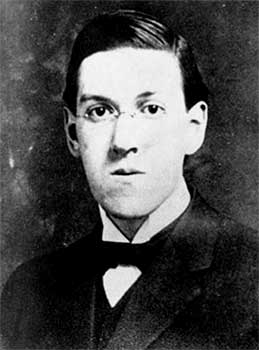
Any magazine-cover hack can splash paint around wildly and call it a nightmare or a Witches' Sabbath or a portrait of the devil, but only a great painter can make such a thing really scare or ring true. That's because only a real artist knows the actual anatomy of the terrible or the physiology of fear -- the exact sort of lines and proportions that connect up with latent instincts or hereditary memories of fright, and the proper colour contrasts and lighting effects to stir the dormant sense of strangeness.

H. P. Lovecraft
"Pickman's Model"


Since most of my free time over the next few days will be taken up with the actual reading of stories and novel(s) in preparation for October, until the 1st I'll be putting up this series of pictures of, and quotes from, the kind of writers I'll be talking about for the next month(!).

Followers