.
One of the things I use October, and these posts, as an excuse to do is to catch up on the horror writers I grew up with, but never read. Like Thomas Tessier from the other day, there are a slew of horror writers who weren't household names when I was growing up in the 1980s, devouring Stephen King books and so forth, but whose names popped up everywhere a horror fan looked. My thinking has been, well, some of these guys must be good, right?
.
Today's subject, Chet Williamson, isn't entirely alien to me, or even to this blog. Long time readers may, but almost certainly won't, remember that in 2008 I read a couple of his short short stories, in conjunction with similar stories by Steve Rasnic Tem and William F. Nolan, and that one Williamson story in particular, "The Assembly of the Dead", really struck a chord with me. And though this post wasn't really about Williamson, I did also make very favorable mention of his horror Western story "'Yore Skin's Jes's Soft 'n Purty'...He Said" at the end of this post last year. So I'm not exactly oblivious to the guy, and have read a couple more short stories outside of those mentioned above. But having liked what I've read up to now, I believe further investigation is warranted.
.
And it'd be one of Williamson's novels, if I had the time, but sadly I don't, so it was back to scouring the anthologies again last night. The two Williamson stories I landed on are interesting in that they make me picture Williamson's career in terms of the classic pulp writers -- not people like Lovecraft, who only wrote one kind of story, but the guys who wrote Westerns, horror, romance, science fiction, even porn, whatever market was open that week. The difference being that Williamson is writing horror only (to my knowledge), but in my experience so far he's crossing lots of styles and subgenres within horror, as is illustrated by today's stories.
.
First is "Blood Night", taken from the first of the Hot Blood anthologies edited by Jeff Gelb and various co-editors throughout the late 80s, mid 90s (or however long they lasted). These were, for lack of a better term, erotic horror anthologies, or at least so I believe was the intent. Meshing those two kinds of writing is ultimately going to shed a pretty dark light on the "erotic" part of this whole transaction, but I would still have a hard time calling "Blood Night" erotic, though it's undeniably abot sex. To each his own and all that, but the story is about Richard Bell, a single fellow who awakes one morning from an intensely sexual dream to find that not only did he apparently achieve completion while sleeping, but the dream woman who clawed his back drew real blood, as well. Not jumping to any conclusions, Bell simply marvels at his personal, slumbering vigor and goes about his day. Though it would appear from this description that "Blood Night" is going to turn out to be succubus tale, or something to do with some other type of supernatural night visitor, it's not. No, because when Bell gets to work and gets to chatting with a friend about what happened, the conversation turns towards dream control, and how a person can, supposedly, through certain planning and procedures and a lot of focus, dictate what he or she will dream about that night. So Bell decides he's going to read up on the great lovers, like Casanova and Don Juan, and let those stories and images dominate his mind while he sleeps. This works. It works really well. Then, in his ignorance, Bell moves on to De Sade.
.
I appreciated, if that's the word, the De Sade section, because I feel like Williamson is playing with the popular perception of him (such as it is, these days), as personified by Bell and his expectations, and off-setting that with the reality. A reality which Bell doesn't entirely dislike, but this is a horror story, after all.
.
Bell is not, nor does he become, a terrible human being -- rather, he's a guy who regards sex as a contest, and who loses all his control to this power he's suddenly located in himself. At one point, Williamson says that Bell feels "very sad", which is such a simple phrase, one you might use to describe a child, or a movie, but which can be very powerful in the right context, as it is here, because Bell's sadness is based on discovering that he harbors certain awful desires, ones he would absolutely rather not have. It's like he's become disappointed in himself, and dreads what this knowledge will mean down the line. It'll mean disaster, of course, and Williamson's ending is both surprising and a little...what? It's sort of a Twilight Zone twist, really, a stinger kind of ending, one that's a little overexplained, and maybe goofy, but I'll be damned if it doesn't also make a certain amount of sense. I mean, knowing what Bell is seeking to accomplish, and fast, at the end of the story, it seems like as good an idea as any.
.
The other story, “The Return of the Neon Fireball”, surprised me by not being as pulpy as it sounded, or as “Blood Night” actually was. The title is, in fact, intended to sound like a throwback to a 1950s drive-in B movie (and an old Mickey Rooney film called The Fireball is referenced here) because the story is about Michael Price and his desire to buy, restore, and reopen The Fireball, a drive-in theater beloved in his youth (the “neon” comes from the marquee, of course). Not so much his desire, actually, but rather the fact that he goes ahead and does it – with the help of his more wealthy friend, Lenny – and the effect it all has on him. Price is a widower, and he complains to Lenny that his life isn’t fun anymore. He owns his own clothing store, but it’s nothing to him, even though he’s by no means wealthy, to sell it and funnel that money into the Fireball.
.
The fact that Price is completely locked in, financially, to the success of the Fireball is not a big deal in this story – once they open, the place does pretty well. What does matter is that, on that first night, a group of kids show up driving a vintage – but not mint – Mercury, decked out in 50s styles, and paying with coins and bills dated from that decade and earlier. Price clues into what this is all about pretty quickly, or at least he gets a sense of it – certainly more quickly than I did, because I was expecting “The Return of the Neon Fireball” to have something of the loony vengeful-spirit-of-the-1950s feel of certain Stephen King works, like Christine or “Sometimes They Come Back”, but that’s not it at all. Instead, the story is steeped in the melancholy of a lumpish middle aged guy whose teenage years just happened to unfold in the 1950s. If the story was written by somebody my age, instead of a drive-in it would have been an arcade, and instead of the kids driving up in a Mercury, it would have been, I don’t know, a Buick Grand National or something. The point is the truth of Mike Price’s life, both as we see it, and as he saw it, or wishes it had been, in the 1950s. “The Return of the Neon Fireball” is ultimately a very sad story, its semi-pulp references – in the title, in some of the films set to play in the theater – only making us wonder if anything was ever as good as we remember it.

Showing posts with label October Project. Show all posts
Showing posts with label October Project. Show all posts
Friday, October 22, 2010

Thursday, October 21, 2010
The Kind of Face You SLASH!!! - Day 21: The Memory of That Look
 When I wrote about Karl Edward Wagner back in 2008, I basically just used him as a stick with which to beat Mick Garris, and while I view this as an entirely valid use of anyone's time, it can't be said that I've given Wagner, one of the major figures in late 20th century horror fiction, his due. This makes a certain amount of since when you consider that, at the time, the story I read for that 2008 post, "More Sinned Against", was the first piece of Wagner's fiction I'd ever read. For someone who claims to be interested in this stuff, that seemed a little off to me.
 .
Well, I've corrected my ways, and earlier this year I read the rest of Why Not You and I?, Wagner's story collection that contains "More Sinned Against". As a brief recap to the brief biography I provided in the linked post, Wagner died at the age in 1994 at the age of 48, and Why Not You and I? was the second and last collection of his horror fiction that he lived to see published (though he's primarily remembered for his contributions to horror, he actually produced a lot more fantasy fiction, both in short story and novel form). A psychiatrist by training, but disillusioned of that practice, Wagner's fiction is as often about the self-destructing minds of his protagonists as it is about any supernatural threat, and can sometimes be about the former while having an element of the latter shoehorned in, arbitrarily, or so it sometimes seems. Why Not You and I? begins with an interesting story called "Into Whose Hands" that delves into Wagner's medical training, as it's set in a mental institution, but what struck me as I was reading it was how many stories deal directly with the world of art, either popular or otherwise, or the clash between those two, as in "Neither Brute Nor Human", about the careers of two rival science fiction authors (and yes, that one's also a horror story). "More Sinned Against" interested me initially because it was tangentially a horror story about the world of film, and I like that sort of thing, but I was slightly taken aback to find out how much of Wagner's fiction follows a smiliar line. Apart from the stories already mentioned, there's also "Old Loves", where the central premise is a transparent take on the obsession so many fans developed towards Diana Rigg in The Avengers, or "The Last Wolf" which is about the last writer in the world, and so on.
.
It's been noted by friends and fans of Wagner, such as Ramsey Campbell (he does come up a lot, doesn't he?) that his later horror stories were particularly grim and personal, even insular, as the title of one such story, "Silted In", might indicate. My own experience with Wagner thus far seems to have leaned heavily on that period of his writing, and I have to wonder, reading stuff like "Silted In" and "The Last Wolf", if the focus on the worlds of art and entertainment in his fiction is maybe a part of that -- "Neither Brute Nor Human" is an especially bitter look at the world of genre popularity and fandom, for instance -- and maybe Wagner's growing distaste had as much to do with his chosen profession as it did with anything else. As an editor, which he frequently was, Wagner had a reputation for holding rigorously high standards, and not suffering slapdash work. Perhaps he was living to see too much of that, and wanted to blast the world of genre art in his own fiction. I honestly have no idea if that's true, but I'm beginning to wonder.
.
For today, I ended up straddling the two main sections of Wagner's horror fiction career, choosing as my main focus what is possibly his most enduring story, "Sticks", taken from his first collection In a Lonely Place. Reading "Sticks", I was struck by another feature of Wagner's writing, which is that he openly worked in styles of, or worlds and ideas created by, other writers. In the case of "Sticks", we have a clear Lovecraft homage, complete with the discovery of an otherworldly language that's all Ys and Gs. When discussing Michael Chabon's own trip down this road yesterday, I was generally accepting, and why shouldn't I be the same here, but I must say it's slightly frustrating to find so many talented horror writers falling back on Lovecraft, not just for inspiration, but for the basic core and even structure of their fiction. "Sticks" is really a very good story of this type -- and it's also set in the world of creative types, as Colin Leverett, our hero, is an artist who lives through World War II to become an illustrator for the pulps, modeled after Lee Brown Coye -- with terrific atmosphere and building dread. The title comes from bundles of sticks, woven into lattice, Leverett finds all over the woods in his rural Pennsylvania homeland before going to war, and the horrible world of cosmic evil they're linked to, and I quite liked that set up and how it wove through the narrative of Leverett's life as an illustrator. It's just that when reading one of the premiere stories by one of the giants of modern horror fiction, I was hoping for something more than just a more tightly structured Lovecraft. Which is nothing to sneeze at, but too often I think the horror genre is content to fold in on itself, and I would love for that pattern to be broken.
.
It's funny, though -- or maybe it isn't -- the way these things evolve. I'm reading a major (by which I partly mean "long") story by one of the genre's grand statesmen, Hugh B. Cave, for a post set for this weekend, and when I started reading it the first thing I thought of was Karl Edward Wagner. In Why Not You and I?, he has a novella called "Sign of the Salamandar, by Curtis Stryker, with an Introduction by Kent Allard". This story is pure pulp adventure -- though somewhat post-modern in the idea that Wagner didn't write either the story or the introduction, even though he did -- very much like the Cave story I'm reading, and since Wagner was a huge admirer of Cave, and editor of the Cave collection from which I'm reading, not a whole lot of dots need to be connected. However, Kent Allard, under whose name Wagner wrote the introduction to the novella he wrote, is also the horror writer who is central to the plot of "Sticks" -- it's his books that Leverett comes to illustrate later in his life, and, in a sense, through whom he finds out the truth of the sticks and his early experiences in Pennsylvania, before the war. So there's that, and then right after that in Why Not You and I? is another long story called "Blue Lady, Come Back", which takes the fun pulp trappings of "Sign of the Salamandar..." and spits right in their face. "Blue Lady..." is the sequel to "Salamandar..." in the same way that smoke, ashes, and ruin are the sequel to a house that has a comfortable fire going in the fireplace.
.
And while Wagner perhaps built his own autobiography into some of his fiction by simply setting it in the business he worked in (for lack of a more concise phrase), he also did it, at least later in his life, by plonking himself down in the stories, too. I read two very short pieces by him for today, one called "Lacunae" and the other called "But You'll Never Follow Me". In "Lacunae", a very graphic but also fairly rote story of violently spit identity (sexual, in this case), there's a side character named Blacklight who is described as being a large man, a Vietnam burnout, with a shaggy beard and biker clothes. If you look at the picture of Wagner I've provided here, and search for other images on-line, you'll maybe see where he got that look. Similarly, in "But You'll Never Follow Me", Michael Marsden, the main character, is a jobless drunk with a "spreading beer gut", a beard, "limp brown hair", and denim clothes.
.
That's him, right there, and in "But You'll Never Follow Me", the writing of which he told editor Thomas E. Monteleone was like "throwing [himself] on a live grenade" you see a writer who has spent a great deal of time beating himself up for the choices he's made. Deservedly or not, I don't know -- more likely the same choices most people are forced to make whether they like it or not. It's just that most people don't spill the acid such choices fill them with all over the page for others to read. "But You'll Never Follow Me" is one of those late life, deeply angry and personal stories Wagner was known for, and it's also one of the best from him I've read. It's about six pages long, and it will make you quite depressed. It pays homage to no other writer but Wagner.
Tuesday, October 19, 2010
The Kind of Face You SLASH!!! - Day 19: He Was His Own Truth
.
If I were on the outside looking in, I would guess that one aspect of these posts that gets really boring for some people are the parts where I decide it's necessary to tell everybody what my background is with the writer in question. Or, even better, when I tell you how I first heard about them. Because what could be more engrossing? Well, I have to get started somehow, so quit yer bitchin'. Today, though, I'm not even going to bother, because when it comes to Thomas Tessier, I have (almost) no history. I'd never read him before this year, when I read a fine short story by him called "In Praise of Folly" a couple months ago, and outside of that I was merely aware of him, as a ubiquitous name on the contents page of any number of anthologies.
If I were on the outside looking in, I would guess that one aspect of these posts that gets really boring for some people are the parts where I decide it's necessary to tell everybody what my background is with the writer in question. Or, even better, when I tell you how I first heard about them. Because what could be more engrossing? Well, I have to get started somehow, so quit yer bitchin'. Today, though, I'm not even going to bother, because when it comes to Thomas Tessier, I have (almost) no history. I'd never read him before this year, when I read a fine short story by him called "In Praise of Folly" a couple months ago, and outside of that I was merely aware of him, as a ubiquitous name on the contents page of any number of anthologies.
.
Since then, I've learned that Tessier got his start back in the mid-70s. At the time, he was living in England, and worked as a music critic for the UK edition of Vogue, a nice gig he bailed on in order to concentrate on his fiction. His first novel, The Fates, was helped along to publication by his good friend Peter Straub, and this led Tessier to try a second novel, specifically a werewolf novel. He drew inspiration from Guy Endore's The Werewolf of Paris (though the final result doesn't really show it) and Jack Williamson's Darker Than You Think (which I haven't read, but will be seeking out shortly). For the record, I'm pulling all this information from Tessier's own afterword to the Leisure Books reprint of The Nightwalker, the werewolf novel that was the result of all this, and in that afterword Tessier describes the Williamson novel as being ambiguous to the end about whether the protagonist was really transforming into a wolf or not. This central idea is key to Tessier's The Nightwalker, which is certainly one of the more unique and disturbing takes on a werewolf story I've come across.
.
If Endore's The Werewolf of Paris is the primary, enduring classic of werewolf fiction, The Nightwalker, first published in 1979, is the modern masterpiece, which, given the relative obscurity of both, should tell you something about the werewolf's place in horror literature. What exactly the deal is with that, I couldn't tell you, but considering how much I like both the Endore novel and now Tessier's, I'd sure be thrilled if maybe people would start shifting away from zombies for a little while. But fine, do what you want, I'm sure there's a story about how WE are the real zombies that hasn't been told yet, or perhaps one about zombies that are....they're not people but maybe clones, so not only do you have a zombie outbreak, and everybody has to deal with that shit, but also there's this question of bioengineering or whatever, or bio...bio...something, whatever, clones, is the point, and ethics, so sometimes what'll happen is, you'll have a guy who's not a zombie, and he'll meet his clone who is, and he'll be "Can I kill myself?", as a zombie, I mean, so you have all these questions, this, this veritable stew of issues, and the great thing is it'll all be inside this bowl that's made up of rock-n-roll, kick-ass zombie action. In stores 2012.
.
The Nightwalker is not the werewolf version of the zombie-clone novel. Instead, it's the story of Bobby Ives, an American Vietnam vet who now lives in London. When we first meet him, he's waking up from a disturbing dream about some vague transformation, to find his apartment, and the hallways outside, to be filled with smoke. He locates the source, which is the burning dinner of another tenant, a drunk named Platt, who is passed out in his room as his apartment threatens to go up in flames. Ives takes care of the fire, but he also proceeds to beat the shit out of an already near-unconscious Platt. Once he's eased off, Ives feels no guilt for what he's done, and he will continue, through much of the novel, to ride guilt-free through some pretty heinous acts, shrugging off the initial shock he feels and coming to accept himself, and his nature, musing, at one point, after a particularly nasty bit of business:
.
Whatever kind of person he was, he could accept it. And the world would have to accept it, too, because he was a part of the world. Bobby knew that was a simple, self-justifying argument, but he also believed it held a basic truth. He was his own truth, whether he fully understood it or not.
.
Whatever kind of person he was, he could accept it. And the world would have to accept it, too, because he was a part of the world. Bobby knew that was a simple, self-justifying argument, but he also believed it held a basic truth. He was his own truth, whether he fully understood it or not.
.
The Nightwalker is not really a plot-heavy novel, in the sense that there is no subplot about the police detective trying to track down the perpetrator of these savage murders, or anything about Ives hunting the werewolf who bit him -- he never even gets bit. That's the strange thing about this book: it is, first and foremost, a good, old-fashioned, what-they-used-to-call character study about a guy living reasonably comfortable off of government checks, in London, a guy who has a girlfriend named Annie who he loves, and who loves him, and who he considers to be something of a break between himself and howling loneliness. But if he is a werewolf, and there is at least some reason to believe that he is -- as opposed to just a psychopathic killer -- the origin of that is left hidden. No, the two main bits of Ives's past that Tessier wants us to know are that, while in Vietnam, a soldier who shared his name was killed, and for a time the records reflected that he, our Ives, was the man who'd died, causing Ives to experience a sort of perpetually bemused existential crisis; and, number two, Ives is convinced that he's been reincarnated, and one of those past lives (the only one, possibly) is related, in some detail, by Ives to Annie, and it involves a Caribbean Island plantation, voodoo, and possibly zombies (the traditional, folkloric kind, not the flesh-eating kind).
.
It is, as I say, an odd book, and despite what the above might indicate, not at all over-stuffed at only about 200 pages. Most of The Nightwalker consists of Ives experiencing strange physical and mental health tics, such as sudden numbness and pain in his extremities, and abrupt waking blackouts. These experiences lead him and Annie to seek some sort of help, though Ives is less interested in her traditional methods. But that's essentially the course of the book, until Ives begins killing people. Very suddenly, very shockingly, not only in the violence of the deaths, or left-field quality of it, but the identity of some of his victims. Not only that, but the first person he kills is not shredded and partially eaten, the method you might expect from a werewolf, but casually murdered on impulse, on a spur of the moment, in a manner that would be at hand for any one of us, on any given day. Ives begins to follow his murders in the paper, and takes note of how they drift from the front page to the back. His reaction: "So sad. Good-bye."
.
For much of its length, The Nightwalker is an exceptionally, even brilliantly, cold-blooded novel -- Ives's refusal to feel guilt is possibly the most appalling aspect of this man. After all, he might be a werewolf, so we're going to expect a few killings to his name. But not the complete indifference to what he's done. At one point, Ives kills an anonymous jogger, and Tessier does a good job of telling us nothing about this man, not even his name, but still making his death hurt as he describes the man rising flash of terror, followed by his hopeless attempts to beat away Ives (in wolf form, or no?), which end in mere seconds. The fact that this whole business is over in seconds, that the guy was out jogging, and the amount of time that elapses between his last moment of carefree thought, to his first jolt of abject terror, to his complete evisceration, is far more horrifying than even the details of that evisceration (it reminds me in some small of way of the guy in the tube station in An American Werewolf in London, who just wanted to go home after work, and buy some candy along the way, some small thing he could enjoy, only to find his life over in the most unbelievable manner. The fact that, in the film, when David's victims return as ghosts, that guy is the most pissed off feels very appropriate to me).
.
More typical elements of the werewolf story -- a psychic, for instance, and silver -- will make their way into The Nightwalker as it progresses, and these are the least successful parts of the book. But the one standard that, after a long absence, shows itself in a very welcome manner is guilt. Ives does eventually feel it, and this moment of clarity does not feel wedged in, but rather truly heartbreaking. The way Ives pushes his deeds into the background makes it easy for the reader to do the same, until one, the first one, comes back in an unexpected rush, and Ives feels it like a wallop. So does the reader, or anyway I did, and I also found myself really hating Ives, right at the moment when his humanity is returning. I hated him, but came to cheer his race for either a way to control whatever was raging through his body, or his pursuit of self-destruction. Whatever works.
Monday, October 18, 2010
The Kind of Face You SLASH!!! - Day 18: The Devil Told Hitler to Give it a Miss
.
Of all the obscure, intriguing, contemporary horror writers whose work is hard to track down, no obscure, intriguing, contemporary horror writer's work is harder to track down than Reggie Oliver. I can't remember exactly where I first heard of him, but I know I was on some internet forum where horror fiction was being discussed, and somebody said that the books they'd most would like to get their mitts on were the three collections written by Reggie Oliver. I was all "Who?" One of the books in question is called The Complete Symphonies of Adolf Hitler, and well, I mean...I'm not made of stone. I became briefly intent on getting my own mitts on Oliver's fiction, only to find that all of his books were out of print already (The Complete Symphonies was first published in 2005), and the asking price for used copies was exorbitant. Ostensibly good news was on the way, however, when I learned that Centipede Press was going to publish Oliver's complete works in one volume called Dramas from the Depths. When I checked that book, though...well, just look at this shit!
.
However, as is often the case when you first hear about something -- a new writer, a new word -- I found myself stumbling across his name pretty frequently after that, even finding a few of his stories tucked away in anthologies I already owned. As I didn't know who Oliver was before, his name never registered any interest when initially perusing these anthologies, but now I realized I could sample his work before deciding whether or not I wanted to, some day, spend way too much money on a single book. So now I've read a couple of his stories, and unfortunately they're both excellent.
.
(A quick aside: the title of this post has nothing to do with The Complete Symphonies of Adolf Hitler, and, in fact, nothing even to do with the story from which I pulled it. I just thought it had a nice ring to it.)
.

Of all the obscure, intriguing, contemporary horror writers whose work is hard to track down, no obscure, intriguing, contemporary horror writer's work is harder to track down than Reggie Oliver. I can't remember exactly where I first heard of him, but I know I was on some internet forum where horror fiction was being discussed, and somebody said that the books they'd most would like to get their mitts on were the three collections written by Reggie Oliver. I was all "Who?" One of the books in question is called The Complete Symphonies of Adolf Hitler, and well, I mean...I'm not made of stone. I became briefly intent on getting my own mitts on Oliver's fiction, only to find that all of his books were out of print already (The Complete Symphonies was first published in 2005), and the asking price for used copies was exorbitant. Ostensibly good news was on the way, however, when I learned that Centipede Press was going to publish Oliver's complete works in one volume called Dramas from the Depths. When I checked that book, though...well, just look at this shit!
.
However, as is often the case when you first hear about something -- a new writer, a new word -- I found myself stumbling across his name pretty frequently after that, even finding a few of his stories tucked away in anthologies I already owned. As I didn't know who Oliver was before, his name never registered any interest when initially perusing these anthologies, but now I realized I could sample his work before deciding whether or not I wanted to, some day, spend way too much money on a single book. So now I've read a couple of his stories, and unfortunately they're both excellent.
.
(A quick aside: the title of this post has nothing to do with The Complete Symphonies of Adolf Hitler, and, in fact, nothing even to do with the story from which I pulled it. I just thought it had a nice ring to it.)
.
They're also quite different from each other, despite both belonging to the same genre and featuring some level of animal cruelty. The first, "Mrs. Midnight", can be found in volume two of Ellen Datlow's The Best Horror of the Year, and it's a fairly pulpy story, in the best sense. On the back of the book, there's a rundown of each story, with a few words devoted to describing the contents, and "Mrs. Midnight" is said to be about "a television presenter [who] stumbles upon the chilling connection between a forgotten animal act and the Whitechapel murders". I believe I've already mentioned that I'm not made of stone.
.The narrator of "Mrs. Midnight" is Danny Sheen, host of the British show I Can Make You a Star. He's one of those blunt, informal, egotistical, but not wholly unlikable showbiz types with no discernable talent of his own, other than being comfortable in front of a camera. His show is a big hit, and because of this he gets roped into various charity events, none of which interest him much, particularly the one that pertains to this story. The charity is called the Save The Old Essex Music Hall project, and is just what it seems to be. There's an old theater, called the Old Essex, which has sat in disuse since 1888, following a fire that gutted the place, and it's now going to be torn down unless somebody does something to convince the powers that be that it shouldn't, and Sheen is the big name they've pegged to help out. So, with Jill Warburton, who is the cultural advisor for the mayor and the one spearheading the project, and Crispin de Hartong, foppish architectual expert and former host of a home makeover show called Premises, Premises..., Sheen heads to the Old Essex for a first look.
.
While there, he finds a wad of old playbills crammed behind a bar. On one, he sees a list of acts that performed on the night of the fire. Among them are famous names of the British music hall yesteryear, such as Dan Leno and Little Tich. Further down is an unfamiliar act, listed as "Mrs. Midnight and her Animal Comedians". Genuinely interested, to some degree anyway, Sheen agrees to do some research into this. The fruits of that research are a fair chunk of what makes "Mrs. Midnight" worth reading, so I don't want to spoil it, but I will say that, obviously, Jack the Ripper starts to enter into things, and Sheen finds himself consulting an old cohort who happens to be a "Ripperologist" named Bill Beasley, who's developed his own theories about the Ripper's identity over the years...
.I think his idea was that it was Gladstone and Queen Victoria in collaboration, which is loony of course, but not as loony as that daft American bint who thinks it was Sickert the painter.
.The above mentioned theory is, indeed, daft, but can't possibly be the daftest one every devised by an American.
.In any case, what Sheen goes on to discover is considerably insane, and quite imaginative, and quite disturbing. It's a fun, eerie, strange story that hit certain areas of interest for me, by which I don't just mean Jack the Ripper, but also weird old showbiz acts from the 19th century, and the dark undercurrents of that era in London. Plus, with that reference to Dan Leno, and an element of gender confusion that's introduced, I was put in mind of one of my favorite novels, Peter Ackroyd's Dan Leno and the Limehouse Golem, which might well have inspired Oliver to write "Mrs. Midnight". Not that the two are all that similar, but they certainly approach two very similar things, and make certain shivery connections. Good stuff, is my point.
.The other story I read is called "The Children of Monte Rosa", and it can be found in volume 19 of Stephen Jones's Best New Horror (I know, it's those two again! Well, we'll call this rematch a push). "The Children of Monte Rosa" is very different from "Mrs. Midnight", being much less pulpy, and far less eventful, in any obvious way. Not that plenty doesn't happen in "The Children of Monte Rosa", but rather that what does happen often feels disconnected from any clear meaning. Even by the end, when some things seem to be tied up, we realize that there's far more that we still don't know, and that, really, nothing has been explained at all.
.The mode in which Oliver is working here has a rich history in horror fiction -- it's the one that finds an English (or American, but often English) couple, or family, on vacation, in some exotic European country (in this case it's Portugal; Ian McEwan wrote a whole novel on this premise, The Company of Strangers, which is set in Venice. See also Don't Look Now and etc.), where they meet another couple, or family, that turns out to be most odd. Here, the parents of the narrator, and the narrator himself, a young boy, meet Hugh and Penelope de Walter, British expatriates who fascinate the narrator's mother with their surface oddities -- their dress, their choice of drink -- and, being the forward type, the mother insinuates herself and her family into the de Walters' existence, into which they are willingly accepted. To such a degree, in fact, that they are invited to the de Walters home, which is where everything, such as it is, happens.
.The rough part about describing a story like this is that by listing some of the strange occurences, I would essentially be ruining "The Children of Monte Rosa", at least as a story. Not as a piece of writing, bu still, the accumulation of subtly -- and less subtly -- bizarre episodes is where the meat of this kind of story can be found. But it's worth mentioning that, shortly after the family arrives at the de Walters home, the young narrator is excused to explore the surrounding land. He finds a well, tucked into a lovely green spot near the house, and sitting at that well is another young boy. This young boy is named Hal, and he's a bit aggressive with the narrator when it comes to the subject of cricket, though the narrator (who is obsessed with the sport) has never heard of Hal's favorite player, and vice versa. As their childish game of one-upsmanship progresses, Hal becomes more irritable, finally yelling at the narrator to leave, which he does, but...
.The sound of his cry rang in my ears. I turned from him and ran up the path to the top of the slope. When I had reached it, I turned again and looked back. Hal was still sitting there on the lip of the old well, his heels banging against the stones. He was facing in my direction but I could not tell whether he was looking at me or not. The light, which was not quite right in that strange garden, had turned his eye sockets into empty black holes. I turned again and ran. This time I did not look back.
.When the narrator gets back to the house, he encounters Penelope de Walter, who asks if he met the little boy. The narrator says that he did, and Penelope makes him promise to not mention the boy to anyone. And then things get crazy.
.
I feel like I'm doing Oliver a little bit of a disservice here today by not plundering these stories more fully, but "The Children of Monte Rosa" is particularly vulnerable to having its effects ruined by simply summarizing its inexplicable narrative. Both stories display a deft hand with two very different styles of horror, and I wouldn't dream of ruining their impact.
Sunday, October 17, 2010
The Kind of Face You SLASH!!! - Day 17: Surely There Must Be Total Darkness
.
In yesterday's mail, I received a mysterious package. It arrived to me from overseas -- from England, to be specific -- and was posted to me by someone who went by the name "Al". In the package was a book and a note, the note assuring me that "Al" was "sorry for the delay". None of this made any sense to me whatsoever, but the package had clearly been addressed to me, and the note was to "Bill". Perplexed, even slightly ill at ease, I examined the book. It was called The Seventh Pan Book of Horror Stories, said stories having been "selected" by one Herbert van Thal. 
.
This "Al" fellow clearly knew my tastes. Glancing at the table of contents, I saw tales by Patricia Highsmith, R. Chetwynd-Hayes, cult science fiction author Harry Harrison, as well as several writers I'd never heard of (though it seems plain that Van Thal is somewhat keen on such enigmatic figures as Dulcie Gray, John D. Keefauver, William Sansom, and Martin Waddell, as each gets two stories in this slim volume). Unquestionably, Al wished me to read from this book, and finding myself with some time on my hands earlier this morning, I decided to sample what was on offer -- though not feeling terribly adventurous, I went with established names, which is to say, I chose the stories by familiar names Harrison, Highsmith, and Chetwynd-Hayes.
.
I've never read Chetwynd-Hayes (or Harrison, or not all of anything by Harrison), but I knew that though his name indicated to me that he scribbled during the late 19th century, and into the dark beginnings of the 20th, he actually was born in 1919 and didn't pass on until 2001. I also knew that his short horror fiction had been plundered for more than one horror anthology film, such as Amicus's From Beyond the Grave, and The Monster Club, in which Chetwynd-Hayes is actually portrayed by John Carradine. For some reason, these scraps of knowledge cohered in my mind to make Chetwynd-Hayes a Writer I'd Like to Read, and so his story in The Seventh Pan Book of Horror Stories (a story that, on that contents page, has a check mark penned next to it -- is this the work of "Al"?), called "The Thing", was the first one I read.
.
And I loved it. Both this and the Highsmith story are rather short -- not short short, as yesterday's stories were, but brief -- and what's most appealing about "The Thing" is how much of it feels like an anecdote told by a born storyteller, of the English, gimlet-eyed variety. Our narrator is a man who views getting drunk as a hobby, and who orders six whiskeys at once to save himself the trips. He does this at the stories open, takes his seat at a table, and notices the lovely white back of a young woman sitting on one of the bar stools. The woman senses his leer and turns around, winks at him, and then approaches his table...
.
I sighed deeply and downed my second whiskey to wash away my disillusion, for surely the strangest part of a man's make-up is that he will pawn his soul for what he thinks he cannot have, but will turn his head in disgust when he learns it is will within his means to buy it.
.
That fairly represents the tone that Chetwynd-Hayes strikes throughout much of "The Thing", before events turn towards the strange. This comes in the person of a young man who enters the pub, and whose youth reminds the narrator of a piece of fruit that never ripens properly and possesses "a soft green skin full of corruption, that will fall to the ground at the first breath of autumn." With this young man, and more to the point, is a creature, "a Thing" that only the narrator can see -- it has a "a dead white face; a face made of wax" and "eyes of terrible hunger", and it appears to mimic everything the young man does. And eventually, that young man makes his way to the narrator's table.
.
It's all rather like Graham Greene or Nigel Balchin got it into their heads to write a horror story, and a find job they did of it, too, through the pen of R. Chetwynd-Hayes. "The Thing" really is quite good, both in its imaginative and unnerving premise, and in the easy, entertaining, scornful indifference of the prose.
.
Highsmith's story doesn't have quite as much meat on its bones as "The Thing", but still manages to be entirely effective. Called "The Snail Watcher" (and also checked by Al -- or someone -- on the contents page), the story has a certain Roald Dahl-esque flair about it, and would have been right at home as an episode of Alfred Hitchcock Presents, if a proper adaptation of it wouldn't have possibly exceeded the budget of that show. The other easy comparison to make are the stories in Highsmith's own collection The Animal Lover's Book of Beastly Murder, and in fact I was quite surprised to discover that "The Snail Watcher" is not included in that book.
.
It's the story of Mr. Peter Knoppert who, one day, while passing through his kitchen and noticing the living snail that are waiting in bowls to be served at that night's dinner, becomes obsessed with the slimy, be-shelled little creatures; specifically, and disturbingly, their mating rituals. So obsessed that he declares that no snails shall be served that night, and he begins acquiring more and more snails, and urging them, successfully, to mate, that eventually his study is overrun.
.

The difficulty in writing about a story like "The Snail Watcher" is that a million stories like it have been written over the years, and most of them have probably been read by you. Highsmith isn't offering any new ideas; all she's bringing to the table is her typically wonderful writing, which comes across best at the very end, when she delivers a wonderful last line, and portrays an everyday creature in terms of an alien intelligence that surrounds us constantly, and that we take lightly at our peril.
.
More consciously "about something" than either the Chetwynd-Hayes of the Highsmith story is "The Streets of Ashkelon" by Harry Harrison (unchecked by Al...). A very pure science fiction story, of the 1960s variety -- very little in the way of tech, and instead all extrapolated social questions and philosophies -- up until its final few pages, which explain its inclusion in a horror anthology, "The Streets of Ashkelon" is about a brief cold war between a space trader named John Garth, who does his collecting on a planet called Wesker's World, where he lives among a peaceful, intelligent, and exhaustingly logical alien race; and Father Mark, a Christian missionary who bought his passage to Wesker's World on another trading ship, and whose arrival on Wesker's World both surprises and angers Garth. Garth is angry because he's an atheist, and he dreads the thought of what Father Mark's gospel will do to planet's natives, who are free of any religion of any kind.
.
So the two men butt heads, and Harrison's sympathies are pretty obviously accounted for. My one big complaint against "The Streets of Ashkelon" is that, because he clearly has no time for religion himself, Harrison is either unwilling or unable to provide Father Mark with any intelligent points of is own -- every counter he offers to Garth, or answer to the questioning natives, is essentially "Just believe things, that's all." Anyone who thinks, whatever their own views, that's as far as religious thought has taken us, even by 1966, hasn't been paying attention.
.
Ultimately, this is only "rather annoying" rather than "crippling", because the direction Harrison has in mind is not only effective as a bit of storytelling, but also cruelly logical, philosophically powerful, and just plain nasty. Harrison does just enough in creating these inhabitants of Wesker's World, and making the reader understand their thought process, that where we wind up makes perfect sense. In getting there, Harrison might hammer on the "issue" element of his story, but frankly that's one of the things I like about mid-century science fiction, and one of the things I miss about the genre when I don't read it for a while. This brand of SF  was unabashedly about things, and yet the best writers somehow thrilled as storytellers at the same time. Talk about your lost arts.
 was unabashedly about things, and yet the best writers somehow thrilled as storytellers at the same time. Talk about your lost arts.
.
So that's it. What Al intends for me to do with The Seventh Pan Book of Horror Stories is anyone's guess, although it is true that I do now possess his address, or, at any rate, an address. I'm tempted to travel there and see what his section of England is like. I imagine vast moors, skittish locals, several old churches... Being something of an antiquarian myself, I think an excuse to exercise that hobby, as well as my physical self, is most welcome. But oh, what's this? A sliver of some ancient wood just fell from the pages of the book. I shall now retrieve it from the floor.
.
Oh! I've stuck myself with the sliver! God rot you, you miserable piece of wood! Well, never mind, never mind. I'm only bleeding very slightly. And yes, I do feel a bit dizzy as I go to wash my wound under the kitchen tap, but I imagine there's no connection, and its simply a result of having been seated for so long a period.
.
My, but my head certainly is spinning. And my finger is terribly red -- the tapwater has done nothing for me. It hasn't even stopped the bleeding. Perhaps if I sat down again...oh, heavens...
.
Etc.
Saturday, October 16, 2010
The Kind of Face You SLASH!!! - Day 16: Love of Cruelty
.
Well, the time has come for me to once again take the easy route and delve into the world of the short short story (seriously, is there no other name for this form?). As is my habit, I grab a handful of these things, read them, and do a usually not-literally bullet point run down of them. The last two years of The Kind of Face You SLASH!!! have been slightly hampered in this regard, from my point of view, by the fact that I have two big collections of these kinds of stories, but for the longest time could only find one, 100 Hair-Raising Little Horror Stories, edited by Al Sarrantonio and Martin H. Greenberg. Well, in the time between last Oct. 31 and today, I found the other one, called 100 Creepy Little Creature Stories, edited by Robert Weinberg, Stefan Dziemianowicz and, yes, Martin H. Greenberg. I'm trilled, I must say, because not only do I have a new pool from which to draw, but these ones are about creatures.
I'll begin with the least of the bunch, "The Gargoyle Sacrifice" by Tina L. Jens. It's about a 14-year-old Goth girl named Marissa, whose 18-year-old boyfriend Rudy has pressured her to get her nipples pierced, and in the skeevy tattoo/piercing parlor and occult store where they've gone to have this done, Marissa finds her eye caught by clunky-sounding gargoyle necklace, the ruby stone prominently featured therein being "the size of the lenses in her Lennon glasses." It was right about here that I said "Oh, Jesus", and I was right to do so. Jens piles on the terrestrial horrors for Marissa to endure, before bringing in the dull otherworldly version. The shrug-inducing nature of "The Gargoyle Sacrifice" is highlighted by the big payoff at the end, in which a character we've never met and know very little about meets with a demon or Satan, and we find out why what just happened just happened. What's so goofy and anti-climactic about this scene is that the guy talking to the demon says "There, I've done this terrible thing a whole bunch of times, so that should cover my end of the deal," and the demon says "No, you haven't done it enough...you have to do it seven more times!!!" And that's it. The number seven, as opposed to eight, or six, is ,I suppose, meant to add that last little chill.
"The Gargoyle Sacrifice" highlights the dangers of the short short story by showing that the unusually abbreviated length is not always the result of having a particular idea that suits the form, or the wish to play with said form, but of having not much of an idea and not developing it enough to reach past three or four pages. Two stories that have a better grasp of the form are "Dark Brother" by Donald R. Bruleson and "The Feather Pillow" by Horacio Quiroga. The brevity of "Dark Brother" is justified in part by the fact that it's told from the point of view of a family cat. I most disdainful family cat, who is aware, while its lumpish owners are not, that a malicious spirit lurks within their home. The cat revels in the spirit's torment of the man and woman who foolishly believe they own their house, and "Dark Brother" chronicles the cat's truncated view of the proceedings. The story goes where you'd think, with no surprises, but the fate of the couple is describe with a disturbing restraint, and a lack of empathy, that is very effective:
[Dark Brother] shoots out a tendril to thicken upon her and take her down, moaning, in the hallway, where, pulsating, he worries at her face until the screaming stops.
That "worries at her face" is unpleasantly evocative, I think.
Like "Dark Brother", Qurioga's "The Feather Pillow" shrinks a fairly large chunk of time down to a few pages, and I find this approach to time to be the most effective in this format. It allows for a certain style and gloss that something like "The Gargoyle Sacrifice" doesn't understand. Qurioga's story is about a pair of newlyweds, Alicia and Jordan. Upon returning from their honeymoon, Alicia finds her new home badly contributing to her already nervous demeanor, to the point where she's first terrified, and then ill. "The Feather Pillow" charts her rapid decline, at the end providing evidence that what's behind her sickness is a horror staple before revealing a far stranger truth. What I liked best about "The Feather Pillow" is the last paragraph, which transforms the story from a straight piece of horror into an almost zoological cautionary tale.
To round things off, I went with two especially short stories, each one only two pages. Orlin Frederick's "The Throwback" is nothing too special, merging, as it does, the horrors of war -- World War I, in this case -- with the horrors of, I don't know, werewolves probably. It's not bad, by any means, but you have a character, Heinz, part of a German battery whose face is evil and who occasionally loses it completely, disappears for a night, and then the next morning someone has died violently and mysteriously. It's simply a brief metaphor for cruelty and bloodlust in war, and if you've read one of those, you've read "The Throwback".
Finally we have Steve Rasnic Tem's "There's No Such Things as Monsters". I went with Tem, even though I've written about his work more than once, because the short short seems to be his chosen form, and I find him fascinating. Not that "There's No Such Things as Monsters" is a masterpiece, but it's a moving little bit of enchantment about the fears of a small child, storytelling, and a monster's restraint that confirms that Tem is a most unusual and unexpected talent. I'd love to see another major work from him soon, but there's still so much of his past fiction I've never read, there's no reason to look too far ahead just yet.
Well, the time has come for me to once again take the easy route and delve into the world of the short short story (seriously, is there no other name for this form?). As is my habit, I grab a handful of these things, read them, and do a usually not-literally bullet point run down of them. The last two years of The Kind of Face You SLASH!!! have been slightly hampered in this regard, from my point of view, by the fact that I have two big collections of these kinds of stories, but for the longest time could only find one, 100 Hair-Raising Little Horror Stories, edited by Al Sarrantonio and Martin H. Greenberg. Well, in the time between last Oct. 31 and today, I found the other one, called 100 Creepy Little Creature Stories, edited by Robert Weinberg, Stefan Dziemianowicz and, yes, Martin H. Greenberg. I'm trilled, I must say, because not only do I have a new pool from which to draw, but these ones are about creatures.
I'll begin with the least of the bunch, "The Gargoyle Sacrifice" by Tina L. Jens. It's about a 14-year-old Goth girl named Marissa, whose 18-year-old boyfriend Rudy has pressured her to get her nipples pierced, and in the skeevy tattoo/piercing parlor and occult store where they've gone to have this done, Marissa finds her eye caught by clunky-sounding gargoyle necklace, the ruby stone prominently featured therein being "the size of the lenses in her Lennon glasses." It was right about here that I said "Oh, Jesus", and I was right to do so. Jens piles on the terrestrial horrors for Marissa to endure, before bringing in the dull otherworldly version. The shrug-inducing nature of "The Gargoyle Sacrifice" is highlighted by the big payoff at the end, in which a character we've never met and know very little about meets with a demon or Satan, and we find out why what just happened just happened. What's so goofy and anti-climactic about this scene is that the guy talking to the demon says "There, I've done this terrible thing a whole bunch of times, so that should cover my end of the deal," and the demon says "No, you haven't done it enough...you have to do it seven more times!!!" And that's it. The number seven, as opposed to eight, or six, is ,I suppose, meant to add that last little chill.
"The Gargoyle Sacrifice" highlights the dangers of the short short story by showing that the unusually abbreviated length is not always the result of having a particular idea that suits the form, or the wish to play with said form, but of having not much of an idea and not developing it enough to reach past three or four pages. Two stories that have a better grasp of the form are "Dark Brother" by Donald R. Bruleson and "The Feather Pillow" by Horacio Quiroga. The brevity of "Dark Brother" is justified in part by the fact that it's told from the point of view of a family cat. I most disdainful family cat, who is aware, while its lumpish owners are not, that a malicious spirit lurks within their home. The cat revels in the spirit's torment of the man and woman who foolishly believe they own their house, and "Dark Brother" chronicles the cat's truncated view of the proceedings. The story goes where you'd think, with no surprises, but the fate of the couple is describe with a disturbing restraint, and a lack of empathy, that is very effective:
[Dark Brother] shoots out a tendril to thicken upon her and take her down, moaning, in the hallway, where, pulsating, he worries at her face until the screaming stops.
That "worries at her face" is unpleasantly evocative, I think.
Like "Dark Brother", Qurioga's "The Feather Pillow" shrinks a fairly large chunk of time down to a few pages, and I find this approach to time to be the most effective in this format. It allows for a certain style and gloss that something like "The Gargoyle Sacrifice" doesn't understand. Qurioga's story is about a pair of newlyweds, Alicia and Jordan. Upon returning from their honeymoon, Alicia finds her new home badly contributing to her already nervous demeanor, to the point where she's first terrified, and then ill. "The Feather Pillow" charts her rapid decline, at the end providing evidence that what's behind her sickness is a horror staple before revealing a far stranger truth. What I liked best about "The Feather Pillow" is the last paragraph, which transforms the story from a straight piece of horror into an almost zoological cautionary tale.
To round things off, I went with two especially short stories, each one only two pages. Orlin Frederick's "The Throwback" is nothing too special, merging, as it does, the horrors of war -- World War I, in this case -- with the horrors of, I don't know, werewolves probably. It's not bad, by any means, but you have a character, Heinz, part of a German battery whose face is evil and who occasionally loses it completely, disappears for a night, and then the next morning someone has died violently and mysteriously. It's simply a brief metaphor for cruelty and bloodlust in war, and if you've read one of those, you've read "The Throwback".
Finally we have Steve Rasnic Tem's "There's No Such Things as Monsters". I went with Tem, even though I've written about his work more than once, because the short short seems to be his chosen form, and I find him fascinating. Not that "There's No Such Things as Monsters" is a masterpiece, but it's a moving little bit of enchantment about the fears of a small child, storytelling, and a monster's restraint that confirms that Tem is a most unusual and unexpected talent. I'd love to see another major work from him soon, but there's still so much of his past fiction I've never read, there's no reason to look too far ahead just yet.
Friday, October 15, 2010
The Kind of Face You SLASH!!! - Day 15: The Dull, Dumb, Faceless Thing
.

There are two subgenres of horror that, these days, work almost like poetry, at least in a commercial sense. Those are the weird tale and its near-sibling, the ghost story. Together, these subgenres practically make up the entire core of horror, and most everything else grows outward from them. So far outward that only the whispiest of connections can be traced now, but that doesn't mean they're no long there. The relation to poetry is that nowadays weird fiction and ghost stories, even the best of them, are most often published by very small presses, whose market is the hardcore fans, mixed with the collectors -- this is reflected in the prices charged by most of these small presses. Not that all poetry is published by small presses, but poets are doomed to not make a living from their poetry, as ghost and weird fiction writers are, I'd say, similarly doomed, although I know nothing, and care to know nothing, about the various financial situations of these writers. But this stuff is no longer easily marketed, because it's no longer what people think of when they think of horror (as poetry is usually not what people think of when they think of literature). You sort of have to know what it is before you even know it's out there. In other words, I only know who Mark Samuels is, for instance, because I know what weird fiction is.
Similarly, I only know who Terry Lamsley is because I know that there are still people out there writing classical (which is not to say derivative) ghost stories. Lamsley's work is published by small presses, and as is often the case with writers so published, there is one book that gets sold at a price that wouldn't make a regular working stiff horror fan such as myself blanch at the idea of paying for it. With Lamsley, that book is Conference with the Dead, published by Night Shade books. In his introduction to Conference with the Dead, Ramsey Campbell -- who has an incredibly sharp eye for this kind of writing -- relates an interesting, charming and even inspiring anecdote about his introduction to Lamsley's work. In brief, he says that he was at a science fiction convention, and encountered Lamsley hawking his self-published collection Under the Crust (check out how much that one is currently going for online). Because Lamsley was standing right there, Campbell found it difficult to simply put the book down, having just picked it up for a browse-through, and also Lamsley hailed from, and set much of his fiction in, Buxton, where Campbell had met his wife. So he bought the book, and later that night, after reading some of it, called Stephen Jones and Karl Edward Wagner to announce the arrival of a major new talent.
Later in the introduction, Campbell says:
In this book Lamsley consolidates his reputation as an inheritor of all the qualities of classic English supernatural horror fiction: wit, detachment, an economy of effect bordering on the poetic, a seemingly effortless originality.
In this book Lamsley consolidates his reputation as an inheritor of all the qualities of classic English supernatural horror fiction: wit, detachment, an economy of effect bordering on the poetic, a seemingly effortless originality.
Yes, yes, yes, and yes, from what I've been able to tell after reading seven of the ten stories in Conference with the Dead. Reading Lamsley, I'm reminded of M. R. James, without thinking that Lamsley is simply treading old ground. You might come away from your first Lamsley story tempted to say "They don't write 'em like that anymore", if it weren't for the fact that Lamsley is alive and well and writing at this very moment (well, probably). The fact, or the theory, that his classicism is why Leisure Books, the most productive publisher of affordable, mass market horror fiction (new and reprints), hasn't come near Lamsley yet is both depressing and inevitable (and, for the record, Leisure Books puts out some good stuff on occasion, and they're far from a total write-off. I just wish Lamsley and his kin could get a look into that sort of deal).
For today, I read two Lamsley stories, the first of which, "Blade and the Bone", is the most M. R. James-y of Lamsley's many M. R. James-y stories. It tells the story of Ogden Minter, a man of late middle age, but still very active, who is on vacation with his wife, Poppy. Poppy hurt her ankle in a bike accident, however, and "Blade and the Bone" find Ogden on his own, tracking Poppy's antiquarian interests through the English countryside. Specifically, on this day, he's looking for an old church called St. Margaret, with the intent of taking photographs of the church and its surrounding, and of collecting any lore about the area he might pick up from the locals, all of which he plans on presenting to Poppy later in the day. We're told that Ogden not only doesn't share Poppy's antiquarian streak, but that he's lost a fair amount of interest in Poppy herself. Still, this is something to do.
.
At one point, Ogden is caught in a massive rainstorm, and seeks refuge in one of a group of abandoned cottages and huts. Inside, he finds a vast collection of abandoned tools, some of them apparently fairly old, even ancient, and some quite unusual:
He came up short then, because he suddenly found hismelf contemplating some very strange toolds indeed. If they were tools, in the normal sense! Occupying a spcae of their own, and isolated in a frame fixed to the wall, were a number of knifelike objects with curving blades and ornately carved handles. They were quite free of rust. They were obviously part of an incomplete collection, as they had been set out in the form of a tapering cross, and there were three gaps where the missing weapons should have been.
He came up short then, because he suddenly found hismelf contemplating some very strange toolds indeed. If they were tools, in the normal sense! Occupying a spcae of their own, and isolated in a frame fixed to the wall, were a number of knifelike objects with curving blades and ornately carved handles. They were quite free of rust. They were obviously part of an incomplete collection, as they had been set out in the form of a tapering cross, and there were three gaps where the missing weapons should have been.
Weapons?
Suffice it to say, the history of these tools, or weapons, is eventually laid out, as is the history of the region, and of St. Margaret herself. "Blade and the Bone" isn't very long, but, like the fiction of M. R. James, it's rather dense, condensing centuries worth of information into one long monologue delivered in a tearoom by an old man. There's some very nice imagery towards the end of this story, as the early chill builds to a full blast of cold air, though quoting those passages would defeat the purpose of reading it for yourself. I will question the very ending, as I'm not sure what happens there necessarily significantly heightens the story's natural dread, though having thought about it for a little while now, I'm not sure where else Lamsley might have profitably taken the story. Even so, the final half page has a whiff of the obligatory about it.
The longer of the two stories I read for today is called "Screens", and I preferred this one, even heavily preferred it, to "Blade and the Bone", which I already liked a good deal. If I have any nit to pick, it's not with the story itself, but rather with Ramsey Campbell's brief thoughts on it in his introduction. And it's not even that I think Campbell is wrong -- in fact, I think he's probably right in his view of what's happening in this story. But if he is right, then that means "Screens" has an explanation, of a sort at least, and I feel it would be more effective without it. That's not to say that in Campbell's reading of it, the bizarre events of the story are suddenly reduced to Scooby Doo-ian hijinks, because no matter how you slice it, "Screens" is still a pretty bizarre story. It's just that with Campbell's take on things, by the end of the story you do have a "who", whereas, the way I initially read it, you didn't even have a "what".
All of which will hopefully makes far more sense to anyone who's actually read "Screens". If you haven't, the story is about a hapless, utterly luckless man named Andrew, who has just returned to his little home village of Longton after some weeks away on a business trip in Scandanavia. Andrew is divorced, and also slightly disfigured, due to a hang-gliding accident (Lamsley's fiction is full of this kind of strange, off-hand detail). He's not a native to Longton, and therefore feels like a perpetual outsider. This feeling is alleviated a bit by his friendship with his neighbor, a widow named Kate. Slightly older than Andrew (by seven years), the wags of Longton nevertheless find much about their relationship worthy of gossip. Though their relationship has not proceeded with anything like the pace the townspeople believe, it's reasonably clear to the reader, if not to Andrew, that he wouldn't mind so much if it had.
Eager to see Kate again, Andrew finds himself waylaid into chatting with an elderly shopkeeper who tells him that Kate hasn't left her home in a some time, and the people who have seen her at home have noted her disheveled appearance. Concerned, Andrew makes his way to her home as quickly as he can, nearly running over a young girl walking her dog, who suddenly walks in front of his car. He finally makes it to Kate's home, but he does indeed find her a different person, as described by the shopkeeper. She is disheveled, and she's nervous, distracted, occasionally overly enthusiastic...but strangest of all is the haste with which she shuts off her television when Andrew enters her home:
He pointedly looked away from her toward the television. The screen was mostly dark, but formless, off-white, slithering shapes that he could not identify drifted langorously across it from time to time. He couldn't make out what was going on. He leaned forward and squinted. The volume was low; he was unable to understand a word of the whispered commentary.
He pointedly looked away from her toward the television. The screen was mostly dark, but formless, off-white, slithering shapes that he could not identify drifted langorously across it from time to time. He couldn't make out what was going on. He leaned forward and squinted. The volume was low; he was unable to understand a word of the whispered commentary.
When she saw what he was doing, Kate pointed the remote at the set and touched a button. The picture shrank and shrank. There was a whirr and a click, and Andrew realised that he had been watching a video.
.
From the there, things will become stranger, and worse for Andrew, as the plot expands to encompass a missing child (possibly the girl who dashed in front of Andrew's car) and a bizarre gray figure Andrew sees first in Kate's backyard. The appearance of this figure allows Lamsley to get at the heart of this kind of horror writing, as he describes Andrew regarding it more in awe than fear, as his ability to provide context to the thing before him shuts down.
.
Summarizing the plot of short stories often strikes me as foolish, though I do it every day in October -- still, I'm cutting off my summary of "Screens" right here. Best that you just read it yourself. And once you do, if you agree with Campbell's take on it, fine, but I think he's possibly being a bit too...maybe not literal, but perhaps too analytical. Probably not that, either, but the fact is that his interpretation of "Screens" can be supported by what's on the page, but it cannot be fully confirmed. I think "Screens", like most, if not all, weird fiction and ghost stories, roots its horror far in the past, even in another world, or dimension -- specifically when and where, I don't know, but I think what's going on in "Screens" is greater in its portent than simply the hideous results of somebody's dabbling in the occult (which would have to be the implication of Campbell's reading, I think).
.
In any case, Lamsley is a very fine writer, who deserves to struggle far less in order to get his work out there. Such is the lot of pretty much all the best horror writers these days, and in some cases I suppose it's appropriate, in a certain sense. In life, as in the fiction, this kind of creeping dread has to be dug for.
Thursday, October 14, 2010
The Kind of Face You SLASH!!! - Day 14: Burbling Organ Music
.
There are times during this project, after I've read the stories slotted for the next day's post, when I really wish I'd read something else. Today is one of those days, and I started feeling that way about halfway through the first of the two stories. It's one thing to not like a story, or a pair of stories; it's something else again to not like them and also not want to write about them, which is the dilemma on whose horns I presently find myself.
Helping matters not at all is the fact that I also know next to nothing about Robert Devereaux, the writer in question. Before selecting two stories from his collection Caliban and Other Tales, a book I bought more or less at random some years ago, all I knew was that he was a fairly obscure contemporary horror writer who is admired by Poppy Z. Brite, among others, and whose fiction (like Brite's) tends toward the extreme. Despite the fact that it maybe doesn't always seem that way, I am, in truth, perfectly fine with extreme whatever in horror fiction, as long as there is an intelligence and talent behind it (see, well, Poppy Z. Brite, for instance, or Clive Barker, or etc.). So there was that, and also I knew that Devereaux had written a novel called Santa Steps Out, which is, I guess, some over-the-top Christmas satire, which put me in mind of that old Lobo comic, The Lobo Paramilitary Christmas Special. The Adolescent Me had been a huge admirer of that particular comic, and the Current Me might well find something to enjoy in it still, but I wouldn't be able to convince myself that there was anything meaningfully transgressive, or anything other than juvenile, going on in its pages. And while I don't fancy myself a psychic, the connection I made between Santa Steps Out and that Lobo comic (a connection that could very well be entirely in my head, as I hven't read Santa Steps Out) should have sent up a flare, warning me to not expect too much from Devereaux's fiction. That warning flare would have been nice to have. It may have even overcome my belief that because Devereaux looks like an English professor, he must be a good writer. Or, more to the point, a writer I would like.
Because he's not a writer I would like, and, in fact, is a writer I do not like. The two stories I read for today -- "Bucky Goes to Church" and "The Slobbering Tongue That Ate the Frightfully Huge Woman" -- are in some ways interchangable, in that both walk around wearing a satisfied smirk as they, I don't know, blow the lid off of Christian...something something. I'm not even sure, because "hypocrisy" isn't it. In "Bucky Goes to Church", the title character is an obese young man who is mercilessly teased by, apparently, everyone in town, until one day a voice in his head tells him to kill them all. Somehow, Bucky gets his hands on some serious firepower, and, this being Sunday, goes to the church and opens fire. That's most of the story, is Bucky shooting up the church:
Then the voice slammed in louder and harsher -- (KILL THE FUCKERS, BUCKY, KILL THEM SONS O' BITCHES!) -- like a new gear ratio kicking in. Bucky used its energy to fight the impulse to relent, dredging up an image of his dead folks fountaining blood like Bucky's Revenge, using that image to sight through as he picked off the Atwoods, four generations of hardware greed on the corner of Main and Garvey: old Grandpappy Andrew, a sneer and a "Shitwad!" on his withered lips as Bucky stiched a bloody bandolier of slugs slantwise across his chest...
And repeat. I'll spare you further examples, but these are the jokes, as they say, until we get to Devereaux's big reveal. The police soon bust into the church and open fire on Bucky, and as he's dying, time freezes, and God appears. Except God's a black woman...or rather, well, read:
Like Don Rickles trapped in a carpet, the face of an angry black woman grimaced out from behind the white beard and mustache of God.
The "Don Rickles" line sailed right by me, too, as did the point of having the black woman have a beard and mustache. It's true that she's not God, or at least not the God, but rather the soul of a woman who, herself, shot up a bunch of people at her office some time ago. What happens is, every time somebody goes on a shooting spree, they've been urged to do so by the previous person who committed a similar crime, and the reason is so that their spirit can be freed, and the new spirit can take over. What the new spirit takes over is the weight of all the world's suffering, and it's right about hear that Devereaux's own hypocrisy begins to bloom. Because that first bit, with Bucky shooting up the church, was meant to be just a lot of bloody fun, because Bucky has been horribly mistreated by these people, and even so they're all in church, and you know what that means. Except now Devereaux spends some time reminding us that they were people too. We had our fun, but come on, man, they're dead now, so no more jokes.
I find this kind of two-faced shit pretty appalling, and in the 80s, and especially the 90s, it was all over the place in horror fiction. It's what "splatterpunk" was all about, and why those guys were able to fool themselves into thinking they were making any kind of point, or taking a stand. It's meant to be, I suppose, one of those "if you gaze into the abyss" kind of things, but instead it's a "have your cake" kind of thing, and I don't like it.
"The Slobbering Tongue That Ate the Frightfully Huge Woman" is no better, and in fact may be worse. This time around, we meet Sally Holmes and her husband John. John's a cop, and Sally works in a lab with a brilliant man named Dr. Baxter. Baxter is physically repugnant, but...
...when he spoke, his labials, his fricatives, his palatals, his urps of intelligence, the way his moist pink tongue oystered in his mouth -- all of those orals sorts of things made Sally go all soft and squoozy inside.
Squoozy, despite the fact that Sally and her husband are typically uptight Christians who are ashamed to even have sex with each other! Oh, the merriment. Baxter, meanwhile, has been working on a major new science-type experiment, which he's eager to reveal to Sally:
Baxter anticipated her amazment.
"Oh, my!" she ejaculated, her fetching shoulder blades flexing like coy airplane struts under that white coat she plumped out so well in front.
"You've never seen a ten-foot cock before?" [Baxter asked.]
Hold onto your hats, though, because he's actually talking about a rooster! These, as I've said, are the jokes.
So yes, Baxter is working on some crazy growth serum, and then he rapes Sally, who fights back by cutting him into pieces with all the science knives that are lying around, choosing to preserve that tongue she so admired in some of that growth serum, which also splashes all over Sally, so that in the days to come she begins to grow. The tongue, meanwhile, becomes sentient, and escapes from the forensics lab, or whatever, where it was being stored, and begins to stalk her. This story is basically for anybody who wished Attack of the 50 Foot Woman had been a porn film, except that it's also intended to teach uptight Christians that sex is okay, because by the end, even though his wife's dead, John feels okay because he's no longer ashamed of his boner. THE END.
In fairness, I guess, this story, and "Bucky Goes to Church", are intended to be "funny", thereby somewhat ameliorating a bit of the otherwise unforgivable ridiculousness. What would have worked even better would have been going beyond mere intentions, and actually making the fucking things funny. Or not endlessly obnoxious, or relentlessly smug. Or maybe if Devereaux didn't take his religious stick figures at face value. Something. Something other than this. Anything other than this.
There are times during this project, after I've read the stories slotted for the next day's post, when I really wish I'd read something else. Today is one of those days, and I started feeling that way about halfway through the first of the two stories. It's one thing to not like a story, or a pair of stories; it's something else again to not like them and also not want to write about them, which is the dilemma on whose horns I presently find myself.
Helping matters not at all is the fact that I also know next to nothing about Robert Devereaux, the writer in question. Before selecting two stories from his collection Caliban and Other Tales, a book I bought more or less at random some years ago, all I knew was that he was a fairly obscure contemporary horror writer who is admired by Poppy Z. Brite, among others, and whose fiction (like Brite's) tends toward the extreme. Despite the fact that it maybe doesn't always seem that way, I am, in truth, perfectly fine with extreme whatever in horror fiction, as long as there is an intelligence and talent behind it (see, well, Poppy Z. Brite, for instance, or Clive Barker, or etc.). So there was that, and also I knew that Devereaux had written a novel called Santa Steps Out, which is, I guess, some over-the-top Christmas satire, which put me in mind of that old Lobo comic, The Lobo Paramilitary Christmas Special. The Adolescent Me had been a huge admirer of that particular comic, and the Current Me might well find something to enjoy in it still, but I wouldn't be able to convince myself that there was anything meaningfully transgressive, or anything other than juvenile, going on in its pages. And while I don't fancy myself a psychic, the connection I made between Santa Steps Out and that Lobo comic (a connection that could very well be entirely in my head, as I hven't read Santa Steps Out) should have sent up a flare, warning me to not expect too much from Devereaux's fiction. That warning flare would have been nice to have. It may have even overcome my belief that because Devereaux looks like an English professor, he must be a good writer. Or, more to the point, a writer I would like.
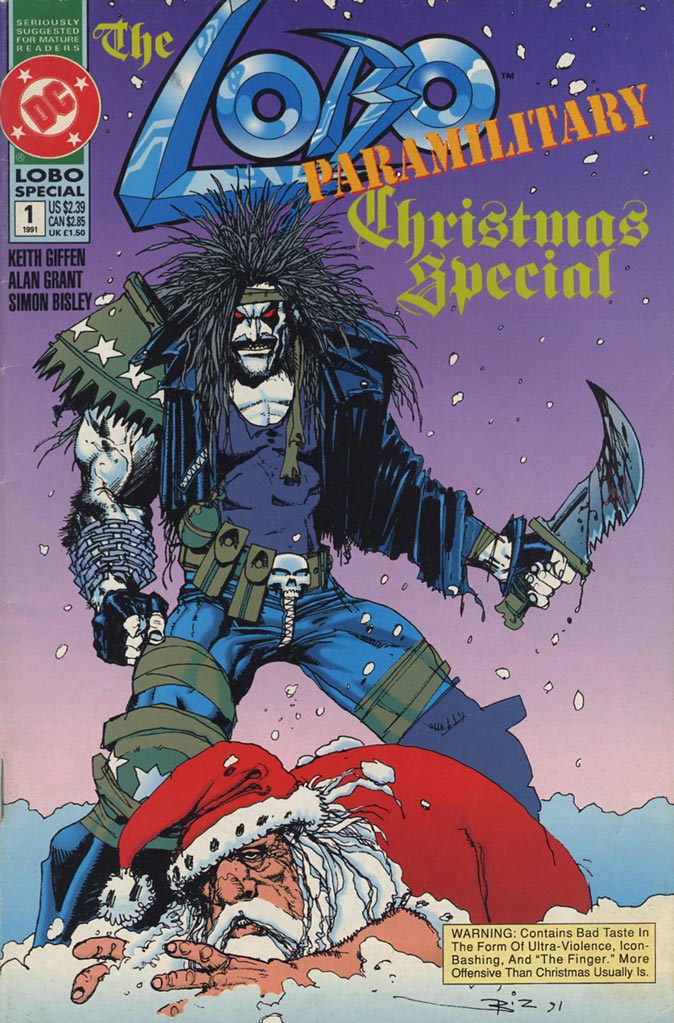

Because he's not a writer I would like, and, in fact, is a writer I do not like. The two stories I read for today -- "Bucky Goes to Church" and "The Slobbering Tongue That Ate the Frightfully Huge Woman" -- are in some ways interchangable, in that both walk around wearing a satisfied smirk as they, I don't know, blow the lid off of Christian...something something. I'm not even sure, because "hypocrisy" isn't it. In "Bucky Goes to Church", the title character is an obese young man who is mercilessly teased by, apparently, everyone in town, until one day a voice in his head tells him to kill them all. Somehow, Bucky gets his hands on some serious firepower, and, this being Sunday, goes to the church and opens fire. That's most of the story, is Bucky shooting up the church:
Then the voice slammed in louder and harsher -- (KILL THE FUCKERS, BUCKY, KILL THEM SONS O' BITCHES!) -- like a new gear ratio kicking in. Bucky used its energy to fight the impulse to relent, dredging up an image of his dead folks fountaining blood like Bucky's Revenge, using that image to sight through as he picked off the Atwoods, four generations of hardware greed on the corner of Main and Garvey: old Grandpappy Andrew, a sneer and a "Shitwad!" on his withered lips as Bucky stiched a bloody bandolier of slugs slantwise across his chest...
And repeat. I'll spare you further examples, but these are the jokes, as they say, until we get to Devereaux's big reveal. The police soon bust into the church and open fire on Bucky, and as he's dying, time freezes, and God appears. Except God's a black woman...or rather, well, read:
Like Don Rickles trapped in a carpet, the face of an angry black woman grimaced out from behind the white beard and mustache of God.
The "Don Rickles" line sailed right by me, too, as did the point of having the black woman have a beard and mustache. It's true that she's not God, or at least not the God, but rather the soul of a woman who, herself, shot up a bunch of people at her office some time ago. What happens is, every time somebody goes on a shooting spree, they've been urged to do so by the previous person who committed a similar crime, and the reason is so that their spirit can be freed, and the new spirit can take over. What the new spirit takes over is the weight of all the world's suffering, and it's right about hear that Devereaux's own hypocrisy begins to bloom. Because that first bit, with Bucky shooting up the church, was meant to be just a lot of bloody fun, because Bucky has been horribly mistreated by these people, and even so they're all in church, and you know what that means. Except now Devereaux spends some time reminding us that they were people too. We had our fun, but come on, man, they're dead now, so no more jokes.
I find this kind of two-faced shit pretty appalling, and in the 80s, and especially the 90s, it was all over the place in horror fiction. It's what "splatterpunk" was all about, and why those guys were able to fool themselves into thinking they were making any kind of point, or taking a stand. It's meant to be, I suppose, one of those "if you gaze into the abyss" kind of things, but instead it's a "have your cake" kind of thing, and I don't like it.
"The Slobbering Tongue That Ate the Frightfully Huge Woman" is no better, and in fact may be worse. This time around, we meet Sally Holmes and her husband John. John's a cop, and Sally works in a lab with a brilliant man named Dr. Baxter. Baxter is physically repugnant, but...
...when he spoke, his labials, his fricatives, his palatals, his urps of intelligence, the way his moist pink tongue oystered in his mouth -- all of those orals sorts of things made Sally go all soft and squoozy inside.
Squoozy, despite the fact that Sally and her husband are typically uptight Christians who are ashamed to even have sex with each other! Oh, the merriment. Baxter, meanwhile, has been working on a major new science-type experiment, which he's eager to reveal to Sally:
Baxter anticipated her amazment.
"Oh, my!" she ejaculated, her fetching shoulder blades flexing like coy airplane struts under that white coat she plumped out so well in front.
"You've never seen a ten-foot cock before?" [Baxter asked.]
Hold onto your hats, though, because he's actually talking about a rooster! These, as I've said, are the jokes.
So yes, Baxter is working on some crazy growth serum, and then he rapes Sally, who fights back by cutting him into pieces with all the science knives that are lying around, choosing to preserve that tongue she so admired in some of that growth serum, which also splashes all over Sally, so that in the days to come she begins to grow. The tongue, meanwhile, becomes sentient, and escapes from the forensics lab, or whatever, where it was being stored, and begins to stalk her. This story is basically for anybody who wished Attack of the 50 Foot Woman had been a porn film, except that it's also intended to teach uptight Christians that sex is okay, because by the end, even though his wife's dead, John feels okay because he's no longer ashamed of his boner. THE END.
In fairness, I guess, this story, and "Bucky Goes to Church", are intended to be "funny", thereby somewhat ameliorating a bit of the otherwise unforgivable ridiculousness. What would have worked even better would have been going beyond mere intentions, and actually making the fucking things funny. Or not endlessly obnoxious, or relentlessly smug. Or maybe if Devereaux didn't take his religious stick figures at face value. Something. Something other than this. Anything other than this.
Wednesday, October 13, 2010
The Kind of Face You SLASH!!! - Day 13: The Raw Human Heart
.
In their introduction to the strikingly titled collection of fiction by Ludmilla Petrushevskaya, There Once Lived a Woman Who Tried to Kill Her Neighbor's Baby, editors and translators Keith Gessen and Anna Summers describe Petrushevskaya as both the most popular writer in Russia today (now that Solzhenitsyn's gone, anyway) and a public figure who continues to be extremely divisive. Summers and Gessen say that many readers object to the relentlessly bleak nature of Petrushevskaya's work (to which I might say "Well, look around you", if that didn't sound so insensitive), while others refuse to accept that great literary respect has been bestowed upon a woman who, among other things, has been known to perform a solo cabaret act "while wearing an enormous hat." I had no idea enormous hats were such a hot potato in Russia, but there it is.
.
The above just about exhausts my knowledge of Ludmilla Petrushevskaya, the public figure. I have a little bit more experience with her fiction, having now read the majority of There Once Lived a Woman Who Tried to Kill Her Neighbor's Baby (a title I refuse to shorten, so catchy do I find it) -- I've read enough of it, in fact, to know that it's subtitle, Scary Fairy Tales, is at least a tiny bit misleading. Though my past reading from the book yielded a number of horror or horror-tinged stories -- "The Arm", "Incident at Sokolniki", "The God Poseidon", the plague story "Hygiene" -- last night caught me floundering through the unread stories, trying to find something that I wouldn't have to twist myself into knots trying to justify as horror. It's a sad story, I know, but this is what I sometimes have to go through. The point being that Scary Fairy Tales is a rather reductive description, or at least the "scary" part is -- it is true that all of the stories from the book I've read so far have an unmistakable fairy tale ring to their prose; some more than others, but it's always there. But "scary"...not always. One story I read, "The Miracle", featured mysterious portents and gutter prophecies and all that, but, for once, ended on a note of obscure uplift that cast the whole story into an odd, new, horror-less light. Same thing with "The Father", which features a childless father tramping through the snow to a mysterious hut and finding a baby that looks like an old man. Even these horrid beginnings are eventually transformed into a story of paternal fulfillment (sort of, and also, I think).
.
Two stories did eventually fit the bill, however, or as close as I was able to get. The first, called "There's Someone in the House", is an especially odd duck of a story about a woman who believes there is a poltergeist in her home, and decides to go to war with it, all the while reflecting on what would appear to be her own difficult childhood, where she suffered at the hands of an overbearing stage mother. The woman's method of battling this ghost is particularly warped, however:
.
It clearly wants something, this Creature, It's trying to get at something...Now if she could just figure out what It wants, she could -- she's done this before -- defeat Its design. She could seize the initiative. That's a classic maneuver -- meet your enemy halfway. Like when they light a fire to battle another fire in the forest -- if they intersect in the right spot, they'll both go out for lack of oxygen.
.
Once upon a time, for example, the mother had owned an expensive set of German china...and she guarded this china with her life in case they'd have to sell it to pay for a funeral (hers) -- and one time, when, in a fit, the daughter had hurled one of the cups to the floor, the mother cold-bloodedly began smashing the rest of the set ("slut!" went the noise it made, "slut!"), piece by piece by piece, nearly driving her daughter insane, and declaring, to top it off, "I'm going to die, all right, but you'll be left with nothing."
.
That's how her plan to defeat the poltergeist is summarized, so it's fair to wonder how much of this ghost business is actually on the level. No matter, though, because clearly the woman -- who eventually comes to be referred to in the story as "mother-daughter" -- believes it, and she proceeds to demolish her apartment before the poltergeist can do it first. "There's Someone in the House" is clearly not a chronicle of a ghost infestation, but rather one of a damaged psyche finally cutting loose, with a subplot about how all this is effecting her cat. It's a weird little story, full of more pain than I'm probably getting across here. "Is there a ghost or is s/he mad?" stories being very common (as I think I've mentioned) in the horror genre, "There's Someone in the House" fits in nicely, even though I think the answer is pretty apparent. Either way, in all manifestations of this idea, the answer is often thought to be beside the point, and while that doesn't always play for me, in a perverse way it does here. No, I don't believe there's a ghost. However, yes, she does. As a result, her wide-eyed, stumbling progress into some kind of happiness at the end may be objectively phony, to someone who doesn't live in her head, but if she believes it then at least that's something.
.
On an even more obscure note, the next story is called "The Fountain House", and it begins like this:
.
There once lived a girl who was killed, then brought back to life. That is, her parents were told that the girl was dead, but they couldn't have the body (they had all been riding in the bus together; the girl was standing up front at the time of the explosion, and her parents were sitting behind her). The girl was just fifteen, and she was thrown back by the blast.
.
There once lived a girl who was killed, then brought back to life. That is, her parents were told that the girl was dead, but they couldn't have the body (they had all been riding in the bus together; the girl was standing up front at the time of the explosion, and her parents were sitting behind her). The girl was just fifteen, and she was thrown back by the blast.
.
I'm going to admit, up front, something I maybe shouldn't, which is that I don't really have any idea what happens at the end of this story. On a certain level, yes, I do, up to a point. But beyond that point, and in a more general sense, I'm flummoxed. What I do know is that the dead girl's father kidnaps her body from the morgue because he believes she's still alive, and needs to see a doctor. He bribes his way to the hospital, and bribes his way to a doctor, who he bribes to take a look at the girl. The doctor can see she's dead, but he plays along, partly because of the money, and partly because...
.
...there was nothing more important to him than a difficult case, than a sick person, no matter who it was, on the brink of death.
.
And therein lies my difficulty with this story. One the one hand, Petrushevskaya is blunt about the girl being dead. At other times, such as in the first paragraph I quoted, and here again in the doctor's consideration of his task, she makes you wonder. The fact that much of the rest of the story consists of strange dreams had by the father does not go very far towards clearing things up.
.
Which is unimportant, ultimately. What "The Fountain House" is at its core is a story about tearing grief, and the brief flickers of madness it can create in otherwise stable human beings. In its obscurity, "The Fountain House" also leaves open the possibility that a girl is brought back from the dead, and in doing so it marries itself, in my head anyway, to the non-horror Petrushevskaya story I mentioned earlier called "The Miracle". At one point in that story, Nadya, the protagonist, is desperately trying to find a way to phrase her wish, one she expects to be granted, in a way that will minimize any karmic blowback that are often the nasty residue of wishing. During her figuring, another woman lists a series of wishes that came true for other people, and the difficulties and horrors that followed after. What one usually thinks of in these cases is W. W. Jacobs's "The Monkey's Paw". Or at our darkest hours, Stephen King's Pet Sematary. And it follows that, unless I'm completely of the charts in my consideration of "The Fountain House" (a possibility I know to never discount), the father who stole his daughter from the morgue could be facing a nightmare that Petrushevskaya simply couldn't bring herself to tell us about.
Sunday, October 10, 2010
The Kind of Face You SLASH!!! - Day 10: A Small Tail Was in My Pants
.

Sigh...
.
Okay, let me tell you how I first heard about Carlton Mellick III. Actually, I can't tell you exactly. All I know for sure is that, many years ago, I was dicking around on Amazon, browsing through random books, presumably in my chosen genres, by authors I'd never heard of before. Somewhere along the way, I came across a book called Satan Burger by Carlton Mellick III. The cover of Satan Burger told me pretty much everything I needed to know about Mellick, and I imagine I wondered idly if he was of legal drinking age yet. Or voting age, for that matter. I'm not going to include an image of Satan Burger's cover in this post, because I will not have the good name of this blog sullied in that manner, but some of you are going to want to see it, and instead of being all superior and telling you to look it up yourself, I will include this link. However, be aware that this link is NSFW, and not because it's sexy and awesome. Whether or not you choose to view that link, I will take a moment to note Satan Burger's cover blurb, provided by one "Vincent W. Sakowski" (talk about a get!), which reads: "This generation's Vonnegut!" If so, then may God have mercy on us all.

.
Jump ahead a bunch of years, and I'm shopping for horror anthologies in preparation for posts such as the one you're reading this very moment. I find two massive ones edited by John Skipp, one called Werewolves and Shapeshifters: Encounters with the Beast Within and the other called Zombies: Encounters with the Hungry Dead. Taken together, these collections contain short stories by, among others, Ray Bradbury, Angela Carter, John Collier, Saki, Steve Rasnic Tem, Melanie Tem, Theodore Sturgeon, and Neil Gaiman. And both collections boast a story by Carlton Mellick III. That's some mighty high-toned company for a guy who looks like this on purpose...
.
...and is undoubtedly a massive GWAR fan to be keeping. Is it possible that I let a book cover and a generally snobby attitude cloud what I like to think is my open mind about such things? Was I wrong about Carlton Mellick III? Is it possible that he's actually a talented writer?
.
NO!!! What, are you fucking kidding me? No, not at all. But I have evidence now to back this up, as I read both stories offered by the two Skipp anthologies: "War Pig" from the werewolf book and "Lemon Knives n' Cockroaches" from the zombie one.
.
NO!!! What, are you fucking kidding me? No, not at all. But I have evidence now to back this up, as I read both stories offered by the two Skipp anthologies: "War Pig" from the werewolf book and "Lemon Knives n' Cockroaches" from the zombie one.
.
So "War Pig" takes the werewolf myth and turns that motherfucker on its ear because instead of the guy turning into a wolf he turns into a pig. And also it's sort of like The Running Man, but the movie, not the book. What happens is, in the future poor people can't make any money, but there's this sport where first you go through this series of "serum" injections that turn you into a part man, part animal creature, and then once you're enough of an animal, they put you in the ring with another manimal, and you both fight until one of you is dead. The winner gets money. The title character is the reigning champion, but he's taken so much of that serum that he's about to become all pig, and/or die. So his time's running out, and War Pig's son, Tommy, who's still all human, and is our narrator watches on in sadness as War Pig seems set to fall beneath the slashing claws of his current opponent, named Grizzly Titan. Meanwhile, War Pig's manager, an unscrupulous greed-monster named Mr. Crumbly, is trying to entice Tommy to begin the serum treatment himself. War Pig gets wind of this, and is all "Oh no you don't."
.
So that's your story, basically. It ends in a fury of violence, described in Mellick's best approximation of high school creativity:
.
Mr. Crumbly whistled and three of his fighters came up from the lower deck to protect him. A werewolf, a crocodile man, and a werehorse. But all three were quickly pummeled to death.
.
Mr. Crumbly whistled and three of his fighters came up from the lower deck to protect him. A werewolf, a crocodile man, and a werehorse. But all three were quickly pummeled to death.
.
Not the werehorse! "War Pig" develops a surprising sentimental streak towards at the end, when War Pig and his son Tommy bond over the carnage and mend their relationship, which has been fractured ever since the dad started to try to become a pig. But I'd like to break away from my analysis of "War Pig" and focus on this serum treatment business. When Mellick cracks his knuckles and gets down to the task of providing us exposition on this stuff, here's what he lays out:
.
Every injection would make you a little less human, and a lot more animal. Which beast you transformed into depended a little on your DNA and a lot on chance.
.
Every injection would make you a little less human, and a lot more animal. Which beast you transformed into depended a little on your DNA and a lot on chance.
.
So what kind of animal you become has nothing to do with the serum? Your DNA has more to do with it than the frickin' made up serum?? What does Mellick think DNA is? A bunch of human goo mixed with a mystery animal goo, unique to each person, so that while I might have a bit of giraffe in me, my brother might be part seal? I realize this doesn't really matter in a made up story, but Mellick seems to think it does, otherwise he would have left that inanity out completely. Which I guess makes sense, as Mellick is the same guy who, when describing the appalling conditions the poor live in, later writes:
.
After paying, I went to the nearby fire pit to cook the meat, passing a rat woman nibbling on her meat raw. The animal people often preferred the taste of raw meat, though they usually ate it that way because using the fire was an extra cost.
.
Well why the fuck don't they just eat it raw if that's the way they like it??? You dumb bastard, you just said they liked it better raw! Fire being "an extra cost" shouldn't even enter into their considerations because they don't even want to cook the meat! THEY'D RATHER EAT IT RAW!!
.
And speaking of all that, there's this other story, "Lemon Knives 'n Cockroaches". Never mind what it's about -- uh, it's post-zombie Apocalypse, and humans have devolved into filthy underground dwellers who eat zombies and also other humans, and there's these two people, our narrator and some chick named Alyxa, who do all sorts of gross things, and who live in this tribe run by this guy named Thomas who is evil and gay, and who eventually Alyxa and the narrator fight back against and kill, and then feed to zombies, but then Alyxa wants to eat Thomas, also, but then she gets killed by other guys from her tribe because they think she's a zombie and so they kill her the way she used to kill zombies, which is pretty ironic -- because in the story are these things called "lemon knives". "Lemon knives", we are told, are "sharp handmade knives greased with sour acids yellow in color..." Perhaps this is nit-picking, but in order for our narrator to know that the acids are sour, someone at some point in the history of the development of this weapon must have drunk some of this acid and said "Oh hey, it's pretty sour. We should call these 'lemon knives'", just before the acid finished eating through his face.
.
Then again, aren't sour flavors often referred to as "acids"? That's what the Food Network continues to imply, because on that channel someone will try some pork dish and say "This needs an acid", which often means "You needed to squeeze a lime all over this plate." So maybe all acids really are sour, and therefore, regarding the lemon knives, our narrator was making a relatively safe assumption.
.
Although, you know what lemon knives basically are? They're basically knives, because while a number of people are stabbed and sliced with these things over the course of the story's fifteen pages, at no point is anyone said to have been burned by acid. So maybe it's just a color thing with these people, an aesthetic choice. This theory is given credence by the fact that we are first told about lemon knives when Alyxa "opens her lips to release two lemon knives" into her hands. So they're just tucked up their in her mouth for hours on end until she decides she needs them, and then she opens her lips. Meanwhile, no ill effects due to the acid. On a related note, later on Alyxa is completely naked, but our narrator realizes "[b]y the way she walks" that "she has her lemon knives hidden between her legs". So she's not wearing a stitch of clothing, but she's walking around with two knives between her legs. Just...what, taped there? Or her thighs are locked tight over two knives, and the guy she's about to use these knives on doesn't think "God she's walking stupid. What is between her legs, anyway? It better not be two lemon knives."
.
Anyway, so that's what reading Carlton Mellick III is like. Better stories tomorrow, hopefully.
Subscribe to:
Posts (Atom)