Showing posts with label Ingmar Bergman. Show all posts

Monday, May 28, 2012

The Light I Never Knowed

Ingmar Bergman is not a filmmaker I find it especially easy to associate with summer. This despite the fact that, for the filmmaker not only of Smiles of a Summer Night, but Winter Light and Autumn Sonata, seasons were important (why no Spring? I know, The Virgin Spring, I thought of that, but it turns out he's talking about something else there). But typically, my approach to Bergman's films, and to the films of almost any other director with a deep catalogue, is to pick and choose what seems most interesting to me. This lack of any kind of deliberate approach has left me with the possibly not entirely accurate view of Ingmar Bergman's films as medieval and wintry and angry at a God he doesn't believe in, despairing when they're not being terrifying. Even the comic Smiles of a Summer Night has stuff about suicide in there. So the upcoming release by Criterion of Bergman's tenth and twelfth films, respectively, Summer Interlude from 1951 and Summer With Monika from 1953, left me wondering about this presumably sunny side of Bergman with which I had been previously unaware.

Well, I needn't have worried. While there are long stretches in both films depicting -- even, if you like, celebrating -- young love and freedom and happiness, both also ultimately deal with the death of romance. Not just romance as in between a young man and a young woman, but in the naive beliefs that such men and women sometimes have that they are different from everyone else, that their lives will be special. That makes Summer Interlude and Summer With Monika sound cruel, and they sort of are, but Bergman is not out to gleefully obliterate anyone's dreams. He's just acknowledging that those dreams will probably be obliterated.

In Summer Interlude, Maj-Britt Nilsson plays Marie, an accomplished ballerina who is at the tail end of rehearsals for a production of Swan Lake when she receives in the mail a package containing the diary of Henrik (Berger Malmsten), a young man she loved for a brief time when they were both very young. She doesn't know who sent the diary, but it becomes pretty clear that it didn't come from Henrik, and that, in fact, there may no longer be a Henrik. Far from delighted, Marie falls into a melancholic revery that leads her to travel back to the lakeside spot where she and Henrik had been together, and where, also, she spent time with her Uncle Erland (Georg Funkquist), an "uncle" not by blood but by family friendship, a man whose relationship with Marie's deceased mother was, as far as Erland and Erland only was concerned, transcended mere friendship, and he seems to want to translate that gnawing desire to Marie. The bulk of the film is told in flashback, and charts the passionate yet mostly innocent relationship between Marie and Henrik as it would naturally play out, the frustration of their first fight being a moment of high drama here.

Summer Interlude is largely pleasant, though the sadness of the older Marie is never far away, but in Bergman terms it is a lighter, sweeter film than I, at least, am used to. What takes me aback about the film is how the end comes about, and how sudden and senseless and arbitrary it is. What happens in Summer Interlude, and what causes Marie, at Erland's rather appallingly devious suggestion, to erect an emotional wall around herself, is the kind of thing that must happen, somewhere, every day, but can have the effect on film of seeing simply too absurd to be accepted. But Bergman plays it as something entirely real that must be dealt with, somehow. At Summer Interlude's end, Marie is shown dealing both with her current boyfriend (Alf Kjellin) and this distant tragedy whose very nature makes it nearly impossible to keep at bay. In the final moments, Marie has either succeeded, or perhaps Bergman is anticipating the ending of Lindsay Anderson's O Lucky Man! Either one makes sense.
Summer With Monika, meanwhile, is a bit more obviously bitter. Not necessarily in any sort of personal way, but it's a bitter story. Based on a novel by Per Anders Fogelström, the title character is played winningly, initially, by Harriet Andersson (in the first of many performances for Bergman) as a fun, slightly goofy, young woman whose home life consists of a half dozen people living in maybe two rooms, most of them young, loud children, Monika's siblings, their mother no longer having the energy to control them much, though she's willing to control Monika because she, at least, is old enough to obey. Throw in a drunken father and a job at a grocery store where she is repeatedly groped by various men, and it's a wonder Monika has any brightness left within her at all. She meets and charms a shy young man named Henry (Lars Ekborg). His father is still alive, but his mother has died, and he lives with his aunt, and he works at job that seems to mainly consist of boxing up and delivering glassware. His boss and co-workers are hard on him, and it becomes very easy for him to be swept up in Monika's pursuit for freedom, which leads them both to taking a boat and sailing off alone, from secluded beach to secluded beach, eating what they find, a little of what they bring with them, have sex, and in general bask in the sun and the wind and their youth.

A key scene in Summer With Monika, one that seems quite lovely when you first see it, shows Harry and Monika docking near an outdoor party. Monika wants to dance, but Harry is uncomfortable around these other people, possibly not only because of his natural shyness, but because they are a part of the world they're both trying to get away from. So taking pity on him, Monika agrees to leave, and so they take their boat to another dock, this one empty and some distance from the party, but not so far that they can't hear the music. Bergman shoots them from a distance, dancing together and alone, which is all they want. But Harry is 18 years old and Monika is 19, which is just about the right age to still think this pipe dream of dropping happily off the grid might not end in disaster. Before that happens, Monika mentions in a breathtakingly offhand way that she is pregnant. She thinks this will all work out swimmingly, but in mere days she's complaining that all they eat anymore are mushrooms, and shortly after that she's stealing roasts right off people's dinner tables.

It's Harry and Monika's return to society, which they manage with a minimum of shame and with, at least as far as Harry's concerned, a determination to work and make their own way in the world, that signals the true end of it all. Monika becomes an awful creature, one delighted by the idea of motherhood but horrified by the reality, one who cheats on her husband because he makes her save money and she's bored. Watching Harry's life come apart is very difficult because he's a decent kid who is only dumb in the way that all kids are, but he's willing to learn. Monika is not at all willing. Bergman may want us to take pity on Monika as well, but I myself found that I had very little pity to offer her. I cared only for Harry, and for his baby daughter. Harry closes the film sadly remembering the wonderful part of the summer with Monika that just passed. I'd like to shake him and demand that he let it go, but Bergman himself had it more clearly. In an interview with himself printed in the Criterion booklet, Bergman says that if we must reduce Summer With Monika to a message, about the good things in youth that end up horribly wrong, which is to say, about youth, he chooses these four words which he indicates are from Fogelström's novel: Get out! But return!

More enigmatically, though, Bergman asks himself about any "beautiful moments from the shooting of the film," and Bergman's response (to himself, remember) is one that describes his film in a nutshell, and adds one last thing that perhaps could count as something Harry should bear in mind:

One morning at six o'clock, we were on our way to location, the engine of our little boat, the Viola of Ornö, thumping across the still waters. The horizon at sea fused with the sky, the islets stood like floating octopuses in all that soft white. Up above, the fiery button of the sun was burning. It was warm and unusually still; there wasn't even a swell, not a ripple. It was like eternity itself. It was like being in eternity. The smell of the sea, the quivering in the hull, the murmur around around the stem, and the high silence -- the summer of eternity.

AND THEN WHAT HAPPENED?

Nothing. That was it.

Friday, March 25, 2011

This Meaningless Carcass

.

In The Magician (d. Ingmar Bergman), Max von Sydow's Albert Vogler, the titular magician and leader of Vogler's Magnetic Health Theater, doesn't speak for about a full hour of screen time. Tubal (Ǻke Fridell), the troupe's carnival barker, claims this is because Vogler is mute, but he isn't. We're given reasons to suspect this well before he actually says his first words (which, significantly, are "I hate them"), among them is the fact the his supposedly male assistant, Aman, is quite clearly a woman, and is, in fact, Manda (Ingrid Thulin), Vogler's wife. Then there's Vogler's fake beard, fake mustache, his wig...the man is a walking fraud. This, at least, is the view taken by Dr. Vergerus (Gunnar Björnstrand), a cold man of reason who wishes to expose Vogler's tricks, and publicly humiliate him.

Among the many things going on throughout the films of Ingmar Bergman, the most gripping thing to witness is his battle with God, his hopeless and desperate attempts to answer the question of the possibility of a divine existence. In interviews, Bergman often claimed atheistic tendencies, but his films reveal a much more complex picture -- even when a given film might refute the possibility of God, Bergman always respected that which he tried to leave behind him. And anyway, it's clear he could never really shake it. The Magician is one of the most interesting battles waged in this artistic and theistic war, as it's the one example I know of where Bergman depicts the skeptics, the rational, as venal, hateful, condescending little shits. Or not the only time, because check out that name: Vergerus. A not uncommon name among Bergman's deep cast of characters through his career, it also appears most memorably in The Serpent's Egg, where Heinz Bennent plays a man by that name who is not only a proto-Nazi (the ur-Nazi, perhaps), but whose approach to science and the rational is almost literally Satanic.

This Vergerus ain't that bad, but he's a cruel and petty man who must protect his worldview. Vogler's magic, however easily exposed (or is it? Certain things that happen in The Magician are eventually explained; others are not) allows for the possibility of belief, yes, but more importantly of emotion. "A momentary fear of death" is something he makes one man feel, in an attempt to shake the man to his core, to blast his certainty out of its comfortable hole for at least an instant. Vogler must be exposed, according to Vergerus and the other leaders of the village where Vogler has come to perform, because a failure to prove him a phony would "be a catastrophe for science", opening the world up to the possibility of God. "How out of date!" cries one of Vergerus's cronies. In The Magician, as today, the question of the universe's origin is reduced to a competition.

I don't claim to know what Bergman ultimately believed, nor do I really care. Hell, I take the man at his word. But over and over again in his films, he reveals himself to believe most in the necessity of the question. Vergerus says he detests the inexplicable; what Bergman detests is certainty.

Friday, February 19, 2010

Traum

.
In David Edelstein's negative review of Martin Scorsese's Shutter Island, he takes a second to place at least a little bit of the blame on Dennis Lehane's source novel. "Dennis Lehane's novel," he writes "...is a doodle, a Paul Auster Lite breather between his tortured Mystic River and the panoramic The Given Day." What Paul Auster has to do with what's in that book, I don't know, but I will agree with Edelstein on a couple of things about Lehane's work, neither of which are stated outright, but which can be inferred: that Mystic River is a masterpiece, and that Shutter Island isn't as good (I haven't read The Given Day yet). What I absolutely do not agree with Edelstein about is the idea that Shutter Island was, for Lehane, a lark, some inconsequential dash-off that he needed to get out of the way before he settled down to something that mattered. I don't know how you can read that book and not feel to your bones the deep sense of loss, the spiritual tearing that comes with grief, on every page. Where I turned ambivalent to Lehane's novel was the climax, when the hugely entertaining post-World War II Gothic-detective maze reaches its destination, and I was forced to incredulously ask "That's what this was about?"
.
Yes, that's what it was about, and while I still am not sure the ending is as strong as it could be, either on the page or on the screen, or that there maybe wasn't some other way entirely to do it, Martin Scorsese's film version (written by Laeta Kalogridis, and co-produced by Lehane) makes me feel a little bit like a chump for being so unsure about Lehane's motivation. Before I get into why, I should probably confess something. You see, I think Martin Scorsese -- or "MartSco", as he'd probably insist I call him, should we ever meet -- is a good filmmaker. I enjoy his films very much, and have done so for many, many years. Wait, don't leave! I understand that a past and -- worse, and therefore more importantly -- consistent appreciation of Scorsese's work renders any opinion I have of whatever movie he has out right now null and void (provided that opinion is a positive one), and that the only people who can be trusted to give an honest and clear-headed assessment of MartSco's current work are those who haven't liked any of his movies from the past decade (or so I've recently learned), but please, let me at least finish. These water buckets are heavy.
.
It's hard to know where to begin talking about Scorsese's Shutter Island. It might do to quote Edelstein again, who laments that the film is "suffocatingly movieish", which is a hell of a thing to complain about. When Edelstein reads Nabokov's fiction, does he complain that it's "too novelly"? If I take him to mean that the film is too bold in its style, then I would ask what, exactly, he was expecting? After all, Shutter Island is about two U.S. Marshals -- Teddy Daniels (Leonardo DiCaprio) and Chuck Aule (Mark Ruffalo) -- who, in 1954, are sent out to the titular island, on which can be found Ashcliff Hospital, an institute for the criminally insane, from which has escaped a patient named Rachel Solando, who is, we are told, a very dangerous woman. Daniels is a pretty beat-up looking wreck when we first meet him, and he's also a war hero who helped liberate Dachau, an ex-drinker, and a widower -- his wife died a couple years back, in a fire ("She died of smoke inhalation," Daniels tells Chuck. "Not the fire. That's very important."). So this island, and this asylum, is packed with mentally deranged killers, and, as the film opens, the hospital staff and the prison guards (for Ashcliff is that, too, in a sense) are a bit concerned about the massive stormfront heading their way. So, 1950s, island, mental asylum, deranged killers, hurricane...all well and good, but please, could you tone it down a bit!?
.
The gist of all this being that I think Shutter Island is beautiful, the most visually arresting film Scorsese has made since Gangs of New York, and the most stylistically consistent, and the most justified and organic in its specific bold choices, since at least Casino, and probably as far back as Goodfellas. With this film, I got the feeling that Scorsese was scratching a particularly nagging itch, one he hadn't quite reached the last time he tried for it, with his, I believe, badly misjudged remake of J. Lee Thompson's Cape Fear. As Teddy Daniels goes deeper into the case, he begins to have some fairly awful flashbacks, and even worse nightmares, about his past traumas in the war, and dealing with the death of his wife. The nightmare sequences, in particular, are gloriously horrible, rich and varied in their imagery, and like all good nightmares, more terrible before we know what they mean than after.
.
These scenes -- the whole film, really -- are nightmare-as-opera, Gothic horror treated seriously, not as a way to get a few kicks. Scorsese is pulling from a very deep cinematic well for his inspiration here: Kubrick, film noir, Val Lewton, Ingmar Bergman (the very welcome presence of Max von Sydow in the film, as one of the hospital's senior doctors, wasn't the only thing about Shutter Island that made me think of Hour of the Wolf). So it's this self-consciousness, and not just what Scorsese and cinematographer Robert Richardson make the camera do, that is probably what Edelstein means when he talks about the movie being "movieish", but so what? Remember how last year everybody was saying that Inglourious Basterds was really, at its heart, all about movies? And how that was so great and everything? Well, so is Shutter Island. In this film, characters say things, important things, while staring off into the middle distance, like characters in a 1940s melodrama. And watch Mark Ruffalo in the background of an early scene set at the home of Dr. Cawley (Ben Kingsley); DiCaprio, Kingsley and Von Sydow have pretty much all the lines, but when Ruffalo does interject, he has the jittery bits of business and sweep-the-room eyes of a film noir character actor.
.
The puzzled look on your face tells me that I'm doing a bad job of describing this -- well, it is difficult to put into words, but the point is that while Scorsese may be wearing his cinematic influences on his sleeve here, and he wants you to notice (though it's plenty okay if you don't), his motives are pure: this is the best way to tell this story, to build this mood, and to oppress you with an atmosphere of violence, mourning, madness, and soul-destroying guilt.
.
All of which is just more "water-balloon throwing to Marty", or whatever it is people who enjoyed this film are supposed to be doing. If you clicked on any of those links I provided earlier, you'll probably have seen people making reference to the dishonesty inherent in anything positive said about the film, and Scorsese in general, and you'll have seen Glenn Kenny -- who was quite keen on the movie -- wonder if possibly some of his goodwill towards it has to do with his state of mind at the time he saw it. Well, let me offer my own bit of justification for feeling the way I do about Shutter Island: this is the kind of shit I like! I love film noir, I love Gothic horror, stories about storms and the criminally insane, and their possibly evil doctors. And I love it best when it's taken seriously.
.
I've often wished that I'd never seen The Shining, so that I could still look forward to seeing it for the first time. The very idea that an artist of Kubrick's stature made a straight-ahead horror film on such a grand and chilling scale is something I will always be grateful for. Shutter Island, for reasons that might finally amount to nitpickery, is not quite horror, not literally, but in its wonderfully suffocating moviesh-ness, it recognizes two things very specific to the genre, and even portrays both: that all supernatural horror is a metaphor: for death, our fear of it, of the unknown and our fear of that; and that the truth behind the metaphor is quite often worse than we ever imagined.
.

Monday, April 20, 2009

TOERIFC: The Already Perfect Reptile

Ingmar Bergman’s The Serpent’s Egg begins with a gray image of people marching towards doom. We might think, at first, and depending on our knowledge of the film’s subject, that these people are Jews, possibly being rousted from a ghetto, or herded to a gas chamber (and that is where this film is heading, though Bergman ends his story before it gets there). But these miserable people, shown in clips throughout the very Woody Allen-esque opening credits, which are played over cabaret jazz, are in fact the people who will either actually carry out the Holocaust, or will facilitate it through their indifference, fear and callousness.

The Serpent’s Egg is set in Berlin, in 1923. Abel Rosenberg (David Carradine), the film’s protagonist (“hero” seems like the wrong word), is an American Jew who has been living in Berlin with his brother Max for the last three years. With Max’s ex-wife, Manuela (Liv Ullmann), the brothers formed a circus trapeze act, until Max hurt his wrist. Since then, Max and Manuela have divorced, and both Max and Abel have descended into a kind of nightmare depression, which Abel dulls with alcohol, and which Max ends, at the beginning of the film, with suicide. After meeting with the police, in the form of Inspector Bauer (Gert Frobe), Abel goes to the cabaret where Manuela works to inform her of Max’s death. He shows her Max’s suicide note, and she stares at it uncomprehendingly, saying it is completely illegible. She asks Abel to try to read it, but he can only make out one line: “There is poisoning going on.

That line is, really, the film. Bergman’s vision of 1920s Germany is one of endless grotesquerie and madness, one where an evil is growing quietly from within. Those who are not directly linked to the creation of Germany’s monstrous future, like Abel and Manuela, can only suffer through the country’s devastating poverty and try to make their way, while either choosing to ignore, or smile their way past, what they see going on around them, as Manuela does, or let the nightmare consume them, which is the route that Abel chooses, for a while. He gets drunk every night, and later in the film, when he’s moved in with Manuela, he complains that a noise from outside their room, the rumbling of an engine, is “driving him wild”. Manuela can’t hear the engine, unless he mentions it, and then she can almost make it out. This is because Abel is tuned into the great and Hellish machine that’s revving to life beneath them, because he knows the world is about to end in fire. Manuela secretly knows the same thing, but tries to forget it. And it’s the knowledge, not the sound, which drives Abel wild. Berlin’s upper classes pursue their decadence with a forced and manic joy, but the wildness of Abel’s knowledge drives him to pursue similar diversions the same way he pursues waking up in the morning, which is to say: grimly. Abel throws a brick through the window of a Jewish shop, and humiliates a fellow patron at a brothel he visits late in the story, a scene which ends with him hitting one of the prostitutes – such are his tools for dealing with the engine.

Before going any further, it should be noted that Carradine is a spectacularly weird choice for a lead in a Bergman film. His gaunt, old-before-its-time face and mopey eyes are just right for Abel, and in that sense he’s not unlike Bergman favorite Max von Sydow, but his line delivery can sometimes seem over-pronounced (Carradine’s excuse -- given on the commentary track – that Abel is an American surrounded by Europeans, and that’s how people often speak to foreigners, doesn’t quite fly with me) and carry only the weight that the words had as originally written, but no more. And his drunk walk, which he performs regularly over the course of the film, is of the exaggerated, 1930s comic hobo variety. When faced with Nazi atrocities while stumbling down the street, I kept expecting him to stop, rub his eyes, look at the half-full bottle in his hand, and then pitch the bottle to the side.

“Drunk” and “sad” aren’t the only things Carradine has to do, however, due to the fact that Abel is not an entirely passive victim -- he nearly is, but not quite – because The Serpent’s Egg has a structure that is unique, in my experience, in Bergman’s work. It flows like a mixture between a mystery story and a horror film, with the emphasis on the latter. In its basic narrative line, The Serpent’s Egg most resembles horror films like Angel Heart (itself a horror film mixed with detective fiction) and The Ninth Gate, the kind where the hero follows a set of clues that lead him from a dark crime to a darker, often occult, revelation that either destroys him or at least opens his eyes to the broad-spanning and evil truth at the heart of his society, or the secret mad powers that will tear that society apart.

As I say, these stories are told as mysteries, and end up in the horror genre based, generally, on what is discovered. The beginning of this mystery is the suicide of Abel’s brother Max, although given the relentlessly grim nature of Bergman’s film, it’s less surprising that Max, who we only ever see as a corpse, blows his brains out than that everybody else in Berlin doesn’t follow his example. The mystery is deepened, however, when Inspector Bauer calls Abel to the morgue to show him a series of corpses, asking, after revealing the face of each body, if Abel knows them. A couple he knew in passing, one female was engaged to his brother, and another reminds Abel of his father. It appears at first, to Abel and to us, that Bauer is looking at Abel as the killer of all of these people, so it would appear that, along with everything else, Bergman is setting Abel up as a “wrong man” figure. But Bauer’s suspicions, if he ever even had them, ultimately go nowhere. In any case, when Abel clues into these suspicions, he accuses Bauer of doing this because he, Abel, is Jewish. This stops Bauer cold, which Abel takes as confirmation that he was right.

Another staple of the various genres Bergman is poking around with is the former acquaintance of the protagonist, now the villain of the story. In this film, that man is Hans Vergerus (Heinz Bennent), who Abel runs into, for the first time in ten years, in the wings of the stage at Manuela’s cabaret. He begins peppering Abel with questions about their mutual past, but Abel acts as though he doesn’t know him. Later, Abel tells Manuela that when he and Hans were children, Hans tied a live cat down and dissected it. He describes seeing its heart still beating very fast. This incident, not surprisingly, has lingered with him, possibly in the back of his had as an indicator of the future, or as a clue to the world’s infernal secrets. It’s certainly a clue to the character of Vergerus, who he will meet again, and learn more about. Among other things, Manuela has a menial day job in Vergerus’s clinic, and Abel eventually will, too, in the clinic’s archives.

All of this is leading us to the solution of a mystery – to be honest, Abel, in his role as the protagonist, isn’t much of a seeker of facts, but he does have a talent for stumbling across them. And he trips face first into the truth when he returns one morning, from the brothel mentioned earlier, to the room he shares with Manuela, and discovers her dead. Here, also, Bergman’s sense of logic shatters – deliberately, I’d guess -- along with all the mirrors that Abel breaks in the room, revealing behind each one a camera. In a scene that seems to challenge us to locate ourselves within any kind of physical geography that pertains to what we’ve seen, or thought we knew, before, Abel climbs into one of those hidden camera rooms and finds himself running around a subterranean series of rooms, filled with metal walls, metal staircases, and metal bars (in fact, it looks not unlike his work area at the clinic’s archives). We realize, before Abel does, that someone is following him through these rooms, and finally attacks him – and, due to the way the subsequent fight is shot, we never see the assailant’s face. The fight ends on an elevator, with the attacker being decapitated, and the horror film feeling Bergman has been toying with all along is now put in the forefront.

The motives of the man behind all this, Vergerus, might be considered muddy. The human experiments he’s been conducting – which, like the similar Nazi experiments that followed in reality, result always in torture, and often in death – are intended to indicate what is weak about humanity, and what is strong, so that the weak can be eliminated. How injecting a man with a drug that causes him to endure unbearable dread until he’s driven to suicide is supposed to indicate what’s weak about humanity is anybody’s guess, but Vergerus’s methods aren’t exactly that far-removed from those of the Nazi scientists he, in Bergman’s world, gave birth to. And unclear motives are simply something you have to come to terms with when considering Nazi atrocities. The genocide they perpetrated wasn’t just genocide (but then, genocide never is); these atrocities included, in some cases, turning their victims into furniture. Such acts inspired several generations of serial killers, so, with the Nazi Germany, what you have, at the core, is serial murder on a national scale. Horror film tropes and general illogic might be the best approach to a fictional tale of the Holocaust or its beginnings, even if your style is intended to be naturalistic, which Bergman’s isn’t.

The horror idea is carried further in the film’s climax, which features Vergerus swallowing a cyanide capsule. He says he knows Bauer is on to him – these experiments aren’t yet sanctioned by the government – so he takes the capsule without regret, knowing that what he has helped set in motion is much bigger than anyone’s romantic ideas of justice. Just before the cyanide takes effect, Vergerus positions a bright light over his head, and holds a mirror to his face, so he can clinically observe the way the muscles in his face distort as the poison shuts down his body. This is a psychopathology so far removed from any sense of human worth and dignity, and so dedicated to its idea of a better world, that when the pathology grows, and cracks its shell and steps fully formed to take its place in the world, the option -- for those among us normal enough to regard the serpent with an overwhelming incredulity -- of going mad right along side it might seem, must have seemed, awfully tempting. You can’t beat, or reason with, or argue with, or feel superior to, or react to in any rational way, that which you have no hope of understanding.

In his autobiography, The Magic Lantern, Bergman says of The Serpent’s Egg:

If I had created the city of my dreams, a city that does not exist and never has, and yet manifests itself acutely with smells and loud sounds, if I had created that city, not only would I have been moving in it with total freedom and an absolute sense belonging, but also, more important, I would have brought the audience with me into an alien but secretly familiar world. In The Serpent’s Egg, however, I ventured into a Berlin that nobody recognized, not even I.

I pulled that quote from the internet, not the book itself, so I don’t have the context necessary to tell me if Bergman thinks the result was good or bad, although the tone implies that he had regrets. The film is generally regarded, in truth, as one of Bergman’s worst, and it’s true that there are hiccups along the way – when Abel tells a prostitute to “Go to hell!”, and the prostitute laughingly responds “Where do you think we are?”, it’s hard to believe that Bergman didn’t know that he’d already made that point several times over – but I really don’t think his Berlin is one of them. The desperate decadence we associate with the country at that time is all there, to the point where it seems like, as shown by the bizarre, but not unfamiliar, cabaret acts in Manuela’s club, even Germany’s distractions were insane. The madness of the society is so deeply rooted that the entertainments available are grotesque enough to be slightly removed from humanity, which will be necessary to do the work asked of them some ten or fifteen years later. At one point, Inspector Bauer sees a street musician, the kind with an accordion and a monkey, performing with a blank faced to a crowd of people just as dull-eyed as he. Although Bauer is actually a fairly sympathetic character, the way he makes a point to give the musician money seems to say, “Keep it up. You’re doing good work.”

Humanity isn’t completely dead in Bergman’s Berlin – it’s just dying. Manuela clings to it, smiling sometimes insanely, and Ullmann’s performance, considered shrill by some, I think is hysterical in just the right way. Manuela is a fundamentally decent person, one of the few left in her world who can still feel guilt, which she does, over Max’s suicide. In one of the film’s best scenes, she goes to see a Catholic priest, played with a kind of simple warmth by James Whitmore. The priest is at first dismissive of her, based on her inability to come to the point, but when she does, and he sees that she wants forgiveness for something she most likely isn’t even guilty of, his wall of apathy crumbles, and he tells her that God is so remote that he probably can’t even hear our prayers for forgiveness. But, on His behalf, he, the priest, will forgive her, and ask her forgiveness in return, for his previous indifference, which she grants. In Bergman’s long battle with God, here he seems to allow for the possibility, at least, of His existence; he just doesn’t see what good that existence does anybody. But at least two of His believers, Manuela and the priest, seek and bestow forgiveness. There won’t be much more of that in the years ahead, so you take what you can get.

When the film ends, we’re told by Inspector Bauer that Hitler’s Munich putsch has failed completely. Vergerus has already predicted this to Abel, and said that Hitler was a dullard, and would not be the future of Vergerus’s dream. Little does he know, although this low opinion of Hitler as an intellect might tie in with the film’s title, which supposedly comes from this line from Shakespeare’s Julius Caesar:

And therefore think him as a serpent's egg
Which hatch'd, would, as his kind grow mischievous;
And kill him in the shell.

But that’s not what happened, is it? And as it pertains to The Serpent’s Egg, the line comes off as an optimistic fantasy, because you read the words “kill him in the shell” and you have to think: if only.

Wednesday, April 15, 2009

The Gang


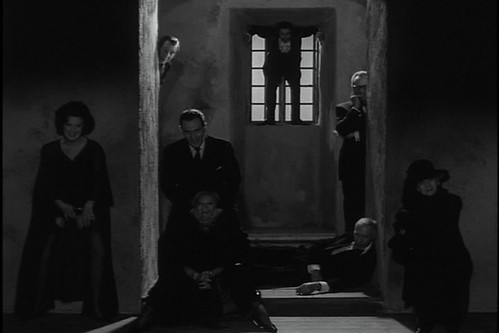
Presented as part of a countdown to the TOERIFC discussion of The Serpent's Egg (April 20, 10:00 AM EST, right here on this blog), which this image is not from.

Sunday, January 11, 2009

Hodgepodge or Potpourri or Whatever

I hope you all like capsule reviews, announcements combined with mild complaints, and just plain announcements, because here all of those are...


Smiles of a Summer Night, d. Ingmar Bergman - Not surprisingly, Ingmar Bergman's version of a comedy romp about the battle of the sexes still manages to include tortured spirituality, suicide attempts, and Russian roulette. But a comedic romp it is, and I got the sense that, whether he liked it or not, this film has wormed its way into Woody Allen's subconcious far more than Cries and Whispers or The Silence, say. But that's fine, because from what I can tell, Woody Allen is actually far better at this sort of thing (excluding his mediocre riff on this film specifically, A Midsummer Night's Sex Comedy), not least because Allen is much funnier than Bergman. Very little in Bergman's film induced me to consider the possibility of laughing (the Captain is really the only character who seems to be unamibiguously taking part in a comedy), but, even so, I found Smiles of a Summer Night to be perfectly enjoyable, which means that Bergman's film shares a curious feature that I've noticed is common in older (pre-1960, roughly) comedies that in no way holds true of their modern counterparts -- specifically, you don't necessarily have to think the film is funny to think it's good. I guess the main reason for this difference is that, unlike classic comedies, modern comedies are far more likely to include fat suits, Dane Cook, and farting, and those are really the sorts of thing that you either like, or you don't.


The Grissom Gang, d. Robert Aldrich - Aldrich has always felt like a poor man's Sam Peckinpah to me. Not an original thought, to be sure, but, like Richard Fleischer, Robert Aldrich's critical reputation seems to always be creeping upward, and, also like Fleischer, I've never been able to understand precisely why. Aldrich frequently tackled the same the same kind of material as Peckinpah (and this kind of material is very often central to the Kinds of Films I Like), but while, for instance, Peckinpah's brand of cynicism feels hard-earned and genuine, Aldrich's seems fashionable, even if it is genuine (not only that, but I can't quite see Peckinpah allowing a writer like Clifford Odets to yammer on and hamstring one of his films the way Odets did to Aldrich's The Big Knife).

The Grissom Gang is as okay-I-guess as many of Aldrich's movies (but listen, I love The Dirty Dozen just as much as the next guy, so don't everyone pile on at once). It's adapted from a nasty pulp novel by James Hadley Chase called No Orchids for Miss Blandish (a book which George Orwell called both "a brilliant piece of writing" and "pure Fascism"), and is about Depression-era Socialite and kidnap victim Miss Blandish (Kim Darby) and her relationship with her kidnappers, especially Slim Grissom (Scott Wilson), who is sort of like Lenny, from Of Mice and Men, if Lenny killed people on purpose. Wilson is, I think, a great actor, but Aldrich lets him completely off his leash, to the point where the expression on his face when the virginal Slim turns slowly to face Miss Blandish after she has just offered herself to him, puts me in mind of Alfalfa turning around to face a ghost. Wilson isn't the only actor to suffer under this sense of freedom, and, beyond that, the film feels cheap, and its style borrowed.
---------------------------------------------------------------------
ITEM!

I recently came across this...


A great subject for a documentary, I must say, but that tagline drives me nuts. In case you can't read it, it says "He was in only five movies. Each was nominated for Best Picture". While John Cazale's particularly admirable filmography is without a doubt part of what makes him fascinating, the fascinating part isn't the Oscar nominations, but the films themselves, and Cazale's work in them. Why not just say "He was in only five movies: Dog Day Afternoon, The Conversation, The Deer Hunter, The Godfather, and The Godfather Part II"?

Beyond that, of course, is the implication that John Cazale holds a place in film history because of some fluke-ish bit of trivia, and not because he was a great actor who landed great roles because filmmakers respected him and, you know, wanted him in their films.

But, okay, it's just a marketing ploy to bring in the kind of audience who has no idea who John Cazale is, but who positively loves semi-obscure Oscar facts. Those three people can join the rest of us in watching this thing when it airs on HBO some day in the future, or when it comes out on DVD.
---------------------------------------------------------------------
ITEM!

Hey, don't any of you forget about the inaugural post for the Oldest Established Really Important Film Club! Said post goes up some time tomorrow, and it will be/has been brought to us by Marilyn of Ferdy on Films. The film this month is The True Meaning of Pictures: Shelby Lee Adams' Appalachia. Be there, won't you?
--------------------------------------------------------------------
ITEM!

Sort of, anyway. This is actually just an announcement for an announcement, but I have anywhere from two to three semi-big projects in the works, blog-wise, that will begin in the next couple of months, and the announcement for the first project will be going up on Tuesday. The announcement will describe the idea behind the project, and will also give a short list of titles that will be involved, so that you can better take part in whatever discussions arise. I have no firm dates, though, so I guess that means I'm going to have announce this thing twice.

Followers