

On the morning of August 14, 2012, David Cronenberg and actor Robert Pattinson rang the opening bell at the New York Stock Exchange. That they were approached to do this at all is strange -- it may in fact indicate a sense of humor among those who run the NYSE, but few people on the outside looking in will ever entertain this notion, but either way, it was strange. Cronenberg and Pattinson were there to satirically promote, or maybe promote satirically, whichever one more strongly suggests that they were there to do a specific job but fully understood that it was funny that they were there, Cosmopolis, the film that Cronenberg had recently made from the 2003 novel of the same name by White Noise and Underworld writer Don DeLillo.
In a 2012 interview with Cronenberg, Glenn Kenny asked the director about the fact that many people seemed to miss the point -- at least the point as Cronenberg saw it -- of his ringing of the NYSE bell, to which Cronenberg responded:
Yeah, I know, some people thought that we were betraying the movie by doing that. I thought, no, no, you're really not getting it at all. That was so perfect. I couldn't believe when they were asking us. But that was the perfect expression of capitalism. They were lovely there. They were so excited, they love their Stock Exchange and, after all, we were selling a movie and selling is what they know. So it was all perfect. A capitalistic enterprise, and there we were.
The reason all of this is strange, and ripe to be misunderstood, is because Cosmopolis is anti-capitalist to its bones. I would hesitate to assume that it follows that Cronenberg is unquestionably anti-capitalist, or even that DeLillo, a paranoid novelist of the same basic philosophical bent as Thomas Pynchon, is (although I bet he is); in the interview with Glenn Kenny, Cronenberg says that DeLillo told him that his novel wasn't inspired by a desire to attack capitalism but rather by a curiosity about New York's limos, and what happens to them at night. But nevertheless, that's what Cosmopolis is. The basic thrust of the novel and film's driving theory is that capitalism is not unlike anarchy, and that like anarchy, and according to Marx, the destruction wrought by capitalism is a creative act. As you read, or watch, Cosmopolis, how this idea applies to the events of the story will become clear.
"What events!?" many will sneer, and sneered at the time of Cosmopolis's release. Because this is one of those films that..."invite" isn't the right word, but maybe attracts criticism to the effect that "nothing happens" in the film, novel, etc. If I tell you that the story is about a New York City billionaire in his late 20s named Eric Packer (Robert Pattinson) who decides to get a haircut, and as he rides in his limo towards that goal through horrific traffic caused by a visit to NYC by the President of the United States, he has encounters and conversations with various of his employees, semi-friends, lovers, and one wife, Elise (Sarah Gadon), both in and out of his limo (traffic moving at such a ridiculously slow pace to allow for such things), you might agree that yes, indeed, this is one of those things in which nothing happens.
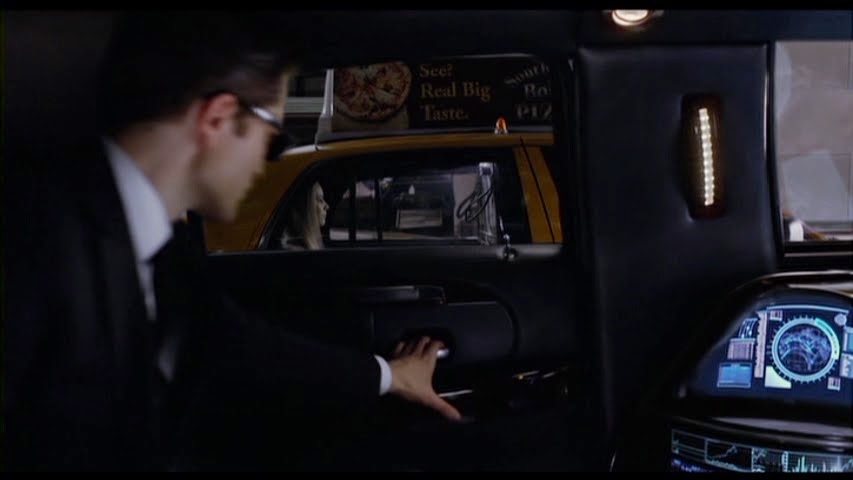
And what of it? Cosmopolis is essentially about a kind of economic theory extrapolated to the point of science fiction dystopia. The story is ostensibly set in the present day, but Packer's limo travels through a haze of near-future America, or anyway New York (the word "cosmopolis" roughly means "city of the world"), on the brink of collapse, with a potentially post-Apocalyptic, as the movies have taught us to define that phrase, aftermath. So Packer might be talking to his head of IT security (or whatever), played by Jay Baruchel, in the back of his ridiculously tricked out limo -- it looks, probably not at all accidentally, like the cockpit of a spaceship -- and see Elise, to whom he's been married for less than a month and whom he apparently rarely sees, in the cab next to him, so he'll get out and get into her cab, which they'll both exit to go find breakfast. This is the basic structure of the film. Packer never seems to be actually traveling by car, but the ease with which he flows in and out of it, and always seems to be somewhere in the city where he has something to do or someone to see nicely illustrates his place within the city: it revolves around him. (This also somewhat resembles the film Game 6 from 2005, falling somewhere in between the novel Cosmopolis and Cronenberg's film version; this is a film that boasts DeLillo's so far only original screenplay, and which features a playwright played by Michael Keaton taking a lengthy and labyrinthine, sort of cab-based trip through the city.)
On top of all this is a development relayed by Packer's security chief, Torval (Kevin Durand, an unusual actor with an unusual presence). A "credible threat" has been made on Packer's life. The President's, too, but that is announced earlier, and which seems to fade into, or be overshadowed by, the threat on Packer. Also on this day, video of Arthur Rapp, "managing director of the International Monetary Fund," being stabbed repeatedly in the eye (to death, in case clarification is needed) on a Korean talk show, is big news. Packer watches this with some fascination, but not exactly horror. All the while, a risky financial move by Packer is not paying off, and continues to not pay off, so that after not too long, and by his own calm admission, he's losing money by the truckful. And around him, anti-capitalist protesters are running wild, as visually inspired as Packer was earlier in theoretical terms, by a line from the poem "Report from the Besieged City by Zbigniew Herbert: "a rat became the unit of currency."

So maybe not so free of incident as previously suggested, although a lot of the above is communicated through dialogue. A lot goes on around Packer's limo, and therefore, in a sense, around the film itself, but visually Cosmopolis is hardly bereft of ideas. And the dialogue's not exactly worthless anyway. It's not simple exposition. Though the script was written by Cronenberg, he hewed very closely to DeLillo's novel (there are one or two changes at the end, changes which manage somehow to be both major and insignificant, in that nothing vital to the novel is really lost), and one of the most important things Cronenberg hung onto was DeLillo's dialogue. I'm not the world's biggest fan of Don DeLillo -- my objections tend to be philosophical except when they're aesthetic, and also except when he's great, which even I think he sometimes is -- but if he has one unquestionable gift, it is his approach to dialogue. As a matter of fact, he writes my favorite kind of dialogue: sentences that are realistically, humanly ungrammatical, funny in a way that makes it difficult to track the source of the humor. For example, and I may have to leave it at one, early on Torval tells Packer about a security threat. He's talking about a threat to the President which will further impede Packer's quest for a haircut, but Packer thinks Torval is referring to a threat on his, Packer's, life. Torval says "Not your life, his," and Packer says "Who the fuck is his?" I don't believe I've ever heard anyone say anything quite like "Who the fuck is his?", but I believe it to be nevertheless absolutely correct. And funny. Why? It's not because I believe it reveals Packer to be a dope. Somehow, this sort of thing is funny because it's right.
Also funny, in a different way, is when Samantha Morton as Vija Kinsky, Packer’s "chief of theory," tells him about her love of the idea of nanoseconds, even though she's not certain what it is, Packer informs her that there is also such a thing as a zeptosecond, and a yoctosecond, and she responds "Good, I'm glad." It's a strange sort of humor, I'll grant you. At any rate, on the page all of this reads as pure Don DeLillo, as you'd guess it would, but in Cronenberg's hands the words, and everything else about Cosmopolis, takes on the cold steel shape of a J.G. Ballard phantasmagoria. The very title Cosmopolis already sounds like it belongs to Ballard as much as or more than it does DeLillo, and Cronenberg, being basically the Canadian film director version of Ballard, slides into this mix of compatibly warped pathologies as easily as one would into a painfully cold bath.
None of which is to suggest that I think all of Cosmopolis works like gangbusters. In truth, I think it comes in second only to A History of Violence as my least favorite among his films. It's just that I do not for a second believe that the film is any kind of baffling misfire, much less the disaster it was claimed by some to be. The long stretches of theorizing that comprise a large portion of the film can become enervating, as I found was the case with the novel. I can find it well-written while wishing everybody would just shut up a second. Large swaths of it don't seem to matter, which on one level, on the level of the story of Eric Packer, I suppose is intentional -- things not mattering is almost a theme here -- but it also doesn't seem to matter as thought, thoughts thought up by Don DeLillo or David Cronenberg. Upon seeing an image of a large TV screen in Time's Square flashing the phrase "There is a specter haunting the world. The specter of capitalism," my reaction is to say "It's very interesting to me that you think so" and move on. All of this can be tedious, is what I'm getting at. If the section with Samantha Morton has more life in it, it's because Morton has more life in her than, say, Gadon (who was quite good in Cronenberg's A Dangerous Method but here seems to have been ADRed into oblivion), or Baruchel who is doing his normal shtick but without so many jokes as usual, or Juliette Binoche who seems very out of sorts playing one of Packer's lovers, or Kevin Durand, an actor I am not knocking here so much as I'm admitting that I can't make heads nor tails of him. The same goes for the various...set pieces isn't right, concepts doesn't seem much better, everything that happens takes so little time, but anyway, if the bit with the protesters in the diner holding the dead rats works -- and it does, not least because it feels like it could have come from Cronenberg's eXistenZ -- then it's just as certain that the later bit with the French "pie assassin" played by Mathieu Amalric, is just frankly stupid nonsense, a desperate grasp at satire and humor from two men (Cronenberg and DeLillo) who are much funnier than this, and much smarter about how to make humor flow along unseen and under the surface, but here want to announce their comedic intentions with a bullhorn. A gag bullhorn that makes fart sounds.

For a while, Cosmopolis is an interesting but only sporadically successful experiment. This depends, I'll admit, on how one views the subject to begin with. "You've convinced me!" is not something anyone has ever said after leaving a film with an argument to make. As this is more or less irrelevant, the interestingness of the argument or the film as a film becomes paramount, and Cosmopolis is mostly not especially interesting as an argument, but as a film making its argument through a lens of subtle science fiction, it can be fascinating. It's that lens that makes the argument better than the words do. Then Packer (and in the interest of fitting this in somewhere, I should mention that Pattinson is terrific and underrated here, dead-faced, consciously not looking at people who don't matter as people, but not dead behind his eyes, because he's human, even if he has a somewhat inhuman way of going about being that) confronts the man who threatened his life. Played by Paul Giamatti in one of his greatest performances, this long final scene, which lasts something like twenty minutes, pretends to hang on to its "philosophical theory" approach to the subject of economic inequality, but in fact largely jettisons it, or lets Giamatti's frightening, frightened, furious performance to do the jettisoning for them. A blank face is replaced by a real one, even if the character is as ridiculous in his extremes as everybody else. I mean, here you have a guy who lives in an apartment where he has to shit through a hole in the floor arguing with a character whose apartment is tricked out with two elevators programmed to play different kinds of music and move at different speeds, between which he may choose, depending on his mood. This is set up as an absurd illustration for an absurd lecture, but among the things that don't hurt this scene is the fact that Giamatti's Benno Levin isn't an angel with a dying child -- he is violent, and fundamentally self-serving. He's not angry because there are poor people; he's angry because he's a poor person.
But of course, that's what it comes down to. If up until this section Cosmopolis has been a somewhat intriguing experiment, in this last stretch it suddenly becomes a masterpiece, for 20 minutes. Levin's frustrations are so specific that they become weapons in the argument being made by DeLillo/Cronenberg as sharp as everything before was smooth in their generalities. A man who has to shit in a hole in the floor is driven crazy by people who have doctors who can order tests for them, by the sight of people sitting outside a café on a sunny day having drinks and talking, by the international symbol of disposability that is represented by the endless varieties of shoes available to people who are not him. The unavoidable truth of the discrepancy -- and your thinking on the subject can vary, and two people can hate each other based on those variations, while each still seeing the same thing as clearly as the other -- is plainly felt and strongly stated: "You are foully and berserkly rich," says Levin, and it's that one word, "berserkly," that carries within it such sudden clarity. It makes the case. "How rich is he?" now has an answer we can all grasp.

