
 A common complaint leveled – by general audiences and some critics – against films of a darker philosophy than may be the norm, one that has been the source of some debate recently, is that the film in question does not have any “likable” characters. This criticism strikes many people, including myself, as completely dismissible (it can get slightly more complicated than that, but that’s not for today) since “interesting” or “good”, in the aesthetic sense, trumps “likable” any day of the week. If I needed my characters to be likable, I’d steer clear of Richard Stark’s Parker novels, lots of Jim Thompson and Charles Willeford books, and other works that I consider indispensable. So cram your likable characters with walnuts, see?
But there is another criticism, a close cousin of the “likable characters” one, and one that seems more readily embraced even by some of those cocking a snoot at the aforementioned, and that is the apparently fundamentally moral claim that a given filmmaker doesn’t like, or even hates, his characters. Because how dare he, for one thing, and who does he think he is, for another. This criticism does not tend to involve films in which a character that reflects the filmmaker’s political or philosophical or moral bias is set up to be knocked down. More often than not, those characters are what we in business like to call “the villain” and so it’s no biggie. No, in the cases I’m referring to, the hated characters aren’t villains, but might even ostensibly be the hero, or anyway the lead, and the evidence for the filmmaker’s rage can be found in the ways the character is mocked, verbally or through the hand of fate, as well as general misfortune and lack of empathy for the character from creator, or lack of openings for the audience to provide their own empathy, if the director’s going to be like that about it.
 I’ll admit, I don’t really understand what it might mean for an artist to hate one of their characters, or why it should be the first thing that matters. I mean, you know made up people aren’t real, right? But let’s stop speaking in generalizations and get to the topic at hand: Todd Solondz. In his controversial 1998 film Happiness, one scene featured two overweight (this is important!) characters played by Philip Seymour Hoffman, as a deeply disturbed and chronically lonesome obscene phone caller, and Camryn Manheim, as a friendly woman whose idea of a perfect night is to drench herself in blankets and watch TV while eating ice cream, and who also killed a man who was trying to rape her, dancing to “All Out of Love” by Air Supply. Well, said some, why should this moment of tenderness be mocked by the inclusion by a song as lousy as “All Out of Love”? Why couldn’t Solondz have chosen a good song so that we would know not to laugh at the fat people? I know, it’s infuriating. Except, how about the idea that the song means a lot to Manheim’s character, and that “All Out of Love” means to the scene what it means to her? And that it might not be intended as an insult to say that someone like the woman Manheim is playing would probably like a song like “All Out of Love”? And that one needn’t even like “All Out of Love” to not mean that as an insult? And that the thousands (this is purely hypothetical) of Air Supply fans reading this must be wondering why this is even a question to be hashed out? And that, by the way, some people just really do like Air Supply? And that for all we know Todd Solondz is one of them? Point being, when you say a filmmaker hates their characters, you just might be revealing more about what you don’t like about that character than you realize. You fucking snob.
Then again! I watched Happiness again recently, as a lead up to watching Solondz’s kind of sequel, Life During Wartime, which will be released by Criterion tomorrow, and it struck me how many cheap shots Solondz really does take throughout the earlier film. The Air Supply thing does not count as a cheap shot, but the way he portrays Trish – played by Cynthia Stevenson in Happiness and Allison Janney in Life During Wartime, and one of the three sisters who are the core of both films – as entirely oblivious of the nightmarish crimes happening under her own roof and smugly condescending to her sister Joy (Jane Adams in Happiness, Shirley Henderson in Life During Wartime), and finally as a mockable “type” by twice having her chirpily and inappropriately ask “Did you see Leno last night?”, which carries a texture that is completely unlike that of the Air Supply scene. There is a context for mockery with Trish in Happiness that grates, and gives ammunition to the Air Supply protestors, if only they saw it.
 This is all probably why Life During Wartime has been hailed by many as Solondz’s best film so far. The man makes pitch-black comedies about pitch-black subjects, and even in Life During Wartime he is not above the occasional cheap or easy shot at his characters, but he never does it in order to tear them down. For instance, at one point Janney as Trish, and Michael Lerner as Harvey Weiner (apparently the father of Dawn Weiner from Solondz’s earlier Welcome to the Dollhouse) are made to say trite things about terrorists – that they have no goals and hate freedom and that’s all that needs be said – that Solondz probably figures is the sort of thing that people dumber than he would say. Okay, fine, and then this is followed by a scene of genuine warmth and caring (though boy does it backfire) from Lerner and a subsequent fierce motherly protectiveness (though boy is it misplaced) from Janney. In other words, Life During Wartime seems to find Solondz developing a special brand of maturity that can still include taking cheap shots at your creations, as long as you don’t let those shots define them. In Happiness, that’s how Trish was defined; in Life During Wartime, while she’s still quite a piece of work (and played hilariously by Janney), she is no longer empty.
 Life During Wartime has lots more to recommend it, too. If you’re a fan of Happiness, then it’s essential, and it’s quite interesting to see how Solondz – who once, in his film Palindromes, cast eight different actors to alternate playing the same role – has recast the major characters from Happiness, and how in some ways the casting and resulting performances mirror the earlier work (the switch from Jon Lovitz to Paul Reubens goes down pretty smooth) or starkly contrasts it (replacing Dylan Baker with Ciarin Hinds is much more jarring) or, in at least one case, significantly rewrites the character so that you have to wonder how connected the two films are really meant to be. In Happiness, Allen, the obscene phone caller, is played by Philip Seymour Hoffman. In Life During Wartime, he is played by Michael Kenneth Williams. Williams is black, which doesn’t matter; what does matter is that Solondz has now given Allen a background as a former gangbanger, which would be hard to imagine when played by Hoffman. So Solondz is jerking us around, again. Plus he probably hates Allen anyway. But still, check it out. Solondz puts off a lot of people, with his funny stories about rape and pedophilia and abortion, and about half the time is frankly asking for it. He’s also the only guy I can think of who is currently making films like this. That’s no little thing.

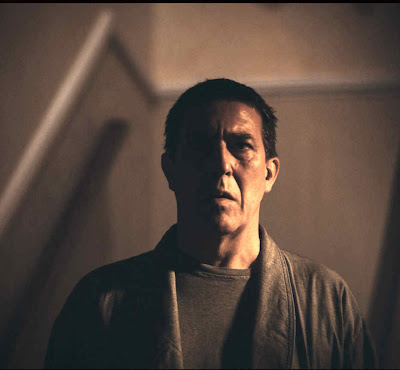 Conor McPherson has, though, or at least he's come awfully damn close. His new film The Eclipse (based on a story by Billy Roche, who appears in the film in a cameo role) is pretty extraordinary, in my view, in the way it uses supernatural horror as no more than one element of a story about a widower named Michael Farr (a superb Ciarán Hinds) who volunteers as a chauffer at an annual Irish literary festival. In the film, he chauffers two writers -- Lena Morelle (Iben Hjelje) and Nicholas Holden (Aidan Quinn), the latter of whom is a particularly obnoxious and self-involved American-Irish writer who is one of the festival's big "gets". Farr also has two children who he's raising by himself since his wife's passing a few years previously, and an elderly father-in-law (Jim Norton), who lives in an nursing home. This father-in-law begins appearing to Farr as a corpse, after a short period when Farr hears strange sounds in his home, and even screams, not just outside his home, but outside, or in, Lena's hotel, as well.
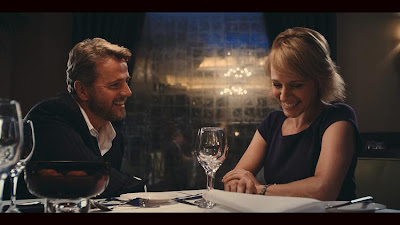 What makes this film so fascinating also occasionally works against it. McPherson uses pretty standard "jump scares" for his moments of supernatural horror, and these sometimes sit uneasily with the spare, quiet naturalistic scenes (indeed, the most effective and visceral moment of horror is not supernatural at all). But if you want the supernatural to sit back a bit more, how far back do you go before this whole approach to the genre becomes too smoothed over and beige? And then that question raises another one, which is how much do you want your new horror model to be explicitly noticed as such, rather than simply as a story about these people in these situations? I don't know. Still, if the "scare" scenes in The Eclipse don't always quite work, I'm glad McPherson chose to present them so directly. The harder to ignore they are, the better.
 The problem with finding a film in my