

I should perhaps begin by talking about how I screwed up. My intention was to read Naked Lunch by William S. Burroughs so that when I wrote about David Cronenberg's 1991 film I could say "Hey I read that book." Having read Burroughs before only to find his way of going about things to be entirely anathema to my own, I don't know that I would have been able to say much beyond that, but it seemed important to be able to say it, if for no reason other than to cover matters of due diligence and so forth. Well, I read most of Naked Lunch, and then one day I set it down, but with no sense of anticipation for the next time I might pick it up, and this is I think key. I never picked it up again, though I only had about 80 pages to go, and I've remembered very little about what I did read that could be useful to me today. Therefore, in any way that matters, I have not read Naked Lunch.
I think I'll be okay, though, because watching the Cronenberg film again yesterday, and doing some research, I feel sure that David Cronenberg was not so much adapting Burroughs's 1959 novel as he was adapting this passage from Burroughs's 1985 publication of his novel Queer:
I am forced to the appalling conclusion that I would never have become a writer but for Joan’s death, and to a realization of the extent to which this event has motivated and formulated my writing. I live with the constant threat of possession, and a constant need to escape from possession, from Control. So the death of Joan brought me in contact with the invader, the Ugly Spirit, and maneuvered me into a lifelong struggle, in which I have had no choice except to write my way out.
"Joan" is of course Joan Vollmer, Burroughs' common-law wife, who, while in Mexico in 1951, and in a roomful of friends, Burroughs shot in the head and killed, apparently while trying, with Vollmer's permission, to shoot a glass off her head. "Why I did it, I don't know," Burroughs later told biographer Ted Morgan. "It was an utterly and completely insane thing to do." He would publish his first novel Junky two years later, then write Queer shortly afterwards (though it wouldn't be published until 1985), and then his signature, landmark novel, the phantasmagorically drug-sick Naked Lunch.
And while I might not be a fan of Burroughs' work, David Cronenberg, unsurprisingly, is. The idea of making a film out of Naked Lunch had been kicking around between him and producer Jeremy Thomas since 1984, though he says in David Cronenberg: Interviews with Serge Grunberg that the very early notion was more of a joke than anything else -- a joke, presumably, because as he tells Chris Rodley in Cronenberg on Cronenberg, a "literal" adaptation of Naked Lunch "would cost $400-500 million...and of course it would be banned in every country in the world. There would be no culture that could withstand that film." And, well, no, probably not -- the sex and violence in that novel ("what I read of it," he shamefully amends) is not only very graphic, but also so stratospherically elaborate that filming the sexuality alone would force the great special effects minds of the late 1980s to devise new ways of doing things. Add to that the fact that Naked Lunch is also, essentially, science fiction, and the expense begins to grow exponentially.

However, after The Fly and Dead Ringers, the film version of Naked Lunch was becoming a reality in Cronenberg's mind, and the method he developed was what he calls a "fusion" between himself and Burroughs, while the result was something like a general adaptation of Burroughs' ideas and a kind of biopic. Peter Weller plays William Lee, which Burroughs used not only as a character name in several novels but also occasionally as a pseudonym, an exterminator in New York during the 1950s, or perhaps an "exterminator" in "New York" in the "1950s." At the beginning of the film, he discovers that the bug powder he uses in his work has been skimmed. Lee learns from his writer friends Hank (Nicholas Campbell) and Martin (Michael Zelniker) that Lee's wife Joan (Judy Davis) has been doing the skimming, because she's become addicted to the powder, injecting it like heroin. Lee is less horrified by this than maybe bemused, but anyway he goes along with her idea and begins using it too. He does take some steps towards getting Joan off the stuff by visiting a Dr. Benway (Roy Scheider), who introduces him to "black meat," made from a particular kind of Brazilian centipede, which is supposedly a drug similar to methadone -- wean her off the powder with the black meat, increase the black meat little by little, her craving will disappear. Things really kick off, however, when Lee is approached by two cops who take him to the precinct, where he's introduced to a giant talking cockroach (voiced by Peter Boretski) who tells him that he, the roach, is Lee's "case worker," and that Lee is an agent whose new mission is to kill Joan because she is an agent for Interzone, Inc., which in the grand scheme of things is essentially both a country and a drug-manufacturing corporation. It's best to not try to summarize all this too much, so the important part now is that Lee dismisses all this and flees, first killing the giant roach. Lee is a wry but passive sort of fellow, and he's soon back living his normal life, even his newly-boosted paranoia failing to crack him too much, until during a bug powder-and-booze fueled gathering of himself, Joan, Martin, and Hank he tells Joan that they should do their "William Tell" act, so she puts a glass on her head, he pulls a gun, and shoots her in the head. We're maybe a half hour into the film at this point.
Typically, I'm not a huge fan of films whose stories can mostly be interpreted as a hallucination of the protagonist, or some kind of drugged-out fever dream, but Naked Lunch is a different kettle of fish in this regard. Soon after Joan's death, Lee goes to a bar -- he's trying to figure out what to do, but he's also not a guy who's capable of doing a great deal -- where he's introduced by a gay man named Kiki (Joseph Scorsiani) to a Mugwump, a big humanoid insectile alien creature (voiced again by Boretski) who gives Lee new orders, as though that roach had never been killed, to travel to Interzone and investigate and write reports and such, et cetera and et cetera, the point being that later when Lee is telling Martin where he plans to flee, from the legal aftermath of Joan's death, he shows a confused Martin his plane ticket, which we saw the Mugwump give him, but what he holds out to Martin is a tube of bug powder. Or heroin, in other words. Martin is no less confused by this, but Cronenberg's intentions couldn't be more clear. Lee's "plane ticket" doesn't exist. He's going on a "trip," a pun I don't like making, and which Cronenberg himself doesn't make even while he's making it.

How much of what happens really happens? Very little, it would seem, but I can't see how that matters. Cronenberg's Naked Lunch is, in its best moments, an exhilarating intellectual portrait of diseased creativity, or creativity born from disease, the artistic flowering (whether you like what Burroughs wrote or not) of one writer from a brain exploding with the most powerful and deadly of narcotics, and raw guilt, and from tragedy that almost redefines "senseless." The cockroach, and the Mugwump, insist that Lee write very detailed reports, which he does (on a typewriter that itself turns into a Brundlefly-like object, half talking cockroach, half typewriter, which, needless to say, Boretski again), and this is why Lee/Burroughs writes anything at all. And he doesn't type a word until Joan is dead and he's in Interzone. His need to escape both justice and his guilt transforms into the "appalling conclusion" of a writing life. Of course Cronenberg complicates things a little bit further by having the idea of killing Joan planted in his head by a talking cockroach, which even in that early scene is a hallucination (isn't it?), because by then he'd started on the bug powder-as-drug (the bug powder, Joan tells him, provides a very "literary high," and by the end of the film I suppose we know what that means, don't we?) so nothing he sees, at least nothing that seems so very much out of the ordinary, can be read as "real," even within the very expansive borders of a Cronenberg film. The point being, in this film Burroughs has to kill Joan to become a writer, though he doesn't understand any of this, it's a subconscious notion (earlier he tells Martin and Hank that he gave up writing when he was ten; he also tells them that writing is dangerous), and in Cronenberg's film it can be read almost as his destiny. Which sounds terribly cold-hearted in regards to the death of Joan Vollmer, but one mustn't be so literal about these things. When you look at the mark Burroughs eventually made on 20th Century American literature, and you think about what Burroughs says led him to write in the first place, this demonically stupid death, is it insulting to think -- again, let's not take this literally, please -- that this was all going to happen one way or the other?
So there's William Lee pounding out his reports on his Clark-Nova bug typewriter, in a little room in Interzone. His literary career has begun, and though Lee still doesn't regard himself as any kind of writer, in Interzone he finds himself among the literati. Because Interzone, as Cronenberg depicts it, is, or might as well be, Tangiers, Morocco. This is where Burroughs wrote the novel Naked Lunch, and in the 1950s it was also for strung-out or otherwise socially unacceptable writers what Paris in the 1920s was for Hemingway and all the rest. A lot of Beat activity, in other words, but also the home, by then, of the American writers Paul and Jane Bowles. Paul Bowles and Jane Bowles were both gay, but were married to each other (in the case of Paul Bowles, at least, there could have been some of the intense denial that Cronenberg says was such a strong feature of Burroughs' own struggles with his sexuality, and which helped the filmmaker construct how homosexuality is presented in Naked Lunch, as a "disguise"; in any event, in his introduction to The Stories of Paul Bowles, Robert Stone writes that Bowles was "genuinely puzzled" that so many people thought he was gay). I bring them up because in Interzone/Tangiers, William Lee meets Tom and Joan Frost. Tom Frost is played by Ian Holm, and you're meant to pick up on the Paul Bowles link from certain circumstantial clues, such as Ian Holm's hair in the film, and then you see a picture of Paul Bowles, and you go "Hey their hair is the same." As for Joan Frost, she's also played by Judy Davis. Here's a picture of Davis as Joan Frost:
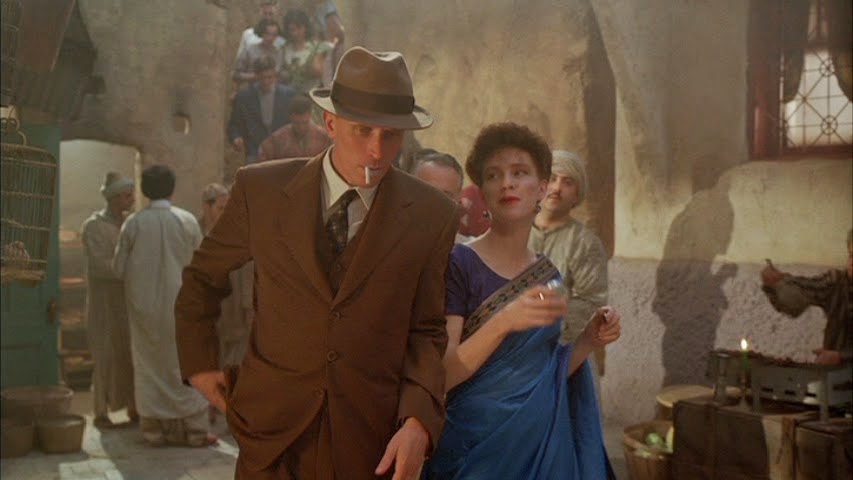
Okay, now here's a picture of Jane Bowles:

Now tell me, am I crazy? No, I don't think I am, either. While the last half of Jane Bowles's life is a very sad story filled with disease (she had a stroke when she was 40, which essentially put an end to her writing career, though it would take another thirty years to kill her), it's not as if Paul Bowles had anything to do with her death. So even though Burroughs and the Bowleses knew each other in Tangiers (Bowles was even instrumental in getting Burroughs's career started), the presence of these stand-in figures in Cronenberg's film is a little bit obscure to me. It could have as little to do with the historical figures as W. P. Mayhew in Barton Fink being very loosely based on William Faulkner, or Fink himself being based on Clifford Odets, neither detail being something about which too much should be made. But there are a couple of things. The Frosts are somewhat sinister figures, with Tom Frost going from friend to Lee to a man battling with Lee over insect typewriters (because Tom Frost is himself possessed/addicted/infected), and Joan (Jane) being revealed as having connections with Interzone, Inc., and a strange lesbian cabal. Nothing much is made of Joan Frost as a writer, and her drifting away from the action for a while could be her "stroke"...maybe. Whatever the case, in the film Joan Frost the writer, as Jane Bowles the writer, is sucked away from her literary life. Joan Frost also becomes the key to one of the most bone-chilling, brutally ingenious moments in any Cronenberg film. At the end, Joan Frost has ended up with Lee. They've left Interzone in a van and have crossed the border to Annexia, a country under some kind of Communist influence, it would be appear, because their van is stopped by soldiers. Joan is asleep in the back, Lee is driving. The soldiers ask Lee questions, including his profession. He tells them he's a writer, but they want proof. He holds up a pen. Not good enough, they tell him. So he turns around in his seat and wakes up Joan. He tells her that they need to do their William Tell act. So she puts the glass on her head, he takes out his gun, and he shoots her in the forehead. He has now proven himself a writer.


