Showing posts with label The Cronenberg Series. Show all posts

Saturday, February 28, 2015

The Cronenberg Series Part 18: All the Flesh That Says Yes


About a quarter of the way into Maps to the Stars, the new film directed by David Cronenberg and written by Bruce Wagner, a callow young Hollywood type (Jonathan Watton) and friend, of a sort, to washed-up actress Havana Segrand (Julianne Moore) wonders aloud to Havana regarding the young woman with whom they will soon be enjoying (well two of them will; that the third enjoys it is debatable) a threesome, "I wonder if Blake Shelton peed in that butt." Upon hearing this crass joke, employing as it does the name of a real life celebrity being talked about by movie people in a film (I'm talking about Maps to the Stars here) set in Hollywood the plot of which, or a portion of the plot of which, revolves around, or rather in the vicinity of, the making of another film, one which is the remake of another film thereby providing a link to Old Hollywood, something which is always an important part of these things -- upon hearing this crass joke, as I say, the viewer of Maps to the Stars might reasonably conclude that what they are currently watching is a Hollywood Satire, one of the dark ones like The Player, something about how unforgiving the movie business is, how corrupting it is to the soul, and how twisted are the lives of those who exist within it. Well, to begin with, as far as the film being twisted goes, you have no idea. To the question of whether or not Maps to the Stars is the satire that so many critics have decided it must be, I would say that this is the case only if your definition of satire is "something which makes jokes about another thing." I think that is most people's definition of satire, although in the case of this film you'd actually have to alter the definition again, adding "but not many jokes, and then the jokes stop."

In addition to Julianne Moore's pathetic, amoral actress, Maps to the Stars boasts a freak show of characters, such as Benie Weiss (Evan Bird), at thirteen a recovering drug addict and the star of the Bad Babysitter film series, his parents Christina (Olivia Williams) and Stafford Weiss (John Cusack), the latter an author, therapist, and self-help guru who has among his clients Havana Segrand. She is seeking treatment from Weiss to deal with psychological problems she still wrestles with due to having been sexually abused by her mother, the actress Clarice Taggart (Sarah Gadon, who has appeared in each of Cronenberg's last three films), who died years ago in a fire, and who appears now to Havana as either a literal or figurative ghost, not sure, could be either one (given the facts of her life and death, I couldn't help but see Clarice as some unholy union of Linda Darnell and Anne Sexton, by which I mean to imply nothing about and give no offense to Linda Darnell). One of Clarice Taggart's movies, Stolen Waters, is being remade with a post-modern twist, and Havana wants desperately -- unhealthily, one could argue -- to play the role of her mother. While frantically pursuing this goal, she hires, on the recommendation of Carrie Fisher (herself), a new personal assistant, or "chore whore," named Agatha (Mia Wasikowska). Fisher got to know Agatha online, and, long story short, Agatha is now fresh off the bus, though doing pretty well under the circumstances, landing this pretty big job pretty quickly, and even striking up a romance with struggling actor/limo driver Jerome Fontana (Robert Pattinson, moving from the back seat of the limo he occupied in Cronenberg's Cosmopolis to the front, a little detail that I'm sure has been lost on absolutely no one). Agatha seems to be a winningly quirky young woman, remaining sunny even though her face was badly scarred in a fire, her body, she tells Jerome, more badly scarred still. But winning as she may be, that Cronenberg and his team have designed her look to resemble that of Holly Hunter's character in his adaptation of J.G. Ballard's Crash can't help but raise certain alarms in the heads of Cronenberg fans. In any case, Agatha's arrival in Los Angeles is noticed by Christina and Stafford Weiss, and remarked upon by them with dismay.


I hesitate, briefly, to reveal the source of their uneasiness because among the entertainments that Maps to the Stars offers is a completely mad story whose madness is skilfully parceled out. However, I'd judge it to be maybe just inside the outer limits of acceptable spoilers to say that Agatha's last name is Weiss, she's Stafford and Christina's daughter, and they're uneasy because the last time they saw Agatha she'd just tried to kill her brother Benjie, out of a disturbing, marital kind of love, and set the family home on fire. There is also another reason for their uneasiness, but anyway.

If I'm hesitant to deal with Agatha it's because she's the film's mystery, she's the stranger in black (check out those gloves) who shows up in town and turns everything on its head. This is an archetype found in the Western -- the West being where one can find Los Angeles -- but of course this tradition also exists in horror. Richard Matheson's classic short story "The Distributor" leaps to mind, as does The Intruder, the similarly themed non-horror novel by Matheson's friend Charles Beaumont, which is more instructive in this case in that that book has the premise of a social satire, but is not a satire. That's about as far as I can take this comparison in any event because Agatha, though potentially dangerous, is not menacing. It's not her intention to bring harm, whether she finds herself bringing it or not. So what is her intention?

An answer of sorts, or a clue anyway, could be lying in plain sight. Throughout the film, Agatha performs little rituals -- involving taking her pills, for instance, or, in one instance, kneeling worshipfully over Clarice Taggart's Hollywood Walk of Fame star -- the actions of which she accompanies with a recital of Paul Éluard's poem "Liberté". This happens over and over again, and in the film, this poem, which is twenty-one stanzas, is usually represented by the same few lines (for those as curious and ignorant as me, you'll have to do some digging to find an English translation online close to the one used in Maps to the Stars but this one does the trick pretty well), which are:

On my school notebooks
On my desk and the trees
On the sand on the snow
I write your name

and

On all flesh that says yes
On the forehead of my friends
On each hand that is held out
I write your name

Regarding the background of this poem, the reader and viewer might want to know two things. One is that the poet, Paul Éluard, is one of the fathers of surrealism, and the other is that the poem was dropped from RAF planes over France to serve as a source of inspiration during the Nazi occupation. Knowing that, you can sure see it, can't you, even in these relatively few lines? What's interesting though is that first bit -- which is the poem's first stanza -- "On my school notebooks/On my desk and the trees/On the sand on the snow/I write your name." In addition to being a poem about freedom, "Liberté" is also a poem about devotion, and without any work at all (it's perhaps the way of things that it now takes more work to find the intended meaning) those lines can be made to evoke the love a teenage girl -- let's say, for the sake of argument -- has for a teenage boy. Or a movie star. Or someone who is both.

Things can mean many different things, of course, even clichés. Maps to the Stars, which perhaps not at its heart, because at heart it's sad, but in its bones, and all surrounding tissue, it is an evil movie, so when one character says of a child that he is "a little miracle," it's one of the film's most hair-raising moments. Similarly, that phrase of easy hope, "everything happens for a reason," is turned by Cronenberg and Wagner into an assurance that someone is good and fucked. In this way, a poem meant to inspire those crushed under a bootheel transforms into a chant of sincere love and almost mystical doom. Agatha's burned face stumbles into the City of Angels with a bag full of pills reciting a poem about freedom and we're not supposed to run screaming?  I mean, that the poem is called "Liberté" certainly isn't insignificant -- in the context of Maps to the Stars, the questions are free from what (I have some ideas) and free how? Ah. Yes. Well.

I don't think any of this would displease a surrealist like Paul Éluard, who was, by the way, an ideological mess, which is even better, or rather "better." Surrealism is meant to be disqueting -- that seems to me to be the first step, and sometimes the last step -- as well as grotesque on some level. Something that is grotesque can be awful from the skin on down, or the entire source of its alarm may be simply that physically it skews badly from the norm. Hence pity (asked for and unasked for) and sadness. Hence Agatha. Anyway, these concepts of surrealism and the grotesque challenge reality with the unreal, and Maps to the Stars would like to get in on that. Clocks should drip from trees and freedom shouldn't mean that.


And yes, Maps to the Stars is funny, too, but then Cronenberg usually is to some degree, and plus these days the worst thing you can say about an artist is that they're humorless, which I don't believe is the same thing as saying "Why isn't everything a satire?" The grotesque and the surreal can pull from the audience any number of reactions, from laughter to revulsion to abject horror. Those who don't think Maps to the Stars is a satire have taken to describing it as a horror film, and that's something I can get behind, because it is. And you don't have to stretch the definition the way some people do so they can say things like "In many ways Gravity is a horror film." No -- Maps to the Stars has ghosts in it. Add to this the fact that many horror directors and horror writers (Ramsey Campbell is especially keen to point this out) talk about the close relationship between comedy and horror, having to do, I believe, with the explosive involuntary emotional reaction that both forms can bring from their audience, the loss of control they can force on others, and you start to think that this whole "satire" categorization is a bit of a dodge.

Sure, yes, it takes place in Hollywood, and it does sometimes feel like ninety-nine out of every hundred films set in Hollywood is a satire, but Bruce Wagner, the writer of the film, has made Hollywood his subject or his environment for pretty much his whole career (people who know Wagner's work better than I do have told me that Maps to the Stars is every bit a Wagnerian piece of writing), and so that the characters exist in or around the movie business seems to me to be incidental. You write what you know, so they say. What I'm getting at is, Blake Shelton probably didn't pee in that butt, though even if he did it wouldn't matter.

Wednesday, October 15, 2014

The Cronenberg Series Part 17: It is Difficult to Find Crisco in Paris, But Not Impossible


When it was first announced, what seems like ten years ago now but was probably somewhat less, that David Cronenberg was writing his first novel I was quite excited and intrigued, but also far from shocked. As I hope I've made reasonably clear of the last sixteen posts in this series, Cronenberg is one of the most literary filmmakers in the English-speaking world. The works of Freud, William S. Burroughs, Stephen King, Patrick McGrath, David Henry Hwang, Don DeLillo, and, most importantly, J. G. Ballard have all, in one way or another, found their way into his films. In terms of style, he has transitioned from a visceral genre director into an arthouse intellectual, without ever, somehow, appearing to be a different filmmaker. He's even retained the viscera, though now it often takes a different form than it once did. Besides that, he'd shown an interest in writing novels in his younger days (though who hasn't?), and while the possibility hadn't actually occurred to me until the announcement, that Cronenberg would one day bite the bullet on this felt (retroactively) inevitable.

That novel, called Consumed, finally came out on September 30, after a long enough wait that I was beginning to wonder if he'd abandoned the project. But no, and one thing that didn't occur to me almost until I had the book in my hands was that this represented the first original Cronenberg story -- that is, not an adaptation of someone else's work (and I'm going to conveniently exclude his short films Camera and At the Suicide of the Last Jew in the World at the Last Cinema in the World) since eXistenZ fifteen years ago. And eXistenZ came eight years after what would have counted as his previous original story, Naked Lunch, a film that is officially an adaptation of Burroughs, but then again who are we kidding here. Anyway, Cronenberg the Writer had been gone far too long, and the notion that his return was in a medium that would, in theory, allow him to expand his natural, unique inventiveness into areas that film, with its financial burdens, might not so easily find room for, was somehow more than I felt I could expect from Cronenberg at this stage in his career. It all made perfect sense but managed to still be unexpected.

And "unexpected" is a word that I don't think begins to encompass the strangeness of Consumed itself. I'll have to begin somewhere, so let's see: to begin with, Cronenberg's facility with character names returns with our protagonists (of a sort) Nathan Math and Naomi Seberg. The political and cinematic significance of that last name does not go unremarked upon, but anyway, Nathan is a photojournalist who specializes in medical stories -- he dreams of landing something in The New Yorker's "Annals of Medicine" series -- and Naomi is a photojournalist of a more generalized, catch-all sort. She is pursuing a story about the eminent French philosophers Celestine and Aristide Arosteguy. The Arosteguys -- aging, sexually adventurous married intellectuals who, once openly, now somewhat more surreptitiously, bring students of both genders into their bed -- are beloved in their home country for their work in and approach to a kind of Marxist consumerist philosophy which posits, for example, that "the only authentic literature of the modern era is the owner's manual." Reading from one such manual, for a camera, Celestine says:

"Auto-flash without red-eye reduction. Set this mode for taking pictures without people." She laughed that rich, husky laugh, and repeated, this time with great drama, "Set this mode for taking pictures without people." A shake of the head, eyes closed to fully feel the richness of the words. "What author of the past century has produced more provocative and poignant writing than that?"

So that's the kind of work they do, but Naomi is reduced to watching videos of Celestine online because it appears as though Celestine's husband Aristide has murdered and partially eaten her. Why he did this is the story Naomi is pursuing. Meanwhile, Naomi's boyfriend Nathan is in Budapest interviewing Dr. Zoltan Molnar, a rather strange oncologist (and restaurateur) whose focus is breast cancer. He's developed an aggressive form of treatment (which I won't bother trying to describe) that has not been cleared by any international governing body in medicine, so he has to work on a sort of black market basis. Nathan is writing a story about him, and along the way he begins a sexual affair with one of Dr. Molnar's patients, a woman ("So many women have cancer these days," she says) from whom he contracts an STD thought extinct called Roiphe's Disease. This he subsequently passes on to Naomi, who is naturally furious when he confesses, and the two of them -- whose sexual encounter that allowed for this transference of disease occurred during a rare moment of togetherness, between the two of them flying to different parts of the world, pursuing different goals -- split yet again, he to Toronto to meet Dr. Roiphe, because, ostensibly, Nathan wonders about the fame, or infamy, that comes from being a doctor like Barry (Convex?) Roiphe, or Alois Alzheimer or James Parkinson, she to Tokyo to track down Aristide Arosteguy. She was led to Tokyo by Herve Blomqvist, former student and lover of both Arosteguys, and a man who tries, unsuccessfully, to seduce Naomi by bragging about his penis which was twisted by another STD which, well, it's all very complicated. But, so, she goes to Tokyo.

In truth, Nathan does not share the stage with Naomi. He's a supporting character whose story runs in parallel and seems to bear the same weight as Naomi's, but Cronenberg's head and heart clearly lie first in Paris, then in Tokyo. The bizarre world of Nathan, Roiphe, and Roiphe's grotesquely self-harming daughter Chase could probably support their own novel -- there is enough material in Consumed for several -- but in this novel they exist to provide links to, and back from, Naomi and Aristide. In Tokyo, Naomi, whose fascination with the Arosteguys has always been on the fringe of inappropriate, spiritually and sexually untethers herself from Nathan (the implication is strong that she'd been faithful to him, while the woman from whom Nathan contracted Roiphe's Disease was not his first dalliance) and lets herself satisfy her curiosity about her own physical attraction to an old intellectual cannibal. She's still working on her story, with his full cooperation, and she's also wary, even fearful, of what Aristide might do to her, but as is usually the case with Cronenberg, anything sexual is on the table.

And before you look at that description of Aristide and jump to the conclusion that he's some kind of Hannibal Lecter rip-off, the primary inspiration for the character is made clear as Cronenberg doesn't hesitate to throw into the mix the specter (though he is still, unfortunately, alive) of Issei Sagawa, the Japanese man who in 1981 murdered and partially ate a Dutch student named Renée Hartevelt. This happened in France. Sagawa served almost no time in prison, and not much more in a mental institution. For a while he lived off his own celebrity, writing books, restaurant reviews, appearing on TV, and so forth. I first learned of Sagawa from an essay about him written by Colin Wilson and published in the second of Adam Parfrey's horrific and in many ways detestable Apocalypse Culture books. Wilson's essay tried and failed to make the case that Sagawa didn't deserve to be incarcerated, come on, I bet he won't do it again (he hasn't, for the record, though I don't feel that this counts as "paying one's debt"), and, anyhow, long story short, Sagawa's story has always been surrounded by deplorable apologists, skin-crawling implications about celebrity, and vile jokes (see the interview with Sagawa conducted by Vice magazine and their use of the phrase "tasty little dish," not to mention the headline "Who's Hungry?") that seem to exist to convince the teller that Renée Hartevelt's humanity was theoretical at best. Arosteguy says to Naomi:

"You know, Sagawa, the Japanese cannibal, who still lives right here in Tokyo, said that the Dutch girl's ass tasted like tuna prepared for sushi. That's enough to make it dangerous for any Dutch woman to visit Japan. He's considered a tragic hero here, a media celebrity. An artist. I can envision lineups of Japanese men waiting for the Netherlands tourist buses to unload, each with his Suisin maguro bocho sharpened and ready...Of course, she was a Dutch girl. That made it somehow not so criminal. Maybe even praiseworthy."


So Cronenberg, unsurprisingly, is fully aware of what he's throwing together here, and even manages a gesture towards the somewhat fraught history Japan has with the Netherlands. As if Consumed didn't have enough going on in it. This is, in fact, a very plot-heavy novel. Unexpectedly so, though it is unexpected in ways that perhaps it shouldn't be. And maybe the phrase should be "incident-heavy," because the structure of Consumed flits between being tightly put together and a loose one-damn-thing-after-another sprawl. To my mind, this is largely to the good. Cronenberg's films, particularly those made from his original scripts, have never lacked for narrative drive, and Consumed pushes that to lengths that are intentionally absurd. This isn't to say that I believe that by the time the novel's plot has folded into itself a section about serving on the Cannes jury, the secret, sinister power of one of the films in competition, the truth of Celestine Arosteguy's pathology (or is it?), and so forth, again, that isn't to say that Cronenberg is making fun of anything in particular, any kind of storytelling style, I mean. But Cronenberg's is a curious but genuine sense of humor, and he's in complete control of how darkly ridiculous his plot becomes.

Ridiculous, but gripping. That along with everything else, David Cronenberg is a born storyteller is a compliment he's not often paid, I'd guess because everyone is usually so understandably busy figuring out the implications of his stories to pay much attention to how good those stories are. In Consumed, he's building perhaps the ultimate Cronenberg story out of the various meanings and applications of the word "consumed." Some of this is blatant (cannibalism) and even a little tired (consumerism) but when apotemnophilia, the desire to have body parts amputated, and a wild critique of Communism have been included into an already head-spinning collision of juxtapositions, even the tired stuff becomes new.

Plus it's that tired stuff that gives the novel its blood. Before beginning Consumed, my great concern was that the prose wouldn't be up to snuff. You can be a great film writer and a shit prose writer, and vice versa, and I had no particular reason to believe that Cronenberg would turn out to be one or the other. As it turns out, the consumerism facet of the novel is the key to the prose, because it's this facet, especially when set in front of some of the more grotesque material, that best reflects J. G. Ballard back to the reader, and back through the book. Early on, Cronenberg writer about how Nathan and Naomi for all intents and purposes fetishize their various computers and camera gadgets, complete with long blocks of brand names and descriptions of their various features -- a little of this goes a long way, and there's a lot of it, but it's in no way irrelevant. Anyway, as I was saying, early on Cronenberg writes about how, because of their jobs, this couple shops (separately, it must be noted) for their electronics in airport stores, and text to each other the various finds they've made or deals they've noticed that the other might want to look for when the other inevitably passes through that airport themselves. This is laid out as a vital part of their relationship, and if there's a more Ballardian part of Consumed I didn't notice it. And Cronenberg's prose, while in many ways not much like Ballard's, nevertheless works the same way. He matches Ballard's pathological-space-alien disinterest in what's happening, the nonjudgmental psychotic clinician's report. In short, the prose is exactly what it should be.

In the end, Consumed goes in a direction I was not sure, at the moment, I wanted it to go, but I can't now say that I'm sure it even took that direction. When I consider the evidence provided that the thing some characters claim happened happened, or rather that a thing didn't happen, or...well, anyhow, there's not much reason for me to necessarily swallow this whole, if you'll pardon the pun I didn't realize I was making, but anyway, there you have it. Which is the other thing about the ending, and the title, and I realize how vague I'm being about all this but if and when you read the book I suspect you'll think like me, which is that by the end you could say that Consumed is beginning to eat itself.

Monday, September 29, 2014

The Cronenberg Series Part 16: Foully and Berserkly Rich


On the morning of August 14, 2012, David Cronenberg and actor Robert Pattinson rang the opening bell at the New York Stock Exchange. That they were approached to do this at all is strange -- it may in fact indicate a sense of humor among those who run the NYSE, but few people on the outside looking in will ever entertain this notion, but either way, it was strange. Cronenberg and Pattinson were there to satirically promote, or maybe promote satirically, whichever one more strongly suggests that they were there to do a specific job but fully understood that it was funny that they were there, Cosmopolis, the film that Cronenberg had recently made from the 2003 novel of the same name by White Noise and Underworld writer Don DeLillo.

In a 2012 interview with Cronenberg, Glenn Kenny asked the director about the fact that many people seemed to miss the point -- at least the point as Cronenberg saw it -- of his ringing of the NYSE bell, to which Cronenberg responded:

Yeah, I know, some people thought that we were betraying the movie by doing that. I thought, no, no, you're really not getting it at all. That was so perfect. I couldn't believe when they were asking us. But that was the perfect expression of capitalism. They were lovely there. They were so excited, they love their Stock Exchange and, after all, we were selling a movie and selling is what they know. So it was all perfect. A capitalistic enterprise, and there we were.

The reason all of this is strange, and ripe to be misunderstood, is because Cosmopolis is anti-capitalist to its bones. I would hesitate to assume that it follows that Cronenberg is unquestionably anti-capitalist, or even that DeLillo, a paranoid novelist of the same basic philosophical bent as Thomas Pynchon, is (although I bet he is); in the interview with Glenn Kenny, Cronenberg says that DeLillo told him that his novel wasn't inspired by a desire to attack capitalism but rather by a curiosity about New York's limos, and what happens to them at night. But nevertheless, that's what Cosmopolis is. The basic thrust of the novel and film's driving theory is that capitalism is not unlike anarchy, and that like anarchy, and according to Marx, the destruction wrought by capitalism is a creative act. As you read, or watch, Cosmopolis, how this idea applies to the events of the story will become clear.


"What events!?" many will sneer, and sneered at the time of Cosmopolis's release. Because this is one of those films that..."invite" isn't the right word, but maybe attracts criticism to the effect that "nothing happens" in the film, novel, etc. If I tell you that the story is about a New York City billionaire in his late 20s named Eric Packer (Robert Pattinson) who decides to get a haircut, and as he rides in his limo towards that goal through horrific traffic caused by a visit to NYC by the President of the United States, he has encounters and conversations with various of his employees, semi-friends, lovers, and one wife, Elise (Sarah Gadon), both in and out of his limo (traffic moving at such a ridiculously slow pace to allow for such things), you might agree that yes, indeed, this is one of those things in which nothing happens.

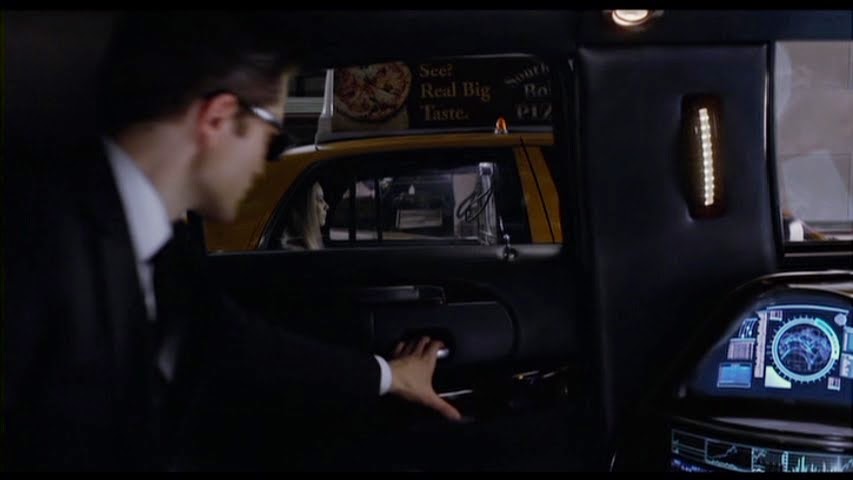
And what of it? Cosmopolis is essentially about a kind of economic theory extrapolated to the point of science fiction dystopia. The story is ostensibly set in the present day, but Packer's limo travels through a haze of near-future America, or anyway New York (the word "cosmopolis" roughly means "city of the world"), on the brink of collapse, with a potentially post-Apocalyptic, as the movies have taught us to define that phrase, aftermath. So Packer might be talking to his head of IT security (or whatever), played by Jay Baruchel, in the back of his ridiculously tricked out limo -- it looks, probably not at all accidentally, like the cockpit of a spaceship -- and see Elise, to whom he's been married for less than a month and whom he apparently rarely sees, in the cab next to him, so he'll get out and get into her cab, which they'll both exit to go find breakfast. This is the basic structure of the film. Packer never seems to be actually traveling by car, but the ease with which he flows in and out of it, and always seems to be somewhere in the city where he has something to do or someone to see nicely illustrates his place within the city: it revolves around him. (This also somewhat resembles the film Game 6 from 2005, falling somewhere in between the novel Cosmopolis and Cronenberg's film version; this is a film that boasts DeLillo's so far only original screenplay, and which features a playwright played by Michael Keaton taking a lengthy and labyrinthine, sort of cab-based trip through the city.)

On top of all this is a development relayed by Packer's security chief, Torval (Kevin Durand, an unusual actor with an unusual presence). A "credible threat" has been made on Packer's life. The President's, too, but that is announced earlier, and which seems to fade into, or be overshadowed by, the threat on Packer. Also on this day, video of Arthur Rapp, "managing director of the International Monetary Fund," being stabbed repeatedly in the eye (to death, in case clarification is needed) on a Korean talk show, is big news. Packer watches this with some fascination, but not exactly horror. All the while, a risky financial move by Packer is not paying off, and continues to not pay off, so that after not too long, and by his own calm admission, he's losing money by the truckful. And around him, anti-capitalist protesters are running wild, as visually inspired as Packer was earlier in theoretical terms, by a line from the poem "Report from the Besieged City by Zbigniew Herbert: "a rat became the unit of currency."


So maybe not so free of incident as previously suggested, although a lot of the above is communicated through dialogue. A lot goes on around Packer's limo, and therefore, in a sense, around the film itself, but visually Cosmopolis is hardly bereft of ideas. And the dialogue's not exactly worthless anyway. It's not simple exposition. Though the script was written by Cronenberg, he hewed very closely to DeLillo's novel (there are one or two changes at the end, changes which manage somehow to be both major and insignificant, in that nothing vital to the novel is really lost), and one of the most important things Cronenberg hung onto was DeLillo's dialogue. I'm not the world's biggest fan of Don DeLillo -- my objections tend to be philosophical except when they're aesthetic, and also except when he's great, which even I think he sometimes is -- but if he has one unquestionable gift, it is his approach to dialogue. As a matter of fact, he writes my favorite kind of dialogue: sentences that are realistically, humanly ungrammatical, funny in a way that makes it difficult to track the source of the humor. For example, and I may have to leave it at one, early on Torval tells Packer about a security threat. He's talking about a threat to the President which will further impede Packer's quest for a haircut, but Packer thinks Torval is referring to a threat on his, Packer's, life. Torval says "Not your life, his," and Packer says "Who the fuck is his?" I don't believe I've ever heard anyone say anything quite like "Who the fuck is his?", but I believe it to be nevertheless absolutely correct. And funny. Why? It's not because I believe it reveals Packer to be a dope. Somehow, this sort of thing is funny because it's right.

Also funny, in a different way, is when Samantha Morton as Vija Kinsky, Packer’s "chief of theory," tells him about her love of the idea of nanoseconds, even though she's not certain what it is, Packer informs her that there is also such a thing as a zeptosecond, and a yoctosecond, and she responds "Good, I'm glad." It's a strange sort of humor, I'll grant you. At any rate, on the page all of this reads as pure Don DeLillo, as you'd guess it would, but in Cronenberg's hands the words, and everything else about Cosmopolis, takes on the cold steel shape of a J.G. Ballard phantasmagoria. The very title Cosmopolis already sounds like it belongs to Ballard as much as or more than it does DeLillo, and Cronenberg, being basically the Canadian film director version of Ballard, slides into this mix of compatibly warped pathologies as easily as one would into a painfully cold bath.

None of which is to suggest that I think all of Cosmopolis works like gangbusters. In truth, I think it comes in second only to A History of Violence as my least favorite among his films. It's just that I do not for a second believe that the film is any kind of baffling misfire, much less the disaster it was claimed by some to be. The long stretches of theorizing that comprise a large portion of the film can become enervating, as I found was the case with the novel. I can find it well-written while wishing everybody would just shut up a second. Large swaths of it don't seem to matter, which on one level, on the level of the story of Eric Packer, I suppose is intentional -- things not mattering is almost a theme here -- but it also doesn't seem to matter as thought, thoughts thought up by Don DeLillo or David Cronenberg. Upon seeing an image of a large TV screen in Time's Square flashing the phrase "There is a specter haunting the world. The specter of capitalism," my reaction is to say "It's very interesting to me that you think so" and move on. All of this can be tedious, is what I'm getting at. If the section with Samantha Morton has more life in it, it's because Morton has more life in her than, say, Gadon (who was quite good in Cronenberg's A Dangerous Method but here seems to have been ADRed into oblivion), or Baruchel who is doing his normal shtick but without so many jokes as usual, or Juliette Binoche who seems very out of sorts playing one of Packer's lovers, or Kevin Durand, an actor I am not knocking here so much as I'm admitting that I can't make heads nor tails of him. The same goes for the various...set pieces isn't right, concepts doesn't seem much better, everything that happens takes so little time, but anyway, if the bit with the protesters in the diner holding the dead rats works -- and it does, not least because it feels like it could have come from Cronenberg's eXistenZ -- then it's just as certain that the later bit with the French "pie assassin" played by Mathieu Amalric, is just frankly stupid nonsense, a desperate grasp at satire and humor from two men (Cronenberg and DeLillo) who are much funnier than this, and much smarter about how to make humor flow along unseen and under the surface, but here want to announce their comedic intentions with a bullhorn. A gag bullhorn that makes fart sounds.


For a while, Cosmopolis is an interesting but only sporadically successful experiment. This depends, I'll admit, on how one views the subject to begin with. "You've convinced me!" is not something anyone has ever said after leaving a film with an argument to make. As this is more or less irrelevant, the interestingness of the argument or the film as a film becomes paramount, and Cosmopolis is mostly not especially interesting as an argument, but as a film making its argument through a lens of subtle science fiction, it can be fascinating. It's that lens that makes the argument better than the words do. Then Packer (and in the interest of fitting this in somewhere, I should mention that Pattinson is terrific and underrated here, dead-faced, consciously not looking at people who don't matter as people, but not dead behind his eyes, because he's human, even if he has a somewhat inhuman way of going about being that) confronts the man who threatened his life. Played by Paul Giamatti in one of his greatest performances, this long final scene, which lasts something like twenty minutes, pretends to hang on to its "philosophical theory" approach to the subject of economic inequality, but in fact largely jettisons it, or lets Giamatti's frightening, frightened, furious performance to do the jettisoning for them. A blank face is replaced by a real one, even if the character is as ridiculous in his extremes as everybody else. I mean, here you have a guy who lives in an apartment where he has to shit through a hole in the floor arguing with a character whose apartment is tricked out with two elevators programmed to play different kinds of music and move at different speeds, between which he may choose, depending on his mood. This is set up as an absurd illustration for an absurd lecture, but among the things that don't hurt this scene is the fact that Giamatti's Benno Levin isn't an angel with a dying child -- he is violent, and fundamentally self-serving. He's not angry because there are poor people; he's angry because he's a poor person.

But of course, that's what it comes down to. If up until this section Cosmopolis has been a somewhat intriguing experiment, in this last stretch it suddenly becomes a masterpiece, for 20 minutes. Levin's frustrations are so specific that they become weapons in the argument being made by DeLillo/Cronenberg as sharp as everything before was smooth in their generalities. A man who has to shit in a hole in the floor is driven crazy by people who have doctors who can order tests for them, by the sight of people sitting outside a café on a sunny day having drinks and talking, by the international symbol of disposability that is represented by the endless varieties of shoes available to people who are not him. The unavoidable truth of the discrepancy -- and your thinking on the subject can vary, and two people can hate each other based on those variations, while each still seeing the same thing as clearly as the other -- is plainly felt and strongly stated: "You are foully and berserkly rich," says Levin, and it's that one word, "berserkly," that carries within it such sudden clarity. It makes the case. "How rich is he?" now has an answer we can all grasp.

Monday, September 15, 2014

The Cronenberg Series Part 15: Another Thing, in Another Country


In 1889, a London newspaper called the Southern Guardian printed an editorial concerning the Jack the Ripper murders, crimes which at that time would have still been fresh but also dormant long enough to allow for some reflection. The editorial contains this passage:

Suppose we catch the Whitechapel murderer, can we not, before handing him over to the executioner or the authorities at Broadmoor, make a really decent effort to discover his antecedents, and his parentage, to trace back every step of his career, every hereditary instinct, every acquired taste, every moral slip, every mental idiosyncrasy? Surely the time has come for such an effort as this. We are face to face with some mysterious and awful product of modern civilization.

Over a century later, Alan Moore would take this basic idea and run with it in From Hell, the exemplary comic book about the Ripper murders (plus loads else) he created with artist Eddie Campbell. A quote attributed to Moore (the question of who said this first is somewhat unsettled, but anyway) in relation to From Hell and Jack the Ripper goes so far as to claim the Ripper "gave birth to the 20th Century." In the comic itself, this idea appears as a revelation spoken by Jack the Ripper to his carriage driver: "It is the beginning, Netley. Only just beginning. For better or worse, the Twentieth Century. I have delivered it." This doubtlessly gives Jack the Ripper far too much credit but it's a powerful idea, especially if you're an extremely pessimistic sort of person.

Anyway, the power of the idea doesn't have to rest in Jack the Ripper specifically. If you want to look at where we find ourselves today ("we" as a species, and as the only agents of history that care to regard themselves as such), and regardless of your individual politics or philosophy or theology I think we can pretty much all agree that where we are is describable as "not good," the impulse to trace it all, all of this, to a certain point, a specific moment, a thing, or cluster of things, or even a thought, can be irresistible. And such is the pull of A Dangerous Method, a late career masterpiece for David Cronenberg and screenwriter Christopher Hampton. The film, based on Hampton's play The Talking Cure and John Kerr's non-fiction book A Most Dangerous Method, pins the birth of the 20th Century as we understood and experienced it, and which in turn gave birth to today, right near its beginning -- in 1904, in Zurich. The key figures over the course of the film, which will stretch until 1913, a not insignificant year, are Carl Jung (Michael Fassbender), at this time, 1904, a young psychiatrist who is fascinated by the new methods of psychoanalysis developed by Sigmund Freud (Viggo Mortensen), who he hasn't met yet, but will, and the young patient Sabina Spierlein (Kiera Knightley), who, in Cronenberg's typical "let's get to it" fashion, Jung begins treating scant minutes after A Dangerous Method has begun.


Sabina, a bundle of extreme physical tics that serve to put on display the deep shame and anger she feels as a result of her somewhat off-center sexual desires, is extremely intelligent, so intelligent in fact that despite her desperate unhappiness ("There is no hope for me," she says) she is fascinated by her own mental illness, and the mental illnesses of others. This leads Jung to take her under his wing, and to encourage her to pursue a career in psychiatry. She assists him in psychoanalytical experiments, such as testing the concept of word association on Jung's own wife, Emma (Sarah Gadon), and interprets the subsequent answers with unsettling perception. Sabina and Jung become so close, in fact, that Cronenberg wants us to make no mistake: when Jung first visits Freud in Zurich, he arrives with Emma. When their meeting is done, the next scene shows Jung walking down in the street in conversation with Sabina. Some members of the audience (I'm talking about me here) might find themselves trying to remember which one he actually when to Zurich with. Emma and Sabina are becoming the same in his mind, though he doesn't know it, or won't acknowledge it. The difference is, Emma is the one he impregnates.

Because yes, soon Jung and Sabina are having sex. But first, to be clear about where we stand: Jung, an Aryan doctor, is treating a Jewish woman suffering from a deep sexual repression that has led to a mental breakdown. Jung's mentor is Freud, a Jewish doctor who watches his independently wealthy protégée waltz through his life and career with little worry, so oblivious that it's beyond Jung why Freud's Jewishness might be an obstacle in Freud's theories of psychoanalysis gaining any traction among the European establishment. It is beyond Freud how this could be beyond Jung. Jung's major criticism of Freud's interpretation of the human mind and subconscious is that it is exclusively focused on the sexual ("There must be more than one hinge into the universe," he says to Sabina). Freud, in turn, is frustrated, on the surface, by Jung's drifting into mysticism -- Jung wants to study telepathy, he believes he can sense what's coming in the near future, etc. -- but of course at root what frustrates Freud is Jung's naïveté. In any case, Freud certainly couldn't have foreseen the consequences of sending into Jung's care another psychiatrist, Otto Gross (Vincent Cassel), a man whose instability is the opposite of Sabina's -- if anything, he's not repressed enough, and he encourages Jung, his Aryan colleague, to embark on the affair with the young Jewish patient Gross is quite certain is what Jung truly desires. That Gross is Austrian -- as he was in real life, as the real Sabina Spielrein really was Jewish, A Dangerous Method being, after all, "based on a true story," as they say -- is certainly neither here nor there. Certainly not in the early 1900s, before even World War I. Yet it's Jung, with his somewhat mystical and superstitious mind, who continually insists that he doesn't believe in coincidences.


Of course, as with most of us, it doesn't matter what Jung believes in. He's a great doctor, and a brilliant man, and throughout the film Cronenberg positions him as a keen, in his mind, observer -- passive too, up to a point, but that's part of the psychiatrist's job, after all -- anyway, sitting back, across the room, often behind the other person as he listens to them speak. But the point is, he misses everything. Despite how man hinges there are into the universe, he can't find them. About midway through the film, the key line is spoken to him by Sabina, and he doesn't understand it. This is not his fault, because given what it portends who could? But Jung is the mystic, so when Sabina, building off her reading of Wagner's treatment of the Siegfried myth in his Ring Cycle, says that she's developing the theory that "only the clash of destructive forces can create something new," he seems to miss out on every practical or immediately relevant, or even cosmically human, meaning those words might carry. When shortly thereafter Gross is pushing him into an affair with Sabina -- an affair she badly wants, because despite her obsessions she's had no sexual experiences of her own -- he doesn't even seem to recall what Sabina told him about their relationship, their opposite natures, among them being that she is a Jew and he an Aryan. "And other, darker differences," she said, which he wondered about at the time but then when that hinge to the universe that so preoccupies Freud swings his way, pfffft! Everything else leaves his brain.

Competing psychoanalytic theories presented in A Dangerous Method involve the reasonable repression of desire -- that's Jung (never mind how he actually behaves); Freud, in the context of the film, is noncommittal -- and the perhaps unreasonable pursuit of an pleasure one might desire. That's Gross. To cut to the chase, and considering the film's eventual implications, is it unreasonable to see Gross as the Teutonic will that will one day unleash Aryan dominance, powered by an untrammeled freedom to do as they wished, throughout Europe? Even Jung's occupation as a passive observer feels like the sometimes admired neutrality of the Swiss, until you consider sometimes what they're being neutral about. You can do it, you can stop it, or you can allow it to happen. Sabina, as unable to see into the future as anybody, loves Wagner's operas, and she asks Jung if he admires Wagner as well. Jung replies "The man and the music." Nowadays, with hindsight being so powerful, most people would only pick the second of those two things to admire, and of course even that perspective, justifiable as it unquestionably is, forces them to share an interest with Adolf Hitler.


This film isn't about taking Carl Jung down a peg, however. Given the metaphorical nature of A Dangerous Method, it's actually quite difficult to view these characters as bearing much relation to the historical truth, no matter how accurately it depicts the events and personalities (I'll confess that I'm the wrong guy to ask about this). One of the ancillary interests Cronenberg and Hampton seem keen to pursue is their skepticism of "great men" -- Jung, of course, but also Freud, who, wiser than Jung though he can often appear, is nevertheless shown being envious of Jung's wealth (his wife's wealth, to be specific); even his ideas about human sexuality, which one might guess Cronenberg to be sympathetic towards, is skewered. Anyway, I think it's pretty funny when Freud tells Jung, after the latter has just related a dream about hauling around a giant log, "I think you should entertain the possibility that the log represents the penis." In fact, I'd go so far as the argue that Mortensen as Freud -- a strange bit of casting that I think nevertheless pays off quite nicely -- is giving an essentially comic performance. His occasionally sing-song delivery sharply but quietly illustrates Freud's condescending arrogance, and if Fassbender plays Jung as naïve and thoughtless, he's also open and generous. Mortensen plays Freud as free of those weaknesses, and those strengths.

Jung is still difficult to like, and after a while he's even difficult to admire. Fassbender's performance is a model of the kind of absence of judgment you often hear actors claim is essential to playing unsympathetic characters. Late in the film, Jung may have lived to regret some of his behavior, but for much of A Dangerous Method's run time the notion that his choices might actually be destructive would, if not exactly surprise him, be something he could rationalize. He could build a case in his own favor. His love for Emma -- genuine, I'd have to suppose -- would be his main argument for doing, or rather not doing, certain things, and he could even reasonably claim that the sexual relationship with Sabina, deeply unethical though it was, actually helped her. Two destructive forces -- Jung's entitled blundering and Sabina's erratic, sometimes violent madness -- clashed in deliberately painful sex, and created a brilliant woman who could put her inexperience behind her. Knightley, giving the performance of a lifetime, so exquisitely plays Sabina's wounds that the softening of her alarming harshness, and wild and ugly physical convulsions, that the mere quieting of these becomes incredibly moving (the real brilliance of Knightley's criminally underrated performance is that she never lets go of Sabina's peculiarities; she may be better, but some things are never gone, and Knightley holds on to that, beautifully). The pain her cure causes for others becomes acceptable. That's the positive reading.


But the rest of the 20th Century still has to be accounted for. The Aryan/Teutonic freedom Otto Gross celebrates and which Jung only pretends to want to restrain, is about to sweep through Europe. Cronenberg's fascination with the relationship between sex and death has never been so monumental in scope as the film he only hints would follow A Dangerous Method. Freudian psychoanalysis seeks to interpret the human mind and human behavior in terms of the drive for sex and towards death, and this method, the talking cure, was born at the conception and birth of the century. Sex can create -- Jung has many children with Emma -- and destroy, as it nearly did Sabina, as it to some degree seems to have destroyed Otto, at least as a functional person who could survive in civilized society, as it destroys Jung's sense of his own morality. It is a destructive force, one of Sabina's, and Wagner's, two destructive forces that clash and create something new. Psychoanalysis joined them, and the 20th Century was born. The film ends in 1913, the year before World War I. That's Death. In the years following this, in Berlin, Weimar Germany is now popularly remembered for its decadent nature. That's Sex. They joined in Freud and Jung, as personified by Sabina, they split into war and its desperate aftermath, and joined together again in 1939.

At the end of A Dangerous Method, Jung tells Sabina about a dream he had, one of an ocean of blood destroying a town. It was "the blood of Europe." Not, perhaps, Christopher Hampton's subtlest line, but it's interesting to note, as I circle back around, that in Moore and Campbell's From Hell, the conception of Adolf Hitler is actually depicted. Hitler would have been conceived in 1888, right in the middle, or thereabouts, of the Ripper killings. In one of Moore and Campbell's least subtle moments, this sex act between Alois and Klara is symbolized by an ocean of blood pouring out of a synagogue. That too, I'd say, counts as the blood of Europe. So the 20th Century is conceived, but according to Cronenberg and Hampton, it was born in the back of a carriage, with a doomed woman screaming, as though giving birth.

Sunday, August 24, 2014

The Cronenberg Series Part 14: He Is The Undertaker

 
In 2005, three years after what I, in my last post, sort of kind of tried to argue was a decisive turn towards the "literary," David Cronenberg began a two-film foray into what by then had become an at least somewhat respectable genre, but one that still wallowed in and lived off of the exploitation (or "exploitation" really, because come on now) of sex and violence. Which is to say, the crime thriller. Ever since the French -- goddamn them, but they did get this one right! -- recognized in American crime films and crime novels a style and artfulness that most US critics were unable or unwilling to acknowledge, that genre has made massive leaps into the realm of highbrow acceptability. And every so often, a filmmaker will come along to jolt crime films back to life just as they appear to be fading. What I'm saying is, the two crime films that Cronenberg made in the mid-2000s probably wouldn't exist if not for Quentin Tarantino, even though Cronenberg's style and approach couldn't be more different. The impact of Pulp Fiction remains immense.

This is sort of my way of saying that A History of Violence and Eastern Promises feel a little bit like an itch Cronenberg wanted to scratch, because even ten years later the influence of Pulp Fiction was in the air, and Cronenberg was aware of it, and intrigued. Plus, as non-genre writers like Richard Price who have taken very artistically profitable turns into the crime genre have noted, anything you might want to do creatively can be done within the structure of a crime story.  Violence, as it happens, interests Cronenberg, as should probably be apparent now, and also in the air in 2005 was the changing nature of violence in action films.  At the time of the release of A History of Violence, a new brand of brutal hand-to-hand combat choreography had been popularized by The Bourne Identity and The Bourne Supremacy; in those films, one person knows how to fight better than the other guy, and the fights don't last long.  Though Cronenberg spoke somewhat dismissively of the Bourne films, their influence can be found in both A History of Violence and Eastern Promises. The main difference is than for Cronenberg, the acceptability of this kind of cinematic combat made some things easier for him, and unlike Doug Liman and Paul Greengrass, who'd directed the Bourne films, no one would expect Cronenberg to hold back, least of all himself.  He wanted to deal with real violence -- which in truth he'd never really done before, the violence in his films prior to this being mostly fantastical in nature, in one way or another -- bluntly, and with his signature grotesqueness adapted to the crime scene.

What also happened was David Cronenberg found the actor who would be, and still could be, for him what, say, Robert DeNiro was for Martin Scorsese. Or, rather, what Leonardo DiCaprio currently is for Scorsese; that is, a very fine actor who happens to have the box office clout to help an aging but still extremely vibrant director get his films get made.  Viggo Mortensen was pretty fresh off the Lord of the Rings trilogy, which made him a star. Mortensen, being who he is, cashed in by making three films in a row with David Cronenberg, a Western with director Ed Harris, a terribly bleak Cormac McCarthy adaptation, and so on. Mortensen hasn't been in the last two Cronenberg films (though he would have been in Maps to the Stars, Cronenberg's latest, however scheduling messed that up), but I hope they pair up again soon. Mortensen's ability to seem like both an ordinary man and an extraordinary one in the same film, even the same breath, his general, and genuine, strangeness, all were an immeasurable help in transitioning Cronenberg from the bizarre and the deranged into the relative realism of this pair of films. Although one of these could have used a little more help, which is I guess my way of finally getting started.


Based on a comic book by John Wagner and Vince Locke, with a screenplay by Josh Olson, A History of Violence is about a man named Tom Stall (Mortensen) who lives on a farm in rural Indiana with his wife Edie (Maria Bello), teenage son Jack (Ashton Holmes), and young daughter Sarah (Heidi Hayes). Tom owns a diner in town, and one night two ruthless criminals (Stephen McHattie and Greg Bryk, who we previously saw at the beginning of the film, leaving behind a pile of corpses, including a child, in a motel massacre) bulldoze into the diner. They're about to kill one of Tom's waitresses when something clicks in him and soon he's smashed one of them across the face with a coffee pot, scooped up a dropped gun, and pretty soon Tom, though wounded, has killed them both. His story hits the TV news, the evening papers, it's a story big enough to reach Philadelphia, where some gangsters get wind of it and think Tom Stall looks familiar.  So Carl Fogarty (Ed Harris) and a couple henchman come to town, shadow Tom and call him "Joey," as in Joey Cusack, crazy violent Philly gangster who took out one of Fogarty's eyes with barbed wire.  Is it possible that Tom Stall really is, or was, Joey Cusack? Of course it is, because otherwise the title A History of Violence would be meaningless. Maybe if it'd been called A History of Violence? some suspense could have been maintained on that count.

I suppose I should be blunt about this. Having seen A History of Violence several times over the last nine years, I have come to the conclusion that it's something of stumble, a film that is at once clumsy and lean, which makes for an odd mix though one that slightly recalls Cronenberg's earliest features. However, those films, like Shivers and Rabid, had the benefit of Cronenberg's immense and restless imagination. Even Spider, which he also didn't write, provided him with an expansive set of parameters. With A History of Violence, for the first time Cronenberg seems hemmed in by the ordinariness of it all -- said ordinariness includes the gangsters by the way.

Small town America does not rest easily alongside Cronenberg's aesthetic or philosophy.  Josh Olson, I don't know about, and either way I'm grateful that the reaction to something Cronenberg is unfamiliar with is not to be condescending, patronizing, or insulting. The Indiana town where most of the film takes place is portrayed as regular, friendly, undramatic, save for that which would count as "every day" -- bullies and such. But Cronenberg is a filmmaker who turned down the opportunity to direct Witness because he felt no intellectual or philosophical connection to the Amish and therefore believed he would do a bad job.  I would say that there is certainly a philosophical distance between Cronenberg and the clichés Olson has filled out the town with. The way Cronenberg directs the diner patrons, the ridiculous head bully at the high school (Kyle Schmid, giving a miserable performance, something that's a cross between a cartoon letter-jacket meathead and a cartoon '50s switchblade-wielding greaser, a performance bad enough that I'm at a loss to understand how Cronenberg, one of the great, underrated directors of actors, allowed it to happen), the small-town reporters, everybody basically who's not central to the action, announces loudly that he doesn't know these people. Not that he doesn't like them or respect them, but that their world is far enough away from his own that recreating it on film is, at least in this case, somewhat out of reach.

And judging from the script I guess it's out of Olson's reach, too. When the Stalls' young daughter wakes up screaming from a nightmare, is it necessary that first Tom, then Jack, then Edie, all have to come into her room and give her a cute little pep talk? Does everything have to be piled so high?  And while storytelling wouldn't get very far as a form of communication without a few contrivances here and there, Olson's script is occasionally almost insulting. A small-town diner owner kills two small-time criminals in self defense, and the press goes nuts. He kills three big city gangsters in his front yard maybe a week later -- maybe a week -- and the press couldn't give a shit. And if all Carl Fogarty is there to do is to get Tom to come back to Philadelphia, why poke around for days on end? Why not say "I'll shoot your son if you don't get in the car." It comes to that anyway, more or less. If the only reason, and I suspect this is the case, is to allow doubt about whether or not Tom Stall actually is Joey Cusack to linger for a while, well, as noted earlier, I've got some bad news for you.


When he was doing press for the film, Cronenberg was repeatedly asked about the scene when Edie, after finding out beyond a doubt that her husband's real name is Joey Cusack, he's a killer, and the life he helped her build is a lie, slaps him, he grabs her, they struggle angrily together, and then both collapse on the stairs tearing at each other's clothes. After they've finished, Edie pulls her skirt down, looks at Tom with no less disgust than when she'd slapped him, and walks away. I remember Cronenberg responding to one question about this scene by saying "Sex and violence go together like bacon and eggs." He's made a career out of proving that this is essentially true, for him anyway, but you can get to attached to an idea, I'm starting to think. I think this scene is frankly absurd, it has nothing to do with Edie (and I should find the time to note that Bello is terrific in this film, her character one of the few who isn't a cliché, and she makes every moment work -- look at her response to the clerk in the shoe store, when she's looking for her daughter), or even Tom and his past. The scene is only about the fact that Cronenberg thinks sex and violence go together like bacon and eggs. And the scene is, unfortunately, central to the film, even though it doesn't work. There's no reason to believe that Edie finds sex with murderers a turn-on, but how else are we to take this? I know, power and things like this, human sexuality is complicated. That doesn't mean anything goes, everything will work, under every circumstance. The scene is as blatant an announcement of theme as Bello holding up a sign would have been.

This carries over in the other key relationship in the film, between Tom and his son Jack. Ashton Holmes' performance is as unfortunate as Kyle Schmid's, but going in sort of the opposite direction.  He's the smart, sensitive nerd who's afraid to fight back, and Holmes plays him like he's auditioning to play one of Woody Allen's on-screen surrogates.  Olson gives him a ton of precocious smart-ass lines, and they -- more than Holmes, to be fair -- verge on the unbearable, particularly when Tom has been unmasked as Joey and Jack wants to know if he tells his friend the truth about Tom, will Tom have him wacked.  Or "If I rob Milliken's drug store will you have me grounded if I don't give you a piece of the action? What, Dad? You tell me." This latter, in particular, galls, both the writing and Holmes's delivery -- the delivery indicates that Holmes doesn't buy a word of what he's being made to say. "You can write this shit but you sure can't say it," Harrison Ford once said to someone or another. Holmes might have said it to Olson. What's he got to lose? Olson won't read his fucking script anyway. Anyhow, the whole relationship between Tom and Jack is nonsense, practically incoherent. Tom is a thoroughly loving father, and Jack seems to adore him. Tension sets in, at least for Jack, when Tom is celebrated for his bravery in the diner, while Jack can't even shove the bully who just shoved him. This is understandable, and potentially interesting, but all Olson and Cronenberg do with it is make Jack a snippy prick, one whose retorts, before and after the truth about his dad is revealed, but especially before, are meant to highlight some idea about violence but in context are total bullshit. When Jack finally blows his lid and punches the shit out of the bully, Tom says "In this family, we don't solve our problems by hitting people" and Jack says "No, in this family we shoot them!" Well, but...I can see the douchebag kid saying that, but what can it mean in the film? That Tom should have thought twice about killing those two criminals? I think the film is not saying that at all, actually, so why do I feel like this fuckin' kid is supposed to be audience surrogate?

It's maybe no surprise that the film's short, final stretch, which brings Tom/Joey to Philadelphia and a showdown with his brother, crime boss Richie Cusack (William Hurt), is my favorite section of the film. It takes everybody who has no business in a small town like that, not just Joey but also Cronenberg, and takes them back to their weird, slightly psychotic roots, exemplified by a totally off-the-wall performance by Hurt. This performance is a divisive one, and I can understand why, but I like it a great deal. Olson's writing of Richie is his own best work, Mortensen gets to play both sides of Joey/Tom at once, and he does so effortlessly, Cronenberg gets to stage some violence, Hurt goes bonkers...it's great. It's what the film really wants to be. The only crucial piece being left behind is Maria Bello's great performance, but these parts don't seem to fit together anyway. Despite what the film's last scene implies, this was a bad marriage.


As I hope I've made clear, none of this rests on the shoulders of Viggo Mortensen. It's simply that as far as I'm concerned, A History of Violence wasn't his equal. Two years later he would reteam with Cronenberg for a film that was more deserving of both of them. Eastern Promises wasn't as easily and quickly admired as A History of Violence had been, but the love for it has grown steadily over the years, probably because it's a much stranger, and therefore more interesting, film.  Mortensen plays Nikolai, a low-level Russian gangster who chauffers mob boss, and restaurateur, Semyon (Armin Mueller-Stahl) and his son Kirill (Vincent Cassel) around London. At the beginning of the film, two seemingly separate events occur that will form the brutal, but interestingly low-key action to come: a young Russian woman dies during childbirth, and the nurse (Naomi Watts) caring for her takes on both her surviving baby and the diary she left behind as her personal responsibility. Meanwhile, in a Russian-run barbershop, Azim (Mina E. Mina) is cutting a man's hair when Azim's mentally handicapped son Ekrem (Josef Altin) walks in. Azim forces a straight razor into Ekrem's hand, and Ekrem then begins sawing into the throat of Azim's customer. This is something he promised his father he would do.


Where Nikolai is in all of this is part of what's interesting about Eastern Promises. He's just a driver at first, though when he's called on to dispose of the corpse of the man killed by Ekrem, Kirill -- who ordered the murder -- refers to Nikolai as "the undertaker." Along with this, when Anna, the nurse played by Watts, is led by evidence left by the dead girl to Semyon's restaurant, informing Semyon of the diary and the baby, though what this should mean to him she can't yet know, Nikolai is a threatening figure off to the side, more frightening because he's less obviously crazed than Kirill, frightening in his potential, as Semyon is, a similarity which will become crucial.

Eastern Promises is a film with a major twist, one I will have to spoil in due time, but before that, I have to say that the stark contrast between this and A History of Violence stems primarily from the fact that I think Eastern Promises is almost entirely successful. There are no bad performances (though as always, Cassel's flamboyance occasionally tests me), and some of the best work is being done off to the side of the main action -- Sinead Cusack as Anna's mother and The Shout director Jerzy Skolimowsky as her uncle Stepan, who translates the girl's diary and discovers the depths of her horrible connection to Semyon and Kirill, for example. Strongest are Mueller-Stahl, who I'm used to seeing play the magic grandpa with a twinkle in his eye and who is here perverting that very image, though thankfully without hammering on that idea -- Semyon is simply a man who knows how to project and use the image of a charming old man -- and Mortensen, who nails (I guess, I don't know, seemed good to me though) the Russian accent, first of all, but goes further by creating a unique, weirdly endearing, almost likably sinister presence. He seems to regard his job and those he works for with a sarcastic respect, a respect he nevertheless he kind of means. And he regards the wedge of moral questioning that Anna brings into his life (for the record, the part of Anna isn't rich with possibility, but Watts is reliably excellent) as...interesting. Worth considering, at any rate. But still terribly threatening -- the famous (relatively speaking) image of Nikolai threatening Stepan by thrusting two fingers into his own throat is wonderfully violent, and specific, even if the viewer isn't sure about that specificity. What weapon does that represent? A fork?


What really fascinates me about Eastern Promises, however, is how it all plays out, and where Nikolai ends up.  First of all, this is certainly a violent film, that opening throat-cutting is one of the most brutally uncomfortably scenes I can think of, but it mostly kind of drifts along in a way that isn't digressive, but that shows a lack of interest in traditional crime film peaks and valleys. There is another throat-cutting (one less successful in that it seems more choreographed), and then, of course, the infamous climactic knife-fight in the sauna.  Now, it's worth mentioning, by way of supporting my claim that Cronenberg and writer Steven Knight eschew the kinds of big moments we might expect, that even this scene, which involves a completely nude Mortensen fighting off two knife-wielding hitmen (I shit you not, when I saw this in the theater, a guy a couple rows in front of me got up to go to the bathroom about thirty seconds before this scene began, and came back maybe forty seconds after it ended. "What'd I miss?"), having his entirely vulnerable skin slashed at and having to actually get in closer if he has any hope of winning this, even in the case of this scene, we know who set up the attack but don't know what happens to him, and the two hitmen are not familiar to us. Oh, they may have been in the background here and there before, but Nikolai has no special grudge against either of them. Neither of them is The Man Who Killed My Wife. There is clear significance to the plot, but it's more significant as a fight, as violence.


In some ways, this sort of thing could be viewed as unsatisfying. It could be viewed that way even by me.  Armin Mueller-Stahl plays a man as hateful as Chinatown's Noah Cross, and what happens to him? Well, we're told. Show don't tell guys, come on, don't you know anything about writing? Which, listen, I'd like to see more of Mueller-Stahl's fate than we do -- which is nothing, we see nothing -- but Cronenberg and Knight aren't making that movie. Eastern Promises is really pretty subversive in terms of how it handles its own material. The twist in the film, which is that Nikolai is actually an undercover cop, comes very late (and is revealed with little of the heightened drama such a moment would normally demand). As twists go, this one's not that interesting, and could be potentially disappointing if as a result Nikolai retroactively becomes a less intriguing character.  Not so here, though, because a little bit later, when the film ends, the extent to which this has been Nikolai's film, and the depth of the character's mystery, becomes clear. What I'm talking about isn't a twist on a twist so much as it is the dawning realization that the twist, or the fact that we are now privy too, means very little in the grand scheme of things to one character in particular. And so what has really been upended by this twist? A talked-about sequel might have revealed that, but Cronenberg, for whatever reason, never made that film. I'd have seen it, eagerly, but I'm also glad it was abandoned.  Knowing more about Nikolai could be a case of knowing too much.

Sunday, August 10, 2014

The Cronenberg Series Part 13: Under the Fountains and Under the Graves

[Spoilers for both eXistenZ and Spider are contained herein]

The turn of the century, or right around there, can now be looked back upon as a pretty significant turning point in David Cronenberg's career. This change began in the late 1980s, really, when his body horror films began to merge with a more overtly literary, for lack of a better word, and which I use here both literally and figuratively, sensibility. This sensibility had always been present, but Cronenberg's fierce intellectualism, pairing off with an almost supernatural ease with classic genre structures as it does, stopped being subtext by the time of Dead Ringers in 1988, and by Naked Lunch in 1991 his grotesque images were lifted out of genre and placed in the arthouse. Though there wasn't in fact much difference for anyone paying attention, spending most of the 1990s adapting William S. Burroughs, David Henry Hwang, and J. G. Ballard had changed the way Cronenberg was perceived. He'd officially become "interesting." Never before had he made a film as extreme as Crash in 1996, but while it faced protests and calls for censorship, it also put him in competition at Cannes for the first time in his career.

If the above sounds cynical, I don't mean it to be, at least the cynicism is not directed at Cronenberg. The artistic impulse that led to The Brood was no less pure than the one that led him to make Naked Lunch, but, in ways outside of his control, having a literary base seems to have helped his career. All if which makes Cronenberg's 1999 film eXistenZ, whatever its links to his famous early work, feel almost like an anomaly, somehow out of character. In an interview with Serge Grunberg, later collected as part of David Cronenberg: Interviews with Serge Grunberg, Cronenberg talked about his relationship with his earlier films:

...With my new movie, eXistenZ, people say it reminds them somewhat of Videodrome. I can see that in a superficial way. I'm wondering though, I think I'm not the same person who made those movies, and when I watch the movies that I've made it's shocking really. I mean it's shocking because it's not a question of not remembering what I did...but I'm surprised at what I've done. It seems alien to me. I find it very difficult. Almost impossible to watch my old movies. I never do. I've recently had to do the commentary on laser disc, and now DVD versions of the film...And even Crash, watching it a year later and talking about it, it's almost as though I'm talking about somebody else's movie. It's very strange. So I do feel that distance, it's increasing rapidly as I get older.

The first thing to say about eXistenZ, it seems to me, and this is a key point, is that to date it is the last original script written by David Cronenberg to make it to the screen.  A little while later it was announced that Painkillers, another original script, would be filmed, but that never happened, and I remember some time in the mid 2000s, when asked about the status on Painkillers, Cronenberg said it wasn't happening, and that he was no longer interested in doing it anyway.  This is the sort of accumulation of ambivalence that generally indicates that the film in question -- in this case eXistenZ -- is no good, or a somewhat tedious final trip to the well. However, eXistenZ is a strong shot of the old Cronenberg, the genre Cronenberg, a return in some ways to Videodrome, as mentioned, while also being the first part of a two-film mucking-around with twist ending and the nature of reality, a structure and theme that were hugely popular in mainstream filmmaking at the time. However the other film, 2002's Spider, based on Patrick McGrath's novel and with a script by McGrath, though it feels more at one with the stately perversion of Crash and Dead Ringers, it's another step in Cronenberg's pulling away from the grotesque, even cutting disturbing images from the novel that McGrath had included in the script with the full confidence that Cronenberg was the man to bring them off. But he didn't do them at all. Everything was changing. So you see these two films match up quite well, and I'm not just being lazy.


eXistenZ does something that you wouldn't quite expect from Cronenberg, which is to address something very specifically of the time -- that's not to say his other films are apart from the era in which they were made, in fact he's always been very rooted in the present, but just that typically his concerns are so big in scope that you can't look at, say, The Fly and peg it thematically as a product of the mid-80s (I have no doubt people will disagree with me on this one, but anyhow).  The one film before eXistenZ that you might call "timely" is Videodrome, the first of many similarities.  That film dealt with video (to simplify it just a tiny bit), and eXistenZ deals with, in a very Cronenbergian way, video games, those things, and virtual reality and such, being a pretty hot ticket in the 90s.  But this is Cronenberg, so of course the game controllers are fleshy, knobbly things that have umbilical cords instead of wire and which plug into the human player's spine through what is called a "bioport" and which looks like an anus. No big deal. The bioports are punched into a person's spine like a cattle gun into a cow's forehead -- in an intriguing bit of thrown away information, we learn that bioports need to be registered with the government -- and we're told it's as common and easy as getting your ear pierced. Nevertheless, the procedure make Ted Pikul (Jude Law) squeamish and hasn't had it done, despite the fact that as the film begins he is working as security for the famous, and famously mysterious game designer Allegra Geller (Jennifer Jason Leigh) during a presentation -- weirdly in what appears to be a country church; in fact in some respects the presentation resembles and AA meeting -- of her new game called "eXistenZ" (the spelling and capitalization are stressed by the presenter played by Christopher Eccleston), to be put out by the game company Antenna Research. The presentation involves bringing several volunteers out of the audience who will plug into the game and play it with Allegra for the first time. After everyone is plugged in, another man from the audience steps forward, shouts "Death to the demoness Allegra Geller! Death to Antenna Research!" (pretty hard to miss the connection to "Death to Videodrome! Long live the New Flesh!") and opens fire, with a very strange-looking gun, killing the presenter and wounding Geller, before being killed himself by her bodyguards.

The injured Geller is hustled out of there by Pikul because it appears that this may not have just been a case of a lone gunman, but rather they may (or may not) be caught up in some kind of anti-gaming terrorist attack. They hit the country roads at night, get a motel room, and because Geller has this new game of hers loaded into her game controller, which she treats and cares for as if it was a living thing which it kind of is, or actually is, and part of taking care of it is to play it, she needs Pikul to get a bioport. I'll skip ahead -- he does, but the black market bioport is intentionally compromised by the terrorist plot, which draws into the drama the very Cronenbergianly named Kiri Vinokur (Ian Holm), a kind of mob doctor for game controllers. His allegiance will be questioned, and the health of Geller's controller is a constant concern. For her, anyway.

But anyway. So. Enough of this plot shit...which is a sentiment not entirely irrelevant to eXistenZ. Of course Pikul and Geller do begin playing the game, and to Pikul it's a marvel: so like the real world that eventually the question of eXistenZ (which, I mean...) becomes what is real and what is the game.  By the end of the film the divide is still unclear -- also unclear who is the terrorist and who is the terrorized -- and virtual reality videogames seem to have just come in for a right skewering. But back to my point: the plot of "eXistenZ" (this being sort of distinct from eXistenZ, you understand) is very complicated and full of double crosses, and is not treated very seriously, except to the extent that it, and its dangers, bleed over into reality (or "reality," but, I mean, you get that by now), and Pikul and Geller react to a lot of it as most people would react to any game that called for role-playing, that is to say, with a kind of self-conscious enthusiasm. And so much of eXistenZ plays like an almost romantic light thriller. It's sort of like North by Northwest, and if in that film Hitchcock used a train entering a tunnel as a visual wink towards wedding night copulation, Cronenberg uses the insertion of a kind of living, fleshy plug into a bioport in one's spine as a wink towards I think in this case anal sex. With Jennifer Jason Leigh performing anal sex upon Jude Law. Anyhow, I'm being diverted again.

So eXistenZ is ostensibly about virtual reality video games, but the points made within it, about the addictive quality of fantasy, and the formal aspects of artistically constructed fantasy, have more to do, particularly in 1999, with film than with video games.  Or at least Cronenberg recognized that, as one would have then extrapolated on the idea of virtual reality games as a science fiction concept, all or anyway many of the things one might wind up thinking about were already present in cinema.  So when Geller regrets that a video game character she and Pikul have just interacted with spouts boring dialogue and is not especially well-formed, these seem less like something that a late-90s game designer would be especially worried about, but a commercial filmmaker would be. The groundwork was being laid, but of course much of the evolution process of video games has been to mimic films as much as possible (I understand there are exceptions, but I'd say this is still pretty much true). To really immerse a player in a game is to make that game more like a film. And at one point in eXistenZ, Pikul, who is being swept along in the game, and is rolling with it all as well as he can, is briefly jarred by the fact that one moment he's making love to Geller in a stockroom (Cronenberg is quite capable of including metaphors for a thing and the thing itself in one film, even one scene), and the next instant he's in a kind of fish-gutting factory. Yes, these kinds of transitions existed in video games, but what Pikul is reacting to is a cut, and what he's very specifically reacting to is Cronenberg's cut, his cinematic cut -- the editing of Ronald Sanders on the David Cronenberg film eXistenZ.


Cronenberg at this point in his career and his life is perhaps a bit tired with what he'd been doing, or rather, what he was known for, and while his work after eXistenZ is actually more classical in many ways than his earlier films, in eXistenZ he's almost mocking classic filmmaking. Or sending it up, maybe. As suggested earlier, this film now plays to me as almost a straight comedy, and though it's a pretty gory one it's also not actually mean.  That is to say, he's not trying to plunge a knife in the heart of movies, but you can't send up the conventions, or possible future conventions, of virtual reality without acknowledging that movies are susceptible to the same dings.  If video games can be addictive, as the AA atmosphere of the bookending presentation scenes imply, as a substitute for reality, if you can lose yourself within the life you pretend to be living as you play, and if you're starting to feel actual heart-beating emotions connected to these unreal events and people (and the terrorist motives in the film, and the plot of the game, revolve around this danger), then what counts as real and what doesn't becomes a question rather than a statement. And if you can be lost in the fantasy of video games, why not the more proven comfort and potentially (depending) passive fantasy of film?

While Cronenberg downplays the similarities between eXistenZ and Videodrome they're less superficial than he claims. In the case of the earlier film, see video and cable television for video games (within the context of the individual films these ideas themselves become very superficial, I'll grant you, and Cronenberg). Unlike Videodrome, though, eXistenZ almost feels conventional, at least in 1999, and now. It wouldn't have been had he made it back when he made Videodrome, but the narrative structure, and the hazy reality and twisty nature of the plot in 1999 becomes part of the game, and part of the joke. Though the "what exactly is going on?" punchline here does have a chill to it.


eXistenZ is often mentioned in relation to other science fiction films of the era that question the nature of reality, such as Alex Proyas's Dark City and the Wachowskis' The Matrix, but you could also connect it to the flood of "twist ending" films that soaked the era. The nature of twists such as the one that made M. Night Shyamalan's The Sixth Sense so famous is that it forces the audience to question what they've already seen, or the "reality" of the film. It's only later in eXistenZ that the audience questions the fact that the bizarre meat gun Jude Law assembles in the Chinese restaurant late in the film was the same gun, or same kind of gun, used by the terrorist in the film's opening scene. This realization makes you wonder if anything was real. The film doesn't have a twist, as such, but the whole premise almost functions in the same way. And traditionally that's how Cronenberg achieved this effect, not by pulling the rug out from under the viewer but by never giving them a rug in the first place. Yet in 2002 he did make his version of the twist ending thriller with an adaptation of Patrick McGrath's Spider.

Spider has a twist ending, but it also forces the audience to question their surroundings almost right from the beginning, because it's told from the point of view of a schizophrenic named Dennis Cleg, nicknamed Spider (Ralph Fiennes) who as the film begins has just been released from a mental asylum.  We first see him getting off a train, and the time is clearly modern day, the other passengers wearing contemporary clothes and so on, but that's the last time Spider will feel contemporary. The boarding house to which Spider has been referred, a boarding house run by the stern Mrs. Wilkinson (Lynne Redgrave), is basically our only present day setting, the rest of the film involving flashbacks to Spider's childhood, and Mrs. Wilkinson pretty clearly doesn't have much interest in keeping the place up to date; her clientele consists entirely of men like Spider. So that's our first bit of wonkiness: when are we? Even though we know, everything feels off. It's both 2002 and the early 1960s at the absolute latest.

The question otherwise becomes, what happened to Spider to make him this way? Or what did he do? Spider is who we follow, but he's a shambling, mumbling, wreck of a human. It's not that he's inarticulate, it's that the viewer can't tell if he is or not. McGrath's novel is written in the first person, and Spider is quite articulate indeed. The novel begins:

I've always found it odd that I can recall incidents from my boyhood with clarity and precision, and yet events that happened yesterday are blurred, and I have no confidence in my ability to remember them accurately at all.

Which sets things up nicely, but anyhow, that's not the Spider of the film. Or maybe it is, in his head, but Fiennes plays him as a man who is constantly talking to himself but specific words can only be understood very sporadically. His fingers are perpetually tobacco-stained, his hair is stuck in a kind of Samuel Beckett-like dishevelment, he's hunched, he acts fearful of other people, and he's always scribbling in his...journal? It's a notebook of some sort, and what he's writing isn't English. Is it an intentional code? Or is it what Spider has come to believe is language? In any case, we're not getting any information from him, and as such Fiennes' performance is something of a tour de force, a silent film performance if silent film actors were instructed to be as still as possible. What we learn about his past, and why he ended up in a mental institution, comes from his flashbacks.  Spider, by which I mean Fiennes, is present in these flashbacks (shades of Johnny Smith being present in his visions in The Dead Zone), as he follows his younger self (Bradley Hall) home where he lives in fear of his love for his mother (Miranda Richardson) and resentful of his father (Gabriel Byrne), who he views as a drunk philanderer, and finally murderer of his mother. When she's dead, Spider's father brings in Yvonne (Richardson again), the kind of woman who would once have been called a slattern.  Boozy, coarse, generally inappropriate, she's reminiscent of a woman young Spider saw when, in the time before his mother's death, he went to retrieve his father from the local pub. This blonde woman -- blonde and coarse and Cockney in the way Yvonne is -- flashed the boy, frightening him and unhooking something in his pending, or occurring, puberty, as well, possibly, in the madness that is, let's not forget, a problem of biochemistry, not simply a matter of seeing the wrong thing at the wrong time.


So, again, enough of this plot shit. When Miranda Richardson shows up twice, once as Spider's pure angel of a mother and twice as, and let's not put too fine a point on this, her whorish replacement (and accomplice in her murder, by the way), Spider's madness begins to take shape, and the extent to which we can trust his memory becomes a matter for debate.  Gabriel Byrne told Cronenberg that the role of Bill Cleg was the hardest one he'd ever had to play, because in every scene he had to play Bill in a way that kept a baseline of the individual character while adding different distortions, or reality as the case may be, based on the facts, or "facts" (as the case may be), Cronenberg wanted to communicate. Meanwhile Miranda Richardson -- who Cronenberg seems to have cast because he's always wanted to see her really cut loose, and boy does she (this is a compliment) -- has to play Mrs. Cleg, Yvonne, and eventually, as Spider's past begins to take over his present, Mrs. Wilkinson, and finally Yvonne as Mrs. Wilkinson. And is Yvonne even a person?

This is the key. Spider has been driven mad, or hastened to madness, by the murder, with a shovel, of his mother by his father, because his drunken father wanted Yvonne. But Yvonne is just "Yvonne," the nameless woman who flashed him, and whose sexuality he associates with his mother -- perhaps because she's the only woman he knows? -- and the shame of the accompanying arousal forces him to imagine her dead, and the busty Yvonne to storm through, both satisfying his lust, in the sense that he can ogle her without guilt, and inciting his rage because she's taken the place of his sainted mother. But she's his mother, his father didn't kill his mother (when Bill Cleg is off fornicating with "Yvonne," does the audience at that point question how Spider could be privy to these scenes?), his father is evidently as good a man as his mother was a good woman, so that when Spider exacts his revenge, it's not Yvonne he kills. But in the end, his mother has been murdered.

That's our twist, that's how Cronenberg, and McGrath of course, has upended everything, and forced the audience to rewind the film in their brains.  The difference here is that Spider is finally a mix -- not consciously, but still -- of the relentless irreality of eXistenZ and the twist structure of The Sixth Sense, so that if while watching Spider you don't know what the ending will be, you do know that what you're being told can't be right. This may be why the twist doesn't infuriate the way some twists can, when your investment in what you've seen is blown apart for the love of a gimmick, because you're unable to invest in the plot because you don't quite know what the plot is. But it's possible to be invested in Spider, and in fact I'd argue that Spider is Cronenberg's most emotionally powerful film since The Fly. To make another comparison, Spider is closer to Scorsese's Shutter Island, a tremendously good film I happened to rewatch recently, than other twist films because in both cases the twist renders what has come before, in relation to the respective protagonists, not irrelevant, which is the danger, but actually sadder.  The fact that Spider isn't a victim doesn't make him hateful -- it means he has no hope.


As I said before, McGrath's novel has Cronenbergian grotesque imagery -- a bleeding potato, a tiny dead fetus in a bottle of milk -- that Cronenberg skipped over. With eXistenZ behind him, which is wild to the point of satire, with its tooth-shooting meat guns and living-flesh game controllers that buttfuck your spine, it's not impossible to understand that Cronenberg recognized that something was now past. It's also telling, if I may briefly jump ahead, that he cut a dream sequence from his next film that involved a man taking a gun out of his own chest wound because Cronenbreg realized he was repeating himself (it's also telling that for Cronenberg, that is repeating himself).  Though the next phase of his career doesn't involve any narrative experimentation, this one-two shot of eXistenZ and Spider, films that traffic in story conventions of their very specific time, seems to have cleansed him of a certain self-consciousness that may have been creeping in, the kind of self-consciousness that hits a person when they've decided it's time to move on, but they haven't done it yet, because they have this one last thing to do.

Followers