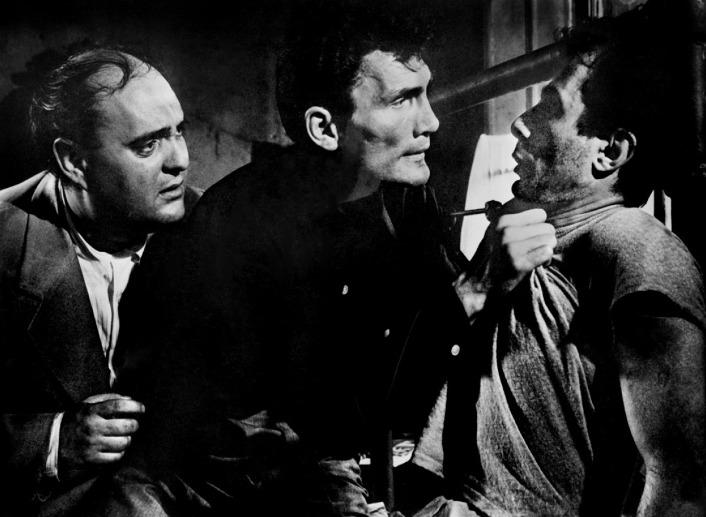
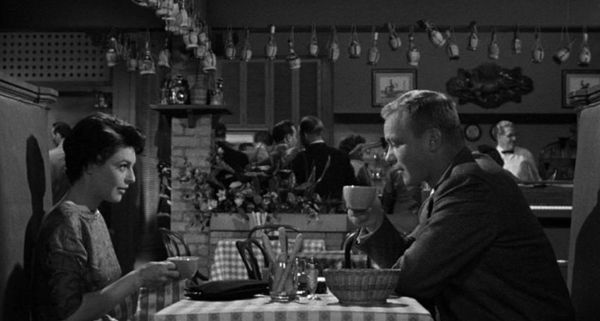
Showing posts with label Blogathon. Show all posts

Wednesday, September 7, 2011

A Heart Can Only Take So Much


In 1937, Edward Anderson published a novel that I am chagrined to say I still haven't read. It's called Thieves Like Us, and while Anderson is not well-known by any means, and in fact only wrote one other novel (Hungry Men in 1933), Thieves Like Us remains a hugely important work of crime fiction, even if only due to its two film adaptations. The second of those films is 1974's Thieves Like Us, directed by Robert Altman. It's a terrific film, one of Altman's best '70s movies, and it plays now -- though I admit that it was almost certainly not conceived as such -- as something of an antidote to Bonnie and Clyde. Altman's film humanizes its criminals as well as their victims, something which almost feels subversive of a certain attitude of the time. But Altman's Thieves Like Us, good as it is, still can't help but feel a little bit like leftovers, because in 1949 Nicholas Ray made his directing debut with an adaptation of Anderson's novel, this time called They Live By Night, a film that, when viewed as a first film, must shatter the morale of any number of bearded, bright-eyed cynics currently studying Ray for film class. It remains a breathtaking piece of work, and certainly one of the most emotionally devastating films of the noir cycle.

They Live By Night doesn't have much to recommend it -- it has everything to recommend it. Most immediately gripping are the performances of Howard DaSilva as the one-eyed Chickamaw and Jay C. Flippen as T-Dub. These are the men, older and professional and mean, with whom the comparatively childlike Bowie (Farley Granger) escaped from prison where Bowie had spent the last seven years, starting when he was 16, for fraternizing with the wrong element, and falling along with them; Chickamaw and T-Dub were there because they deserved to be. DaSilva and Flippen are perfect, easy and clipped in their professional modes, with DaSilva bringing otu Chickamaw's hidden wild side breaking out maybe once or twice too often for Bowie's comfort. But upon obtaining his freedom, Bowie, who hopes to hire a lawyer to get his murder conviction overturned, is young and stupid and therefore willingly hitches his wagon to the two older men, agreeing to assist them in a series of robberies they begin planning right away. This both dooms and damns him, as it damns (if not dooms) Keechie (Cathy O'Donnell), a young woman he meets among the network of family and friends Chickamaw and T-Dub employ to keep them hidden and fed. Bowie and Keechie fall in love, and if ever a more heartbreaking romance has occurred within a cycle of robbery, murder and general criminality, I haven't seen it.

This is the brilliance of They Live By Night. Because look, I'm not one to feel a great deal of sympathy towards criminals in films, because often the pleas for that sympathy is presented (or brayed, usually) by the filmmaker as "Hey, okay, this guy's a criminal, and okay he killed that one guy. But please remember, I've taken great pains to present the police as a bunch of hicks, and anyway my hero would rather not go to prison. He even wants to quit being a criminal, if society would only let him. And remember that scene with his daughter, the one in the diner? Man!" Something like that, anyway. However it might go, I routinely reject it, and my hackles have a tendency to go up if I think a film is trying to court me in that way. Inspire empathy for the criminal? That's one thing. Root for the son of a bitch? That's something else entirely. But They Live By Night is different. You might argue that making Bowie apparently innocent of the crime that landed him in prison is some serious deck-stacking, but it also shows him falling pretty easily into the role of getaway driver for Chickamaw and T-Dub. Not only does he agree to it, he does it almost gleefully. Bowie is an idiot -- that's his tragedy. The film offers no excuses for his criminality, but it's not hard to understand how you can be dumb at 16 and, in the circumstances under which Bowie has been living, come out at 23 just as dumb.

The film contains genuine beauty. Cathy O'Donnell's Keechie has a moment at the end of the film that's as gorgeous in its open-heartedness as the final shot of The Third Man is in its bitterness. In the brief moments when she and Bowie -- and Granger was never better -- are able to tear themselves away from the idiotic and dangerous world they seem lost in, Nicholas Ray actually makes it possible to root for Bowie. His remorse, we see, is genuine, and his simple desire for a normal life not spent robbing people or hiding from cops, evokes actual sadness. When he says to Keechie that he wishes they could go into town and see a movie, and that he's always wanted to hold hands with a girl in a movie theater, Ray basically points out the line dividing sentiment and sap, and how to stay on the right side. There's no pleading, no whining, just a genuine expression of feeling. And later, when Bowie comforts an ailing Keechie, and dreams out loud of a day when they might have a child, and says that children make a man responsible, there is pleading here, but it's a plea from Bowie, masked as reassurance of Keechie, that he will, one day, learn to do the right thing. Even Roy Bean would crumble if faced with that.

That's where They Live By Night achieves greatness, but generations of filmmakers who followed learned his lessons poorly. I suppose they only halfway paid attention. No, where They Live By Night seems at times most influential is in its portrayal of the fringe parts of criminal life. Along with the country roads and farmland that is the often forgotten in favor of urban settings, but still very common backdrop to this sort of story, are the side characters, like the aforementioned network of cohorts. Not quite criminals themselves (though Bowie does, with reason, claim that one of them is a "thief, just like us"), people like Helen Craig's Mattie, or Will Wright's old, drunken Mobley help complete the film's world -- not an underworld, really, but one just off to the side, easily seen if one chooses to, but usually ignored. Diners and gas stations, and nothing nothing but tall grass for miles, before you find another gas station, manned by somebody like Mobley, who has staying with him someone like Chickamaw, or T-Dub, or Bowie. This is closer to James M. Cain's fiction, or James Hadley Chase's No Orchids for Miss Blandish. A world that's wide open and barren, rather than closed-in and towering. In the city, if you want to get away, you find there's nowhere to go; there's always something or someone in your way. You can't swing a dead cat. In the country of They Live By Night, meanwhile, you have everywhere to go. That's the problem: the road never ends.

-------------------------------
This post has been a part of the Nicholas Ray blogathon, hosted by Tony Dayoub at Cinema Viewfinder.

Wednesday, August 31, 2011

Blogathon Ahoy!


Boy, it's been a while since we've had one of these, isn't it? Feels that way, at least. Maybe it's just that it's been so long since anybody bothered to tell me about one of these. Okay, I see how it is.

But I'll get my revenge later. For now, it's important to focus on the topic at hand, which is a Nicholas Ray blogathon, hosted by the effervescent Tony Dayoub, of the great blog Cinema Viewfinder. Ray, as I'm sure you're all aware, was one of the giants of mid-century Hollywood filmmaking, and he is as worthy a subject for a blogathon as you'd imagine. So why don't you all take part? Head on over to Tony's place and read the details. You should know, though, that I plan on taking part in this one myself, so don't you go picking the movie I'm going to write about, or else I will punch you so hard.

Monday, March 28, 2011

If You Like Blogathons and Sam Raimi, Well Have I Got News for You!

.

Bryce Wilson, he of Things That Don't Suck fame, just kicked off his Sam Raimi blogathon...er, yesterday. But it goes on through April 2nd, so there's still plenty of time to make up for my neglect, and I suggest you do. Raimi is quite the curious fellow, beginning his career as a filmmaker with an unabashedly drive-in sensibility, before eventually graduating, or rather switching gears to, Hollywood blockbusters. Quite surprisingly, to anyone who'd followed his career from the early years. And then, of course, came Drag Me to Hell, which might signal a return to his roots. Anyway, I'm most interested in the middle period of Raimi's work, after the Evil Dead stuff, and before Spider-Man, when he was first making his mark with the studios. I will be writing up one of those films in the next couple of days, and, sadly, I think that anyone who has any feeling for my tastes and sensibilities will probably be able to correctly guess which film I'm going to take on. I'm doing it anyway, though!


Meanwhile, check out Bryce's links for the first couple of days, as well as his own write-ups, and should you have a blog of your own, why not throw in your own two cents?

Wednesday, February 16, 2011

Plague Noir

.
Two men are traveling with death, both completely oblivious of that fact. One is a monster, the death is seeped into his skin and blood and lungs, though he can’t feel it, as he chases through the streets of New Orleans looking to validate his ignorance. The other man is a punk, a loser, who believes that the death he holds in his hands is actually money, and so he will protect his own death with all his power. Some twenty minutes after meeting him, we will hear him cough, and we will know he is already dead.
.
The first man, the monster, is Blackie, played by Jack Palance in Elia Kazan’s Panic in the Streets. His death is the pneumatic plague, and it traveled over the ocean to meet him. A man he murders early in the film is discovered by the coroner to be carrying the plague, and so the ensuing race by the authorities – headed up, in this instance, by a Navy doctor played by Richard Widmark – to catch a murderer doubles for, and is in fact superseded by, the need to find the new source of this wheezing death, the man who caught it from the man he killed, before it can be breathed from man to man and woman to woman, and bring down the entire city.
.
The punk is Vince Ryker, played by Vince Edwards in Irving Lerner’s City of Fear. His death is not an ancient germ but a canister of concentrated Cobalt 60, radioactive material ranked as one of the deadliest substances on Earth. Ryker believes it to be heroin – as if that was somehow better – which he plans to sell, and on which he pegs his deluded hopes of a bright future. His future, any kind of future, good or bad, was cut off at the knees the moment he touched that canister, but he protects it like a baby, guards it against theft, and waves the canister’s invisible buzzing clouds that have already killed him at all the other punks and losers with whom he deals, and at anyone else unfortunate enough to be nearby.
.
Blackie seems to enjoy killing people, which makes his responsibility as the carrier of an entire city’s death one that is well-suited to him. In fact, by the end of Panic in the Streets, Blackie will have killed more people consciously – with his gun or his bare hands – than the pneumatic plague, which has the potential to eradicate hundreds and thousands in a few days, manages in the same amount of time. A couple of Blackie’s victims he must share with the plague, as they are deeply sick men when Blackie shoots them, or, in one case, pitches the make-shift stretcher on which the man lays over a staircase railing, dumps his slack, delirious body into the depths like a bucket of fishguts tossed off the side of a boat. Blackie is happy to do the plague’s work, or speed it along, or take it down unexpected alleys. The pneumatic form is only one type of plague, after all, only one of many.
.Panic among the citizenry, the authorities know, is to be avoided if at all possible, but a certain amount is inevitable once, paradoxically, the need to protect that citizenry must include informing them of danger. This danger is what Vince Ryker cradles to his crumbling chest with withering arms when some among the strangers he meets connect him and his deadly canister to the news reports they’ve been watching. Now he becomes a leper who must be dealt with swiftly, his disease taken from his hands by men with gloves who wear rubber suits.
.Blackie, the monster, seems to fare better. There is a cure for one of the plagues he carries inside, and beyond that he faces a lengthy incarceration. Perhaps that’s fine by him. Perhaps he can make that come out to his favor in some way. His work is not yet done.
------------
This post has been part of the For the Love of Film (Noir) blogathon, hosted by Ferdy on Films and The Self-Styled Siren.

Monday, February 14, 2011

Bleeding Over Everything

.
[Spoilers, of a sort, for Nightfall follow]
.
Jacques Tourneur's Nightfall is neither the first nor last film noir to move its action out of the city and into the country. Nicholas Ray's On Dangerous Ground and Joseph Losey's The Prowler, for example, both do this as well, and the crime fiction that preceded and then parallelled the noir cycle could take place anywhere -- James M. Cain and Jim Thompson both habitually found fringe rural diners and so forth to be fertile settings for their stories of lust, corruption, and murder. But there's a curious effect to the choice of moving the action to the country from the city, which would seem at first blush to be the ideal location for noir, because in film's like Nightfall decent people flee their urban bear-traps, but the corruption always follows.
.
Tourneur's film (based on a novel by the great David Goodis, one I'm sorry to say I haven't read) follows one man, David Vanning (Aldo Ray, in full ordinary-guy mode), as he attempts to escape the aftershocks of a trauma he suffered some months back when he and his friend Dr. Gurston (Frank Albertson) were on an extended camping and hunting trip in Wyoming. They had the rotten luck of witnessing a single car accident, and in that car were John (Brian Keith, as almost the villainous flip on Ray) and Red (Rudy Bond, frightening and sometimes hilarious -- one crucial scene involves Red's realization that John doesn't really like him, and Red almost panics in his need to know why, yelling "I gotta know! I gotta know real bad!"). These men are bank robbers, and for a host of reasons they've decided that these two campers, who only wanted to help them, can't wake up the next morning. The doctor is murdered, and David is left for dead. The real problem, however, is that John and Red, in their escape from the scene, grabbed the doctor's medical bag by mistake, leaving their ill-gotten money behind for David to hide.
.Vanning makes it back to the city, taking jobs under an assumed name. He eventually meets Marie Gardner (Anne Bancroft), with whom he strike up a hopeful but nervous relationship, until John and Red reappear. Meanwhile, an insurance investigator, played by James Gregory, is searching for Vanning for his own reasons.
.
So that's the plot of Nightfall, and it all comes to a head in a snowy expanse of Wyoming farmland. Once the action moves in that direction, Burnett Guffey's photography brightens up, as if the perpetual night and shadows of the city can no longer compete with a sun unhindered by all those buildings, never mind the power of that shining white snow. It's not necessarily that films like Nightfall are trying to make the case that things are better in the country -- in The Prowler, the characters seem to move out of the city and into what almost looks like a nuclear wasteland -- but they're certainly different, and anyway it's in the country that these characters are often looking for peace, and safety. In the city, everything's always clouding up, the buildings hang over you, the people hem you in and crowd you, and if they don't want to kill you, their sheer number makes it difficult to escape those who do. In the city, if it's not all money, then it's all booze, and one's as bad as the other.
.
In theory, the country's a new beginning. In Nightfall, Vanning, Marie, and Ben Fraser, the insurance investigator, band together as three decent people to bring an end to all this -- Vanning can give Fraser the money, Fraser can prove Vanning's innocent, and John and Red can be dealt with by honest lawmen. And all of this will happen, can only happen, by going to Wyoming.
.
The problem is that John and Red follow. The safety of the country doesn't last, and the decent people are left, unarmed, with the men pointing guns. Then again, without wanting to spoil too much -- although this is no doubt too much -- it must be said that the agent of Vanning's salvation comes in the form of something that you'd never find in the depths of Los Angeles or San Francisco or Chicago or New York. The country comes through after all, perhaps. Still, there's something unspoken in films like Nightfall, something about the purity of a place, if it ever was pure, being tainted by what our decent characters have allowed to follow them. There's something here about corruption and evil living out on the fringes, or anyway among the majority of the populace, and finding the need to travel inland.
.
-------

Nightfall will be showing as part of TIFF's Hollywood Classics series on March 6 and 8. This post has been part of the For the Love of Film (Noir) blogathon.

Saturday, February 5, 2011

You're Old and You're Ugly and You Killed Me

.

Starting today, and running through April 6, TIFF Cinematheque is running a restrospective called Hollywood Classics, focusing on a wide variety of film noir, "both canonical and cult, celebrated or unjustly obscure, presented as often as possible in new, restored or rare prints", as their website describes it. Clicking on that link will reveal which films we're talking about -- Out of the Past for the canonical, the recently restored The Prowler for the obscure, and so on -- and clicking on the individual film titles will give you their showtimes and dates. A fine line-up, I think you'll agree, one that nicely corresponds with the upcoming For the Love of Film (Noir) blogathon hosted by Ferdy on Films and The Self-Styled Siren, which itself is being done in support of Eddie Muller's Film Noir Foundation, saviors of the aforementioned The Prowler. So this all works out very neatly, I must say.

I do take mild issue with TIFF's description of Fritz Lang's Scarlet Street, the penultimate film in the series, as "genre-defining". They also call it a "masterpiece", which I have no problem with, but I watched Scarlet Street recently and though the 1945 film comes relatively early in what is generally called the "film noir cycle", Lang seems to be employing something of a scorched earth policy in regards to tone. Much of Scarlet Street plays very close to a light-hearted comedy of unrequited love and con artistry (with a sadness at its heart, of course, because what are we to do when Edward G. Robinson's Christopher Cross reassures his own wife that he's never seen a naked woman before, other than chuckle so as not to feel his desperate sadness too sharply?), but that's before the plane slams into the mountain. There are also the unpredictable, deliberately misleading questions of who will kill who and when and why and what will happen then, the posing of and answers to such queries eventually combining to make Scarlet Street a film that keeps the viewer uniquely off-balance. The point being, I've seen few noirs that so happily upset the viewers handle on its proceedings like this one, and had Scarlet Street defined the genre we might not have quite so many traditions within film noir that would allow it to be defined in the first place.

Whatever, this is why TIFF Cinematheque is showing the film in the first place (a full review of which will appear here closer to its actual screening dates), as well as the more truly defining Out of the Past, and several others. If you can make it, and if you can you'd better, don't hesitate to do so.

Wednesday, December 22, 2010

Let 'Em Burn

.
Steven Spielberg first showed that he had a way with violence in 1975 with Jaws. The severed, sinking leg, the terrifying, almost surreal death of the Kintner boy, and the brutal end of Quint still have a strong impact today, but Spielberg rather quickly backed away from that (unless you count the deliberately pulpy fantasy violence of the first two Indiana Jones films, which I don't) and became known for many years as a filmmaker of grand family entertainment, whose occasional attempts to branch out into more mature films, for lack of a better term, were slapped away by critics and audiences (most unfairly in the case of Empire of the Sun). But in the 1990s, he suddenly became one of the most deft, unblinking and morally complex creators of violence on-screen. This is not the sort of thing that a filmmaker is generally given credit for, as such, but I'm nevertheless going to point out that Spielberg never gets credit for it. At best, his way with violence is ignored -- because it's too low a thing to be appreciated? -- and at worst he's badly misunderstood.
.
Not always, of course, because nobody's going to claim that the violence in Schindler's List was out of place, and nobody's going to not mention it, either, because what would people say about you if you did either of those things? But what often goes uncommented on is the specifics of the violence, the details that carry the weight of those snuffed out lives -- in regards to Schindler's List, I'm thinking of a moment when several Jews are lined up back to back, in two rows, while two German soldiers square them up so their bullets will go through the first man, into the second, possibly into the third, thereby saving ammunition. It's the squaring up, though, and the delay before gunfire, and mainly the stiffness of the victims, accompanied by nervous fiddling, as if because they know they are about to die, they don't know what to do with their hands. Also going unmentioned are the bodies as they drop, like empty sackcloth, after the bullets have passed through. For most people, the fact that it's graphic violence is all that needs to be mentioned -- in what ways is it graphic, and in what ways it is shocking, don't need to be mentioned.
.
Of course, in Schindler's List, there are no moral questions about the violence -- it's all unquestionably terrible, although the execution of Amon Goeth (Ralph Fiennes) might carry a certain uncomfortable sting to it, the awkwardness of the moment -- the executioners have trouble kicking the stool out from under Goeth, the noose around his neck waiting to pull taught -- mirroring an earlier scene when Goeth fails, despite his best efforts, to murder an elderly Jew. But for me, that's just a bit of cold-hearted justice and I question the idea that Spielberg wouldn't back me up on that. My reason for this belief is primarily due to Saving Private Ryan from 1998, a film that, for all its flaws (if ever there was a weak, or even bad, script that was turned into a great film entirely due to the skill of the director, it's this one), must be one of the ballsiest films about violence, and violence in war specifically, ever made. In Saving Private Ryan, which is about a squad of eight American soldiers who are ordered, fresh from barely surviving the D-Day invasion, to find Pvt. James Ryan (Matt Damon) and issue him a ticket home as a PR move to offset the tragedy of Ryan's three brothers all dying in combat, Spielberg presents the violence of combat with all the same crushing ferocity of Schindler's List, but in this case the argument is that the violence is not always bad. Or rather, it is always bad, but it's not always wrong.
.
At first, it seems like vengeance. After the Allied forces have broken through the German strongholds on Omaha Beach, we see a German bunker blasted with a flamethrower, and as burning men scramble for air, a GI yells to his comrades "Don't shoot! Let 'em burn!" Later, two Germans are attempting to surrender to two GIs who pretend they don't understand what the Germans want. Then the GIs shoot the German soldiers, and make jokes over the corpses. Tom Hanks's Capt. Miller witnesses this particular war crime, and the weary disapproval is clear in his face. The best excuse possible for those Americans shooting the two Germans is that after seeing their friends slaughtered around them (one of the most enduring images from Saving Private Ryan is a shot from behind a Higgins boat full of Americans getting chopped up by German machine gun fire before they've even been able to take a step towards the beach) they want payback that is more face-to-face than what they would typically experience by shooting a distant, fuzzy figure in an enemy uniform. And while Miller knows this is what war too often is, it's not what it should be, or what he would prefer it to be. Later, when the squad is searching for Ryan, Miller orders his men to engage a German outpost -- unnecessarily engage them, according to some of the men, as these Germans could easily be avoided, and in any case this is well outside of the boundaries of their mission. But Miller orders them, and in the ensuing battle, which occurs off-screen, the squad's medic, Wade (Giovanni Ribisi) is killed. One German soldier (Joerg Stadler) survives the battle, and is taken prisoner. However, he can't be taken with them on their mission to find Ryan, so what should they do with him? Kill him, according to most of the men, because to let him go would simply allow him to join back up with an enemy patrol. Cpl. Upham (Jeremy Davies) is adamant that the man should not be killed, and eventually Miller agrees, and the German, referred to as "Steamboat Willie" in the credits due to his spouting of WWII-era American pop culture references to try to get in his captors' good graces, is let go. Most of the squad considers this man at least partially responsible for Wade's death, and are outraged by the decision, but Miller explains that "every man [he] kills makes [him] feel farther from home," and the men, roughly speaking, accept the decision, and Steamboat Willie is gone.
.
Later, after Ryan has been found and Miller and the remainder of his squad has decided to join Ryan's platoon to help defend the bridge they've been assigned to guard, two moments in the ensuing battle make clear Spielberg's approach to violence in Saving Private Ryan. At one point, Mellish (Adam Goldberg) is engaged in a life-and-death struggle with a German soldier, and Upham can hear what's going on. He makes a move up the stairs to help Mellish, but his combat experience and cowardice cause him to freeze, and Mellish is killed. When the German descends the staircase he sees Upham curled up in fear, and chooses not to kill him, as he doesn't consider Upham a threat, or even a soldier.
.
The second moment comes when we see Steamboat Willie again. He has, in fact, joined up with another German patrol, one who is involved in the assault on the bridge, and it is this man who fatally shoots Cpt. Miller. So in these two moments we see a condemnation of cowardice in Upham's unwillingness, or mental inability, to deliberately engage in combat, in violence, a decision that leads to his comrade's death, and a condemnation -- and here's the real ballsy part -- of mercy. Miller and Upham both stumped for offering Steamboat Willie a beneficent hand, an olive branch, and it leads to Miller's death. When Upham finds Willie among the German captives after the battle, he coldly shoots him, unable to accept how cruelly his own mercy has been rubbed in his face.
.
What seems to confuse some people about Saving Private Ryan (other than the mistaken idea that the German who kills Mellish is the same man who kills Miller; it's not, though, it's Steamboat Willie. I know this because Steamboat Willie and the man who kills Miller are played by the same actor, one who isn't the same actor as the man who kills Mellish. You just have to noodle it through) is that Spielberg takes this approach to total war while never pulling back from the horror of it. World War II was a just war, but just wars are every bit as ugly and hellish as the unjust ones. A Nazi can suffer with his guts blown out just as easily as an American GI -- what Saving Private Ryan is saying is that the Nazi needs to have his guts blown out. He may not need to suffer, but he will because that's what happens when you get shot. It would be dishonest to approach combat as a serious subject and then, when someone gets shot, have him simply grab his chest and fall backwards. Spielberg would rather lay it all out and say, of World War II at least, "This all needed to happen, and it was horrible."
.
Saving Private Ryan takes the unusual stance, for movies anyway, that killing is sometimes necessary. On top of that, it piles on the point that killing is never anything but abominable. War movies in particular can quite often be divided into action movies and anti-war movies, and it's this latter type for which the genuine brutality is saved. Brutality is bad, so it should be used to portray things that are wrong. But that's not honest. Unless you're Nicholson Baker and therefore completely deluded, you know that World War II needed to be fought -- the alternative is not worth thinking about -- yet what should be so confusing about applying your understanding of real world violence to this historical necessity? On this matter, Spielberg, at least, keeps a clear head.
.
This post is part of the Spielberg Blogathon, hosted by Adam Zanzie and Ryan Kelly.

Saturday, December 18, 2010

Up Next

.

Even though I'm not posting as regularly as I used to, when I do I seem to only be posting rather monstorously long pieces -- from my point of view, if not yours, this counts as a good thing. And one not likely to change right away either, because later today I'll be seeing Black Swan which, depending on how it strikes me, will mean a second post today (counting this one), or at the latest tomorrow. On top of that, starting today is the Spielberg Blogathon, hosted by Ryan Kelly of Medfly Quarantine (who has already written up Munich and War of the Worlds, two films I might well have been tempted to write about, so thanks a lot for that one, dickface) and Adam Zanzie of Icebox Movies (who has gone deep into ephemara right out of the gate with an interview with the band who wrote the music to Spielberg's very early short film Amblin' -- this is a post I myself would never have considered, so Adam is not a dickface, at least not in this instance). This is a project I very much want to take part in, so there's at least one more post in the offing, as well.
.
So I guess the idea behind this post is that hey, I'm going to write at least two more things. How wonderful for all of us. But also to help announce Ryan and Adam's project, which I meant to do earlier, but didn't, what with distractions and everything. Anyway, it's lasting from Dec. 18 through the 28th, so check that shit out. And check out my shit, too, when I post it, which will be soon. THE END.
.
PS - Incidentally, the above picture is no signal for which Spielberg film I plan to write about -- I haven't decided that yet. It's a good picture, though.

Friday, September 17, 2010

The Collection Project: You are Big Time!

.

Paul Thomas Anderson’s Hard Eight is not exactly a young man’s film, but in some ways it is very much a young man’s screenplay. In the DVD commentary track, Anderson talks about struggling with the script almost from the start, and saying the way for him to bust through that is to put two characters in a room and get them talking. This method resulted in Hard Eight’s wonderful opening, with John (John C. Reilly) and Sydney (Philip Baker Hall) sitting in a Reno, NV diner, over coffee and cigarettes, the mysterious Sydney offering to help the sad-sack John – who’s just come from Vegas after failing to win enough money at blackjack to pay for his mother’s funeral – avoid becoming a homeless Reno reject.

As I say, this is a great scene, highlighting Reilly’s effortless comic abilities, and Anderson’s considerable gift for dialogue. It also subtly clues you into the fact that the only reason Hard Eight exists at all is because Philip Baker Hall is an actor who is alive now on this planet. Though I had, by the time Hard Eight came out on video and I was able to see it for the first time, seen Hall in Altman’s Secret Honor (as well as – and this is not insignificant – the episode of Seinfeld where Hall plays the library cop), Hall’s work in Anderson’s debut feature was still a revelation for me. Sydney is one of my favorite film characters, certainly of modern times, and Hall gives what I consider one of the great screen performances. From the beginning of the film, you know just enough about Sydney to be fascinated by him, and to admire him (so fascinating that Hard Eight is one of the films from my burgeoning movie geek years that I got my dad to watch. This sort of thing didn't always work out too well, but after watching the film I remember my dad telling me that he didn't like it at first, but the further along he got, the more he thought, to paraphrase the line he most often quoted from Butch Cassidy and the Sundance Kid, "Who is this guy??"). Sydney’s a remarkably decent person, decent in a very old-fashioned way, who appears to know more than anybody else how to get buy in towns like Reno and Vegas, and it’s this knowledge he’s offering to John. But there’s a very sharp edge to him as well, shown first when the knuckleheaded John (who is nevertheless expressing some understandable paranoia) reacts to Sydney’s offer of help by saying he’s not gay, so if Sydney’s looking for some boy hooker, he can forget it. Sydney’s response is to say no, that’s not what I’m after, and this is the last time I’m going to offer my help.
At various points throughout the film, Sydney is shown to be quietly angered and frustrated by any person or encounter that proves to him that basic civility and manners are evaporating, though his only recourse seems to be to make sure those values remain intact within himself, as well as, to the extent he’s able to control such things, John. A sticking point for Sydney is John’s friendship with Jimmy (Samuel L. Jackson), a flashy, loud-mouthed, low-rent dickhead who works security at one of the casinos. When Sydney and Jimmy first meet, Sydney is playing Kino by himself when John and Jimmy come by. As they do, Jimmy uses his outside voice to comment on the physical attributes of their departing waitress. When Sydney quietly objects to this behavior, Jimmy condescendingly explains that these waitresses not only enjoy such compliments, but they’re all whores anyway. To which Sydney says, “I just don’t want it coming from my table.” It’s possibly my favorite line from the movie, delivered by Hall in a way that somehow mixes civility, exasperation, and a kind of suppressed danger.

To counteract, among other reasons, John’s friendship with the loathed Jimmy, Sydney constructs an introduction between John and Clementine (Gwyneth Paltrow), one of those waitresses Jimmy was talking about. Clementine is typical Reno damaged goods, a nice young girl, lost, or close to being lost, to a life of being a waitress as a cover for really being a hooker. Paltrow is very good here, but it’s around the time of her introduction that Anderson’s writing methods, and his youth, start to show their negative influence. Shortly after Clementine and John first make googly eyes at each other, John calls Sydney in the middle of the night, begging for help. When Sydney arrives at the motel room where John told him they’d be, Sydney finds a terrified John, a tearful, weirdly angry and withdrawn Clementine, and another man, unconscious and bleeding on the bed. That man is or was one of Clementine’s clients, but for some reason he refused to pay her for services rendered, so she or John or both of them knocked him out, tied him to the bed, and called the guy’s wife, demanding Clementine’s fee as ransom.

This is, we can all agree, a very stupid thing to have done, but that’s not the problem. The problem is that the long scene that follows, in which Sydney announces how stupid this is, and alternately offers the best practical advice he can and refuses to help at all, feels exactly like a scene that Anderson had no map for when he began, but he kept writing it until he’d found the exit. I’ve mentioned that Anderson is an enormously gifted writer of dialogue, but if screenwriters ever put together audition reels of their best writing, Anderson should leave this bit off. All you really get here is characters saying something, and then a minute later shouting out the same question or statement or insult, slightly reworded, or, if things have gotten really tense, one character will say “Fuck you!”, and then another character will say “Fuck you!”, or words to that effect.

I criticize with love, though, because I feel like I know what he was going through. In my own humble way, of course, and I’m in no way trying to associate myself with Anderson, but I don’t think anyone who has tried their hand at fiction, either in script form or prose, doesn’t know what it’s like to hit a dead end in your story that you simply try to write your way through. It’s like a car being stuck in the mud, and you keep the wheels spinning in the hopes that something will grip. Sometimes it do, sometimes it don’t, and this scene from Hard Eight don’t. At the very least it should have been tightened up, if not ditched outright and completely rethought. But the good news is that the narrative goal of that scene (the scene has other things on its mind, to do with character, which I suppose are more or less accomplished, however clumsily) is simply to find a reason for John and Clementine to get the hell out of Reno and leave Sydney alone with Jimmy, thereby setting up Hard Eight’s brilliant final stretch. In that stretch, which I won’t describe in detail, you find out why Sydney went out of his way to help John, a stranger at the film’s beginning, and while that explanation might be a bit too neat in terms of cause and effect, Sydney remains a largely mysterious figure by the end. Less mythic, perhaps, but still mysterious, and, in any case, Hard Eight, while by no stretch Anderson’s best work, does contain my favorite last shot (or shots) out of any of his films, and those shots would have no weight, or wit, if Sydney’s myth hadn’t been shattered.
-----------------------
This post is part of the Paul Thomas Anderson Blogathon, hosted by Jeremy Richey at Moon in the Gutter.

Monday, September 6, 2010

The Collection Project: A Deep Penetrating Dive into the Plasma Pool

.
An overview of the career of David Cronenberg would have to mark his 1986 remake of Kurt Neumann's The Fly as something of a watershed. In the view of many people, including myself, Cronenberg's The Fly is easily one of his best films, but it also works as a transitional film, coming after his semi-big Hollywood turn as the director of the Stephen King adaptation The Dead Zone. That film feels particularly un-Cronenbergian, and in this sense the ultra-Cronenbergian The Fly could almost stand as his Blue Velvet, following his own Dune, The Dead Zone. That analogy can only really work if anybody thought The Dead Zone was any kind of disaster, but nobody does, because it's terrific and popular, so the analogy turns out to be a big whiff. In any case, the fact that The Fly is a remake is almost incidental, as the material -- especially the way the science of the story was refigured from the 1958 film, credit for which Cronenberg gives to the writer of the original draft, Charles Edward Pogue -- is so in line with what Cronenberg was all about in the early-to-mid-stages of his career that the whole project, and finished film, seems like an absolute natural for him, in the same way that J. G. Ballard's Crash would a decade later.
.
The film is, in short, disgusting, one of the most disgusting films of Cronenberg's very disgusting career. In Neumann's film, a scientist, through a mishap with his newly invented transportation device, is fused at a genetic level with a housefly, which results in his own head, and one hand, being replaced, respectively, with a fly's head and, ah, hand, I guess. Pogue's idea, which Cronenberg ran with, was to have his scientist, Seth Brundle (Jeff Goldblum) suffer a similar mishap, but, instead of an instant and partial transformation, he would transform in stages, and the transformation would present, to borrow medical terminology, as his body gradually disintegrating. That's what happens in Cronenberg's The Fly, and the breakdown -- which starts, cruelly, with Brundle enjoying increased strength and energy -- is by turns sad, grimly funny, and stomach-churning. Of course, this breakdown isn't just a breakdown, because while certain aspects of his new bodily existence, such as copious vomiting, naturally appear to be the symptoms of a man who is desperately ill, they're also part of a new, accidental evolutionary step, from Seth Brundle/housefly to, as Brundle himself terms it, Brundlefly.
.
There is much going on in this film. First, there is Cronenberg's major early theme of body-horror, used to describe and depict in grotesque metaphor the way any of our body's might casually betray us with disease at any given moment. At one point, Brundle even says that his transformation is showing up as a sort of cancer. My problem with focusing too narrowly on this idea, in any of Cronenberg's films that employ it, is that it tends to miss the forest for the trees, which is how I feel pretty much any time someone tries to boil down the work of an artist I admire. Cronenberg himself is explicit enough when talking about his work that all that stuff is indeed on his mind (AIDS wasn't, though, when he made The Fly, despite any number of critics trying to cram that particular metaphor in there), but, as I hinted above, there's the strangely hopeless view of evolution running through The Fly, which is underlined with some vigor at the film's climax, when Brundle has been mangled up into some ungodly amalgam of man, insect and machine.
.
Beyond all this metaphor, though, The Fly is an intense depiction of a single character, Seth Brundle. The film really only has three characters -- along with Brundle, there is Veronica (Geena Davis), Brundle's girlfriend, and the reporter covering the various stages, first, of his work on the transporter pods which he believes will change the course of history and mankind (an ambition that is itself almost evolutionary in its scope) and later of his disease; and Stathis Borans (John Getz), Veronica's editor and former lover -- but for obvious reasons everything else in the film revolves around Brundle. And the key thing about Cronenberg's The Fly, and about Goldblum's extraordinary performance in it, is that Brundle is not simply the vehicle through which Cronenberg can express his themes and ideas. Brundle is a complete person (hell, even Borans and Veronica aren't simply idea markers here), and his graphic tragedy makes The Fly the most emotionally devestating film of Cronenberg's career.
.
There are certain things about The Fly which, watching it again today, struck me as newly interesting, but the emotional power wasn't one of them. I saw this film when I was about eleven, probably ten, and by the end I was a sobbing wreck. Okay, so I was a kid, but I felt almost as helpless and desolate today, as I watched Brundlefly finally give in to his despair and, his body now a complete disaster, lift the barrel of the shotgun that Veronica's holding, up to his forehead. What happens in this film is so terrible, so unfair and cosmically absurd, that you can never view Brundlefly as a monster, even at his most physically monstrous.
.
Which is fitting, since The Fly is also a bit of a throwback. There's a great deal of Frankenstein in Cronenberg's film ("Are you a bodybuilder?" a woman asks Brundle after he breaks a man's wrist in an arm wrestling match. "Yes," he says, "I build bodies."), both in the mad science element, and in its mournful atmosphere. But you can throw it even further back than that, because The Fly is at heart a classical tragedy. Brundle's flaws are outsized ambition and impatience (and let's not forget all the tampering in God's domain he does), and he dies for them. And the film gets there with such precision -- Brundle's rise, if only in the eyes of Veronica, and fall are sketched out in just enough detail, as is the intense love affair between himself and Veronica, which, along with the great work done by Goldblum and Davis, carries the film's emotional weight despite the fact that not a hell of a lot of time is given over to it before things go haywire. Even Borans comes through, as an asshole who might only be an asshole out of desperation.
.
The Fly is really pretty amazing. It's a metaphorical horror film structured as tragedy that doesn't let its themes overwhelm the people inside it. It's a gory horror film in which only one person dies (though it does make room for one of the most psychotically inventive cripplings of a character I've yet witnessed), a monster film in which the monster's lone rampage in a public area is motivated by the need to talk to his girlfriend in private. It is, in fact, the kind of film I dream about: a horror film about people and emotions, the kind of film that -- and you really must pardon me for what I'm about to do here -- fuses its genre trappings with a classic, character narrative. The maturity that Cronenberg really began to show in Videodrome and The Dead Zone was confirmed here, in spades. There was no looking back.
.
--------------------------------------------------------------
This post has been part of the Cronenberg Blogathon, hosted by Tony Dayoub at Cinema Viewfinder. I promise nothing, but I hope this is only my first contribution to this particular blogathon.

Wednesday, December 23, 2009

Overshadowed: I Hope You Slit Your Throat

Gordon M. Williams's career as a writer, at least at a glance, is pretty sobering. In 1969, his fifth novel, From Scenes Like These, was short-listed for the Booker Prize. In 1981, his last published novel (he is still alive, from what I can tell), was The Revolt of the Micronauts, his second novel based on the popular line of plastic robot toys (see comments). Though I don't know for sure, I think it's safe to assume that these last books (as well as the film novelization he wrote, for Ridley Scott's The Duellists, of all things) were written to put food on the table [well, who knows if that's true now - Ed.], and it's simply depressing to actually acknowledge and take to heart the realities of the life of a professional writer.

Even worse (possibly, anyway, but I shouldn't presume) for Williams is that his most famous novel is not really all that famous, except as the basis for one of the most notorious films of the 1970s. In 1969 -- clearly a big year for him -- Williams published The Siege of Trencher's Farm, the story of an American literary scholar named George Magruder, who, with his daughter and English wife, Louise, rent a home in a secluded, rural English village. George wants to finish his book on "Branksheer, the late 18th century English diarist", and Louise wouldn't mind reconnecting with her home country, not least because she's grown to hate America, and Americans, including, possibly, her husband.

And so, with the exception of the different names, the daughter, and the protagonist's intellectual pursuits, you can see that what we have here is the basic set up for Sam Peckinpah's 1971 masterpiece, Straw Dogs. (It's worth noting, as a curious bit of harmony, that Peckinpah's fifth film, if you count his 1966 TV film Noon Wine, was The Wild Bunch, released, as Williams's Booker-nominated fifth novel was, in 1969, and Peckinpah's last film was the paycheck-providing The Osterman Weekend, from 1983. Two years later than 1981, and more dignified than a Micronauts novel, but...) In that film, Dustin Hoffman plays David Sumner, a mathematician, who moves to the same kind of English village with his similarly resentful wife, Amy (Susan George), but sans daughter. The plot of both novel and film progress in pretty much the same way: George/David is a liberal pacifist who, shortly after the disappearance of a village girl, finds himself responsible for the well-being of Henry Niles (David Warner in the film), the man who may be responsible for said disappearance. George/David ultimately finds himself violently defending his home against a group of local men, who would have Niles for themselves, to exact justice how they pleased.

But hold on there, fellows, because things ain't that similar. For one thing, while Henry Niles, in both novel and film, is mentally a child, in Williams's story he's also a convicted, and multiple, child killer, while in the film he's merely the "village idiot" who kills the little girl in an Of Mice and Men-style accident (and he also has a vague backstory, involving "making a mistake" with a girl). And in the novel, child killer or no, Niles is actually innocent of this particular murder. The reader knows this primarily because the girl isn't killed at all. She disappears (she, too, is mentally handicapped in the novel) because she gets spooked at a children's party and runs out into the snowy evening, unseen (she's later found, nearly frozen, but alive).

Overall, the lack of death in The Siege of Trencher's Farm stands out quite a bit, especially if you've come to the novel, as I have, after witnessing the blood-soaked finale of Peckinpah's film. As it happens, while there is still the accidental and fatal shooting of a fellow townsperson and attempted peacemaker, a killing that changes the whole dynamic of the suspense, as well as cluing George/David into how far he may have to decide he's willing to go to protect himself and his family, in the novel, none of the men who attempt to break into George/David's home are killed. A foot is still blown off with a shotgun, and a baseball bat, a poker, and boiling water all come into play, but no one is eternally down for the count in the novel, and their fates, in fact, are tossed off by Williams in his coda with the revelation that the men are "being x-rayed".

All of this makes Williams's novel look a bit soft, even inconsequential. At worst, contradictory. In the novel, George travels much the same path as David in the film: he begins as a firm pacifist, not a bad guy so much as not terribly likable (more about that later) who, when faced with his wife's immediate desire to throw Henry Niles to the wolves, because whatever those wolves do will more than likely be just desserts, can't help but hammer on their shared history as anti-death penalty crusaders. His point of view is fine and defensible, whatever your own views, but given that Niles is a child killer, and he does have a terrified daughter in the house, he could maybe allow his wife to voice her understandable change of heart (more about her later, too). But really, it's more just the way he says things, as opposed to the content of it, which is largely his problem in the film, as well. In any case, of course, he pretty soon will himself move past his own pacifism, much to his own horror, ultimately. This is the novel I'm talking about here, don't forget, and forgive me if the image of George, after just winning his final, vicious battle with the last intruder -- another character who is mentally handicapped, if only mildly, which brings the count of such characters in the novel up to three -- broken and unbelieving at his own capacity for brutality finally leaves me unmoved, due to the fact that the loser in this clash is fated only to be "x-rayed". The villagers had a shotgun and several knives, while George had whatever everyday items -- which somehow does not include knives -- he had to hand. Add to that the fact that Niles is innocent here, and no murder was committed at all, save the one (technically manslaughter, I suppose) committed by the intruders against one of their own, and it's very hard for me to see where the deep moral ambiguity Williams is aiming for ever really comes into play. George is responsible for no fatalities, the reader knows that at least a couple of the villagers had decided to simply slaughter him and his family, to erase witnesses of their earlier killing, and at the end we're left with Williams's trumped up bit of moralizing, asking "Well, what else was George supposed to do?"

And Williams attempts, half-heartedly, to present both sides of the issue of what should be done with Niles. At one point, before Niles is taken in by George, but after he has unintentionally escaped (long story) from captivity, two local policemen, engaged in the search for the girl, discuss the situation:

"You'd have to feel sorry for the poor bugger," said a police sergeant... "He'll freeze to death."

"Won't be much of a loss," said the constable. "Lunatics like that shouldn't be in a position to get out."

"You'd hang him, would you?"

"Maybe not hang him. An injection. He's a liability -- to himself much as anything."

"The Two Waters folk say he's not dangerous anymore. Bad health."

"Can't be bad enough for my taste. You ever see the photographs of the kids he done in? Gave me nightmares for months, they did."

"Aye, I know. But he's not better than a kid himself. He isn't responsible."

"That'd be a lot of comfort to the kids. And their mothers."

At this point, we don't know that Niles hasn't killed the girl, but by the end of the novel we sure enough do, and this knowledge clouds over any ambiguity Williams may have wanted to convey. Wherever you stand on the idea of stringing up child killers -- and let's not pretend this isn't an intriguing notion in some ways -- I think we can all agree that it's pushing it a little bit to string them up for a murder that they not only didn't commit, but that never happened at all. So Williams is either guilty of bad ambiguity, or of deck-stacking.
.
Not so the film, of course. Or not quite so, anyway. Because, to begin with, in Straw Dogs, David takes down just about everybody, and permanently, too. It is within the kingdom of reason to think that David's actions by the end of the film are a bit much. But before we get into what is presented on screen, and what morality, if any, can be gleaned from that, here's what Peckinpah had to say about it, taken from various letters to unsympathetic critics, and conversations with Peckinpah recalled by friends and colleagues (all quotes taken from Marshall Fine's biography Bloody Sam*):

John Bryson, after seeing the film, said to Peckinpah, "Where'd you get the heavies? They were incredible," referring to the beefy British actors.

Peckinpah narrowed his eyes, gave Bryson one of his reptilian smiles and said, "They weren't the heavies. The husband and wife were the heavies."

Following Pauline Kael's famous review, in which she referred to Straw Dogs as "a fascist work of art" (this being around the time that a small group of people decided to completely redefine, and thereby corrupt, the word "fascist", a move that everybody else was pretty much cool with), Peckinpah wrote her letter that read, in part:

"I read your review. Its ambivalence was complete, although I was distressed that you didn't pick up that David was inciting the very violence he was running away from."

I'm not sure I've ever encountered a film that has invited a more diverse stream of opinions, and justifications for those opinions, as Straw Dogs. The idea that David is the villain of the film has been picked up and run with by a number of people, though not in the direction I suspect Peckinpah might have intended. In my view, Peckinpah could very well mean that David's early cowardice, and inability to act, inspires his attackers to push him further and further, to the point that violent death is the only conclusion. A stronger man would have maybe kicked their asses earlier, and scared them into a little respect ("My vision of morality is not yours", Peckinpah told Richard Schickel). I feel that, since the above-quoted statements from Peckinpah have started to widely circulate, some critics have latched on to them -- desperately, even -- and interpreted them as claiming that David literally brings the violence he defends against upon himself. All this in order to make these critics feel better for liking the film they suspect might be distasteful to them.

The problem here, really, is ambiguity. Now, I'm not knockin' the stuff, but a lot of people have a tendency to fetishize ambiguity as some kind of Ultimate Good, until, that is, the ambiguity is in service of something about which they feel they have a pretty clear head. So then, they either flee from it -- the ambiguous thing is clearly unambiguous, and vilely so -- or they condemn it, because such a topic cannot, must not, be viewed in any way other than this way. As a result, the violence in Straw Dogs has a tendency to utterly repulse viewers, or to force them to engage in mental and moral gymnastics resulting in an interpretation of David Sumner as this monstrous -- if ignorant of his own monstrosity -- bringer of destruction.

And let's face it: the guy's kind of an asshole. He treats his wife Amy like a child, he's jealous, yet blithely disregarding of her actions as long as she's not in his way. He's smug, self-important, all that stuff (and all of it brilliantly underplayed by Dustin Hoffman in, for my money, his very best performance. His second best, to me, can be found in Marathon Man, which might give you some idea of how I feel about Hoffman overall. Suffice it to say, I wish there were more Straw Dogs and Marathon Men on his resume). But he's also not wrong, at least not always. In the last twenty minutes of the movie, five drunken, violent men are trying to break their way into his home and murder the mentally handicapped man Sumner doesn't know to be guilty (and neither do the villagers, yet) of murder. He would rather, as a good and reasonable man of liberal tendencies, to wait for the doctor (Niles is injured at this point) and the police to arrive. In fact, he demands that this be the course of action, and he has every right to, as a law-abiding citizen, and because this whole debate is occurring in his own home. The villagers have a skinful at this point -- plus, not incidentally, the missing girl is the daughter of one of the men -- and they lay siege to Sumner's home, with fire, knives, and guns. The violence that follows is the result of a man defending his home and his wife. A wife who, by the way, has been raped twice at this stage, by two of the men now trying to break in, but David doesn't know about this, so I guess it doesn't count. Also, they more than likely strangled his cat.

Again, Peckinpah doesn't make it easy for us. Watching the film again last night, I almost found it funny how thoroughly he seemed to want to fuck with his audience. Amy (Susan George is terrific, and rarely gets the credit she deserves for her performance -- why Hoffman thought she was wrong for the part, I'll never understand) is quite an appealing character for much of the film, but her psyche is well and truly cracked by the double sexual assault she suffers about midway through, committed by a man she once had a relationship with, years ago, and his brother. This notorious scene is the most hotly debated one in the film, because at one point during the first rape, Amy does appear to, as the man said, "lie back and enjoy it". Peckinpah offered a lot of, let's say "dubious", opinions about women and rape in the aftermath of the film's release, and it's frankly hard for me to watch Amy transform from a woman suffering through rape to a woman making passionate love, and begin any thoughts with, "Yes, but what Peckinpah meant was..." For a long time, I was against -- and pretty much still am -- the idea that Amy should not be viewed as "Amy", but rather as All Women, which is the tendency these days. But while Peckinpah's portrayal of women throughout his career offers a sort of limited, but real, variety that he doesn't always get credit for, I'll be damned if he wasn't asking to be hit with both barrels after people saw this scene. The only thing I can offer up now is that while the rape scene is a source of understandable offense to many people, I do wish that more of them would acknowledge the Amy that appears afterwards: withdrawn, angry, haunted, frightened. If her enjoyment was put in the film for a reason, then so was her outrage.


In any case, the Amy that appears at the end of the film is somewhat less likable, on the surface, at least, and mainly to David -- we know something he doesn't, after all. But when the siege begins, and Amy says that Niles is the only one they want so they should just give him up, David says, "But they'll beat him to death." Amy responds, "I don't care," and David's baffled, sickened reply is "You really don't, do you?" Of the three parties involved -- the attackers, Amy, and David -- who occupies the moral high ground here? Can anyone argue that it isn't David? And if David is the film's villain, I can only ask, who isn't the villain?

And then, of course, he slaps her. Later, when she tries to flee the house -- and leave him to defend himself against five armed men -- he grabs her hair and slaps her. The only way I can respond to this moment, which must be mentioned, is that I can understand his anger. But he absolutely should not have slapped her. I can underline that last sentence if you need me to, and I will if you will just understand his anger.

But then again, this anger, and David's sudden taste for violence is all part of what makes Straw Dogs such a skin-crawler, isn't it? In the end, David isn't just defending himself and his wife and his home. He's enjoying it. In the novel, when this change begins, Louise notes:

...at the beginning he'd seemed helpless, weak and passive, looking to her for strength. Then there was a stage when he'd taken over. She'd liked that. To think that George, her bookish husband, was capable of finding ways to keep a gang of ruffians out of their house.

For the first time in years she'd felt the way she'd always wanted to feel, like a woman. Protected. Given a man to lean on....

But now...why was he looking so pleased with himself?

Maybe because he wasn't dead. Also, no points to Williams for sexual maturity, either. But anyway, that's the sticker. Had David performed each act of justified (please tell me how it's not) violence with a grim and never-changing face, I think the film -- the ending, at least -- would have been met with fewer howls of disgust. Violence is not something to be liked, which sounds sarcastic coming from a guy who loved Rambo, though I don't mean it to be. Yet David lets slip that little, cold-blooded smile, more than once. And maybe the reason we blame him in the end, is because we can't blame him. Most of us have never defended our lives, or the lives of those we love, with lethal force. Maybe there is something satisfying about it. Isn't it awful to think so? Isn't it awful that Peckinpah presents that possibility?

Oh, and lest I forget, David spreads that satisfied smile quite a bit wider, in the last scene, when he's driving a successfully protected Henry Niles back to the village. That moment's a real kick in the pants, isn't it? How dare he. But why is a moment never taken to consider what will happen to that smug grin when David gets to the village and finds out what really happened to that girl? Why does no one think about what happens after the credits roll? Why in the world would anyone want Straw Dogs to be any easier to take than it is?


*Just as a by the way, though a possibly unwise one: as I've made clear, I have many problems with Gordon Williams's novel, The Siege of Trencher's Farm, and apparently so does Fine, who, in his biography, calls it "submediocre". But he also persists in referring to it as The Siege at [sic] Trencher's Farm, and says that in the novel "the timid academic rises to the occasion of defending his home, killing all the attackers in the process". Except that the number of attackers George kills is a big goose egg. I feel as though if Fine hadn't familiarized himself with the novel at the time he wrote about it, then he shouldn't have behaved as though he had.
---------------------------------------------------------------------
[This post is part of Neil Fulwood's month-long Sam Peckinpah blogathon, over at The Agitation of the Mind. Fortuitously, it also continues my own Overshadowed series, earlier editions of which can be found here and here.]

Saturday, November 28, 2009

Hangmen

.
This post is part of the Boris Karloff blogathon being hosted by Pierre Fournier at Frankensteinia. Spoilers for The Man They Could Not Hang and Before I Hang follow.

Boris Karloff spent a lot of time trying to defeat death. Often in his films, leaps in medical technology offered the possibility of erasing death as a biological necessity, or at least a reversal of the aging process to such a degree that a person's lifespan could be doubled. Karloff's involvement in these breakthroughs could range from the driving intelligence to the assistant to the driving intelligence to the guinea pig. Whatever his place, Karloff always, finally, realized that death cannot be beaten, and to even try is an immoral act.
.
Karloff's career in anti-morbidity began, of course, in James Whale's 1931 Frankenstein, where he played the stitched-together prototype of immortality to Colin Clive's basically decent, yet deluded, title scientific pioneer. One of Karloff's own first forays into the kind of role Clive portrayed in the earlier film was in Nick Grindé's 1939 The Man They Could Not Hang, in which Karloff plays Dr. Henryk Savaard. Cutting through the script's pseudo-science, Savaard's idea is basically that the heart of a deceased individual, with the kind of medical assistance that includes lots of electricity and beakers, and provided the initial cause of death did not damage the heart, can be restarted, and the deceased can actually be brought back to life. He's attempting to prove this as the film begins, with one of his medical students cheerfully acting as a guinea pig, but he is thwarted by a police raid which has been instigated by the guinea pig's fianceé (and Savaard's nurse), who chose the exact wrong time to turn her private misgivings into action. When the police stop Savaard, he has just killed his assistant, with the intent of bringing him back to life. But the police do not allow him to do this, so the dead stays dead, and Savaard is tried and convicted of murder, sentenced to hang, and hanged. Only, of course, to be brought back to life by one of his partners in science.
.
Before he's hanged, and before he goes all Dr. Phibes on everybody, Dr. Savaard is given the opportunity to speak in court. Here, Karloff is allowed to rage with moral indignation and frustration at everyone who has allowed the boy to die and condemned him, Savaard, for trying to save humanity from mortality. He tells the judge, the prosecutor, the foolish woman who called the police and ensured the death of her fiancé, that when their time comes, in the moments before they each breathe their last, they will remember him, and what he could have done for them. It is with Savaard's conviction, and with his outraged and bitter words directed at all those who he believes, correctly, to be far stupider than he, that all the love for the human race that might have originally spurred him to pursue his theories, drains away from him forever. When he returns from the dead, he is physically as fit as he was the moment before his appointment with the gallows; however, mentally, even philosophically, he is a changed man. His entire existence at this point is given over to exacting vengeance on everyone he blames for his death.
.
The thing is, though, now he has proof! His every breath is a slap to the face of the doctors, judges and policemen who laughed at what he claimed were his motives for killing the young man. When presented with this unavoidable proof, each of these men and women is properly thunderstruck, but Savaard does not use this to push his new technology forward. He uses it to mock his enemies, and throw them off-balance long enough to kill them. When his revenge plans inevitably fall short of his ambitions, and Savaard has to use his invention to resuscitate his own daughter before expiring from a gunshot wound himself, his last act with his second life is to destroy all his work so that it can never be reproduced. The last line in the film is delivered to Savaard a split second before he dies, by one of his intended victims: "Why did you destroy it?" No answer is forthcoming, but the only possibility is that Savaard has decided that, outside of his daughter, mankind doesn't deserve what he's offered them.
.
Had Savaard not been sentenced to hang, but rather given life imprisonment, an imprisonment from which he escaped, would he spend any time seeking revenge, or would he instead retreat to his lab to continue his life's work? Some of Savaard's bloodthirstiness can of course be explained by the gross injustice he suffered, but isn't it also possible that he lost something in the days he spent dead to the world? If a return from the dead is possible, might not something still be lost? In Before I Hang (1940), also directed by Nick Grindé, this question, or some loose variation of it, is also posed. This time playing the far more gentle-of-spirit Dr. John Garth, Karloff is attempting to reverse the aging process. His work, like that of Savaard, is brought to a halt by a death, this time that of an elderly patient. Dr. Garth could not help this man, who was suffering great pain due to his advanced years, so Dr. Garth performed euthanasia. Again, like Savaard, Garth is convicted and sentenced to hang. While in prison, he is allowed to work with the prison doctor, who is convinced that Dr. Garth's new anti-aging, serum-based methods can succeed, and that Garth must be allowed to complete his work. The serum requires blood, and Garth chooses to test the serum on himself, shortly before he's set to hang, using the blood of a recently executed multiple murderer. As it happens, though, Garth's sentences is soon commuted to life imprisonment, which is followed up by a full pardon. As the years Garth has piled up begin to fall away -- he no longer needs eyeglasses, his hair darkens -- he is, like Savaard, walking proof that his crazy ideas aren't so crazy after all. Except that any time he tries to perform his procedure on a patient, he finds himself strangling them to death instead.

Why? Because, in a tip of the cap to the creature's abnormal brain, of the killer's blood now running through his veins. Garth does no choose to murder -- he's overcome by an unstoppable impulse. When he realizes what he's been doing, he begs to be apprehended, even killed himself, so that he won't harm anyone else. His wish is granted, but his work is carried on by his daughter and young apprentice, and the film ends on a note of optimism completely absent from the climax of The Man They Could Not Hang.

Even so, in both films, the best of intentions -- to help mankind live well beyond their natural allotment of years -- results in horror and death. And before Dr. Garth's serum kicks in, both returning Garth to his youth and instilling him with a bloodlust he'd never known before, he spends several weeks in a coma, a condition often referred to as a "living death". Savaard and Garth both return from their graves with a desire to kill that in one case replaces, and in another case betrays, both men's original desire to give life and health to their patients. They don't return from the dead the same men they were when they began that last great journey we will all face, and which we all dread. In perverting nature, the capital N kind, Savaard and Garth also pervert their own private natures, and that piece of themselves that they left behind in their different deaths was their core humanity.

And now look at Karloff in Val Lewton and Robert Wise's The Body Snatcher, from 1945. Five years after Karloff died as the kindly Dr. Garth, he was revived as the cynically and gleefully amoral John Gray, who will do anything to provide his employer, Dr. MacFarlane, with fresh corpses. MacFarlane is a cold man of science who cares only to solve the puzzles that medical science lays before him. He has nothing of the care for mankind shared by Dr. Savaard and Dr. Garth, and Karloff's Gray is amused as he commits the murders that provide the bodies that allow MacFarlane to continue his research. He's further amused by MacFarlane's belief in his own goodness, as well as Gray's essential evilness. Gray knows that MacFarlane is just as nasty and unpleasant a figure, and every bit as culpable in the murders, as Gray himself. Gray also knows where MacFarlane's own brand of medical drive and ambition will lead him. Gray knows how this will end. He's been here before.

Followers