
Monday, May 31, 2010
In the Mood
There won't be a Collection Project write-up with this post -- I just wanted to put the video up. Happy Memorial Day.

Friday, May 28, 2010
The Collection Project: You Oughtta Have Respect for Things That Used to Be
 In Hell is for Heroes (d. Don Siegel), Steve McQueen plays Pvt. Reese, a good soldier, uncommonly brave, who brings his squad -- pinned down by German troops along the Siegfried line -- to the brink of extinction. He does so because he's brave, but it's a bit more complicated than that. Reese is angry, beaten, silent. He's shell-shocked, but no one knows his business better. As the hours tick by, and the Germans manage to begin picking off his fellow soldiers, a frustrated need to do something, to take action, and damn their orders, takes hold of Reese, until he's able to talk his new commanding officer, Cpl. Henshaw (James Coburn) into a reckless mission that involves crawling through a minefield after dark to take out the German pillbox that has been raining hell on them for two days.
.
Hell is for Heroes is an odd, but wildly successful, mix of typical star-studded WWII Hollywood fare (the almost bizarre cast includes not only Bobby Darin, but also Bob Newhart, whose status as comic relief is made so explicit that at one point they actually put a phone in his hand, so he can carry on a one-sided conversation about morale and entertainment for the troops) and merciless This-Is-War! brutality. The performances are excellent, top to bottom -- honestly, I don't think McQueen was ever better -- and the direction and writing are consistently sharp. But it's Reese's journey from calloused grunt with a keen mind for combat, to arrogant failure, to some kind of redemption, that gives the film its unique punch.
.
Because, as I say, Reese fails. Reese has been clashing with Sgt. Larkin (Harry Guardino) about the best way to extract themselves from their seemingly hopeless situation, with Reese pushing for his night-time pillbox assault, and Larkin, who's in command, insisting they wait for the rest of the command that is due to reinforce them, but has been delayed. When Larkin dies, putting Coburn's Henshaw in charge, a window opens for Reese to do things his way, to allow German artillery to win his argument with Larkin for him. Henshaw doesn't know what to do, and believes Reese does. He's wrong.
.

The fact that the bitter, war-hardened loner in Hell is for Heroes, the guy who insists he knows better than the brass, does nothing with these traits but bring death upon his fellow soldiers, proving the usually fumbling brass correct, counts as a subversive twist to the Hollywood war movie formula. When the remainder of Reese's squad is finally relieved, Capt. Loomis (Joseph Hoover) lays into Reese:
.
You had orders to stay here on the ridge and hold it. You knew that! What about Kalinsky? What about the man you left in the field? And you say you gave the order, huh? Reese, you're a private, you don't give orders, you take them!
.
And he's right, clearly, because look what happened? Reese knows it, too -- McQueen's face in this scene is a jittery, sweaty mess, his eyes popping with despair, his mind, you sense, slipping away. Combat is what he knows, or thought he knew. It's the only thing that was left to him, and this is what he did with it. Everything that kept him moving has turned to dust, and men died for it.
.
As I said before, a certain kind of redemption does come Reese's way, and while it's real, and worth something, it's also hopeless and grim, the kind of gut-churning victory one only finds on the battlefield.
.
Have a good Memorial Day Weekend, everybody, but don't forget what it's all about.
Wednesday, May 26, 2010
The Collection Project: Rats
 There's an internet "meme" that's been floating around since 2008 which takes what some apparently believe to be a sharp shot to the ribs of Martin Scorsese's The Departed, specifically the shot at the end of the rat skittering across the railing. The meme's joke comes from an episode of The Simpsons that I haven't seen, and it goes like this: "The rat symbolizes obviousness!"
.
I remember when Scorsese's film came out, and that particular moment was frequently singled out by critics as being a bit of symbolism that was beneath the filmmaker, and as such it made them roll their eyes, gnash their teeth, rend their garments. The problem is that the actual physical rat is no more or less symbolic of Colin Sullivan (Matt Damon) than the repeated use of the word "rat" to refer to the kind of person who poses as a member of one group as a means of hurting or destroying that group. "Rat" is in the lexicon with that definition, and actual rats are conjured in our minds every time we use or hear the word in that context, because words have a tendency to do that.
.
So, when people saw the rat scurrying by at the end of The Departed and said "Oh, I know what that means instantly, without even having to think about it! How dumb!" they were actually sort of missing the point a little bit. Because Scorsese wasn't trying to be "symbolic", as we often think of the word, which is to say he wasn't using coded imagery to depict a nebulous idea that would otherwise resist physical representation. No, what Scorsese was doing was this: he was making a joke.
.
A dark joke, one that, in effect, takes a swift kick at Sullivan's corpse. It's an insult, a mockery of this awful human being: even in death, we'll never forget what you are, and you're still nothing. The guy's just been shot in the face, and the world is still giving him shit. That's what the rat on the rail is. It's not a rat that symbolizes a metaphorical rat; it's a rat that's laughing at Colin Sullivan's body. Nasty, dark, brutal -- in other words, completely in tone with the rest of the film.
Sunday, May 23, 2010
The Collection Project: Not Death, but Love
.
Early in Mad Love (d. Karl Freund), an audience is seen watching Yvonne Orlac (Frances Drake) performing in a Grand Guignol play, in which she appears as "The Torturee". This crowd is there to hoot at the wild, over-the-top grotesqueries of what happens on stage, but one woman finds it all too horrible, and buries her face in her husband's shoulder.
.

Because the play is not being taken seriously by anybody else, nor was it intended to be, the woman's emotions are found to be amusing by her husband and by the people around her..
Early in Mad Love (d. Karl Freund), an audience is seen watching Yvonne Orlac (Frances Drake) performing in a Grand Guignol play, in which she appears as "The Torturee". This crowd is there to hoot at the wild, over-the-top grotesqueries of what happens on stage, but one woman finds it all too horrible, and buries her face in her husband's shoulder.
.
Because the play is not being taken seriously by anybody else, nor was it intended to be, the woman's emotions are found to be amusing by her husband and by the people around her..
 Later, Freund will imply that Yvonne Orlac's "Torturee" has been burned by a hot poker somewhere below frame, as it were, and Peter Lorre's obsessive Dr. Gogol, in his usual box seat at the theater, reacts in a way that implies he wishes he were that hot poker. So who's reaction makes more sense: the woman, or her husband? Mad Love will continue on to reach heights of high Gothic absurdity -- which I mean as a compliment -- that might elicit from its viewers the kind of hoots that most of the Paris crowd was directing at Yvonne Orlac's play, and those hoots will have been anticipated by the filmmakers. It will also present, in Lorre's Gogol, one of the truly unique and most unnerving characters in horror films.
 All of which makes the choice to drop that shot of the woman cowering against her husband an interesting one. I've mentioned before my interest in horror movies and literature that explore the genre itself as the source of our unease. I can't quite twist Mad Love into enough knots to make it that kind of film, but the woman's disturbance, and the way it differs from the rest of the audience, isn't there for no reason.
As a genre, horror, at least on film, has devolved into something that we're not supposed to take seriously, and to shrink from it (never mind actually objecting to it) is met with anything from mild to severe derision. Or gentle patronizing, which is what the woman's husband offers her. None of it's real, he reasons, and besides that it's all too absurd. He thinks this while overhead a small bald man with protruding eyes who has never experienced love is having his warped headspace filled with the theatrical images below, images that will keep him going until they're taken away. At which point he'll begin to bust loose.
Taking things seriously, no matter how absurd they are, is not always such a bad thing. While I may not share all the same cultural tastes as her, it seems to me that the woman in the audience has a pretty healthy aversion to simulated torture (when you get right down to it, what is there to enjoy in such a spectacle?). Perhaps she's experienced enough real-life horror, or at least ordinary human unhappiness, to not want to seek it out in fiction. Perhaps her reasons are her own. Or perhaps it's the lack of horror in the rest of the crowd, less than what's on stage, that really makes her cringe.
Pull yourself far enough back, laugh in death's face too long, and you might find yourself like Rollo (Edward Brophy). Guilty, remorseless, and facing the guillotine, all he can muster by way of emotion is an admiration of the blade that will soon remove his head from his body. Push yourself far enough back from feeling anything -- because it's not real -- and that remove can extend beyond the theater, and fiction. Soon you might find it useful to apply this distance to strangers. Then to acquaintances. It becomes easier to act only for yourself. Then it becomes easier to intentionally act against others. And the distance broadens to take in friends, family. Finally yourself. Nothing matters. It's all so absurd anyway. Your body's not even your own. Soon it's as if your hands were acting of their own accord.

Wednesday, May 19, 2010
The Collection Project: Live, Direct from Hell
 There's nothing left to say about This is Spinal Tap (d. Rob Reiner), and besides, to say almost anything at all is to begin chipping away at the joke until it's all gone. But this film reaches such a high level of comedy, and has been so relentlessly quoted, that it feels like we take it for granted now. What film comedies these days are as endlessly creative as this one? Even the best of Guest's follow up films (and I actually think Waiting for Guffman might, in some ways, be better than Spinal Tap) don't have the sense of verisimilitude that Reiner captures so brilliantly here. If what we were watching wasn't so absurd, there would be no reason to believe it wasn't true.
This is going to be one of those lazy posts that I sometimes do. I just wanted to remind everyone that comedy doesn't often come with this much exuberant imagination, or even, well, comedy, as This is Spinal Tap. Cherish it! Watch it tonight! Also, remember: David St. Hubbins believes virtually everything he reads, Nigel Tufnel will rise above it, you should really check out Derek Smalls' new Jazz Odyssey, and Tucker "Smitty" Brown is just as God made him.
Sunday, May 16, 2010
Neytiri Calls Me Skxawng
 Yeah, so, I watched Avatar. Or as I like to call it: The John Walker Lindh Story. Ah, see, because at its heart James Cameron's insanely successful science-fiction epic is an allegory about the Iraq War, with US Marine Jake Scully (Sam Worthington) finding his sympathies shifting from US/Earth interests to those of the Na'vi, the humanoid inhabitants of Pandora. And Pandora is the planet the US/Earth Marine/mercenaries are set to plunder for natural resources, and they're willing to bomb the shit out of everything to get it, and the phrase "shock and awe" is used in relation to the military tactics used by the Earth forces. Also, this time around the US blows up the World Trade Center. It's all very confusing.
.
This latter detail highlights why I won't be getting into the politics of Avatar -- or indeed any aspect of Avatar -- very deeply. The basic reason is this: while the politics are there in Cameron's film, and while I detest them, they are also completely moronic, barely thought out, and utterly toothless. They're also kind of an afterthought. Cameron has been kicking around the idea for this film for a very long time, or so I understand, and I doubt the Iraq War and Sept. 11 material was always on his mind. When he got around to actually making the film, he just threw everything in, getting so mixed up in the process that he credited his Sept. 11th allegory to those who were, in reality, the victims of it (the crumbling WTC, incidentally, is evoked in a scene where US forces launch a missile strike against the Na'vi's very best tree), but he never really cared about it that much. I mean, he meant it, but he didn't care about it, because James Cameron is essentially a gearhead, or a tech-geek; what matters to him is creating big worlds with big effects, the likes of which haven't been seen before (well, on movie screens, at least -- book, magazine, and album covers are another thing, because those can't move). Ultimately, and broadly, I'm ready and willing to give the political aspect of the film a pass, or ignore it, because it's clear so little effort was put into it. The only thing I really object to is being forced to notice the analogy, and then asked to not follow that analogy through to its logical conclusion, which should be self-explanatory to anyone who watches Avatar and makes note of the rooting interest Cameron wants us to take up.
.
 But anyway! So with the politics dispensed with (in a more involved fashion than I'd planned, but oh well), what's left? Top of the line special effects, occasionally stunning imagery, all to the service of a nearly three hour film, most of which time is taken up with learning how all our brains are connected to trees' brains. Avatar is a thuddingly dull film for great stretches, with no new ideas, but some pretty great technology at its disposal. The whole film is a rehash, sometimes of classic science fiction, sometimes of Cameron's own films. Giovanni Ribisi's Parker, for instance -- the casually evil corporate goon who's behind all this -- is just a less-well imagined, boiled down version of Paul Reiser's Burke from Aliens (by the way, I've heard some people criticize Ribisi's performance, but I think he does a pretty good job of playing the character as written; it's the character as written that's the problem), and Michelle Rodriquez's tough-girl pilot, and the whole space marine thing, are from Aliens, too (and, erm, from Heinlein's Starship Troopers).
.
But let's not get bogged down with where Cameron's ideas came from. If he'd done anything with them, nobody would care, but there's a shocking absence of drama in all this. When things really start to heat up, a major character is killed off in one of the lamest death scenes I've ever witnessed in a film like this. It's as though Cameron took it as a given that we'd be moved, so he needn't bother. The fact that the character dies, and is then taken by our heroes to the Na'vi who are asked to save this person using their native magic, the final prognosis being, in essence, "Nope, sorry, she's too dead", signalled to me that things were edging away from the dull into the unintentionally hilarious.
.
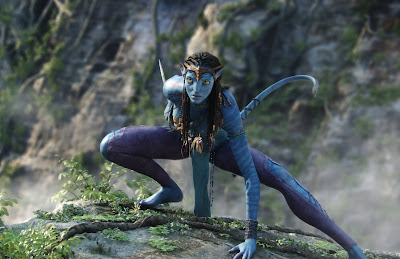
In the credit where credit is due department, I should say that Zoe Saldana's performance as Neytiri, our window into the Na'vi's world and Scully's love interest, is quite good. I don't know if this is because she threw herself into the job of motion-capture performance with an unusual amount of gusto, or if the computer whizzes who worked on her character were particularly on their game -- I don't know how this stuff works, but it's probably a bit of both. In any case, Saldana provides the story with far more life than any other element in the film. Not a hard distinction to achieve, however, since more than any other Cameron film -- and I'm generally not a fan -- Avatar feels like a jumble of technology that needed some sort of basic and self-consciously earnest story as an excuse be used.
.
- - - - - - - - - - -
.
The Collection Project Film of the Day:
.
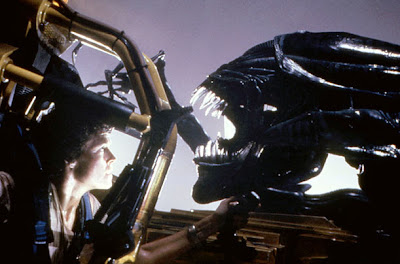
Contrast all this with Cameron's Aliens. This is by no means a perfect film -- for one thing, God is that fucker long, and, related to that, it doesn't know when to quit -- but there's a tension to it that never lags. A good hour of the film goes by before we encounter any alien mayhem (said mayhem, by the way, when the Marines get ambushed after they've been made to give up their ammunition, is actually much thinner than I remembered it; the shit hits the fan, there's an explosion, then a bunch of fuzzy monitors and yelling), but Cameron never lets the audience's attention wander. When the film first came out, part of this effect was, no doubt, attributable to the anticipation created by Ridley Scott's original film (and the idea that Cameron's sequel is somehow better than Scott's is an objectively provable untruth that needs to die), but the fact that I still felt that tension yesterday says something. The fact that, after two hours, I was also saying "Shit, Bishop still hasn't been ripped in half?? How much longer does this thing go on!?" says something, too.
.
There's also the, or some, performances in Aliens. Avatar has Saldana and, sort of, Ribisi (I'm not sold on the opinion that Stephen Lang's villainous Quaritch was anything special), and that's it. Aliens has a rock solid central performance from Sigourney Weaver, typically easy and strong work from Michael Biehn, and Paul Reiser, who, against all logic, is really good as the odious Carter Burke. The facts of his awfulness are pretty over-the-top, but Reiser really sells it well, especially when he's been found out, and is being interrogated by Weaver, Biehn and Bill Paxton. Reiser plays Burke as a skilled liar who is unsure if this talent can save him, but it's all he's got left.
.
And what about those special effects? Obviously, the film was made before the CGI era, and there's a moment in Aliens when, after the shit has hit the fan, our surviving heroes are hustling to meet their command ship, which they hope will whisk them to safety. That ship has been infiltrated by aliens, and the ship crashes right in front of our heroes. I don't believe that a spaceship has ever actually crashed only a few hundred feet away from Sigourney Weaver, but you'd never know it to watch that footage. It's seamless. Meanwhile, in Avatar, even at its absolute, considerable best, you think "Man! That is only barely a cartoon!"
.
I'm not anti-CGI, and defend it often. But when a film completely lives on those effects (as well as the 3D Imax presentation, which I didn't experience, so I don't now spend my nights wishing I could live in the movie), as Avatar absolutely does, it's hard not to wonder what the big deal is, and why so many people care so much. What would have been great is if, with Avatar, Cameron had created those same effects, and had attached them to a story that was engaging right off the bat, before a second of film had been shot.
Wednesday, May 12, 2010
A Collection Project Three-fer
 Häxan (d. Benjamin Christensen) - The above still pretty much says it all, doesn't it? Christensen's 1922 documentary/sociological essay/horror phantasmagoria would find itself very lonely if you were to try and place it within a genre. Occasionally, and tediously, didactic, Häxan is nevertheless gripping for the fact that it broke all the rules of documentary filmmaking before there ever was such a thing to break, and for its deeply bizarre and unnerving horror imagery, which take the form of Black Sabbaths and devils and witches and so forth, as Christensen chronicles the history of a particular kind of supersitious thought in the Middle Ages. What's curious about these images -- which range from the plain creepy, to the ludicrous, to the darkly sexual -- is that they're filmed with such verve and creative energy that they almost convince the viewer that those witch-hunters from hundreds of years ago were maybe on to something. As a thinker, Christensen cares to teach us how not to revert back, in our own modern and self-righteous way, to old and fiendish habits; as a filmmaker, however, he was far more interested in how the world looked through those superstitious eyes.
.

The Night of the Following Day (d. Hubert Cornfield) - Cornfield's DVD commentary track for this film is, for reasons it would be crass to explain, impossible to listen to. From a very shallow point of view, this is a shame, because, frankly, I'd like an explanation. For much of its length, The Night of the Following Day is a lean, precise, and vicious little crime thriller, about the kidnapping, in France, of an English heiress (Pamela Franklin) by a group of American criminals, led by Marlon Brando and Richard Boone.
.
First thing's first: despite the fact that, in his parade of tight all-black get-ups, Brando looks like he's constantly on the way to, or just back from, dance class, he's absolutely terrific, playing the smartest and most moral of the kidnappers with the ease of a top-class character actor. And the role of "top-class character actor" in Night of the Following Day is filled by Richard Boone, as Satanic and horribly convincing as he's ever been (by the way, Rita Moreno, as the female kidnapper, is also excellent, and she gives one of the best stoned-out-of-her-gourd performances I've seen).
.
But after a note-perfect climax (directed, I've gathered, by Boone, at Brando's insistence, due to Brando's belief that Cornfield was incompetent; in fairness the vast majority of the rest of the film doesn't bear this out), Cornfield throws in a loony-bird twist that caused my brain to silently rage "What the dick!? This was all a...wait, no, that can't be it. What? Why!?" In short, the film is like the worm Ouroboros, or the symbol for infinity, or a Moebius strip, and all that, but to no good goddamn purpose. The last few minutes of the film -- which supposedly Brando strenuously objected to -- have the strange distinction of neither ruining the ending's impact and making the viewer wish they'd been cut altogether. Narrative experimentation gone awry, is what I'm talking about, but the lion's share of the film is still well worth anyone's time.
.

Paul Blart: Mall Cop (d. Steve Carr) - I implied there would be films such as this would pop up now and again. And I suppose I could pretend that my wife and I don't think Kevin James is funny, and that we didn't rent this one night because we both really wanted to see it, and that we didn't both laugh often enough at the zany antics of an overweight and socially inept mall cop who finds himself defending his turf (a mall) against a group of gun-wielding robbers (burglars?) that I eventually picked it up at a Blockbuster sale. I could do all that, but it would be a lie. I think this movie's kinda funny. Fuck you, you jerks!
Subscribe to:
Posts (Atom)