Wednesday, October 15, 2014
The Cronenberg Series Part 17: It is Difficult to Find Crisco in Paris, But Not Impossible
When it was first announced, what seems like ten years ago now but was probably somewhat less, that David Cronenberg was writing his first novel I was quite excited and intrigued, but also far from shocked. As I hope I've made reasonably clear of the last sixteen posts in this series, Cronenberg is one of the most literary filmmakers in the English-speaking world. The works of Freud, William S. Burroughs, Stephen King, Patrick McGrath, David Henry Hwang, Don DeLillo, and, most importantly, J. G. Ballard have all, in one way or another, found their way into his films. In terms of style, he has transitioned from a visceral genre director into an arthouse intellectual, without ever, somehow, appearing to be a different filmmaker. He's even retained the viscera, though now it often takes a different form than it once did. Besides that, he'd shown an interest in writing novels in his younger days (though who hasn't?), and while the possibility hadn't actually occurred to me until the announcement, that Cronenberg would one day bite the bullet on this felt (retroactively) inevitable.
That novel, called Consumed, finally came out on September 30, after a long enough wait that I was beginning to wonder if he'd abandoned the project. But no, and one thing that didn't occur to me almost until I had the book in my hands was that this represented the first original Cronenberg story -- that is, not an adaptation of someone else's work (and I'm going to conveniently exclude his short films Camera and At the Suicide of the Last Jew in the World at the Last Cinema in the World) since eXistenZ fifteen years ago. And eXistenZ came eight years after what would have counted as his previous original story, Naked Lunch, a film that is officially an adaptation of Burroughs, but then again who are we kidding here. Anyway, Cronenberg the Writer had been gone far too long, and the notion that his return was in a medium that would, in theory, allow him to expand his natural, unique inventiveness into areas that film, with its financial burdens, might not so easily find room for, was somehow more than I felt I could expect from Cronenberg at this stage in his career. It all made perfect sense but managed to still be unexpected.
And "unexpected" is a word that I don't think begins to encompass the strangeness of Consumed itself. I'll have to begin somewhere, so let's see: to begin with, Cronenberg's facility with character names returns with our protagonists (of a sort) Nathan Math and Naomi Seberg. The political and cinematic significance of that last name does not go unremarked upon, but anyway, Nathan is a photojournalist who specializes in medical stories -- he dreams of landing something in The New Yorker's "Annals of Medicine" series -- and Naomi is a photojournalist of a more generalized, catch-all sort. She is pursuing a story about the eminent French philosophers Celestine and Aristide Arosteguy. The Arosteguys -- aging, sexually adventurous married intellectuals who, once openly, now somewhat more surreptitiously, bring students of both genders into their bed -- are beloved in their home country for their work in and approach to a kind of Marxist consumerist philosophy which posits, for example, that "the only authentic literature of the modern era is the owner's manual." Reading from one such manual, for a camera, Celestine says:
"Auto-flash without red-eye reduction. Set this mode for taking pictures without people." She laughed that rich, husky laugh, and repeated, this time with great drama, "Set this mode for taking pictures without people." A shake of the head, eyes closed to fully feel the richness of the words. "What author of the past century has produced more provocative and poignant writing than that?"
So that's the kind of work they do, but Naomi is reduced to watching videos of Celestine online because it appears as though Celestine's husband Aristide has murdered and partially eaten her. Why he did this is the story Naomi is pursuing. Meanwhile, Naomi's boyfriend Nathan is in Budapest interviewing Dr. Zoltan Molnar, a rather strange oncologist (and restaurateur) whose focus is breast cancer. He's developed an aggressive form of treatment (which I won't bother trying to describe) that has not been cleared by any international governing body in medicine, so he has to work on a sort of black market basis. Nathan is writing a story about him, and along the way he begins a sexual affair with one of Dr. Molnar's patients, a woman ("So many women have cancer these days," she says) from whom he contracts an STD thought extinct called Roiphe's Disease. This he subsequently passes on to Naomi, who is naturally furious when he confesses, and the two of them -- whose sexual encounter that allowed for this transference of disease occurred during a rare moment of togetherness, between the two of them flying to different parts of the world, pursuing different goals -- split yet again, he to Toronto to meet Dr. Roiphe, because, ostensibly, Nathan wonders about the fame, or infamy, that comes from being a doctor like Barry (Convex?) Roiphe, or Alois Alzheimer or James Parkinson, she to Tokyo to track down Aristide Arosteguy. She was led to Tokyo by Herve Blomqvist, former student and lover of both Arosteguys, and a man who tries, unsuccessfully, to seduce Naomi by bragging about his penis which was twisted by another STD which, well, it's all very complicated. But, so, she goes to Tokyo.
In truth, Nathan does not share the stage with Naomi. He's a supporting character whose story runs in parallel and seems to bear the same weight as Naomi's, but Cronenberg's head and heart clearly lie first in Paris, then in Tokyo. The bizarre world of Nathan, Roiphe, and Roiphe's grotesquely self-harming daughter Chase could probably support their own novel -- there is enough material in Consumed for several -- but in this novel they exist to provide links to, and back from, Naomi and Aristide. In Tokyo, Naomi, whose fascination with the Arosteguys has always been on the fringe of inappropriate, spiritually and sexually untethers herself from Nathan (the implication is strong that she'd been faithful to him, while the woman from whom Nathan contracted Roiphe's Disease was not his first dalliance) and lets herself satisfy her curiosity about her own physical attraction to an old intellectual cannibal. She's still working on her story, with his full cooperation, and she's also wary, even fearful, of what Aristide might do to her, but as is usually the case with Cronenberg, anything sexual is on the table.
And before you look at that description of Aristide and jump to the conclusion that he's some kind of Hannibal Lecter rip-off, the primary inspiration for the character is made clear as Cronenberg doesn't hesitate to throw into the mix the specter (though he is still, unfortunately, alive) of Issei Sagawa, the Japanese man who in 1981 murdered and partially ate a Dutch student named Renée Hartevelt. This happened in France. Sagawa served almost no time in prison, and not much more in a mental institution. For a while he lived off his own celebrity, writing books, restaurant reviews, appearing on TV, and so forth. I first learned of Sagawa from an essay about him written by Colin Wilson and published in the second of Adam Parfrey's horrific and in many ways detestable Apocalypse Culture books. Wilson's essay tried and failed to make the case that Sagawa didn't deserve to be incarcerated, come on, I bet he won't do it again (he hasn't, for the record, though I don't feel that this counts as "paying one's debt"), and, anyhow, long story short, Sagawa's story has always been surrounded by deplorable apologists, skin-crawling implications about celebrity, and vile jokes (see the interview with Sagawa conducted by Vice magazine and their use of the phrase "tasty little dish," not to mention the headline "Who's Hungry?") that seem to exist to convince the teller that Renée Hartevelt's humanity was theoretical at best. Arosteguy says to Naomi:
"You know, Sagawa, the Japanese cannibal, who still lives right here in Tokyo, said that the Dutch girl's ass tasted like tuna prepared for sushi. That's enough to make it dangerous for any Dutch woman to visit Japan. He's considered a tragic hero here, a media celebrity. An artist. I can envision lineups of Japanese men waiting for the Netherlands tourist buses to unload, each with his Suisin maguro bocho sharpened and ready...Of course, she was a Dutch girl. That made it somehow not so criminal. Maybe even praiseworthy."
So Cronenberg, unsurprisingly, is fully aware of what he's throwing together here, and even manages a gesture towards the somewhat fraught history Japan has with the Netherlands. As if Consumed didn't have enough going on in it. This is, in fact, a very plot-heavy novel. Unexpectedly so, though it is unexpected in ways that perhaps it shouldn't be. And maybe the phrase should be "incident-heavy," because the structure of Consumed flits between being tightly put together and a loose one-damn-thing-after-another sprawl. To my mind, this is largely to the good. Cronenberg's films, particularly those made from his original scripts, have never lacked for narrative drive, and Consumed pushes that to lengths that are intentionally absurd. This isn't to say that I believe that by the time the novel's plot has folded into itself a section about serving on the Cannes jury, the secret, sinister power of one of the films in competition, the truth of Celestine Arosteguy's pathology (or is it?), and so forth, again, that isn't to say that Cronenberg is making fun of anything in particular, any kind of storytelling style, I mean. But Cronenberg's is a curious but genuine sense of humor, and he's in complete control of how darkly ridiculous his plot becomes.
Ridiculous, but gripping. That along with everything else, David Cronenberg is a born storyteller is a compliment he's not often paid, I'd guess because everyone is usually so understandably busy figuring out the implications of his stories to pay much attention to how good those stories are. In Consumed, he's building perhaps the ultimate Cronenberg story out of the various meanings and applications of the word "consumed." Some of this is blatant (cannibalism) and even a little tired (consumerism) but when apotemnophilia, the desire to have body parts amputated, and a wild critique of Communism have been included into an already head-spinning collision of juxtapositions, even the tired stuff becomes new.
Plus it's that tired stuff that gives the novel its blood. Before beginning Consumed, my great concern was that the prose wouldn't be up to snuff. You can be a great film writer and a shit prose writer, and vice versa, and I had no particular reason to believe that Cronenberg would turn out to be one or the other. As it turns out, the consumerism facet of the novel is the key to the prose, because it's this facet, especially when set in front of some of the more grotesque material, that best reflects J. G. Ballard back to the reader, and back through the book. Early on, Cronenberg writer about how Nathan and Naomi for all intents and purposes fetishize their various computers and camera gadgets, complete with long blocks of brand names and descriptions of their various features -- a little of this goes a long way, and there's a lot of it, but it's in no way irrelevant. Anyway, as I was saying, early on Cronenberg writes about how, because of their jobs, this couple shops (separately, it must be noted) for their electronics in airport stores, and text to each other the various finds they've made or deals they've noticed that the other might want to look for when the other inevitably passes through that airport themselves. This is laid out as a vital part of their relationship, and if there's a more Ballardian part of Consumed I didn't notice it. And Cronenberg's prose, while in many ways not much like Ballard's, nevertheless works the same way. He matches Ballard's pathological-space-alien disinterest in what's happening, the nonjudgmental psychotic clinician's report. In short, the prose is exactly what it should be.
In the end, Consumed goes in a direction I was not sure, at the moment, I wanted it to go, but I can't now say that I'm sure it even took that direction. When I consider the evidence provided that the thing some characters claim happened happened, or rather that a thing didn't happen, or...well, anyhow, there's not much reason for me to necessarily swallow this whole, if you'll pardon the pun I didn't realize I was making, but anyway, there you have it. Which is the other thing about the ending, and the title, and I realize how vague I'm being about all this but if and when you read the book I suspect you'll think like me, which is that by the end you could say that Consumed is beginning to eat itself.
Tuesday, October 7, 2014
War Against Mankind
I don't want to overstate things, but to some degree 2014 is starting -- and I realize we're reaching the end of it -- to feel like The Year of Monte Hellman. First of all, he's prepping a new film (called West Memphis Three, which isn't exactly striking while the iron's hot, but whatever). Second, a couple months ago Criterion announced that this November they would be releasing a double-set of Hellman's classic '60's Westerns The Shooting and Ride in the Whirlwind. Finally, and again on the home video front, today Raro Video is releasing on Blu-ray one of the most unusual films in Hellman's already pretty unusual career, the once butchered, now restored to its full length Iguana from 1988. In an interview with Hellman conducted by Chris Alexander and included with the Raro disc, Hellman talks about how the film was re-cut by the producer after he'd turned in his final edit, and it wasn't until an Anchor Bay release many years later that anyone made an effort to restore the film. However, a mix-up led to two minutes being left out of that Anchor Bay disc, so tomorrow the full version of Iguana is going to be available for the first time. So this is like a whole big deal. I phrase that sarcastically, but mean it sincerely.
The first thing I noticed while watching Iguana the other day was Michael Madsen's name in the credits. This isn't Madsen's first movie, but it's the earliest one I've seen him in, and I immediately remembered that Hellman served as a producer on Quentin Tarantino's first film Reservoir Dogs. Tarantino is an enthusiastic and outspoken fan of Hellman, so it's not difficult to see that had it not been for Iguana, Mr. Blonde would have been played by somebody else. This is an interesting legacy for such a strange movie, about which Tarantino has said "Iguana is the movie that should have made Monte Hellman a household name." I don't know what household Tarantino is thinking about here, but I do take his point. I'm also very fond of Hellman's films, and Iguana is the kid of movie that can at the same time make you grateful that there are people still working to save this sort of fringe film from the trash heap, and frustrated that Hellman has had to struggle so much to get his movies off the ground. Before Iguana, it had been ten years since China 9, Liberty 37 his last real feature (he'd taken over for a deceased Mark Robson on Avalanche Express in the interim), and Iguana, which Hellman frequently points out he came very close to turning down, feels very much like a film that was just barely made. Set in the 19th century, it stars Everett McGill (talk about your unusual careers) as Oberlus, a hideously deformed sailor on a whaling ship. He's treated so badly by his shipmates that one night he jumps overboard and swims to a nearby island. The gist of the rest of Iguana's early action is that Oberlus, an uneducated and angry man, comes to despise humanity as a whole, as an idea, and vows to wage war on mankind. Other boats land, or wreck, on the island, and Oberlus takes prisoners, including Madsen as Sebastian, once a shipmate of Oberlus, and Carmen (Maru Valdivielso), who Oberlus rapes and keeps locked in a cave, as well as, eventually, after setting out specifically to capture him, Oberlus's old captain (Jack Taylor), towards whom Oberlus feels less than generous.
One of the main points of interest, and entertainment, for me in watching Iguana was how seemingly loose is the structure of the screenplay. The film is based on a novel by Alberto Vazquez Figueroa, and the script is by Hellman, David M. Zehr, and Steven Gaydos (who would also write the script for Hellman's Road to Nowhere twenty-two years later). I say it was "seemingly loose" partly because I use the word "seemingly" a lot, but also because I don't believe the film is as shaggy and rambling as it might initially appear. But Iguana does contain a number of what, if they appeared in a more mainstream film, we might call "set-ups," but which in this case aren't actually used to set anything up, or anyway they don't set up the things we might expect them to. For example, one of the shipwrecked men Oberlus captures can read and write. Oberlus demands that this man teach him to read and write as well, so that he might learn more about the world and put down on paper his grievances towards and dark plans for mankind. In another film, as Oberlus learns to read and write, this might set up a particular bond between the men, but not in Iguana. We're shown none of the teaching or learning process, though we gather that time has passed and that Oberlus has learned. The man is still a captive, still hates Oberlus, and still fears for his life. Oberlus promises no special treatment, and also gives none.
There's lots of that in Iguana. The violence is also interesting, in terms of who dies, when they die, sometimes how they die (there is a pretty startling decapitation, done very cleverly using low budget methods I could not quite figure out). I find this sort of thing compelling on a structural level -- you have a violent story which, after the gist is understood, could be pretty closely mapped out by a seasoned film viewer. This person will kill this person maybe halfway through, that person will kill that person at the end, and then will be killed by this person, and so on. You may not nail it, but you'll get pretty close, in most cases. But Iguana, without employing any cheap plot twists, is not easily mapped. I believe this is a natural side effect of the story. Oberlus is a man bent not just on revenge, but on genocide, and he gets nowhere with his plan. He in fact has no plan; he has a desire, but nothing close to the means, or the will, or the intelligence to even begin realizing that his dream is impossible. It's a tiny story that miserably fails to be grand, which is the idea, and the genius of Iguana. As a result, for all the high drama and death and sex (there's a rape scene, by the way, that is more troublesome than the one in Straw Dogs, but as in Peckinpah's film it would be a mistake to assume that queasy moment is the last word on the subject) that occurs in the lives of the film's handful of characters, it doesn't take on a tone of horror or swashbuckling adventure, or even the sober tone of a distanced examination of good versus evil. It quite deliberately shuffles along at the pace of the everyday. Iguana is not a boring film, but the sense of tedium everyone on the island except Oberlus must exist in, almost constantly, save when somebody is being killed, is palpable. Iguana is pathetic, in the best possible way.
Thursday, October 2, 2014
Those Nutty Goofballs Up at the Monastery
On Tuesday, through their "Redemption" line of art and/or exploitation horror titles, Kino Lorber released a little-known, essentially forgotten, if it had ever been remembered, bit of "dark erotica" called The Last Step Down. Released in 1970, The Last Step Down is the vision of director Lawrence Ramport and screenwriters Arthur Allen and Phil Miller. It could be that each of those names is a pseudonym, and, indeed, it appears that none of those men ever worked on another film again, if, I repeat, they're credited here under their real names. Both possibilities strike me as equally likely. Who would want the credit for having made The Last Step Down, and who would want to offer work to the men who made The Last Step Down?
I'm not really up on the history of the American stag film, though I'm sure it's an interesting story. I mention this only because I can't support with hard facts my gut feeling that the behind-the-camera talent who so entertained dark rooms full of cigar-smoking Oddfellows back in the '50s and '60s, chose to not make such a big public deal out of their contributions to those enticements. And I mention it also because The Last Step Down is a stag film. I don't know what else you could call it. God knows it's not a horror film. The idea must have been "Horror movies make money, somebody find some monk robes" and that's as far as their thinking took them. The film, which is 70 minutes long, begins in a kind of I guess you'd call it a church, but a Dark Church, one of those Satan churches, and in this church are our, maybe they are villains? Two guys, anyway, one of whom looks like the dockworker that all the other dockworkers absolutely can't fucking stand, and the other guy I bet probably owns a paint store. These are our Dark Monks (that's what I'm calling them anyhow, though the film offers no identities anywhere near that specific), and the first fifteen minutes of the film consist of those two guys having fairly unelaborate sex with Uschi Digard and Neola Graef. My distaste for this sequence, and other sequences like it, have little to nothing to do with either Digard or Graef, though their enthusiasm is noticeably feigned, but rather with the men, and really just the whole thing. The Last Step Down is the kind of film that can make you think that sex is maybe just gross and stupid and you shouldn't ever do it.
Ah, but then the plot kicks in. The plot is this: Digard and Graef are hookers. They like being hookers because they think that sex is so groovy. There's this new girl, played, or "played," or played? by Terri Johnson, who's about to join their whatever it is, hooker club, but she's a virgin, so they'd better break her in. First they'll break her in, then they'll take her to those loony monk guys with the robes and the wine and the dildo who they see every week. I've just described the entire plot to you. The other 65 minutes is all soft-core sex scenes, the kind that involve a lot of heads being laid on boobs and then later on stomachs. Early on, when Digard and Graef decide to have sex with each other in their living room, one of them moves a coffee table out of the way, so in this sense I suppose The Last Step Down is a procedural.
Anyway, that's it. When we get to the final group sex scene, with those two goddamn idiots in the robes again, I did still kind of think that, well, this one girl is a virgin so obviously the robed guys are going to stab her to death and drink her blood so that their Lord Satan might be once more appeased, or summoned, whichever, but no. They all have sex and the movie ends. The horror is seeing one of the guys, played by Michael Donovan O'Donnell, who you'll all no doubt remember as McGillicuddy in Warren Beatty's Dick Tracy(!), humping away, shot from an angle that symbolizes human misery in its purist form.
Interestingly, a word I use but do not really mean, on the Kino disc The Last Step Down is paired with a fifteen-minute soft-core horror short from 1979 called Blood Lust. Directed by Russell Gay, Blood Lust is set up, hilariously, as an adaptation of J. Sheridan LeFanu's story "Carmilla," which means there's lesbian sex and one of the lesbians is a vampire named Carmilla. But for whatever it's worth, Blood Lust is actually part of the horror genre -- there's blood, and, like, three people die in it, and one of the people who dies is Dracula. What more do you want, for Chrissake?
Monday, September 29, 2014
The Cronenberg Series Part 16: Foully and Berserkly Rich
On the morning of August 14, 2012, David Cronenberg and actor Robert Pattinson rang the opening bell at the New York Stock Exchange. That they were approached to do this at all is strange -- it may in fact indicate a sense of humor among those who run the NYSE, but few people on the outside looking in will ever entertain this notion, but either way, it was strange. Cronenberg and Pattinson were there to satirically promote, or maybe promote satirically, whichever one more strongly suggests that they were there to do a specific job but fully understood that it was funny that they were there, Cosmopolis, the film that Cronenberg had recently made from the 2003 novel of the same name by White Noise and Underworld writer Don DeLillo.
In a 2012 interview with Cronenberg, Glenn Kenny asked the director about the fact that many people seemed to miss the point -- at least the point as Cronenberg saw it -- of his ringing of the NYSE bell, to which Cronenberg responded:
Yeah, I know, some people thought that we were betraying the movie by doing that. I thought, no, no, you're really not getting it at all. That was so perfect. I couldn't believe when they were asking us. But that was the perfect expression of capitalism. They were lovely there. They were so excited, they love their Stock Exchange and, after all, we were selling a movie and selling is what they know. So it was all perfect. A capitalistic enterprise, and there we were.
The reason all of this is strange, and ripe to be misunderstood, is because Cosmopolis is anti-capitalist to its bones. I would hesitate to assume that it follows that Cronenberg is unquestionably anti-capitalist, or even that DeLillo, a paranoid novelist of the same basic philosophical bent as Thomas Pynchon, is (although I bet he is); in the interview with Glenn Kenny, Cronenberg says that DeLillo told him that his novel wasn't inspired by a desire to attack capitalism but rather by a curiosity about New York's limos, and what happens to them at night. But nevertheless, that's what Cosmopolis is. The basic thrust of the novel and film's driving theory is that capitalism is not unlike anarchy, and that like anarchy, and according to Marx, the destruction wrought by capitalism is a creative act. As you read, or watch, Cosmopolis, how this idea applies to the events of the story will become clear.
"What events!?" many will sneer, and sneered at the time of Cosmopolis's release. Because this is one of those films that..."invite" isn't the right word, but maybe attracts criticism to the effect that "nothing happens" in the film, novel, etc. If I tell you that the story is about a New York City billionaire in his late 20s named Eric Packer (Robert Pattinson) who decides to get a haircut, and as he rides in his limo towards that goal through horrific traffic caused by a visit to NYC by the President of the United States, he has encounters and conversations with various of his employees, semi-friends, lovers, and one wife, Elise (Sarah Gadon), both in and out of his limo (traffic moving at such a ridiculously slow pace to allow for such things), you might agree that yes, indeed, this is one of those things in which nothing happens.
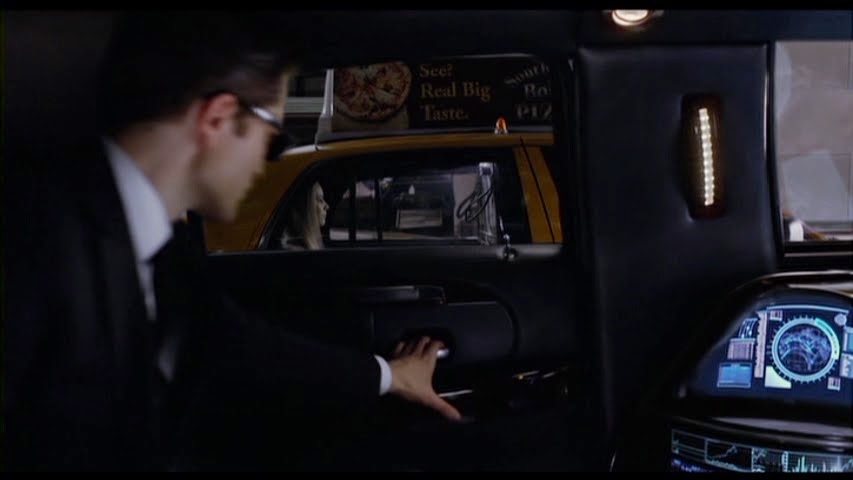
And what of it? Cosmopolis is essentially about a kind of economic theory extrapolated to the point of science fiction dystopia. The story is ostensibly set in the present day, but Packer's limo travels through a haze of near-future America, or anyway New York (the word "cosmopolis" roughly means "city of the world"), on the brink of collapse, with a potentially post-Apocalyptic, as the movies have taught us to define that phrase, aftermath. So Packer might be talking to his head of IT security (or whatever), played by Jay Baruchel, in the back of his ridiculously tricked out limo -- it looks, probably not at all accidentally, like the cockpit of a spaceship -- and see Elise, to whom he's been married for less than a month and whom he apparently rarely sees, in the cab next to him, so he'll get out and get into her cab, which they'll both exit to go find breakfast. This is the basic structure of the film. Packer never seems to be actually traveling by car, but the ease with which he flows in and out of it, and always seems to be somewhere in the city where he has something to do or someone to see nicely illustrates his place within the city: it revolves around him. (This also somewhat resembles the film Game 6 from 2005, falling somewhere in between the novel Cosmopolis and Cronenberg's film version; this is a film that boasts DeLillo's so far only original screenplay, and which features a playwright played by Michael Keaton taking a lengthy and labyrinthine, sort of cab-based trip through the city.)
On top of all this is a development relayed by Packer's security chief, Torval (Kevin Durand, an unusual actor with an unusual presence). A "credible threat" has been made on Packer's life. The President's, too, but that is announced earlier, and which seems to fade into, or be overshadowed by, the threat on Packer. Also on this day, video of Arthur Rapp, "managing director of the International Monetary Fund," being stabbed repeatedly in the eye (to death, in case clarification is needed) on a Korean talk show, is big news. Packer watches this with some fascination, but not exactly horror. All the while, a risky financial move by Packer is not paying off, and continues to not pay off, so that after not too long, and by his own calm admission, he's losing money by the truckful. And around him, anti-capitalist protesters are running wild, as visually inspired as Packer was earlier in theoretical terms, by a line from the poem "Report from the Besieged City by Zbigniew Herbert: "a rat became the unit of currency."
So maybe not so free of incident as previously suggested, although a lot of the above is communicated through dialogue. A lot goes on around Packer's limo, and therefore, in a sense, around the film itself, but visually Cosmopolis is hardly bereft of ideas. And the dialogue's not exactly worthless anyway. It's not simple exposition. Though the script was written by Cronenberg, he hewed very closely to DeLillo's novel (there are one or two changes at the end, changes which manage somehow to be both major and insignificant, in that nothing vital to the novel is really lost), and one of the most important things Cronenberg hung onto was DeLillo's dialogue. I'm not the world's biggest fan of Don DeLillo -- my objections tend to be philosophical except when they're aesthetic, and also except when he's great, which even I think he sometimes is -- but if he has one unquestionable gift, it is his approach to dialogue. As a matter of fact, he writes my favorite kind of dialogue: sentences that are realistically, humanly ungrammatical, funny in a way that makes it difficult to track the source of the humor. For example, and I may have to leave it at one, early on Torval tells Packer about a security threat. He's talking about a threat to the President which will further impede Packer's quest for a haircut, but Packer thinks Torval is referring to a threat on his, Packer's, life. Torval says "Not your life, his," and Packer says "Who the fuck is his?" I don't believe I've ever heard anyone say anything quite like "Who the fuck is his?", but I believe it to be nevertheless absolutely correct. And funny. Why? It's not because I believe it reveals Packer to be a dope. Somehow, this sort of thing is funny because it's right.
Also funny, in a different way, is when Samantha Morton as Vija Kinsky, Packer’s "chief of theory," tells him about her love of the idea of nanoseconds, even though she's not certain what it is, Packer informs her that there is also such a thing as a zeptosecond, and a yoctosecond, and she responds "Good, I'm glad." It's a strange sort of humor, I'll grant you. At any rate, on the page all of this reads as pure Don DeLillo, as you'd guess it would, but in Cronenberg's hands the words, and everything else about Cosmopolis, takes on the cold steel shape of a J.G. Ballard phantasmagoria. The very title Cosmopolis already sounds like it belongs to Ballard as much as or more than it does DeLillo, and Cronenberg, being basically the Canadian film director version of Ballard, slides into this mix of compatibly warped pathologies as easily as one would into a painfully cold bath.
None of which is to suggest that I think all of Cosmopolis works like gangbusters. In truth, I think it comes in second only to A History of Violence as my least favorite among his films. It's just that I do not for a second believe that the film is any kind of baffling misfire, much less the disaster it was claimed by some to be. The long stretches of theorizing that comprise a large portion of the film can become enervating, as I found was the case with the novel. I can find it well-written while wishing everybody would just shut up a second. Large swaths of it don't seem to matter, which on one level, on the level of the story of Eric Packer, I suppose is intentional -- things not mattering is almost a theme here -- but it also doesn't seem to matter as thought, thoughts thought up by Don DeLillo or David Cronenberg. Upon seeing an image of a large TV screen in Time's Square flashing the phrase "There is a specter haunting the world. The specter of capitalism," my reaction is to say "It's very interesting to me that you think so" and move on. All of this can be tedious, is what I'm getting at. If the section with Samantha Morton has more life in it, it's because Morton has more life in her than, say, Gadon (who was quite good in Cronenberg's A Dangerous Method but here seems to have been ADRed into oblivion), or Baruchel who is doing his normal shtick but without so many jokes as usual, or Juliette Binoche who seems very out of sorts playing one of Packer's lovers, or Kevin Durand, an actor I am not knocking here so much as I'm admitting that I can't make heads nor tails of him. The same goes for the various...set pieces isn't right, concepts doesn't seem much better, everything that happens takes so little time, but anyway, if the bit with the protesters in the diner holding the dead rats works -- and it does, not least because it feels like it could have come from Cronenberg's eXistenZ -- then it's just as certain that the later bit with the French "pie assassin" played by Mathieu Amalric, is just frankly stupid nonsense, a desperate grasp at satire and humor from two men (Cronenberg and DeLillo) who are much funnier than this, and much smarter about how to make humor flow along unseen and under the surface, but here want to announce their comedic intentions with a bullhorn. A gag bullhorn that makes fart sounds.
For a while, Cosmopolis is an interesting but only sporadically successful experiment. This depends, I'll admit, on how one views the subject to begin with. "You've convinced me!" is not something anyone has ever said after leaving a film with an argument to make. As this is more or less irrelevant, the interestingness of the argument or the film as a film becomes paramount, and Cosmopolis is mostly not especially interesting as an argument, but as a film making its argument through a lens of subtle science fiction, it can be fascinating. It's that lens that makes the argument better than the words do. Then Packer (and in the interest of fitting this in somewhere, I should mention that Pattinson is terrific and underrated here, dead-faced, consciously not looking at people who don't matter as people, but not dead behind his eyes, because he's human, even if he has a somewhat inhuman way of going about being that) confronts the man who threatened his life. Played by Paul Giamatti in one of his greatest performances, this long final scene, which lasts something like twenty minutes, pretends to hang on to its "philosophical theory" approach to the subject of economic inequality, but in fact largely jettisons it, or lets Giamatti's frightening, frightened, furious performance to do the jettisoning for them. A blank face is replaced by a real one, even if the character is as ridiculous in his extremes as everybody else. I mean, here you have a guy who lives in an apartment where he has to shit through a hole in the floor arguing with a character whose apartment is tricked out with two elevators programmed to play different kinds of music and move at different speeds, between which he may choose, depending on his mood. This is set up as an absurd illustration for an absurd lecture, but among the things that don't hurt this scene is the fact that Giamatti's Benno Levin isn't an angel with a dying child -- he is violent, and fundamentally self-serving. He's not angry because there are poor people; he's angry because he's a poor person.
But of course, that's what it comes down to. If up until this section Cosmopolis has been a somewhat intriguing experiment, in this last stretch it suddenly becomes a masterpiece, for 20 minutes. Levin's frustrations are so specific that they become weapons in the argument being made by DeLillo/Cronenberg as sharp as everything before was smooth in their generalities. A man who has to shit in a hole in the floor is driven crazy by people who have doctors who can order tests for them, by the sight of people sitting outside a café on a sunny day having drinks and talking, by the international symbol of disposability that is represented by the endless varieties of shoes available to people who are not him. The unavoidable truth of the discrepancy -- and your thinking on the subject can vary, and two people can hate each other based on those variations, while each still seeing the same thing as clearly as the other -- is plainly felt and strongly stated: "You are foully and berserkly rich," says Levin, and it's that one word, "berserkly," that carries within it such sudden clarity. It makes the case. "How rich is he?" now has an answer we can all grasp.
Monday, September 22, 2014
Let It Come Down
In 1823, Thomas De Quincey published a short essay in London Magazine called "On the Knocking at the Gate in Macbeth." In it, De Quincey, a writer best known now for his book Confessions of an English Opium-Eater and the series of long essays that are collectively known as "On Murder Considered as One of the Fine Arts," focuses on the scene in Shakespeare's play, following the murder of Duncan, the King of Scotland, by Macbeth, his heretofore loyal Thane of Glamis, then Thane of Cawdor, when, the morning after the killing, before the discovery of Duncan's corpse, there is a knock on the castle gate, and the porter noisily shuffles along to open it and let in, as it turns out, Macduff, the Thane of Fife, and the man who will eventually exact vengeance upon the vile Macbeth. De Quincey begins this way:
From my boyish days I had always felt a great perplexity on one point in Macbeth: it was this: the knocking at the gate, which succeeds the murder of Duncan, produced to my feelings an effect for which I never could account: the effect was -- that it reflected back upon the murder a peculiar awfulness and a depth of solemnity: yet, however obstinately I endeavoured with my understanding to comprehend this, for many years I never could see why it should produce such an effect.
The reason this scene -- the only comedic scene in the play, as the porter grumbles about the knocking, then commiserates with Macduff about the various effects of alcohol -- worked on De Quincey the way it did, he decided, is because it signaled the reaction, presence, and unavoidable continuation of regular life as it pressed right up against shocking horror. De Quincey uses as an example taking part in the funeral procession of a notable figure through city streets, which soon bustle back into life. A more everday example might be having to go out in public, perhaps to run an errand that can't be postponed, soon after hearing about the death of a loved one. People, you might notice, keep on buying beer and getting their glasses fixed. This fact bumps up against your despair, and fortifies it.
In adapting Macbeth in 1971, director and co-screenwriter (with literary critic Kenneth Tynan) Roman Polanski seems also to have adapted De Quincey's essay. If one single thing separates Polanski's Macbeth, which will be released on Blu-ray and DVD this Tuesday by Criterion, from other major film version of the play, such as those directed by Orson Welles and Akira Kurosawa, it is the sometimes breathtaking savagery of the violence. Welles's wonderfully expressionist take depicts the violence in a more or less standard stab-and-fall style, whereas in Throne of Blood Kurosawa, no stranger to blood, keeps it mostly off-stage, including killings that Shakespeare kept on-stage, storing it all up for Macbeth's (Jon Finch) fate. Polanski, on the other hand, puts almost all of it on-stage, including Macbeth's murder of Duncan (Nicholas Selby), not shown by Shakespeare, and meanwhile throws in a handful of brand new deaths, splashing blood all along the way. Throats are cut, axes are buried in backs and groins, heads are severed, wounded men are beaten with spiked maces, people are lynched in groups, children die. Even the loophole to the witches promise that "none of woman born shall harm Macbeth" that leaves him vulnerable is put on the screen, even before we're told what that means.
That loophole, of course, is that Macduff (Terence Bayler) was not "born of woman" in the traditional sense, but rather for medical reasons we in the audience are not privy to but can imagine, he was surgically removed from her belly. So to dramatize that, as one of many images in the dreamy shimmer of the witches' cauldron, Polanski shows a close-up of a pregnant belly, then a knife entering the belly, and slicing. I will be far from the first and far from the last person to point out that Macbeth was Polanski's first film since his wife Sharon Tate was brutally murdered by Charles Manson's cult. Murdered simultaneously with Tate was Tate and Polanski's child, with whom she was eight months pregnant at the time. It's not necessary to go into what Tate's murderers did to her body, but that shot in Macbeth of a knife cutting into a pregnant belly isn't simply, in this version of the play, a bit of plot-work. It transforms the double murder of a young woman and her unborn child into an act of life-preserving surgery. Or perhaps it transforms an act of life-preserving surgery into the double murder of a young woman and her unborn child. I'm assuming this was all done unconsciously.
Hence, long story short, the film's savagery. The very existence of Polanski's Macbeth is an illustration of and comment upon De Quincey's point about the juxtaposition of murder and the "reaction," which is to say, everything that isn't the murder and has nothing whatsoever to do with it, i.e., a hungover old man opening a gate. By the murder of Duncan, Macbeth and Lady Macbeth (Francesca Annis) have been "conformed to the image of devils," De Quincey writes, "and the world of devils is suddenly revealed." To show this, the world of devils must briefly go away, and so "the knocking of the gate is heard; and it makes known audibly that the reaction has commenced...and the re-establishment of the goings-on of the world in which we live, first makes us profoundly sensible of the awful parenthesis that suspended them.
Polanski's unspeakably grim film counted, for him, as "the re-establishment of the goings-on of the world" (though he has said that he consciously chose "serious" material for his return picture). The fact that, even if Polanski saw the significance of everything he was doing with completely clear eyes, none of this turns his Macbeth into some post-modern wank is a testament not only to his talent but also to the seriousness of everything involved, from the immortality of Shakespeare's language on up. Polanski's well-documented failures as a human being are deep, many, and unforgivable, but his films remain uniquely bracing dives into those failures, as well as the shocking tragedies that litter his life. Among those films, and along with his grotesquely funny horror movie The Tenant, Polanski's Macbeth, this reflection back on the "awful parenthesis," is one of the most piercing howls in film history.
Sunday, September 21, 2014
Monday, September 15, 2014
The Cronenberg Series Part 15: Another Thing, in Another Country
In 1889, a London newspaper called the Southern Guardian printed an editorial concerning the Jack the Ripper murders, crimes which at that time would have still been fresh but also dormant long enough to allow for some reflection. The editorial contains this passage:
Suppose we catch the Whitechapel murderer, can we not, before handing him over to the executioner or the authorities at Broadmoor, make a really decent effort to discover his antecedents, and his parentage, to trace back every step of his career, every hereditary instinct, every acquired taste, every moral slip, every mental idiosyncrasy? Surely the time has come for such an effort as this. We are face to face with some mysterious and awful product of modern civilization.
Over a century later, Alan Moore would take this basic idea and run with it in From Hell, the exemplary comic book about the Ripper murders (plus loads else) he created with artist Eddie Campbell. A quote attributed to Moore (the question of who said this first is somewhat unsettled, but anyway) in relation to From Hell and Jack the Ripper goes so far as to claim the Ripper "gave birth to the 20th Century." In the comic itself, this idea appears as a revelation spoken by Jack the Ripper to his carriage driver: "It is the beginning, Netley. Only just beginning. For better or worse, the Twentieth Century. I have delivered it." This doubtlessly gives Jack the Ripper far too much credit but it's a powerful idea, especially if you're an extremely pessimistic sort of person.
Anyway, the power of the idea doesn't have to rest in Jack the Ripper specifically. If you want to look at where we find ourselves today ("we" as a species, and as the only agents of history that care to regard themselves as such), and regardless of your individual politics or philosophy or theology I think we can pretty much all agree that where we are is describable as "not good," the impulse to trace it all, all of this, to a certain point, a specific moment, a thing, or cluster of things, or even a thought, can be irresistible. And such is the pull of A Dangerous Method, a late career masterpiece for David Cronenberg and screenwriter Christopher Hampton. The film, based on Hampton's play The Talking Cure and John Kerr's non-fiction book A Most Dangerous Method, pins the birth of the 20th Century as we understood and experienced it, and which in turn gave birth to today, right near its beginning -- in 1904, in Zurich. The key figures over the course of the film, which will stretch until 1913, a not insignificant year, are Carl Jung (Michael Fassbender), at this time, 1904, a young psychiatrist who is fascinated by the new methods of psychoanalysis developed by Sigmund Freud (Viggo Mortensen), who he hasn't met yet, but will, and the young patient Sabina Spierlein (Kiera Knightley), who, in Cronenberg's typical "let's get to it" fashion, Jung begins treating scant minutes after A Dangerous Method has begun.
Sabina, a bundle of extreme physical tics that serve to put on display the deep shame and anger she feels as a result of her somewhat off-center sexual desires, is extremely intelligent, so intelligent in fact that despite her desperate unhappiness ("There is no hope for me," she says) she is fascinated by her own mental illness, and the mental illnesses of others. This leads Jung to take her under his wing, and to encourage her to pursue a career in psychiatry. She assists him in psychoanalytical experiments, such as testing the concept of word association on Jung's own wife, Emma (Sarah Gadon), and interprets the subsequent answers with unsettling perception. Sabina and Jung become so close, in fact, that Cronenberg wants us to make no mistake: when Jung first visits Freud in Zurich, he arrives with Emma. When their meeting is done, the next scene shows Jung walking down in the street in conversation with Sabina. Some members of the audience (I'm talking about me here) might find themselves trying to remember which one he actually when to Zurich with. Emma and Sabina are becoming the same in his mind, though he doesn't know it, or won't acknowledge it. The difference is, Emma is the one he impregnates.
Because yes, soon Jung and Sabina are having sex. But first, to be clear about where we stand: Jung, an Aryan doctor, is treating a Jewish woman suffering from a deep sexual repression that has led to a mental breakdown. Jung's mentor is Freud, a Jewish doctor who watches his independently wealthy protégée waltz through his life and career with little worry, so oblivious that it's beyond Jung why Freud's Jewishness might be an obstacle in Freud's theories of psychoanalysis gaining any traction among the European establishment. It is beyond Freud how this could be beyond Jung. Jung's major criticism of Freud's interpretation of the human mind and subconscious is that it is exclusively focused on the sexual ("There must be more than one hinge into the universe," he says to Sabina). Freud, in turn, is frustrated, on the surface, by Jung's drifting into mysticism -- Jung wants to study telepathy, he believes he can sense what's coming in the near future, etc. -- but of course at root what frustrates Freud is Jung's naïveté. In any case, Freud certainly couldn't have foreseen the consequences of sending into Jung's care another psychiatrist, Otto Gross (Vincent Cassel), a man whose instability is the opposite of Sabina's -- if anything, he's not repressed enough, and he encourages Jung, his Aryan colleague, to embark on the affair with the young Jewish patient Gross is quite certain is what Jung truly desires. That Gross is Austrian -- as he was in real life, as the real Sabina Spielrein really was Jewish, A Dangerous Method being, after all, "based on a true story," as they say -- is certainly neither here nor there. Certainly not in the early 1900s, before even World War I. Yet it's Jung, with his somewhat mystical and superstitious mind, who continually insists that he doesn't believe in coincidences.
Of course, as with most of us, it doesn't matter what Jung believes in. He's a great doctor, and a brilliant man, and throughout the film Cronenberg positions him as a keen, in his mind, observer -- passive too, up to a point, but that's part of the psychiatrist's job, after all -- anyway, sitting back, across the room, often behind the other person as he listens to them speak. But the point is, he misses everything. Despite how man hinges there are into the universe, he can't find them. About midway through the film, the key line is spoken to him by Sabina, and he doesn't understand it. This is not his fault, because given what it portends who could? But Jung is the mystic, so when Sabina, building off her reading of Wagner's treatment of the Siegfried myth in his Ring Cycle, says that she's developing the theory that "only the clash of destructive forces can create something new," he seems to miss out on every practical or immediately relevant, or even cosmically human, meaning those words might carry. When shortly thereafter Gross is pushing him into an affair with Sabina -- an affair she badly wants, because despite her obsessions she's had no sexual experiences of her own -- he doesn't even seem to recall what Sabina told him about their relationship, their opposite natures, among them being that she is a Jew and he an Aryan. "And other, darker differences," she said, which he wondered about at the time but then when that hinge to the universe that so preoccupies Freud swings his way, pfffft! Everything else leaves his brain.
Competing psychoanalytic theories presented in A Dangerous Method involve the reasonable repression of desire -- that's Jung (never mind how he actually behaves); Freud, in the context of the film, is noncommittal -- and the perhaps unreasonable pursuit of an pleasure one might desire. That's Gross. To cut to the chase, and considering the film's eventual implications, is it unreasonable to see Gross as the Teutonic will that will one day unleash Aryan dominance, powered by an untrammeled freedom to do as they wished, throughout Europe? Even Jung's occupation as a passive observer feels like the sometimes admired neutrality of the Swiss, until you consider sometimes what they're being neutral about. You can do it, you can stop it, or you can allow it to happen. Sabina, as unable to see into the future as anybody, loves Wagner's operas, and she asks Jung if he admires Wagner as well. Jung replies "The man and the music." Nowadays, with hindsight being so powerful, most people would only pick the second of those two things to admire, and of course even that perspective, justifiable as it unquestionably is, forces them to share an interest with Adolf Hitler.
This film isn't about taking Carl Jung down a peg, however. Given the metaphorical nature of A Dangerous Method, it's actually quite difficult to view these characters as bearing much relation to the historical truth, no matter how accurately it depicts the events and personalities (I'll confess that I'm the wrong guy to ask about this). One of the ancillary interests Cronenberg and Hampton seem keen to pursue is their skepticism of "great men" -- Jung, of course, but also Freud, who, wiser than Jung though he can often appear, is nevertheless shown being envious of Jung's wealth (his wife's wealth, to be specific); even his ideas about human sexuality, which one might guess Cronenberg to be sympathetic towards, is skewered. Anyway, I think it's pretty funny when Freud tells Jung, after the latter has just related a dream about hauling around a giant log, "I think you should entertain the possibility that the log represents the penis." In fact, I'd go so far as the argue that Mortensen as Freud -- a strange bit of casting that I think nevertheless pays off quite nicely -- is giving an essentially comic performance. His occasionally sing-song delivery sharply but quietly illustrates Freud's condescending arrogance, and if Fassbender plays Jung as naïve and thoughtless, he's also open and generous. Mortensen plays Freud as free of those weaknesses, and those strengths.
Jung is still difficult to like, and after a while he's even difficult to admire. Fassbender's performance is a model of the kind of absence of judgment you often hear actors claim is essential to playing unsympathetic characters. Late in the film, Jung may have lived to regret some of his behavior, but for much of A Dangerous Method's run time the notion that his choices might actually be destructive would, if not exactly surprise him, be something he could rationalize. He could build a case in his own favor. His love for Emma -- genuine, I'd have to suppose -- would be his main argument for doing, or rather not doing, certain things, and he could even reasonably claim that the sexual relationship with Sabina, deeply unethical though it was, actually helped her. Two destructive forces -- Jung's entitled blundering and Sabina's erratic, sometimes violent madness -- clashed in deliberately painful sex, and created a brilliant woman who could put her inexperience behind her. Knightley, giving the performance of a lifetime, so exquisitely plays Sabina's wounds that the softening of her alarming harshness, and wild and ugly physical convulsions, that the mere quieting of these becomes incredibly moving (the real brilliance of Knightley's criminally underrated performance is that she never lets go of Sabina's peculiarities; she may be better, but some things are never gone, and Knightley holds on to that, beautifully). The pain her cure causes for others becomes acceptable. That's the positive reading.
But the rest of the 20th Century still has to be accounted for. The Aryan/Teutonic freedom Otto Gross celebrates and which Jung only pretends to want to restrain, is about to sweep through Europe. Cronenberg's fascination with the relationship between sex and death has never been so monumental in scope as the film he only hints would follow A Dangerous Method. Freudian psychoanalysis seeks to interpret the human mind and human behavior in terms of the drive for sex and towards death, and this method, the talking cure, was born at the conception and birth of the century. Sex can create -- Jung has many children with Emma -- and destroy, as it nearly did Sabina, as it to some degree seems to have destroyed Otto, at least as a functional person who could survive in civilized society, as it destroys Jung's sense of his own morality. It is a destructive force, one of Sabina's, and Wagner's, two destructive forces that clash and create something new. Psychoanalysis joined them, and the 20th Century was born. The film ends in 1913, the year before World War I. That's Death. In the years following this, in Berlin, Weimar Germany is now popularly remembered for its decadent nature. That's Sex. They joined in Freud and Jung, as personified by Sabina, they split into war and its desperate aftermath, and joined together again in 1939.
At the end of A Dangerous Method, Jung tells Sabina about a dream he had, one of an ocean of blood destroying a town. It was "the blood of Europe." Not, perhaps, Christopher Hampton's subtlest line, but it's interesting to note, as I circle back around, that in Moore and Campbell's From Hell, the conception of Adolf Hitler is actually depicted. Hitler would have been conceived in 1888, right in the middle, or thereabouts, of the Ripper killings. In one of Moore and Campbell's least subtle moments, this sex act between Alois and Klara is symbolized by an ocean of blood pouring out of a synagogue. That too, I'd say, counts as the blood of Europe. So the 20th Century is conceived, but according to Cronenberg and Hampton, it was born in the back of a carriage, with a doomed woman screaming, as though giving birth.
Subscribe to:
Posts (Atom)