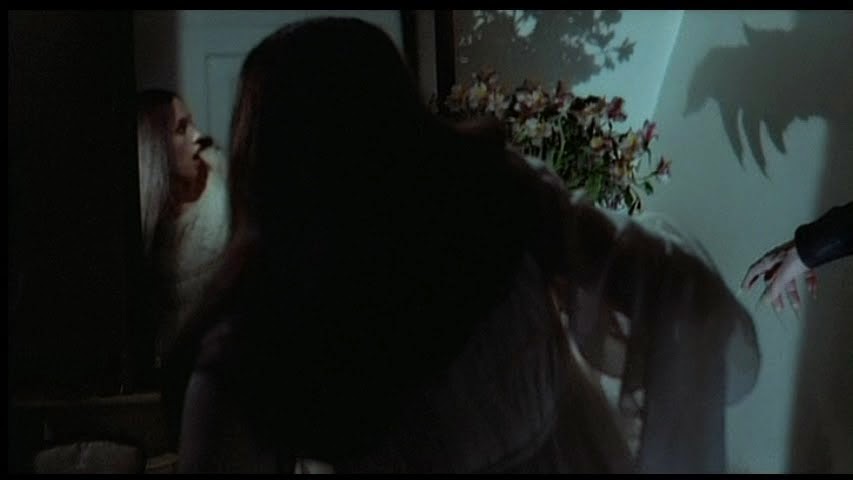
I. From the Seed of Belial Sprang the Vampyre Nosferatu
In 1921, director F. W. Murnau, Rosicrucian and screenwriter Henrik Galeen, and producer, artist, designer and occultist Albin Grau perpetrated an act of intellectual property theft on Bram Stoker, author of
Dracula, a novel immensely influential on the 20th century both for its newness and in the specific ways it was itself derivative. As with so much, too much, that is of cultural interest from the late 19th and through the mid-20th centuries, Aleister Crowley, the Beast, had something to do with this. The impact of Crowley on Murnau, Galeen, and Grau's
Nosferatu was doubtlessly not very direct at all, but it feels important in some obscure way that he was there, even on the fringe.
From a possibly, probably, certainly apocryphal story related by Grau from his World War I days, a story having to do with typhoid fever and the avoidance of it, as well as the transformation of dead father of one of Grau's comrades into an actual vampire, grew the idea to transport the basic concept and general action of
Dracula from 1890s London to 1830s rural Germany. Hutter (Gustav von Wangenheim) is sent by his boss Knock (Alexander Granach) to Transylvania to conduct a real estate transaction that would bring Count Orlok (Max Schreck) to their little town of Wisborg, an idea that excites Knock somewhat unaccountably, in a way that seems beyond money. And so Hutter is soon bleeding in front of, and later into, the vermin maw of Orlok the
nosferatu. His eventual escape from Orlok's castle may be far too late to stop the plague that is about to sweep down on Wisborg, and on Hutter's wife Ellen (Greta Schroder).
In
From Caligari to Hitler: A Psychological History of the German Film, Siegried Kracauer, who by spending fewer than two pages on it seems to want little to do with what must be deemed the most famous film to ever come out of Germany, regards
Nosferatu as one of a group of films that "specialized in the depiction of tyrants"; calling the Germans of that time after the devastations of World War I "a people still unbalanced, still free to choose its regime" Kracauer wonders about what facet of the national psychology could have fed the creation of fictitious tyrants and tyrannies before noting "It is, at any rate, a strange coincidence that, hardly more than a decade later, Nazi Germany was to put into practice that very mixture of physical and mental tortures which the German screen then pictured." Well, yes. Very strange. Still, though completely supportable by the film itself, Kracauer's insistence on slotting
Nosferatu into this political category ends up simplifying the film -- it fits but all the edges and corners get shaved off in the process. It is a film of, yes, tyranny, but also one of plague, literally, with the rats that swarm Wisborg, and figuratively, as the real fever and death comes from a supernatural evil. It's a film washed in Grau's occultism, and the symbols overt (Knock's letter from Orlok) and covert (littering the walls the viewer isn't even meant to look at) that in these convoluted belief systems tie all that is good and all that is vile into one cosmic mathematical equation, a system of thought that almost inevitably will lead, or in several decades time, spread, virulently, to those who don't even know the roots of their own paranoia.
Nosferatu is a paranoid conspiracy thriller from another plane of existence.
In his examination of the history of horror cinema
The Monster Show, David J. Skal quotes critic and Murnau biographer Lotte Eisner as writing:
Mysticism and magic, the dark forces to which Germans have always been more than willing to commit themselves, had flourished in the face of death on the battlefields. The hecatombs of young men fallen in the flowers of their youth seemed to nourish the grim nostalgia of the survivors. And the ghosts which had haunted the German Romantics revived, like the shades of Hades after draughts of blood.
But of course the occultism of Grau and others of the day was a philosophy of a certain optimism, something modern paranoia is anything but. Orlok is a creature to be hated and to be defeated, and defeated he, it, is. At great sacrifice, of course, as ever, but the sun shines again, for most of us. Those who sacrificed themselves will have shovels full of dirt dumped on them. No sun for them. But for us, yes. Sure. For us. For now.
II. The Curse of Nosferatu
Werner Herzog has said that his generation of German filmmakers had no fathers. The directors from whom Herzog and his peers would under other circumstances have normally drawn inspiration either collaborated with the Nazis or fled them. If they fled, their work took on the textures of the country they immigrated to; if they collaborated, the rejection by Herzog explains itself. As a result, Herzog's need for influence, which he believes, I'd say with some historical evidence to back him up, is necessary for any artist, led him to turn to what he calls "the grandfathers," the generation before the fathers. For him, the grandfather that meant the most was F. W. Murnau, and Murnau's
Nosferatu was to Herzog "the greatest film to ever come out of Germany."
All of which led Herzog, in 1979, to make what he calls not a remake, but a "free version" of Murnau's film. A minor change, but not entirely insignificant, comes from the fact that because the rights to
Dracula had not been secured, Albin Grau and Murnau changed all the character names for their film (this didn't manage to fool Stoker's widow, who staged a campaign to have every copy of
Nosferatu destroyed). By the time Herzog was making his film, Stoker's novel was in the public domain, so he was able to insert history's most famous vampire novel back into its most famous, or possibly second most famous, film adaptation. So Bruno Ganz plays Jonathan Harker, Isabelle Adjani plays his wife Lucy (not Mina as in the novel, though there is a Mina who is Lucy's sister-in-law -- I know, it's perplexing), French writer Roland Topor plays Renfield -- still Harker's boss, as Knock, Murnau's "Renfield" was in the original film -- and Klaus Kinski, Herzog's demon, genuine madman, apparently vile slug of a man, stars as Dracula, the role he was born to play.
In addition to Dracula, Kinski also plays pestilence. Pestilence was of course a major element of the Murnau film -- as ships full of dead men and live rats slide to shore, the citizens of Wisborg become panicked at the arrival of the Great Death, the Black Plague. This is the vampire's cover, and Murnau squeezes much of worth from this idea. Herzog takes Murnau's dozens of rats and balloons their number into the hundreds. Among their pack is the Nosferatu, the vampire, Dracula, who Kinski plays as a plague-ridden rodent, a carrier and spreader of the disease. It's a great, queasy performance, one that nevertheless makes room for some comedy -- one of the best moments in the film is when Dracula is serving Harker dinner, and Kinski's face is completely dead, slack-jawed and mouth-breathing, staring openly at Harker even as he pours his water. This is deeply uncomfortable and eerie, but Herzog holds the same shot so long that Harker's barely hidden discomfort becomes funny. Kinski's Dracula is perhaps the first time a film has taken the eternal isolation of the vampire as a theme and then portrayed how centuries of being more than human and therefore alone can transform the social instinct into something dead and gruesome.
So Grau's occultism is gone and the death that's left behind swells to fill the gap. Right at the beginning, it's not mist or shadows or even bats (those will come though) or any other bit of vampiric accoutrement that Herzog chooses to set his mood -- it's the actual mummified corpses of cholera victims that have been preserved in Guanajuato, Mexico. It's this, ugly death accompanied by a Popol Vuh chant, that Herzog's
Nosferatu is about.
And on that note, it's strange how it took a recent viewing of the film for me to realize what a cruel film this is. In terms of story, the biggest change Herzog makes, both to Murnau and to Stoker, is his ending. Murnau and Stoker, as I've said, favored a gloomy sort of optimism, a victory for good that is made possible by terrible sacrifice. Herzog keeps the terrible sacrifice, and he keeps the goodness that chose that sacrifice, but he also dumps the bright world that comes after into the grave. Quite apart from the obvious (the film closes on a shot of beautiful horror), look at the fate of Van Helsing (Walter Landengast). Having driven a stake through Dracula's already dead heart, he is arrested for murder by those who, quite reasonably, don't believe in vampires. On top of that is the fact that Dracula has laid waste to this town, so there's no police, there's no jail, there's no infrastructure to hold this innocent man. In Herzog's film, even reason becomes irrational; even injustice has nowhere to turn.

III. The Word That Blazed Like a Tongue of Flame Was Nosferatu
The history of film novelizations has yet to be written, so far as I know, but I'm certain it would be fascinating to read. Traditionally film novelizations -- which in case you don't know are short novels adapted from screenplays for films that hit theaters just around the same time the novelization hits bookstores -- are aimed at teenagers, or right around there. I used to read them on occasion, although the only one I can remember finishing was
Batman by Craig Shaw Gardner, based on the Tim Burton film. I also remember starting the novelization for
Midnight Run, which might have hoped to grab an older demographic but regardless I didn't finish reading it because it seemed to me that the author had taken out all the film's jokes. Based on evidence I can no longer recall, I thought the author of that novelization was George Gallo, the original screenwriter, but I've recently learned that it was written by Paul Monette. I discovered this when looking up information about Monette, because I found it quite strange that this poet, essayist, and National Book Award-winning memoirist who died of AIDS in 1995 had, in 1979, written the novelization to Herzog's
Nosferatu.
In terms of notoriety and reputation, Monette's
Nosferatu, the Vampyre has hung on much longer than most novelizations. Not an eternally popular or famous book, it's nevertheless remembered by those who read it, and God knows that in any context a novelization of a Werner Herzog film is at least a curiosity. Monette wouldn't be the first good writer to do something like this for money (I will admit here that it was disappointing to me to learn that Monette had written other novelizations, including the one for
Predator; some of the intrigue and mystery surrounding the existence of his
Nosferatu's was gone), but his is probably the only novelization, other than the one written for 1933's
King Kong, to actually come back into print decades after its initial publication, and not only come back into print but to be reissued in a deluxe limited edition with a price tag that ran to three digits (that Centipede Press edition has long since sold out, and it is not the one I read).
Novelizations are, naturally, quite faithful to their cinematic parents, and when they do deviate it's difficult to know if what you're reading comes from an unfilmed portion of the script, or if the writer is embellishing. The
page for
Nosferatu on Centipede Press's website points out that Monette's book "includes many grisly details that Herzog was unable to film." But there are a lot of grisly details here -- did they all come from Herzog? For example, the striking image of Renfield in his jail cell with a dead seagull in his lap, blood gulped messily down by Renfield -- whose was that? Or the destruction of the German village by the vampire plague, which is more wildly apocalyptic than the film? Whatever the case, the book is an interesting beast -- it's more jarring to read the word "Dracula" in this book than to hear it in Herzog's film, but the novel is full of fine writing. I have no idea what Monette's interest in the genre was (he did later write an original horror novel, but the vast majority of his personal work doesn't seem to have anything to do with it), but it does seem to have flipped a switch in this case. What brings out the best in Monette is the massive evil and enormous power of Dracula. When the vampire arrives on land in the
Demeter, Monette writes:
Dracula leapt from the bridge and ran down the deck to the bow. He stood like a figurehead, arms out like a supplicant. For this one moment, he seemed to doubt the success of his voyage, to doubt the queen he had come to marry for all eternity. He seemed to beseech a higher power, though he was the highest power here.
Later, the scope of Dracula's plans, which begin in this seaside German village begin to clarify when Monette writes "he knew that the ownership of every house on earth had begun to pass to him..." He wants not only blood, but he actually craves isolation. He wants a world of empty houses. At one point, when Dracula's passion for Lucy -- the one other person he'd like to keep -- reaches a certain desperation, Monette writes that he had to flee her home and kill one hundred women by morning.
Monette was clearly most taken with Dracula and Renfield; he saves all his best writing for them. But he was also compelled, perhaps by Herzog's script, perhaps not, to focus a great deal of energy on Lucy Harker. This makes sense, as Lucy is the hero, in Murnau's film as well as Herzog's. In Stoker's
Dracula, the Lucy character (named Mina; again, I know) is a symbol of pure good to be protected. In the
Nosferatu films, and again in Monette's novel, she is the only one who can stop what's happening. She's the only one who knows what the real source of the plague is. She even has to convince -- and she only manages once it's too late to save herself -- Van Helsing, who here is not a vampire or occult expert, but a kindly small-town doctor and skeptic. The strongest interpretation of Lucy is in Herzog's film, where Isabelle Adjani plays her with a nod towards silent film performance when the character is frightened or dreaming, but reins it back to a quiet alertness when she begins to realize this is going to all come down to her. Monette lays this all on a bit too thickly, however, and at times his Lucy becomes something of a mouthpiece for a certain philosophy. That may be overstating it, but Lucy's heroism is quite aggressive by the end, as Dracula becomes quite romantic. The Herzog film depicts the death of Dracula as the fate of a weak, lonely, but horribly evil creature who, in effect, finds love to be a fatal poison (a rat poison -- watch how Kinski dies). Monette's Dracula dies trying to protect Lucy, never aware that she's knowingly lured him to his death, and her own.
Still, it's a strong novel, unusually so given its genesis. It may just be that writing about the good in people interested Monette less than writing about unnatural wickedness, which from a certain point of view can seem beautiful, and holy. About halfway through the novel, Renfield is incarcerated. Monette has already established that even a glancing contact with Dracula's power can drive a person to immediate suicide. A man is guarding Renfield, and from inside his cell Renfield hears the man cry out. Monette writes:
The guard had drawn his sword and thrown himself upon it. Blood seeped out and covered the floor like a blanket. As the silence grew, Renfield came off the bed and crawled -- soundlessly, soundlessly -- to the door. He crouched to the crack of light at the doorsill, put out his tongue in the dust, and waited for the stream to reach him. The room was full of glory.
IV. Under the Sway of the Nosferatu
But what about Murnau? Why should he have been lost in all this shuffle? A strange thing to wonder about the director of one of the most famous films ever made, yet it feels as though he has, though, doesn't it, in a way that Bram Stoker never has (but Stevenson and, to a lesser degree, Shelley have) even as his creation stomped over him on its path towards immortality. Given the way Murnau (Albin Grau, really) ripped off Stoker, this might seem fitting to some, but that's as long as I'm going to spend on that notion. The cliché "casts a long shadow" might as well have been created to be applied to Murnau and his long-shadowed film, so impossibly influential has
Nosferatu been, but Murnau didn't wear the makeup Max Shreck wore, and so in the popular imagination, which recognizes Schreck even if it doesn't realize it, Murnau is nothing. I was startled, in fact, to learn recently that the last major biography of the filmmaker, who of course has at least a good handful of hugely important films to his credit apart from
Nosferatu, was written by Lotte H. Eisner in 1973, and is currently out of print. Among cinephiles, Murnau is not at all an obscure figure, so how is this possible?
In 1998, this slack was partially taken up by Jim Shepard who didn't write a piece of nonfiction, but rather a novel about Murnau. He called the novel
Nosferatu (in the UK the book was retitled, more novelistically but somewhat less boldly,
Nosferatu in Love). Though you'd have to say the novel falls somewhere under the umbrella of "historical fiction," a genre generally known for its bloat (which, despite the pejorative sound of that, is really a "for better or worse" situation) and it does cover the majority of Murnau's life, beginning in his late childhood and ending with his death in 1931,
Nosferatu is a short book, barely cracking 200 pages. This brevity is a byproduct of Shepard jumping through time, focusing on the major events, such as Murnau's time as a fighter pilot in World War I, the making of
Nosferatu and
The Last Laugh. When the book's second section, "Berlin, 1910," ends, Shepard provides none of the traditional connective tissue or even much in the way of exposition as the third section, "Verdun, 1917," begins.
There are two constants in Shepard's
Nosferatu: Murnau, and Hans Ehrenbaum-Degele. The novel begins:
He first noted sleeplessness in his journal in May of 1907. That year he turned eighteen, passed his Abitur in Kassel, and moved to Berlin-Charlottenburg to study philology. There he got to know Hans Ehrenbaum-Degele, who was first a schoolmate and then a soulmate. Their friendship made a poet out of Ehrenbaum-Degele, and a filmmaker out of Murnau.
That word "friendship" is deliberately more coy than Shepard is in the rest of the novel. Murnau was gay, and apparently this was a secret to nobody. Shepard writes about his homosexuality as though, outside of not advertising it during his military service and other such circumstances, even in the 1900s through the end of the 1920s it was not such a big deal (though the age of some of his lovers may have been) -- if it went that way for Murnau in reality, this was no doubt due to the circle of artists in which he traveled for most of his life. At any rate, Shepard writes Ehrenbaum-Degele as the love of Murnau's life, a feeling that is reciprocated. But when Murnau is unfaithful, and shortly afterwards both men enter World War I (which of course causes them to be separated), Murnau's life is blown apart. Though I haven't found a source that specifically categorizes him as such, Ehrenbaum-Degele was a classic "war poet" (a term not often applied to Germans, to be fair) like Siegfried Sassoon and Wilfred Owen (both of whom were also gay), though unlike them not much of his writing seems to have survived. Like Owen, however, Ehrenbaum-Degele was killed in action, in the latter's case just four days after his 26th birthday. In
Nosferatu, when Murnau receives word that Hans has been killed, Shepard writes:
That day Murnau's company was standing down, waiting to be resupplied. He was temporarily relieved of his duties. He remained in the dugout.
How had it happened? Were they sure he was dead? He called through to Hans's unit from the captain's field telephone. The voice on the other end said that they'd identified his torso. He'd been given a field burial.
Murnau returned to his dugout. He cracked his head going down the steps.
Ideas jarred one upon the other. Over the course of the afternoon, fellow officers dropped in to offer condolences. Words ground on. His jaw felt dislocated. His hands were filthy with mud from the floor.
In hospitals, he'd seen men beat their heads against the wall in grief. On pickets, he'd seen a guard dog refuse to eat or sleep because its companion animal had been killed. He cried his way into coughing fits.
If my quoting of that passage seems excessive, it's because I wasn't sure when to stop. This is Shepard at his best, expressing all the perfect details with simple poetry. From here, a number of things begin for Murnau: a morose isolation even when surrounded by others, never-ending guilt, and, from his experiences as a pilot, a fascination with images, the cockpit windshield as camera lens, which evolves into a fasciation with cameras, then filmmaking, and finally an ambition to make a film using a camera that moves.
In subtle ways, Shepard displays an interest in the metaphorical birth of the 20th Century (a subject I'm quite
keen on myself), though he never makes a big deal about it. Still, how else am I supposed to take the moment when Murnau, in the early stages of making
Nosferatu, realizes that the factory from which he's getting his camera equipment was used to make airplane parts during the war? If anything, it's almost stunning that Shepard doesn't do more with the idea that camera technology and war technology combined in the imagination of one man (Grau, Stoker, and the rest be damned) to create the first vampire film. But
Nosferatu is not quite that book. However much you can extract from it, Shepard's novel is very much, and very literally, the story of F. W. Murnau, as Shepard interprets it. The central metaphor is not about the world around Murnau, and his effect on it, or even, exactly, its effect on him -- it would have an effect on everybody, after all, so Murnau simply exists in it too. But for all Shepard's sympathy for Murnau, it is crucial to what Shepard is after that it be understood not only that he was a deeply flawed man, but that he realized he was a deeply flawed man. Late in the book, Murnau recalls Hans saying to him "Is it really so hard, every so often, to sustain a thought for somebody else?" Selfish, isolated, taking from others (the book is also told partially as Murnau's journal entries, a choice that intentionally recalls the epistolary nature of Stoker's
Dracula) -- Shepard succeeds in making Murnau
his version of
Nosferatu -- a very dubious leap, on the face of it -- by never actually trying to do so. He calls his book
Nosferatu, and that's enough.
And there's a lot about the filmmaking. A surprising amount, actually -- it is at times a very technical book in this regard, and part of what Shepard achieves by this is to lay out what a film director does in practical terms, supporting auteurism before there was auteurism. Shepard is very smart about it, too. I don't know if this is something Murnau said which Shepard found in his research, but good filmmaking, and specifically good horror filmmaking, is summed up rather beautifully in this one brief passage:
For the vampire's arrival: lack of movement makes the eye impatient. Use such impatience.
V. Look, Nosferatu! Blood!
It shouldn't be surprising that eventually it came to this. In 2000, a fictional film about the making of Murnau's
Nosferatu was released. It was called
Shadow of the Vampire, and the big idea behind it was that Max Schreck (Willem Dafoe), the actor who played Count Orlok, was in reality an actual vampire. Murnau (John Malkovich) knew this, and indeed that's why he lured Schreck to take the role by offering him Greta Schroder (Catherine McCormack), the actress playing Ellen, who, in the film, sacrifices herself to Orlok to save her husband and village. The film was brought to us by writer Steven Katz and director E. Elias Merhige.
Shadow of the Vampire was Merhige's first studio feature, after a series of short films and a bizarre underground feature called
Begotten. That film is reasonably notorious, and once see it's easy to understand why, even if the bulk of it is just as easily forgotten. But level of accomplishment and potential aside, this situation was not unlike David Lynch being hired to make
The Elephant Man on the strength of
Eraserhead.
And what's the outcome? It's not as though the idea of making Schreck a real vampire to whom is forcibly sacrificed the actress playing the heroine who chooses to sacrifice herself in the film they're both starring in is a
bad one. It's also not as though a complete fidelity to the historical record is necessary in a film like this (Shepard's novel is fiction too) --
especially a film like this, which lives on its fantastical plot. So when the opening title card explains that it was Murnau who failed to acquire the rights to
Dracula and therefore simply changed the names and etc., knowing that this was really Albin Grau's doing shouldn't matter terribly much. However, the problems
do begin with those opening title cards, which go on to call Murnau's
Nosferatu the "most realistic vampire film" ever made. As a description of an expressionistic silent German vampire film, "realistic" is almost ruthlessly bizarre. "Beside the point" doesn't begin to cover it, so it is therefore quite obvious that Katz and/or Merhige chose it merely to justify their outlandish, though intriguing and I believe workable, premise. That in 2000 a film about the making of
Nosferatu would not have a sincere thought
about Nosferatu in it is a fact the sudden understanding of which utterly failed to make me spit out my drink.
Not giving a shit about
Nosferatu (this is underlined by the way Merhige recreates, or rather doesn't bother to recreate, Murnau's work) leads Merhige and Katz to not give a shit about Murnau (or Grau, played by Udo Kier, or cinematographer Fritz Arno Wagner, played by Cary Elwes, or...). The gay man who was a teetotaler because of severe kidney troubles is here portrayed as a straight (but kinky!) drug addict. And though there's no evidence to support the notion, Murnau is also depicted as a callous tyrant on the set. A generous sort might interpret this choice as having been inspired by Katz reading Kracauer, but it's a lot easier to believe that the cliché of the tyrannical artist was simply a lot easier to slip into the rigid premise that is
Shadow of the Vampire than a portrait of Murnau that wouldn't allow for easy judgment.
Why should Murnau be kicked? What did he ever do? The final moments in the film that are meant to show Murnau at his most cold-hearted are almost laughable in their seriousness. What do Merhige and Katz think they're revealing about the nature of artists? That some of them are mean? Even if that's it, and even accepting Shepard's portrayal of Murnau as selfish -- and accepting that is tantamount to accepting that Murnau was human -- Murnau evidently
wasn't one of the "mean" ones. So what is it? Why should the ending of
Shadow of the Vampire make me gasp or shake my head or wonder about the downside of the creative impulse? The brainlessness of all this is also foreshadowed by the scene where Schreck interprets a scene in Stoker's novel as revealing the loneliness of Dracula. The problem here is Stoker already revealed that by writing the scene in the first place. What Katz has Schreck do here is not interpret, but restate.
Merhige's
Begotten is a film that is all "edge." This is not a compliment. His is the sort of invention that when faced with the task of being irreverent towards
Nosferatu winds up turning in a film whose edges do nothing more make it look like something soft and easily broken up when set next to the work of Murnau. Or Herzog, or Monette, or Shepard.