Tuesday, August 25, 2015
Do You Like Capsule Reviews? Well Then Brother Guess What!
The Sender (d. Roger Christian) - First up is this 1982 horror film, just out from Olive Films and part of the, I don't know what you'd call it, telepathy-horror subgenre? Anyway, pretty clearly the idea was to follow the path carved out by David Cronenberg's Scanners and Brian DePalma's Carrie and The Fury. It's about a young man who winds up in a mental hospital following a suicide attempt, and the caring doctor who comes to believe that he really can make others feel, and experience, his hallucinations and dreams, which is to say, his nightmares.
The Sender is packed with familiar faces, whose wide variety of credits you simply don't really see coming together in one film anymore. Starring as the doctor you have Kathryn Harrold, who I consider sort of an icon due to her role as Albert Brooks' other half in his masterpiece Modern Romance. Plus besides which, there's just something about her, you know? (Interestingly, given her role in The Sender, Harrold hasn't acted since 2011, and is now a licensed psychotherapist in Los Angeles.) There's also Paul Freeman, best known as Belloq from Raiders of the Lost Ark as Harrold's boss, and Shirley Knight, who not long ago I saw in the very good, and very early, Francis Ford Coppola film The Rain People. Here, Knight plays a mysterious woman who visits the disturbed young man in the hospital. That disturbed young man, by the way, is played by Zeljko Ivanek, who is one of those character actors who has spent nearly the last forty years being always good in everything. More often than not playing a villain, in 1982 Ivanek hadn't yet been typecast, and it's nice to see him in The Sender playing someone we don't want to punch.
He's good, too, as is everyone else. And despite my implication that The Sender was merely riding the coattails of Cronenberg and DePalma, it's quite a solid picture. Setting the film almost entirely within the hospital was a good move on the part of director Roger Christian and writer Thomas Baum, and the sketching out of the employee and patient population is accomplished with a lighter touch than you tend to see from this era. While the nature of this story does mean that certain crazy, special effects-heavy sequences don't actually occur in the reality of the story (although, well, never mind), which I at least find a bit frustrating in a general sort of way, those sequences are handled really well, and at times are pretty spooky. And anyway, the film's not a cop out, and it doesn't cheat. Give it a look.
God's Pocket (d. John Slattery) - Of the handful of films that Philip Seymour Hoffman had finished but which had not yet been released at the time of his death in early 2014, the one I was most looking forward to was God's Pocket, the directing debut of actor John Slattery. In addition to Hoffman's starring role, which itself was more than enough for me, the film also featured John Turturro, Richard Jenkins, and Eddie Marsan, all favorites, and was based on a violent and weirdly funny novel of blue collar crime and neighborhood provincialism by Pete Dexter that I'd read years ago, and liked a fair amount. Then it came out, and people didn't like it very much, and anyway it only sort of came out in the first place. So it more or less drifted off my radar. Maybe it was a swing and a miss, which would be too bad, and which might make me sad to actually watch.
But I finally did watch it, and damn it, it's pretty good! I think some people may have been thrown by the fact that Slattery and his cast, which also includes strong performances by Christina Hendricks, Jack O'Connell, and others, do a very good job of translating Dexter's oddball tone to the screen. There aren't a lot of real jokes in the films, and it's often pretty brutal, emotionally and in terms of actual physical violence, but Dexter, and Slattery, recognize that the kind of behavior exhibited by some of these people, and the choices they sometimes make, none of which are unheard of among human beings, are so absurd that it's sort of grotesquely funny, just on the face of it. It's a hard tone to strike, and Slattery strikes it, but I suppose it's also a hard tone to like. But I liked it.
King Kong (d. Peter Jackson) - I was recently moved by illness to revisit this, Peter Jackson's three-hour remake of a 1933 Merian C. Cooper/Ernest B. Schoedsack motion picture which perhaps you've heard of. It occurs to me that Jackson's film came out almost exactly ten years ago (give or take a few months), and it's been about that long since I watched it all the way through. I've gone back to the opening Great Depression and Vaudeville montage, cut to Al Jolson's "I'm Sittin' on Top of the World," because I'm quite fond of that bit, as I once was fond of the the rest of it. After my recent viewing of the whole film, I'm still fond of that opening montage.
I should say here that I'm not bothered by the 187-minute run-time. In fact, I'd say most of my favorite stuff is in the set-up. There's something about a remake of a movie like King Kong that, unless you're fucking it up left, right, and sideways, adds a unique sort of tension, for me anyway. I felt it here, and I liked seeing what led Naomi Watts' Ann Darrow (a highlight) to meet Jack Black's Carl Denham (not necessarily a highlight but I appreciate the effort), and then to the boat, and all the people on the boat, or most of the people on the boat. It's like the build-up of a disaster movie, in a lot of ways, and that's often my favorite part of disaster movies.
The problem is that following his triumph with the Lord of the Rings trilogy, Jackson apparently lost all control. The absurd cartoonishness of his pre-Heavenly Creatures films (an era I'm not that fond of to begin with) does not marry well with the kind of huge-budget emotional spectacle that he's aiming for with King Kong. And it is emotional. Kong's death is quite moving, and Andy Serkis's performance as Kong is very good (I mean, I guess it is). But when it's just spectacle, or even when it's just people, this thing is a goddamn mess. I've rarely found the one-damn-thing-after-another nature of modern special effects blockbusters to be as enervating as this film was the second time around. The brontosaurus stampede on Skull Island is a complete wash -- at no point did I believe any of the humans were on the same plane of existence as the dinosaurs, and the sequence was just fucking endless. For how many minutes straight must we watch Adrien Brody frantically look left and then right? At a green screen, incidentally, which I swear I could practically see, covered though it was by brontosauri. Plus, I used to think the fight between Kong and the tyrannosaurus rexes was really cool and fun and such, but somehow I'd forgotten that through it all Kong is tossing Ann all over the place. She almost falls to her death but he catches her and throws her to another hand so he can punch a t-rex, and then he has to catch her with his foot while flipping through a whatever-the-fuck kind of tree...it's just too much. Too much by an absurd amount. Never mind that Ann would be dead as hell by the end of it all.
And unlike in The Lord of the Rings, never mind Heavenly Creatures, with the people here Jackson is basically hopeless. All the actors in the 1933 film had a better sense of when to pull back than pretty much anybody here. Clearly, Jackson wanted to honor that era of filmmaking stylistically, but he shouldn't have. Trying to act like that when you're not that kind of actor is death, and I actually think Jack Black (not exactly the subtlest of actors to begin with) knew that right up to the point he delivers the line "It was beauty that killed the beast." And he knew it while delivering it, too. You can almost see him thinking "Oh no, this is going to be too much, this is going to be too much, I should pull back, Peter's wrong about this I need to do someth - 'IT WAS BEAUTY THAT KILLED THE BEAST' - shit goddamnit damn it god shit." Something like that happened, I bet.
Also, that bit where Adrien Brody types "Skull Island" in slow motion while saying each letter out loud, making everybody look at him in terror, is an idea so bad, and a bad idea executed so terribly, that I almost can't believe it, or even speak about it rationally.
Tuesday, February 11, 2014
Hoffman
Late in his wonderful remembrance of Philip Seymour Hoffman, who passed away on February 2, Tom Carson writes “This one really hurts, people” and yes, it really does. Hoffman was my favorite actor. Along with many others, I first noticed him in Martin Brest’s Scent of a Woman. He sort of plays the villain, though he’s one who exists only on a plot level. It’s not a big role, but I remember him, and what he did with the part, better than I do a lot of that movie. Over the next several years, he would turn up in a variety of independent films, both large and small, playing the mournful widower in Todd Louiso’s Love Liza, for instance, and the extravagantly self-destructive gambler in Richard Kwietniowski’s Owning Mahowny, and it was in the course of this stretch, which ran from the mid-90s to the early 2000s, that Hoffman forged the defining creative relationship of his life and career. In 1996, Hoffman appeared in a small part, just one scene in Paul Thomas Anderson’s Hard Eight. Even though Hoffman was nowhere close to a big name at this point, his semi-breakthrough work in Todd Solondz’s Happiness and as the officiously good-natured Brant in the Coen brothers’ The Big Lebowski still on the horizon, this somehow feels like a star cameo, his performance as a cocky and subtly naïve gambler who taunts Philip Baker Hall’s old-school big-timer so energetic and believably ridiculous that it would have been difficult, at that time, not to realize there would be much more from Hoffman to come. A guy doesn’t walk on screen for a few minutes, blow it up like that, and then just disappear.
I'm jumbling the timeline a little bit here, but the importance of Hard Eight cannot be underestimated. It was the first of five movies Hoffman would make with Anderson, comprising one of the great, if painfully short, actor/director collaborations of modern times. Great actors can have a narrow range, or they can have sprawling range – Hoffman had an exhilaratingly sprawling range that is on almost complete display even if you focus only on the five films he made with Anderson. After Hard Eight, you get Boogie Nights, in which Hoffman plays Scotty J, the excruciatingly bewildered boom mic operator, as free of the cockiness of his character in Hard Eight as it is conceivably possible to be, who is in love with porn star Dirk Diggler (Mark Wahlberg). Another small role, Hoffman's Scotty J is nevertheless very much a part of Boogie Night's great splash of color, specificity, and what you might have to describe as heartbreaking nonsense. How Scotty J fell into the world the porn, I couldn't tell you, but Anderson and Hoffman knew enough about him to, for instance, at the end of Diggler's big poolside blow-out with Jack Horner (Burt Reynolds), linger on him, on Scotty, standing back frightened and nervous because something was terribly wrong with the man he loved. Hoffman stands there, one hand holding his other arm at the elbow, helpless, and somehow the whole film is illustrated by Scotty's ill-fitting tank-top and slack mouth.
And that slack-mouthed look...listen, you start writing about someone like Hoffman, someone who's now gone, and what they could do with so little, things that perhaps you were only vaguely conscious of before, the talent begins to clarify, at least somewhat, and maybe you begin to digress a bit. But that slack-mouthed look was, I can now see, something of a Hoffman trademark -- an impersonation of him might begin there. But what's remarkable is how many different things Hoffman could do with that same dead-muscle expression. In Boogie Nights, he used it to express a nervous kind of blankness. In his next film with Anderson, 1999's Magnolia, we get it again, but it means something else. In the film Hoffman plays Phil Parma, a nurse caring for a dying TV producer named Early Partridge (Jason Robards). As the film goes along, its dozen or so characters criss-crossing through each other's lives, Parma learns that Partridge's son is Frank Mackey (Tom Cruise), a misogynistic guru of seduce and destroy dating techniques whose commercials are all over television. So Anderson shows us Parma watching TV, looking for any way at all to contact Frank,, and Hoffman is there, Parma is there, slack-mouthed again. But now it's because, well, he's flipping through the channels, and how bright do you look when you're doing that. At the same time, though, he's focused. He's on a mission. This isn't the hanging jaw of a dullard, but of a man who has something important to do, a limited time to do it, and flipping channels is step one.
If I may continue to connect the question of range with this slackness of Hoffman's by expanding outward into other films -- and I'll get back to Anderson -- let me begin by saying that in my experience with Hoffman's work you could very creditably argue that he never played the same part twice. Even if you said, well, the hopelessness of Wilson in Love Liza isn't, in some fundamental way, terribly far removed from Caden in Synecdoche, New York, it's impossible not to acknowledge that Hoffman was able to play not just the character, but the whole world of the film in which that character lives. Therefore his work in the environment of Love Liza's modest realism can't resemble the morbid phantasmagoric sweep of Charlie Kaufman's Synecdoche, New York, because Hoffman plays that morbid phantasmagoric sweep as well. And in Synecdoche, New York, to get back to business, Hoffman turns the slack-mouthed look into what's almost a life choice for Caden Cotard, the death-obsessed ("Harold Pinter died. No wait, he won the Nobel Prize"), frustrated, self-hating playwright he plays over a span of about 40 years, but also maybe just several months. Hoffman shambles through the film open-mouthed, in this instance because, perhaps, his brain is too busy telling him that everything is going to go wrong and everything is going to kill him to remember to always communicate even basic muscle control.
And Hoffman has to juggle that whole crazy movie. It’s a tough thing, that one, because the absurdity of houses that are perpetually on fire and diaries left behind by a four-year-old daughter that nevertheless, somehow, continue to chronicle her growth into adulthood has to knock down our defenses so that the damn thing can actually be moving, and if Hoffman isn’t the one to knock them down, who’s going to do it? Caden is a man grinded into dust, or near enough, by the nonsensical tortures of his own stupid brain, and Hoffman lets that pain, grief, and frustration pour out. Even when he’s happy, as he briefly is sometimes, such as in a scene where he’s flirting, badly but successfully, with Samantha Morton’s character, Hoffman plays it in a way that indicates clearly Caden’s belief that this can’t be real, this is a trick, I’ll go along with it though because what else do I have? And see, too, Hoffman’s performance as Allen, the obscene phone caller in Todd Solondz’s Happiness, another one of Hoffman’s big breakthroughs, and another character who wears his slack-jaw the way others might wear a certain kind of hat – thoughtlessly, habitually, but as a clear indicator of personality. Like Caden, Allen is angry, a victim of his own mind; unlike Caden, he’s possibly dangerous, in any case creepy, and Hoffman is almost shocking in the way he portrays how terrifying a lonely person can be. Hoffman does the grubbiest things in Happiness as if he was making toast, these things have taken on that level of the ordinary in his life, and here his mouth hangs open because that’s how he breathes – Hoffman lets his face droop here as if from underuse, and this atrophy both thickens and softens his speech. Caden can speak clearly, but at least Allen always has a goal in sight, however temporary.
So where do I stop, exactly? Hoffman would make two more films with Anderson. In 2002 Hoffman gave a very funny turn as the villain in Punch-Drunk Love, and finally, in 2012, he would appear in The Master, a film I think is as much Hoffman’s (and Joaquin Phoenix’s) masterpiece as Anderson’s, and possibly Hoffman’s last great performance (I would be happy and not at all shocked to hear from those who have seen Anton Corbijn’s upcoming A Most Wanted Man, in which Hoffman stars, that I’m wrong about that). With The Master Hoffman and Anderson’s creative relationship reaches its summit. Hoffman plays Lancaster Dodd, a sort of L. Ron Hubbard figure, who is therefore not one of the ordinary man into which category so many of Hoffman’s characters have been slotted, from Happiness’s Allen to Magnolia’s Phil. Dodd is big, he’s booming, his charisma is outsized, his intelligence seems, if anything, larger, he’s not shy or bad with people. Hoffman easily (maybe not, but it seems that way) sheds his history of playing guys who, whatever sort they might be and however crazy the film in which they appear, one might easily meet at any time, and he fills the screen as a Great Man, or rather a “Great Man.” Yet throughout Hoffman plays the underlying cowardly and uncertain nerves that when struck bring outbursts of anger which sometimes seem tinged with a kind of hidden, pulsing illness (“Pigfuck!”). It’s astonishing work. And then there’s Capote, the film for which Hoffman won an Oscar, and Doubt, a film I think is often unfairly dismissed as Oscar-bait, and in which Hoffman is never less than riveting and subtly mysterious.
But the performance I think should probably close on is the one he gave in Before the Devil Knows You’re Dead, from 2007. It’s an imperfect film, but a good one, and a final triumph for director Sidney Lumet, who would die four years later at the forgivable age of 86. In the film, Hoffman plays Andy, a seemingly secure and well-to-do businessman, but who is in fact a kind of panicky Satan, one who commits, and convinces others to commit, terrible deeds, and existing behind a mask of confidence and smarm to hide the fact that his life is in tatters. Though perhaps not technically the film’s lead, Hoffman is, nevertheless, actually the lead, since Before the Devil Knows You’re Dead is about how Andy destroys his whole world. I bring up this film not to draw unseemly parallels, but it’s true, and Hoffman doubtlessly knew it was true when he made it, that this is a drug movie that only pretends that drugs function here as a plot mechanism. But no, underneath everything, it’s almost all drugs, and Before the Devil Knows You’re Dead, never a “fun” picture, has suddenly become much more uncomfortable to watch than it was before.
And so what? How long will that matter to any of us? Not long, not for me, anyway. What springs to mind even now, and always before, when I’ve thought of the film is a scene between Hoffman and Marisa Tomei, who plays his wife, as they drive home from his dad’s (Albert Finney) house. The father-son thing in this movie is pretty fraught, and for all sorts of reasons Andy breaks down. The dialogue here does Hoffman no favors, but Hoffman gives it a big helping hand anyway, and as the breakdown turns into a mania of grief and frustration, he does something, and it doesn’t last long, but something that anybody who has ever really broken down, for whatever reason, whatever kind of grief has overwhelmed them, will recognize. It’s hard to describe precisely, but essentially what happens is the actor goes away, Hoffman’s gone for a few seconds, and Andy loses control. His voice, his hands, they become untethered, just for a bit. This is the kind of acting that makes you want to point and say “Yes, that’s right.”
This is the sort of thing Hoffman did, is what I’m getting at. He was a very specific performer who could do seemingly anything, whose habits as an actor could mean something new every time. And now – and this has been surprisingly easy to forget as I write about his work – he’s gone. And again, this one hurts. Always, for somebody, when a favorite artist dies, it will feel like more of a personal blow than it does for other people, and I suppose that’s the case for me and the death of Philip Seymour Hoffman, but I’m wary of making too much out of that. I didn’t actually know him, I never actually met him, and so on. The connection a person can feel with an artist is often nebulous and hard to define. He was a character actor who looked like a character actor, and this can sometimes be enough to make it personal. This isn’t, in any case, about me, even though funerals are about the bereaved, not the deceased. And on top of that, this isn’t a funeral. Yes, he was too young, and yes, the circumstances of his death are too goddamn sad. If I had or had ever had any ambitions to be an actor this would probably be easier to explain. But perhaps it’s not so complicated. I love movies, I love great acting, and when Hoffman came along, as sometimes happens, the question had to be asked “Who is this guy? Where did he come from?” He was a great actor. That’s enough of a loss. He was my favorite.
Tuesday, September 25, 2012
Free Winds and No Tyranny
Paul Thomas Anderson's 2002 film Punch-Drunk Love might seem to be a strange film to act as a bridge between what now seem to be two very distinct phases in his career, but after seeing his new movie The Master, and thinking about it in relation to 2007's There Will Be Blood, I'm left unable to draw any other conclusion. I've been a fan of Anderson's from the beginning, and I feel no conflict in continuing to love his first three films -- Hard Eight, Boogie Nights, and Magnolia -- while regarding each of them as very much the work of a young man. This stands to reason, as Anderson was a young man when he made them: 26 when Hard Eight came out, 29 for Magnolia, and then after a three year gap -- not so long in the grand scheme of things -- we got Punch-Drunk Love, a superb film. No more or less superb than what had come before, I'd say, but gone now was the sprawl of characters and storylines that seemed like it might be his calling card after Hard Eight, gone was sometimes stretched-thin plotting that seemed like it existed only because Anderson thought it should (I'm thinking mainly of the middle of Hard Eight here), gone was the flashy stylistic debt to Scorsese and, save for a nod or two towards Popeye, Altman. And in fact Punch-Drunk Love is very specifically a film about a man who, while professionaly okay, was a social mess, a child who understood he should have gained something more in the years he's lived, and is frustrated to the point of violence that he hasn't. It's that among other things, but it's also that.
What it all really boils down to is style, both visually and narratively, and there's an unstructured looseness to Punch-Drunk Love that is as much to its favor as the almost mathematic precision of storytelling was to Magnolia. There was also a lot more empty space, and silence, and sunlight that wasn't necessarily warm but white and desert-like. California was starting to look more blasted than it had in his earlier films. There was somehow a new texture to everything. Even as Punch-Drunk Love exploited Anderson's sharp comedic instincts in the way that Hard Eight and Boogie Nights had (and for me, those moments are Boogie Nights at its best), there's a sense that something is being left behind, and Anderson was emerging from under the shelter of his influences and creating something that was very much his own. This would perhaps help explain why his daring, sinister, weird There Will Be Blood, Anderson's next film, five years down the road, feels, in the best possible way, like the work of, if not a different person, than at least a different artist.
Now here we are, again five years down the road, and The Master is, if anything, weirder and more daring. Maybe not more sinister, but that sort of thing is really more dependent on the subject at hand, and the subject at hand in There Will Be Blood, if I may be permitted to boil down that unclassifiable film into something easily digestible, is misanthropy. And as twisted as The Master can be, it's not misanthropic. Some level of misanthropy might have been assumed, given that everyone who hadn't actually made the movie (this obviously includes myself) possessed an undeniable certainty that the primary goal of The Master was to blow the lid off of Scientology, whose lid was blown long ago in any case, but the prospect that Anderson would dramatize that lid-blowing process, and use his frequent collaborator and no-fooling great actor Philip Seymour Hoffman as the film's version of Scientology's mysterious, pulp science fiction writing con artist L. Ron Hubbard was simply too wonderful, and made it impossible for anyone to credit the early protests (not vehement in tone, but more in the "wait and you'll see what we mean" mode) from Anderson and Hoffman that that wasn't exactly what The Master was going to be.
They were right, of course, up to a point. Which isn't to say there was any dishonesty in those protests, but more that while The Master certainly doesn't depict The Cause, the film's Scientology-like cult religion, in a positive light, Anderson also hasn't made the muckraking expose' that we all for some reason or another thought we wanted from him. No, what it is is this: well, no, hold on. What it's about, in terms of story, is this: Joaquin Phoenix plays Freddie Quell, a former Navy man and veteran of World War II who, when we first meet him, is as messed up a human being as one can imagine existing outside of the prison system. He seems irredeemably laser-focused on two things, sex and booze, the sex taking the form of molesting the naked figure of a woman his fellow sailors have playfully built with sand, past the point of any reasonable joke, and then later masturbating on the beach, not really out of sight of anyone at all, but his back is turned so maybe that counts, and the booze manifesting as moonshine of his own concoction, using whatever was handy, which, in the civilian world, tends to mean things like paint thinner and photo emulsifier. We see Freddie bounce through a couple of jobs, including one as a portrait photographer at a department store that ends when he becomes weirdly aggressive, and finally violent, towards a customer, and another as a cabbage harvester among migrant workers, one of whom he almost kills with his hideous booze. Anderson depicts all of this with no connective tissue. We aren't shown how he arrived at the cabbage farm from the city where he worked in the department store, and we don't see how he gets from the cabbage farm to docks where he will stowaway on a yacht, where he meets Hoffman's Lancaster Dodd. The occasional narrative strain of Hard Eight, the need to get his characters in trouble and just hammer out some scenario that will allow the ending to make sense, drops away here. I don't know if Anderson feels any relief in this new, cut-to-the-bone narrative style, this method of writing and filming the parts that are vital and leaving the pedantic continuity concerns for the birds, but it's a curiously thrilling relief for me as an audience member, and inspiring in a way it would be unseemly to get into here.
Anyway, Anderson makes it clear that among Freddie's problems is a rough bout of post-traumatic stress disorder, but I've seen some critics basically say "That's what's wrong with Freddie, now, moving on..." but there's clearly much more wrong with the man than that. The war perhaps freed his mangled brain to act as it had always dreamed to, but there's actual on-screen evidence that the war was just part of it. Whatever difference that makes to you – it makes a lot to me, as taking in all the evidence makes it much harder (and this is crucial) to hang Freddie’s frightening instability on any one peg – Joaquin Phoenix plays Freddie as a bent, scarred, hungry, scrabbling little creature, or a rat who, in addition to being a rat, also dimly understands that he is losing his mind. It’s this understanding that drives him towards bottles of paint thinner, which, I can only assume, obliterates far more of what you’d want obliterated, and never mind the path it’s rotting through your guts, than anything you’d be able to find in a liquor store. It’s an astonishing performance in any case, one I don’t think I believed Phoenix, who before this was a very obviously talented actor, was capable of. It’s a big performance, too, like Daniel Day-Lewis’s in There Will Be Blood, though in the body of a character who is considerably less sophisticated, articulate, or industrious. But the hunch of Day-Lewis’s Plainview at the end of that earlier film is mirrored, which is not to say copied, in every step and every second of Phoenix’s Freddie in The Master. Plainview may have gotten there with regular booze, but he’d also been working at it much longer.
But perhaps Quell has found some kind of salvation on Lancaster Dodd’s yacht. The yacht is sailing at the moment because Dodd’s daughter Elizabeth (Ambyr Childers) is getting married (Dodd himself is performing the ceremony), so Freddie has stumbled already into what would appear to be a relatively high class celebration, where there is booze, and has, against all odds, been accepted. Freddie wakes up from a blackout and is ushered by a young woman into Dodd’s cabin, where Dodd tells him about a conversation they’d had the night before that Freddie doesn’t remember, something to do with Quell offering to work for him, and Dodd, seeing the damage and on-the-brink psychology radiating from Freddie’s entire body, invites him into his cult. Because let’s not beat around the bush here. Anderson doesn’t, as that word is actually used at one point in a terrific scene later on where an outsider (Christopher Evan Welch) overhearing Dodd’s line of nonsense grills Dodd with all the civility and reason he can muster, and it turns out to be just a hair too much for Dodd to bear. I’ve seen some talk that The Master treats the idea of this fringe, cult religion with ambiguity, implying that its benefits as a system of belief or as a guide for one’s life are not commented on one way or another. I think this is exactly wrong. There’s quite a lot of philosophical space between the outright, hammer-on-nail condemnation we all thought The Master was going to dish out and a non-committal “Well who can say if such things work?”, and The Master falls very clearly in the negative area. It doesn’t outright condemn, which may be the issue here, but it shows The Cause failing to work. But I’m pretty sure I’m getting to that.
Along with Dodd’s little minx of a daughter and her new true-believer husband (Rami Malek) the main cast is filled out by Amy Adams as Peggy, Dodd’s wife. Adams’s performance is very strong, and sure to be overshadowed by Phoenix and Hoffman (about whom more etc.), but I’d say of the three leads hers is easily the most subtle. It took me a while to get any sort of fix on her, and I think this is a side effect of how Amy Adams normally is in films – prim, usually, sweet, often, sometimes feisty, but good, and good-hearted. All of these things she certainly seems to be as we get rolling, and she welcomes Freddie Quell onto her family yacht, and invites him to eat with her, and tells him that he has inspired her husband – who in this initial phase of his relationship with Freddie regards him as an experiment through which he can prove his theories, and also as someone who makes crazy-strong booze that Dodd quite enjoys drinking himself – to write more than she’s ever seen him write. So she’s a nice lady, apparently, though you’d have to also think a somewhat naïve one – how else to explain how this outwardly smart woman could devote herself to a man who preaches past lives, theories on an Earth that is trillions rather than billions of years old, and so on? But as the film goes on, she’s revealed to be somewhat more prickly than that. I’ve seen her described as a Lady Macbeth figure, though this must be counted as a stretch, unless your definition of a Lady Macbeth figure is broad enough to include a woman who isn’t always nice to everybody. Peggy does have her own agenda, but within the world of the film, and more to the point of her family, both marital and biological as well as the family of The Cause, it’s an agenda that she believes will benefit many. She also plots, but plotting to get your husband as well as your new friend to stop drinking paint thinner falls in my book somewhere short of regicide. Still, she does become rather unpleasant by the film’s end, as she grows to disdain the outside world that she views as being filled with ignorant people who want only to mock and destroy The Cause, and hardens to it as all successful cults eventually must.
As the world Anderson is depicting in The Master expands, which in this case means only that he’s expanding to more fully show the world of The Cause and the people who inhabit it, other viewpoints into Dodd and his work are allowed some brief but key introductions. With them they bring cracks to The Cause and Dodd’s façade, but the only progress toward anyone seeing through this madness is communicated by Anderson through the reactions Freddie, and even Dodd, have to these moments. Dodd’s son (Jesse Plemons) says to Freddie that his father is making everything up as he goes along, and shortly thereafter, when Freddie and Dodd are carted off to jail together, Freddie’s anger and frustration spills out, and in his tirade he repeats these same words. Later, when Bill, a long-time advocate of Dodd and his work (Kevin J. O’Connor), confides to Freddie that he thinks Dodd’s new book – the first being The Cause, this second entitled The Split Saber -- is “shit”, Freddie attacks him. Meanwhile Dodd, who has already shown his inability to deal with someone who demands that he explain himself (I did briefly flirt with calling this post Pigfuck!), finds himself, in the same sequence of scenes during which Freddie assaults Bill, gently cornered by long-time friend Helen Sullivan (Laura Dern), who is confused and concerned by a change in wording found in the new book, which she is smart enough to understand changes pretty much the entire basis of their shared beliefs. Dodd handles this moment poorly. So while Anderson’s mission is to not furiously dismantle Scientology, or cults similar to it, he does understand that common sense can take what’s laid before it and do the job perfectly well all by itself. These three moments, which I’ve described in the order they occur in the film, depict levels of disillusion. Freddie is easily won back (he’s very susceptible to any number of things), Bill was merely disappointed in the actual book, not in Dodd’s theories, whereas Helen…she’s probably on her way out. Maybe not for a while yet, but she can’t have walked away from her conversation with her messiah feeling particularly bolstered. Regardless, this is a superb scene, one that Laura Dern plays very well (I had no idea she was even in this movie), but Hoffman’s the show. Dodd is an ideal character for him, as it lets him do just about everything an actor could want to do, from humor to rage to despair, but Dodd is a man who has to keep it together, and he’s starting to have trouble. If there’s some ambiguity in how The Master regards The Cause, it shows through how Anderson writes Dodd. I think there’s some reason to believe that Dodd is not merely a charlatan, but might be someone who actually believes this nonsense – might, in fact, not realize that it is nonsense. If he doesn’t for most of the film, though, he’s beginning to, and his conversation with Dern could be the moment when the balloon pops.
This section of the film, which is a long one that begins roughly at the point when Dodd and his people arrive at the home of Dern’s character, is when The Master begins to gain structure. Prior to this, the film was intentionally aimless, but here some specifics of The Cause and of Dodd’s methods begin to take shape, and Freddie begins his training, or schooling, or whatever you’d want to call walking across a room from a wall to a window and describing each over and over again for what appears to be hours, in earnest. The aimlessness of Freddie’s life, which the film adopted as its ephemeral construction, now hardens into some kind of purpose: The Betterment of Freddie Quell. It’s after this section that many people who’ve seen the movie believe The Master begins to lose its way. And the film does become more willowy once the disenchantment sets in, but this is because the purpose has once again scattered into aimlessness. Freddie may be slow on the uptake, but he’s able to find a source of some kind of momentum in his life by very consciously breaking away from Dodd during one of his especially ridiculous and pointless exercises. The Cause may have given Freddie the boost – essentially, the idea -- to take the step he takes towards the end of the film, but nobody, including Dodd (Freddie’s only friend, as Dodd insists, and this may in fact be true) ever told him to actually go do the thing he should have done years ago. To do that would be to tell a member of their cult to contact the outside world for reasons other than to proselytize, and this is something that Dodd, and especially Peggy, cannot have. If Freddie is to leave one of the various places The Cause calls home to do something besides furthering The Cause, then Peggy would just as soon cut him loose. And it’s true that there is some reason, some small reason, for hoping that Freddie might not be a lost cause. It’s worth noting, I think, that for all of Freddie’s obsession with sex, he’s only shown actually having it once, near the end, and the experience seems to be a pleasant one for both parties – I’m not at all convinced this is routinely the outcome for Freddie in these situations. This, of course, being after he’s cut ties, or ties have been cut for him, from Dodd. And it’s Dodd he’s separating from, more than The Cause. The men were close, and when they part for good, in a strange scene involving Dodd singing “Slow Boat to China,” Freddie is moved, though I doubt he could explain why (I also doubt that I could explain why). But then it’s back to aimlessness, as we began. However, it’s not the film that becomes aimless, as some have contended, but Freddie who has returned to that state. This is the structure. It’s hard enough for a filmmaker to let go of the architecture of traditional cinematic storytelling, but if anything it’s harder for the audience. That is, if the film doesn’t announce itself as such. Something by David Lynch, or perhaps Abbas Kiarostami’s Certified Copy can be more easily absorbed for what they are because they present themselves as that thing, or at least clue us in early enough. But Anderson is playing a different game, building a film that appears to be a Film As We Know It, but isn’t actually – it’s one that, like its protagonist, skips and drifts along. Mind you, this is no easier for me. Just in writing this review, in trying to weave plot summary into all the stuff I’m trying to bring to this – I don’t know, analysis or whatever – I actually thought to myself at one point “My God, I still have them on the yacht! I have to get them off the yacht!” This is Anderson’s business, though, not mine, and he gets them off the yacht with no trouble.
The film ends on a beach shot that could be regarded as gentle, if we hadn’t seen Freddie in that exact position earlier, when his psychological future was considerably less rosy. Not that it’s especially rosy by the end, either. His one attempt to step away from The Cause didn’t go as he’d hoped, and all that’s left in his mind to deal with everything banging around up there is what Dodd taught him. The sad part is that at the end he doesn’t really understand that everything he went through with Dodd didn’t work. But it didn’t work. It couldn’t work.
Sunday, May 13, 2012
It Sure Do Bother Me to See My Loved Ones Turning Into Puppets
[A]t 4:15 John Cusack sits on his couch beside Elijah the chimpanzee, desultorily paging through the New York Post, an edition celebrating New York Yankees pitcher David Cone's July 18, 1999, perfect game. The front-page headline reads, "Awesome!" while the rear sports page indulges the woeful pun "Conegrats!" "Awesome" and "Conegrats" together can be anagrammatized to "Get across name woe," "Came onstage worse," while "Conegrats" by itself translates to "Angst core" -- perhaps a tad unsubtle here? David Cone's special rooting section was known as the Coneheads -- derived, of course, from the Dan Aykroyd-Jane Curtin franchise Saturday Night Live sketch -- and they often wore the plastic head costumes, thereby in totality conveying the rebus: alien visitor (alienation) plus head plus cone (or funnel, or tunnel) plus Post (delivery, i.e., birth canal). For the more alert viewer, you barely needed carry on with the film beyond that point, its payload had been so satisfactorily conveyed.
Pretty funny, and also not an altogether bad idea. Being John Malkovich is of course the well-known brain-teaser from 1999, directed by Jonze and written by the then mostly unknown Charlie Kaufman, in which a portal into the mind of actor John Malkovich is discovered behind a filing cabinet by Craig Schwartz (John Cusack), in his exceptionally low-ceilinged workplace one night while working late and pining over the sexy but cold-hearted Maxine (Catherine Keener) and basically acting outside of his home as though his wife Lotte (Cameron Diaz) doesn't exist, or only barely exists. Cusack is a file clerk by trade for a company called LesterCorp, headed by the obliviously eccentric Dr. Lester (Orson Bean), but a puppeteer at heart, of the not very common deep art/street performer variety, and in the scene directly preceding the one where Craig finds the Malkovich portal, Craig explains to Maxine that puppetry is a way to live inside someone else's body and see through someone else's eyes. Then a minute or so later, boom, Malkovich portal. Rarely have I seen a metaphor or theme stated so baldly, and then so rapidly and shamelessly manifested as plot. This is the sort of thing that, 999 times out of 1,000, will get any other film crucified, but in 1999 Being John Malkovich found that post-modern, mind-game sweet spot that apparently everybody, or enough people, hadn't realized they'd been longing for, and as a result the film very routinely finds itself on lists of the best films of the 1990s. Spike Jonze and Charlie Kaufman got careers out of it, with Kaufman being one of the few screenwriters to be noticed as a human being with a name, and his particular brand of smirking unusualness knocked more than a few people for a loop.
Myself, I've never trusted the guy -- I say this even though one of Kaufman's early credits is as a writer on my beloved Get A Life. But I very quickly became sick -- this happened as I was first watching Being John Malkovich in the theaters, in fact -- of Kaufman, for instance, stripping very old science fiction concepts of their SF accoutrements and riding that disguised genre into the open arms of people who think they don't like genre material and therefore don't read/watch it, and therefore marvel at the very idea that anybody, say Charlie Kaufman or whoever, could ever come up with stuff this original and smart, never mind that Kaufman and Jonze have already treated you as so thunderously stupid that you needed to be explicitly told what the film was about right before being shown what it was about. Show, don't tell, but if at all possible do both very loudly. So Kaufman would do this sort of thing, or he would take a genuinely good idea, an actually new approach to post-modernism, and then panic when things started getting too sincere. I'm talking about Adaptation here, a film about the act of literary-to-cinematic adaptation, and about what's lost and what's compromised, and about writer's block, and about Charlie Kaufman, and about commercialism and art, and reality, all that. But more than anything, Adaptation is a film about becoming a joke, and making everything that had come before the joke a joke, too, and it's about people deciding proudly that the only way to not like the joke is to not get the joke, and come on, you like jokes, don't you? Quentin Tarantino said of Adaptation something to the effect of (paraphrased) "Never before have I been so invested in a movie only to be completely thrown out of it by the end." I know how he feels.
Being John Malkovich has its moments. My favorite performance in the film is by, no, not Cameron Diaz, silly, but rather Orson Bean, who is never less than funny as the bizarre company head who it is later revealed to have a somewhat wearisome connection to the Malkovich portal, and I'm grateful to at least Jonze for introducing me, as far as I can remember, to Catherine Keener. And by far the most interesting thing about the film is where it's willing to leave John Malkovich himself. Malkovich is also extremely good in what in concept must seem like an entirely bizarre role, but which he quite effortlessly racks it up as another in a long line of calmly, smartly and articulately intense performances. But anyway, the film leaves Malkovich as Malkovich in a place that is fairly ballsy -- people who play themselves in movies are not often made to portray themselves being so thoroughly destroyed, as Malkovich is here. But of course, the film sort of carves itself out a door, there, by naming Malkovich John Horatio Malkovich, not the real Malkovich's real full name. It's unclear to me why Jonze and/or Kaufman (or Malkovich?) would consider it necessary to hedge their bets in this way, but it of course has the effect of slightly undermining whatever effect Malkovich's fate had achieved. But then again, this is one of those movies That Says A Lot About Identity, so maybe this is just part of that. Except, however discerning my taste for post-modernism, I always liked the whole Malkovich angle here, and would have vastly preferred it if Kaufman and Jonze had not fucking winked their way through that, something that is already one massive wink, as well. In any event, just as a by the way on the topic of celebrity, Being John Malkovich extends its approach to the subject beyond Malkovich himself (or, you know, "himself"; rarely has a film been more filled with quotation marks) to include a few other celebrity cameos -- for jokes! -- and while I'm not against this very popular custom in theory, I'm beginning to think I am in practice, because never before has it left me with such a sense of spiritual deflation as when Charlie Sheen and Sean Penn suddenly show up here.
I lay most of the blame for all this, needless, probably, to say, on Kaufman, Jonze seeming to me to be a quite good director who has grown past his knock-off Coen brothers ambitions in Being John Malkovich to the much more interesting and individual (for all its already noted faults) Adaptation, and on to the, to me, legitimately brilliant Where The Wild Things Are. I'm sure Kaufman thrust his scripts upon an unwilling Jonze. So I've been mostly down on Kaufman, is my point, for years, with the maybe glancing exception of Eternal Sunshine of the Spotless Mind, which struck me as quite possibly a good film, and one that I might consider watching again someday. I'm afraid that's as much as I'm prepared to offer on that one. Just to square the ledger, I'll note that I've seen Kaufman and director Michel Gondry's Human Nature, and it functions for me as perhaps the inverse of Eternal Sunshine of the Spotless Mind, in that it struck me as an exceptionally bad film I hope to never have to even think about again; and also the Kaufman-scripted Confessions of a Dangerous Mind, a movie I actually kind of like, but which Kaufman has disowned. So make of that what you will.
Oh, but we're not done yet, and who looks stupid now? Having put it off for years, I finally settled down last night to watch Kaufman's directorial debut, the divisive Synecdoche, New York, and I came damn close to loving it from beginning to end. The richest film, by far, of anything Kaufman's had anything to do with up to now, Synecdoche, New York picks up on several of his pet themes, such as death and aging, art and failure, sex and gender confusion (what was little more than a gag in Being John Malkovich becomes here a real, but not overblown, aspect of the personality of Caden Cotard, played by Philip Seymour Hoffman) as well as the concept of a meta commentary on all the things being commented on, and the mode of comment, and the medium, and whatever the fuck else, it's all here in Synecdoche, New York. The film is unquestionably in keeping with Kaufman's shtick, but with the film, at the same time, Kaufman seems to be saying, among lots else, "Sorry for being such a dick before." Though tough and even a little cruel at times, Synecdoche, New York is more than anything (well, maybe not more than anything) a very kind film, and generous, in a lot of different ways.
To try to summarize Synecdoche, New York, while maybe not a fool's game, it's at least a considerably more reductive one than summarization normally, by definition, already is. But anyway, Caden Cotard is a theater director who, at the beginning of the film, is staging a production of Death of a Salesman with an all-young cast. He is married to Adele (Catherine Keener), a painter of very small pictures, and has a daughter, Olive (Sadie Goldstein). At his theater, he has a flirting relationship with Hazel, the girl who runs the box office (Samantha Morton), and is possibly worshiped by his lead actress Claire (Michelle Williams). As Caden finds himself crumbling in the face of Hazel's considerable charms, his marriage is slowly coming undone, helped along in part by Caden's exhausting hypochondria, and also by a revelation from Adele at their couples' therapy that she'd fantasized that Caden was dead and she was free to start over, and also by Adele's dismissal of his production of Death of a Salesman, which in fairness is pretty ridiculous, as just a waste of time he could be spending on creating something new and vital and his own.
The film proceeds from there to show Caden taking this last bit rather too much to heart. Awarded a Macarthur Genius grant, Caden moves to a new theater -- a massive one -- and brings together an enormous cast and crew to stage what will eventually turn out to be Caden's own life, every part of it, parts being rehearsed (which is the other thing, the play is in a perpetual state of rehearsal) the day after the real events happened. But of course Synecdoche, New York is miles stranger than that. It's a film that includes things like one character, Hazel, purchasing a house that is always at least a little bit on fire (not my favorite bit of the film); or, after Adele has taken Olive to live in Germany without Caden, Caden finding his four-year-old daughter's diary, which at first is filled with adorable four-year-old girl things, but continues on, as the film does, through the years to contain all of Olive's experiences as she grows older (this was one of my favorite bits, clever and sad and endlessly rewarding); or Caden turning his stage into basically an exact copy of the city where he lives, with full buildings and streets, and nothing open to the audience (non-existent anyway) because to have buildings with open walls would be fake. And this last is really, finally, what the film is, structurally, or what it will ultimately become, as Caden's rigorous pursuit of the "real" and the "tough" results in various Cadens (one most prominently played by Tom Noonan) and Hazels (another played by Emily Watson) and maybe two Claires, as Caden must not only portray, say, a domestic scene, but now he must portray his attempt to portray that domestic scene. And all of this proceeding at the same pace as life, rehearsing on into old age.
What Kaufman is himself doing with Caden is taking an artistic archetype that is often romanticized -- the shy hypochondriac who is struggling to create his masterpiece -- and depicting him as essentially useless. Not worthless, which is pretty key, but useless in the sense that such a temperament will result in nothing more than an endless loop of a grind of a miserable self-hating chamber of anxiety and dread. So don't do that! Well, Kaufman isn't trying to solve anyone's problems, but he is looking into the soul of such an artist, or just anybody like that, and finding it wanting. Of course, Kaufman does still have a bit of that "Let me tell you what I mean" business going on, but here, late in the film when Dianne Wiest rather too clearly explains Caden's character to him -- meaning Caden in the play, but also, we know, Caden himself, because, well... -- Kaufman cuts this with a joke, a not unusual occurrence in his work, but, crucially, a much better joke than I'd heretofore been used to from him.
I said earlier that Synecdoche, New York is in some ways a cruel film, and I just a second ago said that Kaufman looks into Caden's soul and finds him wanting, but Kaufman does not do that thing that artists for some reason are not supposed to do, by which I mean, he doesn't hate his characters. Even though he invites us to laugh at Caden (he may be a hypochondriac, but that doesn't mean he doesn't have a lot wrong with him, and when he has a seizure at one point and manages to punch out a call to 911 and croak out "I'm sick!" to the operator, the operator's response of "Ma'am?" made me laugh really hard) it's only because Kaufman knows full well that none of us is any better or different or more, or less, worthy. That a film can be a great deal more soul-crushing as well as much funnier than the more easily slotted black comedy Being John Malkovich without being any one particular thing -- not even, somehow, particularly soul-crushing, finally, when you think about it, I think -- is a very hopeful clue that maybe Kaufman has shed the smart-ass side of himself. Or tempered it. Synecdoche, New York does still have a lot of smart-ass in it.
Thursday, January 22, 2009
Performance

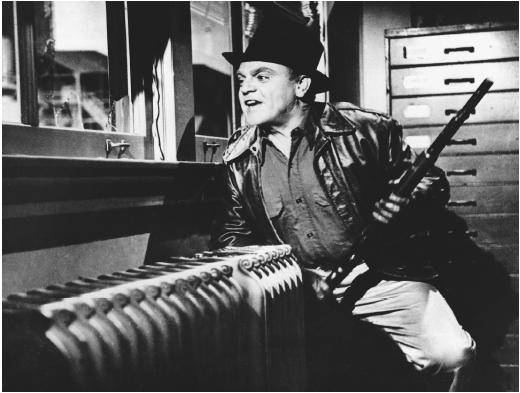
Speaking of big, James Cagney as Cody Jarrett in White Heat must be, in my view, the most successful manic, over-the-top piece of acting I've ever seen. I can't think of another film that focuses so intently on an unrepentent, murderous criminal that manages to elicit genuine empathy from the audience without ever romanticizing him, or demonizing those who are pursuing him, and without ever even making you feel less than repelled by him. Most of the credit for that has to go to Cagney. It's an incredible performance.

Roger Livesey and Anton Walbrook cannot be considered separately when thinking of The Life and Death of Colonel Blimp. Clive Candy and Theo Kretschmar-Schuldorff live particularly strongly for me, because I'm pretty sure this was the first film that I saw featuring either Livesey or Walbrook, so I had nothing in particular to expect from their work. What I got were two actors who understood to the bone the lives of the men they were playing. Walbrook's speech towards the end about how he believed the war with Germany should be waged is breathtaking (not just as a performance, but as a piece of writing), and Livesey was uniquely capable of making the audience forget the not-quite-there quality of his old age makeup because by the end, his eyes and voice did all the work anyway. All the gunk could have been stripped off his face and the then 37 year-old Livesey could have retained his natural appearance, and no one would have failed to understand the film's ending. One thing that actors aren't asked to do very often these days is play a character who is truly and uncomplicatedly decent and good. But that's what Philip Seymour Hoffman was asked to do in portraying Phil Parma in Magnolia. To be honest, his scenes with an equally impressive Jason Robards could have been a bit of a disaster if Hoffman had pulled back or pushed forward just a little bit more than he did. But he hit the seam dead on, so we have a Phil Parma who I believe could actually exist, and one who displays full-hearted emotion to the point even of being, yes, sentimental. But Hoffman knows deep down that "sentimental" isn't itself a bad thing. Dishonest sentiment -- what we call "sap" -- is the real culprit when roles like this go bad, but Hoffman is honest. He means what he says.
Nice picture, right? Apparently, Barry Nelson is not one of the first things people think about when considering Kubrick's The Shining. And yes, I know, Nelson is barely in the film, but he does something very important: he, more than anything else, sells the normality of the Overlook Hotel early on, so that the horror can dawn on the audience at the same rate as it does the characters. Anything in those first several minutes of the film that might put us on edge come from Kubrick, not the hotel itself or those who work within it. Stuart Ullman is not haunted. He's just a guy who runs a resort hotel with a bloody past, but damn it, he needs a caretaker. I love the straightfoward vibe Nelson puts across in the job interview scene, as well as his reluctance in telling the story he fears might scare off his propective employee. This is the last bit of business he needs to take care of before he gets out of that place, but it's vital, and it needs to be done honestly and correctly. So he does it. I would be fascinated to see Nelson play Ullman's reaction when he finally, some months later, receives the news.

Judge Thomas Danforth, as played by the incomparable Paul Scofield in Nicholas Hytner's insanely underrated adaptation of The Crucible, is a man with an open mind. He is not going to idly sentence anyone to hang just because they've been accused of witchcraft. He will sift through all the evidence, and draw on every bit of knowledge he has acquired on this subject over his long life, and he will condemn only those who are truly guilty. And, of course, he's wrong about everything. But he is acting in good faith on the wisdom of the era, and Scofield plays that. Scofield's Danforth has no ulterior motive. He is not a monster. He has innocent blood all over his hands, but when he calls Day-Lewis's John Proctor the "Antichrist", he is convinced that this is the truth. I think this performance is absolutely astonishing in its subtlety.
I could go on all night with this, but I'll cut it off now. Please drop in and tell my how dumb and gay my picks are, and why your own favorites are not even gay at all, but are, rather, quite wonderful. I will seriously consider all opinions.