
 Daphne du Maurier is responsible for a lot of brilliant ideas that moviegoers typically and thoughtlessly attribute to others. Hitchcock's The Birds is Hitchcock's The Birds, and du Maurier's name in the credits registers for most people as someone who had to be paid off so the film could be made. This is nothing to do with Hitchcock himself, and du Maurier is by no means unique in this way. But I think of the unfairness when I think about du Maurier, because of this line from Roger Ebert's review of Insignificance, directed by Nicolas Roeg:
Roeg is a master of baroque visuals and tangled plot lines. His Don't Look Now still has people trying to explain that Venetian dwarf in the red raincoat...
Oh? Is that what Nicolas Roeg did? I remember first seeing Don't Look Now -- which is one of my favorite films -- and being stunned by that ending, then finding the du Maurier story on which it's based and (I still sort of hate myself for doing this) reading the ending. Same red dwarf, same red raincoat, same everything. Roger Ebert is a very well-read man, but it's something I've noticed about some well-read people, that after a certain point, if they haven't read something, it might not actually count as having been written.
All this made me very curious about Daphne du Maurier, who before my Don't Look Now experience I'd pegged as some sort of jumped up romance novelist. I was probably being sexist in my youth. Not only that, but even though I've overcome that knee-jerk assumption, it didn't actually spur me to read du Maurier. My reading life, or more accurately, my not reading life, is positively littered with writers who passingly interest me, and whose work I collect about me, and then leave untouched on the shelf. Even the recent raves of a discerning friend of mine -- too discerning, I might sometimes say -- couldn't provide the necessary push to make me actually crack one of my du Maurier books. Feeling bad about this whole thing and having no idea what to read for today finally did, though.
I finally decided, after much indecision, to go with "The Birds". Like Don't Look Now, Hitchcock's film is a favorite of mine, and I was very curious to see how du Maurier's original played out. And the comparison is very interesting. Reading "The Birds" and watching The Birds is not entirely unlike partaking in the many different films and books that share the premise of humans cloned for the purposes of organ harvesting, but very little to nothing in terms of tone, style, goals, or even plot. The Hitchcock film takes place in San Francisco, and as a result has a larger canvas, of character, setting, set pieces. Du Maurier's original story has a very small cast, made up mostly of a single family: Nat Hocken and his wife, and their two children, Jill and Johnny. Outside of that is the Trigg family, on whose farm Nat works, and Jim, another of the Triggs' employees. Like the film, du Maurier's story takes place in a bayside community, but calling both San Francisco and the small English village where the story takes place "bayside communities" is a little like saying Monte Carlo and Lawrenceburg, IN both have casinos.
Everything that happens -- and it all gets started pretty fast -- in "The Birds" is seen from Nat's point of view, and he's one of the only people in his small circle of family, friends and acquaintances who takes this sudden thread of attacking birds seriously, even though it quickly becomes clear that this is, at least, a national situation:
Various incidents were recounted, the suspected reason of cold and hunger stated again, and warnings to householders repeated. The announcer's voice was smooth and suave. Nat had this impression that this man, in particular, treated the whole business as he would an elaborate joke. There would be others like him, hundreds of them, who did not know what it was to struggle in darkness with a flock of birds. There would be parties tonight in London, like the ones they gave on election nights. People standing about, shouting and laughing, getting drunk. "Come and watch the birds!"
Nat's relationship with what's going on is different from what he predicts will be the reaction of others for several reasons, and is key to why du Maurier's story is so brilliant. First, as implied, he has struggled in darkness with a flock of birds, when, at the story's beginning, they crashed through into both his own bedroom, and that of his children. But it goes beyond that, because throughout Nat also remembers, and compares the bird attacks to the World War II air raids he and so many other English people had suffered through:
Jim was no more interested that Mrs. Trigg had been. It was, Nat thought, like air raids in the war. No one down this end of the country knew what the Plymouth folk had seen and suffered. You had to endure something yourself before it touched you.
This attitude helps Nat and his family revert to the strength and planning that got Nat through those bombings. The fabled stiff upper lip of the British during the war returns in the Hocken home -- and not, you get the sense, elsewhere -- and Nat's enthusiastic attempts to bolster the optimism of his young children is du Maurier at her most moving. As the birds slam heedlessly into the Hocken's cottage, which has been transformed into something as close to a fortress as Nat can manage, Johnny, the youngest, pipes up:
"Stop it," said young Johnny, pointing to the windows with his spoon, "stop it, you old birds."
"That's right," said Nat, smiling, "we don't want the old beggars, do we? Had enough of 'em."
They began to cheer when they heard the thud of the suicide birds.
"There's another, Dad, cried Jill, "he's done for."
"He's had it," said Nat, "there he goes, the blighter."
This was the way to face up to it. This was the spirit.
Because birds suddenly turning into bloodthirsty man-killers could not have been predicted, and travelling far from home soon becomes suicidal, the Hocken family soon even has to resort, once more, to rationing. The two cigarettes Nat has left not only becomes an indicator of his unostentatious ability to go without, but they provide a stark and despairing capper to the story that, quite frankly, trumps the hell out of the still great climax envisioned by Hitchcock and screenwriter Evan Hunter.
So not only all that, and not only does du Maurier get the shaft when it comes to what she invented that has carried over to the film adaptations of her work, but as I read "The Birds" I thought about Richard Matheson, and how he -- more or less good-naturedly, it must be said -- has often pointed the finger at George Romero and claimed Romero liberally borrowed from Matheson's I Am Legend for his own Night of the Living Dead. Apart from the general, very loose idea of the undead in both stories, I have to assume Matheson is referring to the idea of one man, or a small group of people in Romero's case, holed up in a house that they've boarded up and rigged out as best they could to both keep out and defend against massive groups of unnatural killers who will only stop when they're all dead. But in du Maurier's "The Birds", and far more so than in Hitchcock's obviously much more famous film adaptation, the story is about a small group of people holed up in a house that they've boarded up and rigged out as best they could to both keep out and defend against massive groups of unnatural killers who will only stop when they're all dead. Matheson wrote I Am Legend in 1954. Du Maurier wrote "The Birds" in 1952. Not that it can possibly matter at this point, but even so I'm starting to think that maybe it's a good idea to not throw stones.

 For the above, see also Ken Russell, who I find it impossible to separate from Roeg in my mind. I find the critical embracing of Russell entirely maddening and have to remind myself that it’s really no business of mine if that kind of scatology gets excused, or celebrated, as Chaucerian ribaldry because Russell pins it to lunatic historical biopics and literary adaptations, but elsewhere condemned for lowest common denominator pandering. Fine by me, I say (publicly, anyway). And besides, I like at least one Russell film – that would be Altered States, though that’s a case of Russell, to my mind, managing to not fuck it things up completely. In this sense, Roeg has it all over Russell, actually, because I can name three whole Roeg films that I like: the barely Roeg-like Dahl adaptation The Witches; the entirely Roeg-like Bad Timing, which I like because it opens with Tom Waits’s “Invitation of the Blues” and because of the counterintuitive use of the admittedly excellent Art Garfunkel as a twisted sex pest (to borrow from the British); and the unimpeachable masterpiece Don’t Look Now, which I first saw around the same time I was watching Eureka and The Man Who Fell to Earth. At the time, I didn’t like Don’t Look Now much either, but I’ve seen it since, and now I understand that Roeg can never be dead to me. So great, even perfect, a horror film is it that I consider it one of the small handful of modern (relatively speaking) works in the genre that is able to entirely encompass what horror is and should be. Unimpeachable, as I say.
 Yeah, but still. I have reason to be thinking about Roeg because his long-unavailable 1985 film Insignificance will be released on DVD by
 I can’t say this comes across all that strongly – for instance, does it go against our mass projections of McCarthy to depict him as a bully and a thug? Does adding “pervert” really subvert anything? Or to portray Einstein as a shy genius, and DiMaggio as a likable galoot? – and when it does, we get nothing but easy reversals. Marilyn Monroe, you see, may not have been a simple ditzy sex bomb. She might have actually been pretty smart! The fictional Monroe’s crisis of loneliness as it pertains to her fame and the basic meaninglessness of it, and probably everything else (and here I’ll add that whatever my problems with this whole endeavor, Insignificance is a damn good title) forms the core of Johnson’s scenario. The stage roots of Insignificance are betrayed by the fact that the film’s action takes place primarily in Einstein’s hotel room, and the other three come and go to carry on long conversations with him, and occasionally each other, and Einstein and Monroe take up most of the film’s space and time. Monroe sees Einstein as something of a savior, though this is naïve of course, but the two of them manage long and, I guess, significant, or not, discussions about relativity and Einstein’s work on the Unified Field Theory. Meanwhile, McCarthy pops in occasionally to try to force Einstein to testify at the HUAC hearing, and DiMaggio shows up to be jealous that these two guys keep talking to his wife.
 It all adds up to very little. As I’ve said, there is no subversion of these icons to be found, certainly not of the kind implied by Johnson, and relativity and the UFT exist in the film to remind us that those are, indeed, things. No matter how much time is given over to them, Insignificance finally feels like a film made by two men who want to tell us about the only two or three things they can remember about the 50s (though it doesn’t relate specifically to that decade, this shallowness finds its most concentrated form in the brief appearance of Will Sampson as The Indian, a Cherokee elevator operator – the sad and quietly dignified Native American is essential to convincing the viewer that a certain purity of spirit has been achieved). Roeg’s brand of pop surrealism (is what I guess you’d call it) does give the film some energy, and keeps it from feeling too stagebound, but in the way he seems to barely direct Emil, and overdirects Russell to the point of embarrassment, he manages to undercut most of what might be interesting about these portrayals. If Emil wasn’t dressed as Einstein for Halloween, he’d barely register, and if this version of Monroe is meant to be an upending of her popular façade, why then is Russell made to swoon and breathlessly giggle and speak as if she were doing voice work for a Monroe-based Jessica Rabbit-like cartoon character? This isn’t Monroe as we’ve never imagined her; this is Monroe as unflattering burlesque. Russell has maybe never been more gorgeous than she is here, but Roeg somehow manages to make her difficult to watch.
 Contrast these performances with the important but less central work done by Busey and Curtis. Both are terrific, natural and entertaining and vibrant – they inhabit without having to imitate. They’re not given much to do or be, but they’re great, and Busey especially has a wonderful moment with Russell – and here Russell is allowed to pull back and is therefore also allowed to be very good for once in the film – in bed as they discuss the future of their marriage. It’s a sad and sweet little scene, cut off too soon by the disappointing decision to have DiMaggio fall asleep. Fall asleep quite suddenly, in fact, as though this level of genuine intimacy was getting in the way of the bellowing tone Roeg normally likes to shoot for. Anyway, the film as a whole is a depressing reminder of what Busey was once capable of.
 But then there’s the ending. Einstein once famously said of the atom bomb “If only I had known, I should have become a watchmaker.” This forms the core of what I can only describe as Roeg’s astonishing and disturbing series of images that (nearly) closes out Insignificance. So jaw-dropping is his work in this sequence that Roeg’s sex/death obsession has never been more forgivable. It really is a “My God…” piece of filmmaking. Which he immediately blows to shit by showing us again that he has nothing at all to say about Marilyn Monroe. Although I guess what Russell does in the film’s final seconds can probably be described as being “the point” of Insignificance, and even sort of slyly sharp. But a moment that is “slyly sharp” is awfully weak tea compared to what immediately preceded it. For about two minutes there, Roeg revealed himself to be a genius. Then he quickly covered back up again.
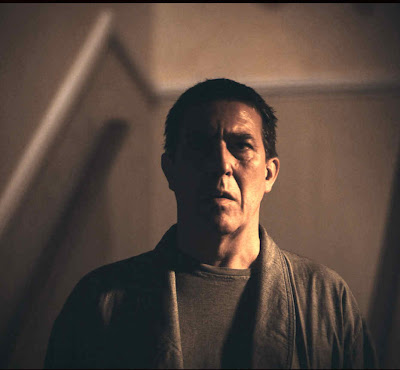 Conor McPherson has, though, or at least he's come awfully damn close. His new film The Eclipse (based on a story by Billy Roche, who appears in the film in a cameo role) is pretty extraordinary, in my view, in the way it uses supernatural horror as no more than one element of a story about a widower named Michael Farr (a superb Ciarán Hinds) who volunteers as a chauffer at an annual Irish literary festival. In the film, he chauffers two writers -- Lena Morelle (Iben Hjelje) and Nicholas Holden (Aidan Quinn), the latter of whom is a particularly obnoxious and self-involved American-Irish writer who is one of the festival's big "gets". Farr also has two children who he's raising by himself since his wife's passing a few years previously, and an elderly father-in-law (Jim Norton), who lives in an nursing home. This father-in-law begins appearing to Farr as a corpse, after a short period when Farr hears strange sounds in his home, and even screams, not just outside his home, but outside, or in, Lena's hotel, as well.
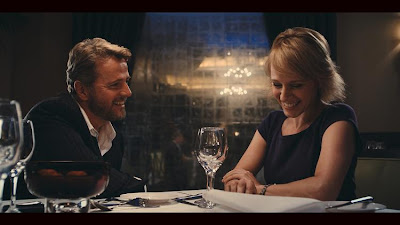 What makes this film so fascinating also occasionally works against it. McPherson uses pretty standard "jump scares" for his moments of supernatural horror, and these sometimes sit uneasily with the spare, quiet naturalistic scenes (indeed, the most effective and visceral moment of horror is not supernatural at all). But if you want the supernatural to sit back a bit more, how far back do you go before this whole approach to the genre becomes too smoothed over and beige? And then that question raises another one, which is how much do you want your new horror model to be explicitly noticed as such, rather than simply as a story about these people in these situations? I don't know. Still, if the "scare" scenes in The Eclipse don't always quite work, I'm glad McPherson chose to present them so directly. The harder to ignore they are, the better.
 The problem with finding a film in my