Showing posts with label Jack Ketchum. Show all posts

Saturday, October 8, 2011

The Kind of Face You Slash - Day 8: The Woman Chews

I have this book here in front of me, it’s called The Woman, and it was written by Jack Ketchum and Lucky McKee. If any of this is ringing any bells, that’s probably because earlier this year at the Sundance Film Festival, a film called The Woman, directed by McKee and written by McKee and Ketchum, made its premiere. To much uproar! Or anyway, a couple of walkouts, one very vocal example of which was caught on video and posted on Youtube, presumably so that we could all gesture with our thumbs over our shoulders at the very angry man and say things like “Get a load of that square” and “That guy sure is square.” Admittedly, the gentleman has apparently never quite processed the whole “it’s only a movie” approach to life, and I haven’t seen the film in question anyway, so what do I know about it? Well, let me refer you back to sentence number one of this post – I did read the book. So what’s all this hubbub about? Here’s the back cover copy for Dorchester Publishing’s trade edition of Ketchum and McKee’s short novel:

The Woman is the last of her kind, the lone survivor of a tribe of feral cannibals who have terrorized the Maine coast for years. She is wounded and weak, but she’s found refuge in a cave overlooking the sea. Christopher Cleek is an amoral – and unstable – lawyer who sees her bathing in a stream on day while he’s out hunting. He follows her to her cave. Cleek has dark, cruel secrets and he will now add one more. He will capture the Woman, lock her in his cellar, and attempt to tame her, with the help of his wife and children. But very soon the question will become: Who is more savage, the hunter or the prey?

Hey, can I guess? Because I think it’s the hunter.

[Pauses to read whole book]

Fuck, I was wrong! It was the prey! It turns out the part about her being a feral cannibal wasn’t just character shading – it actually becomes pretty important down the road.


As one would expect from anything bearing Jack Ketchums’ name. What has, for whatever reason, gone unspoken in the press for The Woman, book or film, is that it is the third story in a series about this cannibal tribe. First, there was Off Season, which must count as Ketchum’s signature book, and published in 1980. As advertised, it is about a tribe of cannibals who cannibalize people ferally. Much skinning and mutilation, as I remember – so less feral so much as sadistic, maybe, as “feral” implies a kind of functional brutality. The function of some of the more sexual maulings escapes me. But let’s not quibble about that – next came Offspring from 1989. That one brought in the child cannibals, by which I mean children who are cannibals, but still some adults, too (one of those adults, I’m led to believe by Ketchum and McKee, would go on to become the title character in The Woman, something I’m going to take their word for). This is also when Ketchum really decided to start hammering on the idea that we normal people, you and me – what’s so great about us, exactly? Did you know that there are people who kill other people? And not feral cannibal people, I mean, like, lawyers, or anyway, people with jobs and cars. So who, finally, is the real feral cannibal? In our society?

So in other words, Jack Ketchum (who I’ve covered here before) is one of those guys who writes about the most graphic and repugnant violence, but he makes sure that you know he’s frowning the whole time. It gives him no pleasure to write, as he (and/or McKee, I suppose, but I’m letting him off the hook, in case you couldn’t tell, because I’ve read lots of Ketchum, and McKee is a film director by profession – I think it’s fair to assume that this work of prose is primarily Ketchum’s thing) does in The Woman:

The Woman digs her thumb and forefinger into those eyes and they pop like pits from ripe fruit and roll across her cheeks. She leans down and quickly bolts first one and then the other. Then her teeth find the soft flesh of [Belle’s] cheek.

That, just so’s you know, is nothing, and, make no mistake, this is the entire reason behind Ketchum’s cult status. The Woman contains not only torture and rape and cannibalism, but incest and child abuse and kids born without eyes and made to live like dogs, because remember the dude behind all this shit is a lawyer, and so the more a writer like Ketchum is willing to pile on, while writing at a level on just the good side of competent, and a shade over into the bad side of up-his-own-ass, the more apt horror fans are, evidently, to regard this stuff as the Real Thing. Also he wants you to get a boner because maybe there’ll be some lesbian stuff later.

I’m assuming things about Ketchum’s motives here, but understanding what we do about The Woman – it’s seriousness and pretensions as typified by lines like “An owl, perched somewhere, calling to his mate. Stilled by the crash of waves”; it’s sort of, I guess, er…feminism? as typified by the fact that the main character is a woman who gets raped and exacts brutal vengeance, before taking two younger, abused-by-men females under her wing – understanding all of that, what does one make of this passage, about Belle, villain Christopher Cleek’s wife, who is none too happy about any of this business, but is too scared of her husband to really speak out, grudgingly washing down the chained up Woman:

[Belle] moves down to [the Woman’s] face and neck, drying these quickly because gun or no gun and even with the towel between them she doesn’t like the proximity of that goddamn mouth of hers [From here on, I’m going to let Ketchum/McKee’s refusal to distinguish between all the “she”s and “her”s stand – Ed.] She dries each arm and as she does she realizes that her husband’s done his job quite well, if brutally. She’s pretty clean. Not much grime coming off on the towel at all. But then comes the hard part.

Her torso. Her breasts and belly. Her privates.

She doesn’t want to touch these. But Chris is expecting her to so she does and as she does
[useless italics Ketchum/McKee’s – Ed.] , as she runs the towel over her breasts, a curious thing happens. There’s a tingling where there shouldn’t be. That’s not possible, she thinks. That’s ridiculous. So she runs the towel roughly over her belly and even more roughly over her ass and the fur between her legs – she thinks of it as fur, not pubic hair. But there it is again. That tingling.

Wait, whose privates?? Well, whichever, the point is where did this come from? It’s even more baffling because it goes nowhere – Belle rejects this lesbian desire, and it is never mentioned again, and then later she gets her eyes eaten out of her face. Still, all this talk of privates and tingling and asses, is clearly there to titillate, and to get the reader actively anticipating the relationship between these two women to get cranked up a notch. It is perhaps the purpose of all this to smack the reader down for even wanting something like that in a book so filled with brutality and anguish (and Ketchum sort of has a point, what the fuck is wrong with you?), but then also, Peggy, the oldest Cleek daughter, has a teacher named Genevieve who tries to help her, and Genevieve is an open lesbian – and hot! Not that she’s going to do anything with Peggy, mind you – she genuinely just wants to help the girl. Except, there’s that bit where Genevieve clues into something being wrong with Peggy because Peggy is covering up her body and Genevieve thinks teenage girls should flaunt themselves. But anyway, Genevieve ends up getting eaten by a bunch of dogs and an eyeless ten-year-old child. I’ve decided there’s nothing strange about any of this.

If you want one more example of the basic thoughtlessness behind Ketchum’s writing and his “radical feminism”, in the edition of The Woman described earlier, the short title novel is followed up by a kind of sequel, a short story called “Cow” (I have no idea if McKee had a hand in this or not). I’m not going to summarize the story (okay, there’s a lot of cannibalism, but that’s all I’ll say), but the narrator is a young man who is not killed so that he can be used to repopulate the currently all female tribe of feral cannibals. Here’s when the guy realizes his fate:

It came to me that this was what I was. This was what I descended to. I was owned. Property. Livestock.

A cow. I was a cow.

To be milked and milked again.


Male cows, or cattle, are called bulls, and when they are kept by farmers to breed with females, they are called “studs.” You dumb stupid idiot.

Sunday, October 19, 2008

The Kind of Face You SLASH!!: Day 18 - What Was in the Box?

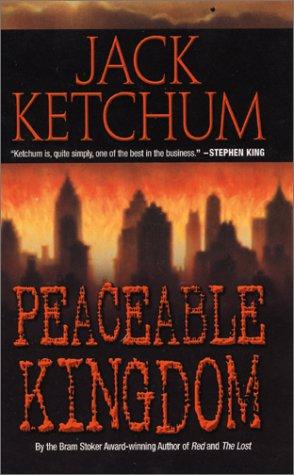
Here's how Jack Ketchum begins the introduction to his short story collection Peaceable Kingdom:

I don't know why you put up with me.

It's a matter of consistency. Or in my case, inconsistency.

As a writer I'm all over the place.

From there, he goes on to list a few of his books, and their basic premises, all the while referring to "Ketchum titles" or "Ketchum books". He seems to think his readers are really thrown by the crazy variety of his books, as well as their occasionally extreme nature. In short, it's very self-serving (which any such introduction will be, almost by definition), and self-aggrandizing. It's a very obnoxious attitude, particularly since Ketchum -- a highly regarded writer by, from what I can tell, younger horror fans who yearn for a full-blown return to "splatterpunk" -- has yet to prove to me that he comes close to deserving the status in the genre he currently enjoys.

He's not a bad writer; he's just not a good one, either. He's also not really a horror writer, at least as I define it. He's only written one novel that deals with the supernatural (She Wakes, which I haven't read); much of his work -- the work on which his reputation rests -- deals with the extreme end of human cruelty, and is often on the verge of being crime fiction.

The most potent book of his I've read is The Girl Next Door. Like a lot of his work, the book is based on a true story, in this case that of Sylvia Likens, a 16 year-old girl who was tortured and murdered by other children in her neighborhood, under the encouraging tutelage of Gertrude Baniszewski, a mother of some of the children involved. That true story really, truly is unspeakably horrific. Ketchum's novel was, as a said, effective, and gave me one bitch of a nightmare. But it also reeked strongly of self-righteous exploitation. At the same time, it's the only book by Ketchum that had any kind of lasting impact on me, and maybe I'm accusing Ketchum of exploitation because I just don't like having done to me what that book did. Maybe his heart was in the right place, I don't know.

Moving on to today's selections from Peaceable Kingdom, I first chose a story called "The Box". It begins with a father riding the bus with his three young children, two girls and a boy. It's almost Christmas, and the four of them have been out ice-skating. Sitting near them on the bus is a man with a red box held tightly in his lap. Danny, the young boy, asks what's in the box. The man says that it's a present. Danny asks if he can see it, and the man agrees:

He opened the lid of the box on Danny's side, not all the way open but only about three inches -- enough for him to see but not the rest of us, excluding us three -- and I watched my son's face brighten at that, smiling as he looked first as Clarissa and Jenny as if to say nyah nyah and then looked down into the box.

The smile was slow to vanish. But it did vanish, fading into a kind of puzzlement...

Shortly thereafter, Danny stops eating. No breakfast, no lunch, no dinner, no candy, no snacks. He tells his parents he's simply not hungry. His parents become obviously concerned, and eventually take him to their doctor. Not soon enough, by my thinking, and the doctor is an "old-fashioned" doctor who believes the hospital should be a last resort. This bit of characterization is simply Ketchum's clumsy way of delaying the question of intravenous nourishment as long as he can.

Before going to the hospital that his parents should have taken him to far earlier, Danny is referred to a therapist. This is because nothing physical has been found wrong with him, and when told by his doctor that not eating leads to death, Danny replies "So?"

There are things about this story that aren't at all bad. It's generally well-written, and there's a strong, creepy drive to the narrative. But apart from trying to dodge modern medical science longer than is reasonable, Ketchum also fails to make this story's conclusion register. I have two theories regarding the conception and writing of this story -- it's possible that neither theory is correct, and that both are unfair, but here they are: 1) Ketchum had what he believed to be a strong idea for a story, and began writing before knowing where it would go. And he never did figure out where it would go, and decided to try and turn that emptiness into a virtue by pumping up the existential subtext. Or 2) Ketchum was more calculated than that. He knew that his usual brand of horror -- hyper-violent, even sadistic -- didn't win awards, so he would self-conciously produce a story that would, one that seemed to be about a lot, but wasn't really about much of anything. If I'm right about that, then he succeeded, because "The Box" won a Bram Stoker Award for Best Short Fiction.

"The Box" just seems phony to me. I don't believe that Ketchum meant a word of it. It's not that "The Box is a bad story; it's just that I don't trust it.

The next story is more typical of Ketchum. Called "Megan's Law", it deals with one man's reaction to the news that a sex offender has moved into his neighborhood. He's a widower, with a young daughter, and when he finds out that this man, Phillip Knott, did six years in prison for raping a young girl, he decides to act. Mostly told from the father's point of view, the story occasionally shifts to Knott, so that we can go back and forth between understanding why the father is going to do what he ends up doing, and wondering if men like Knott, repellent and evil as we may find them, shouldn't be given at least a chance to overcome their urges.

The story feels almost like it's meant as a kind of corrective to the brutal, morally black-and-white fiction of Andrew Vacchs (which deals heavily with violent retribution dealt against men like Knott). So it's meant as a challenge to the reader, it wants to ask the reader what they would do in the father's position. But is it really wise for the author to begin and end such a story with the words "What would you do?" I think Ketchum should publish Peacable Kingdom as a pop-up book, and when you turn to "Megan's Law" a big hammer should pop out and smack you on the head.

Okay, now I'm just being negative. These stories aren't that bad. And the truth of it is, with all my deep reservations about his fiction, I do find Ketchum to be compulsively readable. He's got something -- he at least has the ability to get under your skin. But he doesn't push himself to be a better writer, technically speaking, and he currently also seems content to play with the same subject matter he's been reworking for the last twenty years. If he keeps going this way, I will quickly find him less compelling, and since that compulsion is already of a particularly cheap and nasty kind, that distinterest could begin just about any day now.

Followers