
 I'm not sure what, exactly, I have to say about this one. For those who don't know it, Alan Clarke's 39-minute-long film is nothing more than a series of scenes depicting one or more men quietly and efficiently gunning down some other man, either in the victim's own home, or in a public restroom, or in the street, etc. The film is almost completely free of dialogue -- only one of the scenes features any speaking at all, and even that is of the most perfunctory sort -- and each scene includes many of the same shots: a shot, from the side, of the killer walking, a close-up of the killer's face as he's committing the murder, a close-up of the gun bei
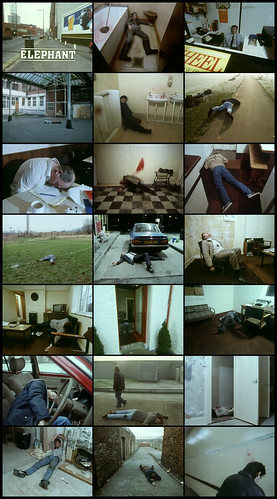 ng fired, and a medium shot, after the murder, of the victim.
.
I first found out about this film by reading an interview with Gus Van Sant regarding his own film called Elephant, about the Columbine school massacre. Van Sant acknowledged his clear debt to Clarke's film by pointing out, among other things, that he'd simply lifted Clarke's title. Both films share other similarities, such as a fascination with showing people walking. This has become a big thing with Van Sant of late, and you can see all the inspiration for it in Clarke's film. As I said, each killer is shown walking for a fairly long stretch before he reaches his victim, and Clarke's camera does nothing more than dolly along beside him, the microphones picking up (or adding later) the sound of the shoes on gravel or macadam or mud. Van Sant has a curious ability to add an enigmatic kind of poetry to his walking scenes, but Clarke seems uninterested in that. He wants only to show -- I believe -- that a human being who has set out to kill another human being has to go through the same old bodily motions that we all do in order to get there, that a conscious decision has to be made to kill, and more actions than the pulling of the trigger have to be taken, and that turning back is always an option. But in his film that option is never taken.
The Van Sant interview clued me in, before I'd ever seen it, that Clarke's film is about Ireland's Troubles. This information gave me the context that, I have to admit, I may not have been able to provide for myself if I'd just watched the movie completely cold. The film aired on BBC in 1989, at a time and in a country that probably didn't need any hand-holding to get the point. I can only imagine the impact this film would have had then, and can only say for myself that I found the film fascinating and sort of bizarre, as well as slightly enervating by the end. Which was probably, in a sense, part of Clarke's point.
.
Anyone who wants to can watch Alan Clarke's Elephant here.
* * * * * *
Update: Sometimes, I go too fast. I realize now that not only didn't I talk at all about the title of this film, but I should have. Over at the Palimpsest, where I also posted this, fellow member Fanshawe reminded me of the source of the title Elephant, which is a quote from Irish author Bernard MacLaverty, who referred to the Troubles as "the elephant in our living room". MacLaverty's elephant, at least according to Wikipedia, are the "underlying social problems of Northern Ireland." Taking Wikipedia at its word, it's quite interesting that Clarke would use the title Elephant, because if there was ever a film that was calculatedly disinterested in exploring cause and effect, it's this one.
And Van Sant's film, too, while we're at it, although some claim that the shower scene in Van Sant's Elephant (as opposed to the shower scene in Van Sant's Psycho), which depicts the two killers kissing, is meant to show that homosexual repression was at the heart of their rampage. I'm not buying that, though, not least because, in that scene, the killers don't exactly seem repressed. In any case, the result is that, with both films, the title Elephant just sort of hangs there mysteriously, daring you to make sense of it.

